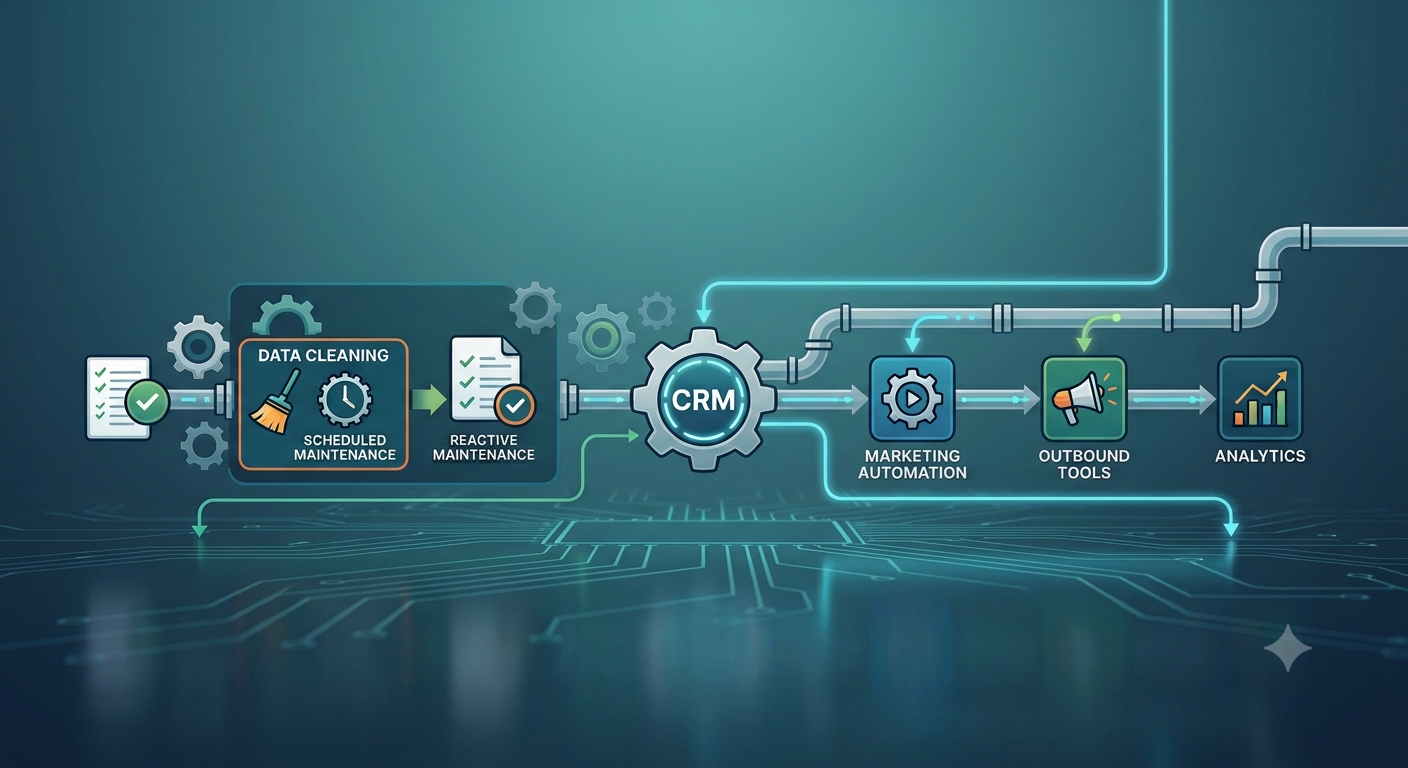


Data governance is the foundation of reliable revenue operations. When marketing, sales, and customer success teams work from accurate, consistent, and secure data, they can make faster decisions, create better buyer experiences, and build a more predictable pipeline.
Without governance, revenue teams operate on fragmented records, duplicate contacts, inconsistent definitions, and unreliable reports. The result is wasted outreach, poor lead routing, inaccurate forecasting, and lost revenue opportunities. A strong data governance framework prevents these issues by defining how customer and prospect data is collected, validated, maintained, accessed, and used across the revenue engine.
This article explains what data governance means in revenue operations, why it matters, which components it includes, and how B2B organizations can implement it effectively.
What Is Data Governance in Revenue Operations?
Data governance in revenue operations is the system of policies, roles, processes, standards, and controls that ensure revenue-related data remains accurate, complete, secure, compliant, and usable across the customer lifecycle.
Revenue operations, or RevOps, connects marketing, sales, and customer success around shared goals, processes, and data. A unified revenue operations strategy depends on a centralized data architecture that gives every team one reliable view of accounts, contacts, opportunities, engagement activity, and revenue outcomes.
Data governance makes that shared view possible. It answers important operational questions such as:
- Who owns each data field and record?
- What qualifies as a complete lead, contact, or account?
- How should data be standardized across systems?
- Who can access sensitive customer information?
- How often should records be audited and cleaned?
- How is consent captured and maintained?
- What happens when data is inaccurate or duplicated?
In simple terms, data governance turns raw information into a dependable revenue asset.
Why Data Governance Matters for RevOps
Modern B2B revenue teams use many systems, including CRM platforms, marketing automation tools, sales engagement software, customer success platforms, intent data providers, analytics tools, and data enrichment services. Each system creates data. Without governance, that data becomes inconsistent and difficult to trust.
1. It Creates a Single Source of Truth
Revenue teams cannot align if they use different definitions of a lead, opportunity, account, or qualified pipeline. Marketing may count a form fill as an MQL, while sales may only consider a lead qualified after a discovery call.
Data governance establishes shared definitions and data standards. This allows every team to measure performance from the same source of truth. It also improves collaboration because teams no longer argue about whose numbers are correct.
2. It Improves Lead Quality and Routing
Poor data quality directly affects lead generation and sales productivity. Duplicate records, missing job titles, invalid email addresses, outdated phone numbers, and incomplete company details can send leads to the wrong salesperson or prevent them from entering the pipeline at all.
Governed data improves:
- Lead scoring
- Lead routing
- Territory assignment
- Account matching
- Personalization
- Sales prioritization
- Campaign targeting
For example, if a prospect changes jobs, their old record may still point to a former company. Without regular validation, sales may pursue the wrong account or use an inactive email address. Governance processes catch these issues before they affect revenue.
3. It Strengthens Forecast Accuracy
Forecasting depends on reliable pipeline data. If opportunity stages are updated inconsistently, close dates are missing, or deal amounts are entered incorrectly, revenue forecasts become unreliable.
Data governance defines required fields, stage criteria, validation rules, and update responsibilities. This helps revenue leaders understand whether pipeline is real, whether deals are progressing, and where risk exists in the forecast.
4. It Reduces Operational Waste
Bad data creates hidden costs. Sales teams spend time researching contacts, correcting records, and chasing invalid leads. Marketing teams send campaigns to unengaged or ineligible contacts. RevOps teams spend hours reconciling reports across disconnected systems.
Governance reduces this waste by preventing data problems at the point of entry and maintaining data quality over time.
5. It Supports Compliance and Trust
B2B organizations handle personal and business data that may be subject to privacy regulations such as GDPR, CCPA, CAN-SPAM, and CASL. Data governance helps teams manage consent, access, retention, security, and responsible data use.
This is not only a legal requirement. Buyers increasingly expect companies to handle their information responsibly. Transparent and secure data practices build trust, which is essential for long-term revenue growth.
Core Components of Data Governance in RevOps
Effective data governance is more than periodic data cleaning. It is an ongoing operating framework that covers people, processes, technology, and policy.
Data Ownership
Every critical data domain needs a clear owner. Ownership determines who is responsible for maintaining accuracy, resolving conflicts, and enforcing standards.
Common ownership models include:
| Data Area | Possible Owner |
|---|---|
| Lead and campaign data | Marketing operations |
| Contact and account data | Sales operations or RevOps |
| Opportunity and forecast data | Sales operations |
| Customer health and renewal data | Customer success operations |
| Consent and privacy data | Legal, compliance, or data protection team |
| Data architecture and integrations | RevOps or IT |
Clear ownership prevents the common problem where everyone assumes another team is responsible for fixing bad data.
Data Standards
Data standards define how information should be captured and formatted. Without them, one salesperson may enter “USA,” another may enter “United States,” and another may leave the country field blank.
Important standards include:
- Standardized naming conventions for lead sources and campaigns
- Consistent job title, industry, and company size fields
- Uniform date, currency, phone number, and country formats
- Required fields for lead, contact, account, and opportunity creation
- Defined picklist values instead of free-text entries
- Rules for account naming and hierarchy
Standards make data easier to segment, report on, and activate across systems.
Data Quality Management
Data quality management ensures records remain accurate, complete, consistent, valid, and current. It includes both preventive controls and ongoing maintenance.
Key practices include:
- Duplicate detection and merging
- Email and phone validation
- Firmographic enrichment
- Job change monitoring
- Regular database audits
- Field completion reporting
- Automated data cleansing workflows
- Exception reports for incomplete records
B2B data decays quickly because people change roles, companies merge, and contact details become outdated. Regular audits and enrichment are therefore essential for maintaining a reliable database.
Data Integration and Sync Rules
Revenue data often moves between systems. A lead may be created through a website form, enriched by a data provider, scored in marketing automation, routed to CRM, and later managed by customer success.
Governance defines how these systems connect. It establishes:
- Which system is the master source for each data type
- Which fields can be updated in each platform
- How conflicts are resolved during synchronization
- How duplicates are prevented across integrations
- What happens when a record is deleted or merged
- How API failures and sync errors are monitored
Without integration rules, teams may overwrite valuable data or create conflicting versions of the same record.
Access Controls and Security
Not every team member needs access to every data field. Data governance uses role-based access controls to ensure people can view and edit only the data required for their role.
Security controls should include:
- Role-based permissions
- Least-privilege access
- Multi-factor authentication
- Encryption for sensitive data
- Audit trails for data changes
- Secure third-party integrations
- Regular access reviews
These controls protect customer data, reduce internal risk, and support compliance requirements.
Consent and Privacy Management
Consent governance tracks how and when a prospect agreed to receive communication. It also records communication preferences, opt-outs, data source, and retention requirements.
A strong consent framework helps revenue teams:
- Respect unsubscribe requests
- Maintain lawful communication practices
- Avoid contacting people who have opted out
- Document the source and purpose of data collection
- Manage regional privacy requirements
- Build trust with prospects and customers
Governance should make consent status visible across marketing, sales, and customer success systems.
How Data Governance Improves the Revenue Lifecycle
Data governance affects every stage of the revenue lifecycle, from first touch to renewal and expansion.
Awareness and Lead Capture
At the top of the funnel, governance ensures that lead capture forms collect the right information in a consistent format. It prevents incomplete submissions, duplicate leads, and inaccurate source attribution.
For example, a governance framework can require:
- Valid business email addresses
- Standardized country and state fields
- Clear campaign source tracking
- Consent checkboxes where required
- Automatic duplicate checks
- Routing rules based on territory, industry, or company size
This creates cleaner leads before they ever reach sales.
Lead Qualification and Scoring
Lead scoring relies on accurate firmographic, demographic, and behavioral data. If industry, employee count, revenue, job level, or engagement data is wrong, scoring models produce unreliable results.
Governed data allows teams to score leads based on meaningful signals such as:
- Fit with the ideal customer profile
- Job seniority and buying role
- Company size and industry
- Website and content engagement
- Email and ad interaction
- Intent signals
- Product usage, where relevant
Clean data makes lead scoring more precise and helps sales focus on the best opportunities.
Sales Handoff and Pipeline Management
A strong handoff depends on complete context. Sales should not receive a lead with only a name and email address. They need relevant account details, engagement history, lead source, qualification notes, and any known buying signals.
Data governance ensures that the handoff record is complete and consistent. It also standardizes opportunity creation, stage progression, close dates, deal amounts, and loss reasons.
This improves pipeline visibility and helps managers identify stalled deals, inaccurate forecasts, and process gaps.
Customer Success and Expansion
Revenue operations does not end when a deal closes. Customer success teams need accurate account, contact, contract, usage, and support data to manage onboarding, adoption, renewal, and expansion.
Governed data helps customer success teams:
- Identify the right stakeholders
- Track product adoption
- Monitor account health
- Spot churn risk
- Identify expansion opportunities
- Coordinate renewal campaigns
When customer data is connected to sales and marketing data, teams can create a more seamless post-sale experience.
Common Data Governance Challenges in RevOps
Many organizations struggle with data governance because it involves people and processes as much as technology.
Fragmented Systems
Marketing, sales, and customer success often use separate tools with separate databases. When systems are not integrated properly, teams create conflicting records and inconsistent reporting.
Lack of Ownership
When no one owns data quality, problems remain unresolved. Teams assume another department will clean the database, validate records, or update fields.
Inconsistent Definitions
Terms such as MQL, SQL, qualified account, pipeline, and closed-won revenue may mean different things to different teams. This creates confusion and weakens accountability.
Manual Data Entry
Manual entry introduces errors. Sales representatives may skip fields, use inconsistent naming, or create duplicate accounts under time pressure.
Poor Change Management
New tools, fields, and processes are often introduced without updating governance rules. Over time, the data model becomes cluttered and difficult to manage.
Limited Executive Support
Data governance requires investment in tools, training, and ongoing maintenance. Without executive sponsorship, it is often treated as a one-time cleanup project rather than a permanent revenue discipline.
How to Build a Data Governance Framework for RevOps
Organizations can build an effective governance framework by following a structured approach.
1. Audit Your Current Data Environment
Start by assessing the current state of your data. Identify where data lives, how it flows between systems, who uses it, and where quality issues occur.
Review:
- CRM fields and records
- Marketing automation databases
- Sales engagement tools
- Customer success platforms
- Data enrichment providers
- Reporting dashboards
- Integration workflows
- Consent and privacy records
Document duplicate rates, missing fields, invalid records, inconsistent values, and unused fields.
2. Define Revenue Data Standards
Create a shared data dictionary that defines every important field, value, and metric. This should include definitions for lead stages, opportunity stages, account types, lead sources, campaign types, and key revenue metrics.
For example, define exactly when a lead becomes an MQL, when it becomes an SQL, and what evidence is required for each stage.
3. Assign Clear Ownership
Assign a data owner for each major domain. RevOps should usually coordinate the overall framework, while marketing operations, sales operations, customer success operations, IT, legal, and compliance teams own specific areas.
Create a RACI model that clarifies who is responsible, accountable, consulted, and informed for data-related decisions.
4. Implement Validation and Automation
Use technology to enforce standards at the point of entry. Validation rules, required fields, dropdown values, duplicate checks, and automated workflows reduce human error.
Examples include:
- Requiring email validation on form submission
- Blocking duplicate contact creation
- Standardizing country and industry values
- Automatically enriching missing firmographic fields
- Flagging records with invalid phone numbers
- Sending alerts when required opportunity fields are missing
Automation makes governance scalable.
5. Establish Ongoing Data Quality Reviews
Data governance is continuous. Set a regular cadence for audits, cleanup, and reporting.
A practical schedule could include:
- Daily monitoring of sync errors and duplicate alerts
- Weekly review of new lead quality and routing accuracy
- Monthly database audits for incomplete or outdated records
- Quarterly review of field usage, definitions, and access controls
- Annual review of privacy, retention, and security policies
This prevents data quality from degrading after the initial cleanup.
6. Train Revenue Teams
Governance fails when users do not understand why standards matter. Train marketing, sales, and customer success teams on data entry rules, CRM hygiene, lead handoff requirements, consent practices, and reporting definitions.
Make training practical. Show teams how bad data affects their daily work, such as misrouted leads, inaccurate commissions, poor personalization, and unreliable forecasts.
7. Measure Governance Performance
Track metrics that show whether governance is working. Useful indicators include:
- Duplicate record rate
- Percentage of complete lead and contact records
- Invalid email or phone rate
- Lead routing accuracy
- CRM field completion rate
- Data enrichment coverage
- Sync error rate
- Time spent on manual data correction
- Forecast accuracy
- Marketing-attributed pipeline quality
These metrics help RevOps leaders demonstrate the business impact of governance.
Data Governance and AI in Revenue Operations
AI is becoming a major part of B2B revenue operations. Teams use AI for lead scoring, intent analysis, personalization, forecasting, conversation intelligence, and automated outreach.
However, AI is only as reliable as the data it receives. If the underlying database contains duplicates, outdated records, biased inputs, or inconsistent fields, AI can produce misleading recommendations and poor buyer experiences.
Before deploying AI-driven revenue tools, organizations should establish strong data governance practices, including CRM cleansing, standardized records, accurate lead source tracking, unified customer data, consent management, access controls, and audit trails.
Governance ensures that AI supports revenue teams rather than amplifying existing data problems.
Best Practices for Sustainable Data Governance
To make data governance effective long term, B2B organizations should follow these best practices:
- Start with the data fields that directly affect revenue decisions
- Create a single source of truth for accounts, contacts, and opportunities
- Use automation to enforce standards wherever possible
- Keep data definitions simple, documented, and widely understood
- Assign ownership for every critical data domain
- Review data quality regularly instead of relying on one-time cleanups
- Integrate privacy and consent management into daily workflows
- Limit access based on job role and business need
- Monitor integrations and resolve sync issues quickly
- Involve marketing, sales, customer success, IT, legal, and finance teams
- Treat governance as a revenue growth initiative, not an administrative task
Final Thoughts
Data governance is a strategic requirement for modern revenue operations. It gives marketing, sales, and customer success teams the trustworthy data they need to generate demand, qualify leads, manage pipeline, forecast revenue, and retain customers.
Organizations that invest in governance gain more than cleaner databases. They gain better collaboration, stronger accountability, improved buyer experiences, more accurate reporting, and a more predictable revenue engine.
For B2B companies building a scalable growth model, data governance should sit at the center of RevOps. It transforms disconnected systems and inconsistent records into a unified foundation for revenue generation. To see how shared data, processes, and goals support predictable growth, explore The LeadCrafters’ approach to building a unified revenue operations strategy.