
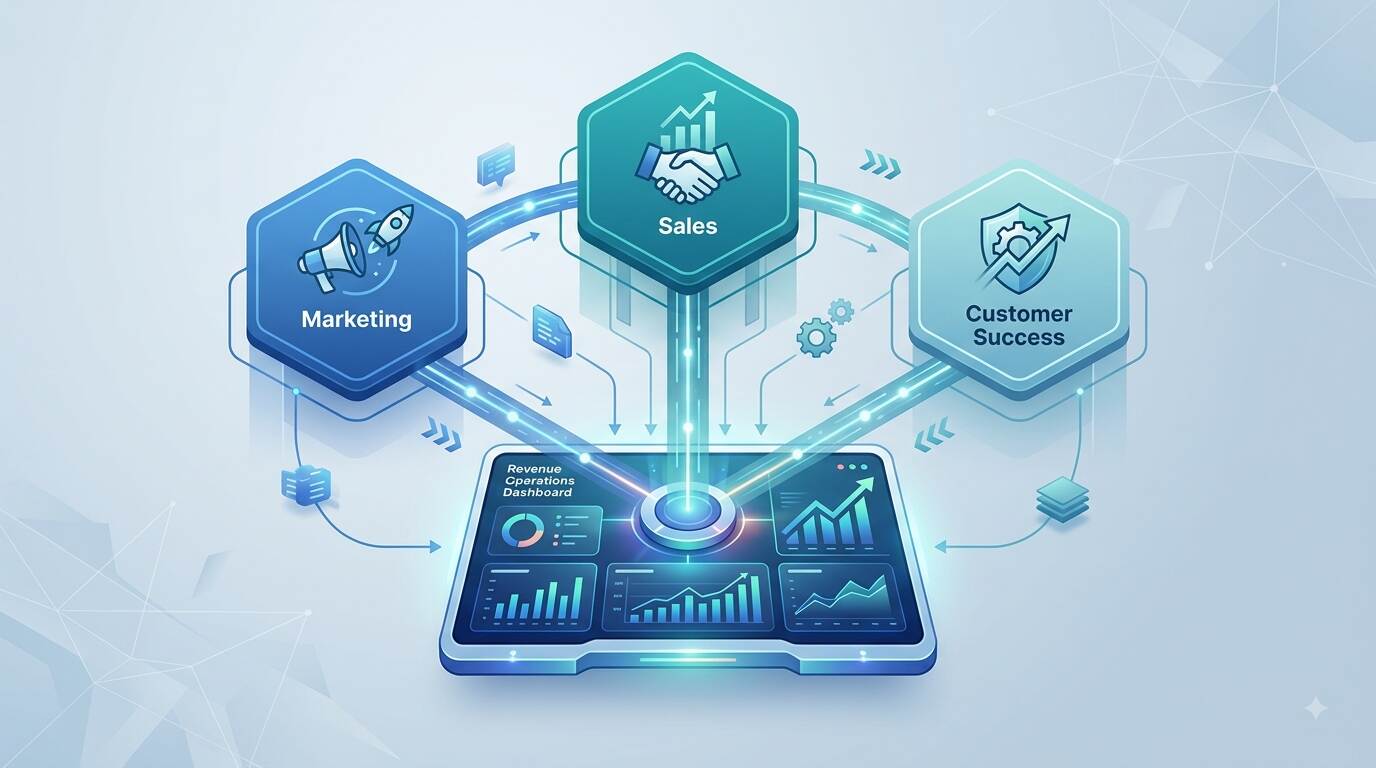

A unified revenue operations (RevOps) strategy aligns sales, marketing, and customer success around shared data, processes, and goals to drive predictable, efficient growth. For B2B organizations, this alignment is no longer optional, it is a competitive necessity that eliminates silos, accelerates pipeline velocity, and improves customer retention.
What Is Revenue Operations (RevOps)?
Revenue Operations is the strategic function that unifies marketing, sales, and customer success operations into a single operating model responsible for the entire revenue lifecycle. Instead of each team managing its own metrics, tools, and definitions, RevOps creates one source of truth for customer data, one set of shared KPIs, and one coordinated process from first touch to expansion.
This discipline coordinates how leads are generated, qualified, converted, and expanded across the customer lifecycle, ensuring that every revenue-influencing team works from the same playbook. The result is clearer accountability, faster decision-making, and higher revenue efficiency.
Why a Unified RevOps Strategy Matters in 2026
B2B buying has become more complex, with more stakeholders, longer cycles, and higher expectations for personalized experiences. In this environment, fragmented operations create friction, data gaps, and missed revenue.
Organizations with fully aligned RevOps teams achieve 10–20% higher revenue growth and 34% higher customer retention rates than those operating in silos. A unified strategy also reduces customer acquisition cost, improves forecast accuracy, and increases net revenue retention by aligning incentives across the go-to-market (GTM) engine.
For companies targeting scalable, demand generation–led growth, RevOps provides the operational backbone to turn strategy into repeatable execution.
Core Pillars of a Unified Revenue Operations Strategy
1. Shared Definitions and Lifecycle Stages
A unified RevOps strategy starts with agreement on definitions. Sales, marketing, and customer success must co-create and maintain:
- A single definition of a qualified lead (MQL, SQL) validated against actual close-rate data.
- Standardized lifecycle stages from awareness to expansion.
- Clear handoff criteria between MQL to SQL, SQL to closed-won, and closed-won to customer success.
Without shared definitions, teams optimize for different outcomes, creating leakage at every transition. Document these definitions in a central playbook and review them quarterly as market conditions and product offerings evolve.
2. Centralized Data Architecture
Data silos are the biggest barrier to revenue alignment. A unified RevOps strategy requires a centralized data architecture that serves as the single source of truth for all GTM teams.
Key elements include:
- Integrating CRM (e.g., Salesforce, HubSpot), marketing automation, and customer success platforms into a unified data layer.
- Creating a “Revenue Master Record” that consolidates pipeline stage, lead score, engagement signals, and churn risk.
- Implementing data governance practices such as deduplication, field-level validation, and weekly data quality reviews.
When sales, marketing, and customer success all work from the same underlying data, forecasting becomes more accurate and execution more coordinated.
3. Unified KPIs and Shared Accountability
Traditional structures often assign revenue metrics to sales alone, while marketing owns top-of-funnel metrics and customer success owns retention. A unified RevOps strategy replaces this with shared KPIs that all three functions own.
Examples of unified KPIs include:
- A “Revenue Health Score” combining new pipeline value, close rate, and net revenue retention.
- MRR growth, net revenue retention (NRR), and customer acquisition cost (CAC) as shared targets.
- Pipeline velocity and conversion rates by stage, visible to all GTM teams.
Shared accountability ensures that marketing cares about conversion quality, sales cares about onboarding success, and customer success cares about expansion opportunities.
4. Automated and Orchestrated Processes
Manual handoffs slow down the revenue engine and introduce errors. A unified RevOps strategy automates workflows and orchestrates processes across teams.
Implementation steps include:
- Automating lead routing based on behavioral scores and fit criteria.
- Triggering sales outreach when a lead reaches a defined engagement threshold.
- Initiating customer success outreach when usage drops or renewal risk increases.
- Standardizing playbooks for onboarding, adoption, and expansion.
Automation removes friction, ensures consistency, and frees teams to focus on high-value activities like relationship building and strategic planning.
5. Integrated Technology Stack
Tools should enable, not hinder, revenue alignment. A unified RevOps strategy invests in an integrated tech stack where data flows freely between systems.
Priorities include:
- Bidirectional integration between CRM, marketing automation, customer success, and analytics tools.
- Shared dashboards that all three teams use as their primary view of pipeline and customer health.
- AI and intent data tools deployed as coordinated inputs rather than siloed experiments.
The goal is not more tools, but fewer, better-integrated tools that support a single operating model.
Building Your Unified RevOps Strategy: A Practical Roadmap
Phase 1: Assess Current State (Weeks 1–2)
Start by mapping your current lead-to-revenue process end-to-end with sales, marketing, and customer success in the room. Identify:
- Where data lives and where gaps exist.
- Current definitions of leads, opportunities, and customer stages.
- Manual handoffs and points of friction.
- Existing tools and integrations.
Audit CRM data quality across completeness, accuracy, recency, and consistency. This baseline will inform your roadmap and help prioritize quick wins.
Phase 2: Data Unification (Weeks 3–6)
Integrate your core systems into a unified data layer. Connect your CRM, marketing automation platform, and customer success tool using integration middleware or native connectors.
Define your Revenue Master Record and ensure critical fields are populated consistently. Implement data governance rules to prevent duplicates and enforce field validation.
Build shared dashboards that display pipeline, conversion rates, and customer health metrics accessible to all GTM teams.
Phase 3: KPI Standardization (Weeks 7–10)
Replace team-specific metrics with shared revenue KPIs. Work with leadership to define a Revenue Health Score or similar composite metric that reflects the contributions of all three functions.
Align incentives so that bonuses and performance reviews reflect shared goals, not just individual team targets. This cultural shift is critical for long-term adoption.
Phase 4: Process Orchestration (Weeks 11–14)
Implement automated workflows that trigger actions based on defined criteria. Examples include:
- Sales outreach when a lead reaches a 75+ behavioral score.
- Customer success outreach when product usage drops by 20%.
- Automated renewal and expansion plays based on usage and health signals.
Document these workflows in a central playbook and train teams on their roles within each process.
Phase 5: Continuous Optimization (Ongoing)
RevOps is not a one-time project. Establish a cadence for reviewing data quality, process performance, and KPI alignment.
Use rolling forecasts and scenario planning to adapt to market changes. Invest in upskilling teams on data literacy, AI tools, and revenue analytics to sustain momentum.
Common Pitfalls to Avoid
Fixing Tools Before Data
Many organizations layer new tools on top of broken data foundations. This amplifies problems rather than solving them. Always fix your data architecture and governance before investing in advanced automation or AI.
Tracking Too Many Metrics
Trying to measure everything leads to confusion and diluted focus. Pick stage-appropriate metrics that align with your current maturity level and expand over time.
Ignoring Change Management
RevOps fails at the adoption stage as often as at the technology stage. Secure executive sponsorship, communicate the vision clearly, and involve teams in designing the new operating model.
Lack of Clear Ownership
RevOps must be responsible for connecting strategy, systems, data, and execution. Without a dedicated function or leader owning this coordination, alignment will degrade over time.
The Role of AI in Unified RevOps
AI is transforming RevOps by enabling smarter scoring, predictive analytics, and automated orchestration. However, AI tools must operate on unified, consistent data to deliver value.
Priorities for AI-enabled RevOps include:
- Deploying intent data and AI scoring as coordinated inputs across marketing, sales, and customer success.
- Establishing AI governance to register every automation touching revenue data and define approval processes.
- Upskilling teams to use AI confidently and fluently.
AI should enhance, not replace, human judgment in revenue operations.
Measuring Success: Key Metrics for Unified RevOps
To evaluate the impact of your unified RevOps strategy, track metrics that reflect alignment and efficiency:
- Revenue Growth Rate: Year-over-year growth in total revenue.
- Net Revenue Retention (NRR): Percentage of recurring revenue retained and expanded from existing customers.
- Customer Acquisition Cost (CAC): Total cost to acquire a new customer, shared across marketing and sales.
- Pipeline Velocity: Average time from lead creation to closed-won.
- Forecast Accuracy: Variance between forecasted and actual revenue.
- Data Quality Score: Percentage of records with complete, accurate, and up-to-date fields.
Review these metrics monthly and adjust your strategy based on performance trends.
Aligning RevOps With Demand Generation
For B2B organizations focused on lead generation and demand generation, RevOps provides the operational infrastructure to scale efficiently. By aligning marketing’s demand creation efforts with sales’ conversion processes and customer success’s retention and expansion plays, you create a seamless revenue engine.
This alignment ensures that every marketing dollar contributes to measurable pipeline, every sales interaction supports long-term customer value, and every customer success effort drives expansion revenue.
Getting Started With The Lead Crafters
If you are ready to build a unified revenue operations strategy that drives predictable growth, The Lead Crafters can help. Our expertise in B2B marketing strategies and data-driven demand generation ensures that your RevOps foundation supports scalable revenue.
From auditing your current operations to designing integrated workflows and KPIs, we partner with you to turn RevOps from a concept into a competitive advantage.
Final Thoughts
A unified revenue operations strategy is the backbone of modern B2B growth. It aligns sales, marketing, and customer success around shared data, processes, and goals to eliminate silos and accelerate revenue.
By focusing on shared definitions, centralized data, unified KPIs, automated processes, and an integrated tech stack, you can build a RevOps function that drives measurable results.
Start with your data foundation, involve all GTM teams in the design, and commit to continuous optimization. The organizations that master RevOps will outperform those that do not both in growth and in customer retention.