
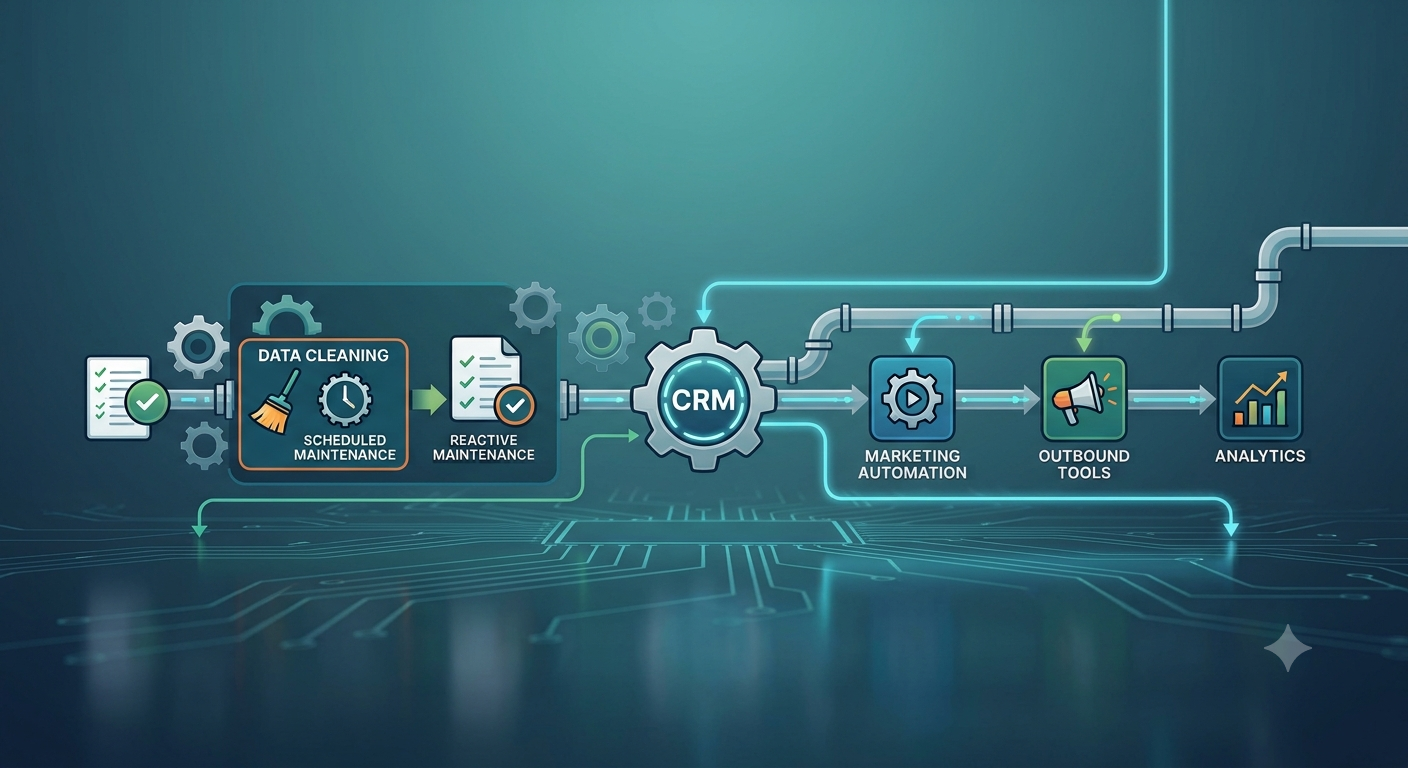

Database management is the strategic operating system that turns raw contact and company data into reliable revenue infrastructure, while data cleaning is just one maintenance task within that system. Treating them as the same thing is like confusing city planning with street sweeping: one designs how everything flows, the other just picks up trash on a schedule.
For B2B teams focused on lead generation, demand generation, and revenue operations, this distinction directly affects pipeline quality, deliverability, and the accuracy of every report your leadership team reviews.
The Core Difference: System vs Task
Data cleaning is reactive maintenance
Data cleaning focuses on fixing what is already broken or decaying in your database. Typical activities include removing duplicates, correcting invalid email formats, standardizing job titles, and suppressing hard bounces. It is essential, but it is inherently backward-looking. You clean because records have already gone stale, inconsistent, or non-compliant.
Common data cleaning tasks:
- Deduplication of contacts and accounts
- Email verification and bounce removal
- Standardizing fields like company name, industry, and phone format
- Suppressing unsubscribes and non-compliant records
- Correcting obvious typos and formatting errors
These tasks reduce noise, but they do not design how data enters, moves, or creates value across your stack.
Database management is proactive infrastructure
Database management covers the full lifecycle of your data: how it is captured, structured, governed, enriched, integrated, secured, and maintained over time. It includes data cleaning, but it also defines the rules, workflows, and ownership that keep your B2B database usable for segmentation, routing, personalization, and reporting.
Key components of database management:
- Data governance: policies for field definitions, ownership, access, and compliance
- Schema design: deciding which fields matter for ICP, scoring, and territory logic
- Capture strategy: forms, progressive profiling, and source tracking
- Enrichment strategy: when and how to append firmographic, technographic, and intent data
- Integration architecture: how data flows between CRM, marketing automation, outbound tools, and analytics
- Quality operations: verification, deduplication, freshness cycles, and exception handling
- Security and compliance: consent management, suppression logic, and deletion workflows
In short, data cleaning keeps your records from rotting. Database management ensures they were worth keeping in the first place and that they actually drive revenue.
Why This Matters for B2B Growth Teams
1. Pipeline quality depends on record quality
A messy database creates false confidence. You may have 100,000 contacts, but if titles are inconsistent, company attributes are missing, and ownership fields are unreliable, your segmentation and routing will be flawed. Sales ends up chasing the wrong personas, marketing sends generic messages to mixed audiences, and leadership sees noisy pipeline reports.
Well-managed databases prioritize actionability over volume. They ensure that every record has the fields needed to answer: “What do we know about this person and account right now, and what should happen next?” That is the difference between activity and coordinated action.
2. Deliverability and sender reputation live in your data layer
Email deliverability is not just a copy or domain issue. It is a data issue. If your database allows unverified or stale addresses into active sequences, your bounce rate climbs, your sender reputation drops, and even good prospects stop seeing your messages.
Database management builds verification into the workflow:
- Verify on entry for all new leads
- Re-verify campaign lists before major sends
- Run quarterly refreshes on active segments
- Auto-suppress records after repeated bounces
Data cleaning might remove bounces after they happen. Database management prevents many of them from entering your workflow at all.
3. Revenue operations needs a shared source of truth
Sales, marketing, and RevOps often argue over whose version of the data is correct. One team uploads event leads with one field structure. Another imports purchased contacts with different naming rules. SDRs overwrite titles manually. Soon you have multiple versions of the same account and no confidence in routing or reporting.
A managed database acts as an operating layer for GTM teams. It centralizes customer and prospect records, standardizes how they are stored, and makes them usable across tools instead of trapping them in each one. That shared foundation is what enables clean handoffs, consistent scoring, and trustworthy dashboards.
The Hidden Costs of Treating Management as Cleaning
When teams equate database management with data cleaning, they underinvest in the parts of the system that prevent problems in the first place.
Cost 1: Constant firefighting instead of prevention
If you only clean, you are always reacting to decay. B2B data decays at roughly 22–30% per year, with job changes, reorganizations, and company updates constantly eroding accuracy. Without governance and structured capture, you are cleaning the same types of errors over and over.
Database management introduces prevention:
- Validation at the point of entry to block bad data
- Clear field ownership to stop inconsistent manual edits
- Documented suppression and compliance logic baked into workflows
This shifts effort from endless cleanup to strategic improvements in coverage, segmentation, and conversion.
Cost 2: Wasted spend on tools and data
Many teams buy multiple tools that overlap: a CRM, a CDP, a lead database, enrichment services, and verification platforms. Without a managed data model, these tools create more complexity than clarity. Records get duplicated, fields conflict, and syncs break.
Database management defines the job of each system:
- CRM: manage active sales relationships and pipeline
- CDP: unify behavioral data across touchpoints
- Lead database: find and enrich prospects not yet in your system
When each tool has a clear role and your schema is consistent, you spend less on redundant fixes and more on growth.
Cost 3: Missed revenue from poor segmentation and personalization
Personalization fails when core attributes are missing or inconsistent. If industry, company size, or role data is unreliable, your messaging becomes generic. If lifecycle stage or territory fields are messy, your routing sends the right lead to the wrong owner.
A managed database ensures that the fields driving segmentation and personalization are:
- Defined consistently across sources
- Verified and enriched before use
- Regularly audited for completeness and accuracy
That is how you move from “we have a lot of data” to “we have data we can act on.”
What Good Database Management Looks Like in Practice
Clear ownership and governance
One team or operator should own schema rules, sync logic, and exception handling. This does not mean one person does all the work. It means one function is accountable for how data is defined, who can edit critical fields, and how exceptions are resolved.
Good governance includes:
- Documented field definitions and allowed values
- Rules for who can create, edit, or delete records
- Clear processes for handling low-confidence or partial records
- Written suppression and compliance logic that systems can enforce
Without this, every new campaign or tool integration reintroduces inconsistency.
Structured capture and enrichment
First-party data from forms, demos, and events is rich in intent but often messy in structure. Database management designs how this data is captured and enhanced.
Effective practices include:
- Standardized forms with consistent field mapping across channels
- Progressive profiling to reduce friction while still capturing key attributes over time
- Automated enrichment to fill gaps in title, company attributes, and technographics
- Source tracking so you always know where each field came from
This turns raw inputs into records that are ready for routing, scoring, and personalization.
Integrated workflows, not isolated silos
A workflow breaks in predictable ways: a form captures a lead, the CRM creates a duplicate, routing sends it to the wrong rep, and marketing starts a nurture sequence based on stale firmographic data. The problem is rarely automation itself. It is connecting systems without clear rules for what data is trusted, when it should update, and where each field belongs.
Database management designs the flow:
- Define which system is the source of truth for each field
- Map how records move from capture to enrichment to routing to outreach
- Build matching and deduplication logic into every sync
- Ensure compliance controls propagate across all connected systems
The goal is a simple, reliable revenue workflow with as few handoffs as possible.
Scheduled maintenance, not panic cleans
Data decay is inevitable. Database management accepts this and builds a maintenance cadence into operations.
A practical schedule might include:
- Real-time verification for all new leads
- Weekly duplicate detection on new records
- Monthly re-verification of high-value accounts
- Quarterly full-database refresh for active segments
- Annual audit to remove records untouched in 18 months
This prevents the “emergency clean” scenario where bounce rates spike and teams scramble to fix deliverability.
How This Supports Lead Generation and Demand Generation
For teams focused on lead generation and demand generation, database management is not a back-office function. It is a growth lever.
Better targeting and segmentation
A managed database lets you segment by firmographics, role, lifecycle stage, and engagement with confidence. You can build precise ICP-based lists for outbound, tailor nurture streams for different personas, and route inbound leads to the right owner without manual triage.
Higher conversion rates
When records are complete and current, personalization works. Reps have the context they need for relevant outreach. Marketing can trigger messages based on real behavior and attributes instead of guesswork. The result is higher reply rates, more meetings, and better campaign performance.
More predictable pipeline
Clean, governed data makes pipeline reporting trustworthy. Leadership can see which segments convert, which campaigns drive revenue, and where bottlenecks exist. That visibility enables smarter budget allocation and more predictable growth.
Common Misconceptions to Avoid
“Our CRM is our database”
Your CRM is a system of record for active relationships and pipeline, not a complete marketing database. It is not designed to store low-confidence prospect data at scale or to unify behavioral signals across channels. Treating it as your only database leads to bloated records, inconsistent fields, and fragile automation.
“We can clean later”
Cleaning later is more expensive than designing correctly upfront. Bad data spreads quickly through integrations and workflows. Fixing it downstream requires more time, more tools, and more disruption than preventing it at capture.
“More data is better”
Record count is a vanity metric if your team cannot trust deliverability, identity resolution, or account matching. A smaller, well-managed database with current contacts and clear attributes will outperform a larger one filled with stale, partial records.
Building a Database Strategy That Lasts
If you are responsible for demand generation or revenue operations, treat your database as shared infrastructure, not a cleanup project.
Start by clarifying:
- What jobs your CRM, CDP, and lead database each perform
- Which fields are critical for your ICP, scoring, and routing
- Who owns schema, sync, and exception handling
- How verification, enrichment, and deduplication fit into your workflows
- What maintenance cadence keeps your data aligned with the market
Then design your capture, integration, and governance around those decisions. Data cleaning will still be necessary, but it becomes routine maintenance within a system that is built to support growth, not hinder it.
Final Thought
Database management is the discipline that turns data into a strategic asset. Data cleaning is just one task within that discipline. For B2B teams that want predictable pipeline, high deliverability, and trustworthy reporting, investing in full database management is not optional. It is the foundation of modern revenue operations.