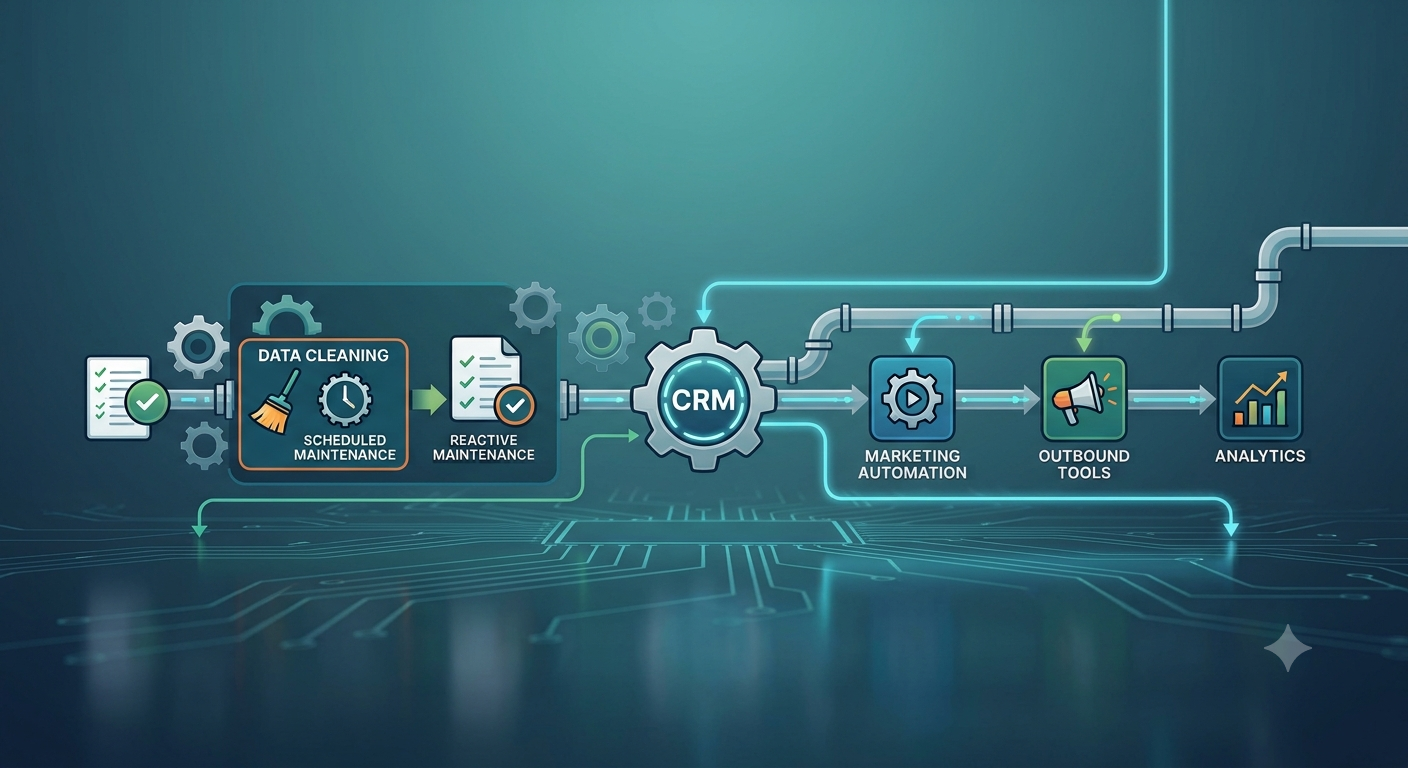


In 2026, a future-proof B2B database is no longer a static contact list; it is a dynamic, compliant, and AI-ready revenue asset that fuels both inbound and outbound motions. If your data cannot adapt to privacy regulation, buying-committee complexity, and AI-driven search, your pipeline will leak opportunities before your SDRs ever pick up the phone.
This guide gives you a practical, step-by-step blueprint to build a resilient B2B database strategy that scales with your go-to-market goals, protects you from compliance risk, and compounds ROI over time.
Why Your B2B Database Needs Future-Proofing Now
The B2B buying landscape has shifted dramatically. Buying groups are larger, sales cycles are longer, and decision-makers research solutions across multiple channels before engaging with sales. At the same time, data privacy laws like GDPR and CCPA continue to tighten, while Google’s AI Overviews and zero-click search change how prospects discover content.
A database built for 2020 simply cannot support 2026 GTM motions. Outdated records, missing consent flags, and shallow firmographic data lead to:
- Poor email deliverability and domain reputation damage
- Wasted ad spend on mis-targeted accounts
- Inaccurate forecasting and ABM performance
- Missed revenue from incomplete buying-committee mapping
Future-proofing means designing your database to be accurate by default, compliant by design, and adaptable to new channels and AI-driven workflows.
Pillar 1: Data Architecture Built for Buying Committees, Not Just Contacts
Traditional B2B databases optimize for “one contact, one record.” In 2026, you need a buying-committee-first architecture.
Map Roles, Not Just Titles
Instead of storing only job title and email, structure your database to capture:
- Buying role (e.g., Economic Buyer, Technical Evaluator, Champion)
- Influence score within the account
- Engagement history across channels (content downloads, webinar attendance, email clicks)
- Intent signals (e.g., content consumption patterns, website behavior, third-party intent data)
This allows you to run true account-based campaigns and tailor messaging by role rather than blasting generic content to a flat list.
Link Contacts to Accounts, Not Silos
Ensure every contact is tied to a canonical account record with:
- Standardized company name and domain
- Industry, employee count, and revenue band
- Tech stack and key initiatives (where available)
- Relationship stage (e.g., prospect, opportunity, customer)
This structure supports both inbound nurture and outbound ABM without duplicating effort or fragmenting insights.
Action: Audit your current CRM/schema. If contacts are not clearly linked to accounts with role-level attributes, prioritize a data model migration before scaling campaigns.
Pillar 2: Continuous Data Hygiene as a Growth Lever
Data hygiene is no longer an annual spring-cleaning task; it is a core growth discipline. In 2026, leading revenue teams treat hygiene as a continuous, automated process.
Core Hygiene Workflows
Implement these recurring workflows:
- Deduplication: Merge duplicate contacts and accounts using fuzzy matching on name, email, domain, and phone.
- Verification: Run email and phone verification on new and high-value records before campaign inclusion.
- Standardization: Enforce consistent formats for job titles, industries, and geo-fields to enable clean segmentation.
- Decay Management: Flag records with no engagement in 90–180 days for re-verification or suppression.
When to Clean vs. Replace
Not every stale record is worth fixing. If a contact has changed companies or an account has been acquired, it is often more efficient to replace the record with fresh, verified data than to patch outdated fields.
Action: Set up automated hygiene rules in your CRM or data platform (e.g., suppress unverified emails, auto-archive role-changed contacts, trigger enrichment on high-fit accounts).
Pillar 3: Compliance and Consent at the Core
Privacy regulation is only getting stricter. A future-proof database bakes compliance into every layer, from capture to activation.
Consent Management
- Capture explicit consent at every entry point (forms, events, content downloads).
- Store consent type, timestamp, and source in dedicated fields.
- Honor opt-outs instantly across all systems (CRM, email, ads, sales tools).
Data Minimization and Purpose Limitation
Collect only the data you need for defined use cases (e.g., lead nurturing, ABM outreach). Avoid hoarding “just in case” fields that increase risk without adding value.
Right-to-Be-Forgotten Workflows
Build automated workflows to:
- Delete or anonymize records upon request
- Propagate deletions across integrated tools (marketing automation, sales enablement, analytics)
Non-compliance is not just a legal risk; it damages sender reputation and trust with prospects.
Action: Run a compliance audit. Map where personal data lives, how consent is captured, and how deletion requests flow through your stack.
Pillar 4: Enrichment and Intelligence Layer
A future-proof database is not just clean; it is intelligent. Enrichment and AI-driven insights turn raw records into actionable revenue signals.
Strategic Enrichment
Use enrichment to fill critical gaps, not to bulk up record counts. Prioritize:
- Direct dial and mobile numbers for high-priority accounts
- Reporting structure and team size for buying-committee mapping
- Recent funding, hiring spikes, or leadership changes as trigger events
Enrichment should be targeted and triggered by fit and intent, not applied blindly to your entire database.
AI-Ready Data Structures
AI search and copilots rely on structured, entity-rich data. Ensure your database supports:
- Clear company and person entities with unique IDs
- Consistent attribute naming for firmographics and technographics
- Tagged content interactions and campaign responses for training predictive models
This prepares you for AI-driven segmentation, next-best-action recommendations, and automated content personalization.
Action: Define a “minimum viable enriched record” for your ICP. Automate enrichment only for accounts and contacts that meet fit thresholds or show buying signals.
Pillar 5: Integration with Inbound and Outbound Motions
Your database must power both inbound and outbound seamlessly. Siloed data creates blind spots and wasted effort.
Inbound: From Anonymous to Account-Aware
For inbound, design flows that:
- Capture high-intent behaviors (pricing page visits, demo requests, high-value content downloads)
- Map anonymous visitors to known accounts via IP enrichment and cookieless identity resolution where possible
- Trigger role-based nurture tracks based on content consumed and stage in the buyer journey
This turns your website and content hub into a pipeline engine, not just a traffic generator.
Outbound: Precision Targeting and Personalization
For outbound, leverage your database to:
- Build tightly defined account lists using firmographic, technographic, and intent filters
- Surface the right contacts by buying role and engagement history
- Personalize messaging using recent triggers (e.g., leadership change, new funding, tech adoption)
High-quality data directly improves response rates and meeting quality.
Closed-Loop Measurement
Tie every campaign back to pipeline and revenue:
- Track which accounts and contacts convert to opportunities
- Measure influence on deal velocity and win rate
- Feed insights back into segmentation and content strategy
This closes the loop between marketing, sales, and data operations.
Action: Map your top 3 inbound and 3 outbound campaigns. Identify data gaps that prevent precise targeting or personalization, and prioritize fixes.
Pillar 6: Governance, Ownership, and Scalability
A future-proof database requires clear ownership and scalable processes. Without governance, even the best architecture will decay.
Define Data Ownership
Assign clear roles:
- Data Owner: Ultimately accountable for data quality and compliance (often RevOps or Marketing Ops lead)
- Data Stewards: Responsible for day-to-day hygiene, enrichment, and issue resolution
- Data Consumers: Sales, marketing, and CS teams who use the data and report issues
Document who can create, edit, and delete records, and enforce role-based access controls.
Scalable Processes
As your database grows, rely on:
- Automated validation rules at point of entry (e.g., required fields, format checks)
- Scheduled hygiene jobs (daily/weekly deduplication, monthly verification sweeps)
- Clear escalation paths for data issues (e.g., sales reps flagging bad records via a simple workflow)
Together, these create a “security-by-design” foundation that supports growth without creating unnecessary exposure.
Action: Draft a one-page data governance charter. Define ownership, key processes, and SLAs for data quality and issue resolution.
Pillar 7: Measuring ROI and Continuous Improvement
Future-proofing is not a one-time project; it is an ongoing optimization loop. Tie your database strategy to measurable business outcomes.
Key Metrics to Track
Monitor:
- Data Quality Score: Percentage of records with complete, verified critical fields (email, phone, role, account linkage)
- Deliverability Metrics: Bounce rate, spam complaint rate, and domain reputation
- Campaign Performance: Response rate, meeting rate, and pipeline generated by segment
- Revenue Impact: Influence on win rate, deal size, and sales cycle length
Clean and compliant data makes ROI measurement far more accurate, especially in ABM.
Quarterly Database Health Reviews
Run quarterly reviews to:
- Assess decay rates and hygiene effectiveness
- Identify new data fields or signals that could improve targeting
- Align with sales and product on emerging ICP shifts or new use cases
Before you start your next planning cycle, ask: Is our database ready to support our goals? If the answer is not a confident yes, now is the best moment to fix it.
Action: Build a simple dashboard with your top 5 database health metrics. Review it monthly in your RevOps or marketing leadership meeting.
How The LeadCrafters Can Accelerate Your Database Strategy
If you are focused on demand generation and pipeline growth, you do not have to build this future-proof database alone. At The LeadCrafters, we specialize in executing effective lead generation and white paper syndication programs that rely on clean, compliant, and highly targeted B2B data.
Our approach integrates:
- Precision ICP definition and buying-committee mapping
- Continuous data hygiene and enrichment workflows
- Compliance-first data capture and consent management
- Tight alignment between inbound content and outbound motions
This ensures your database becomes a compounding asset, not a cost center.
If you want to explore how a future-proof database can transform your pipeline, start by auditing your current data hygiene practices and identifying gaps that block scalable growth.