
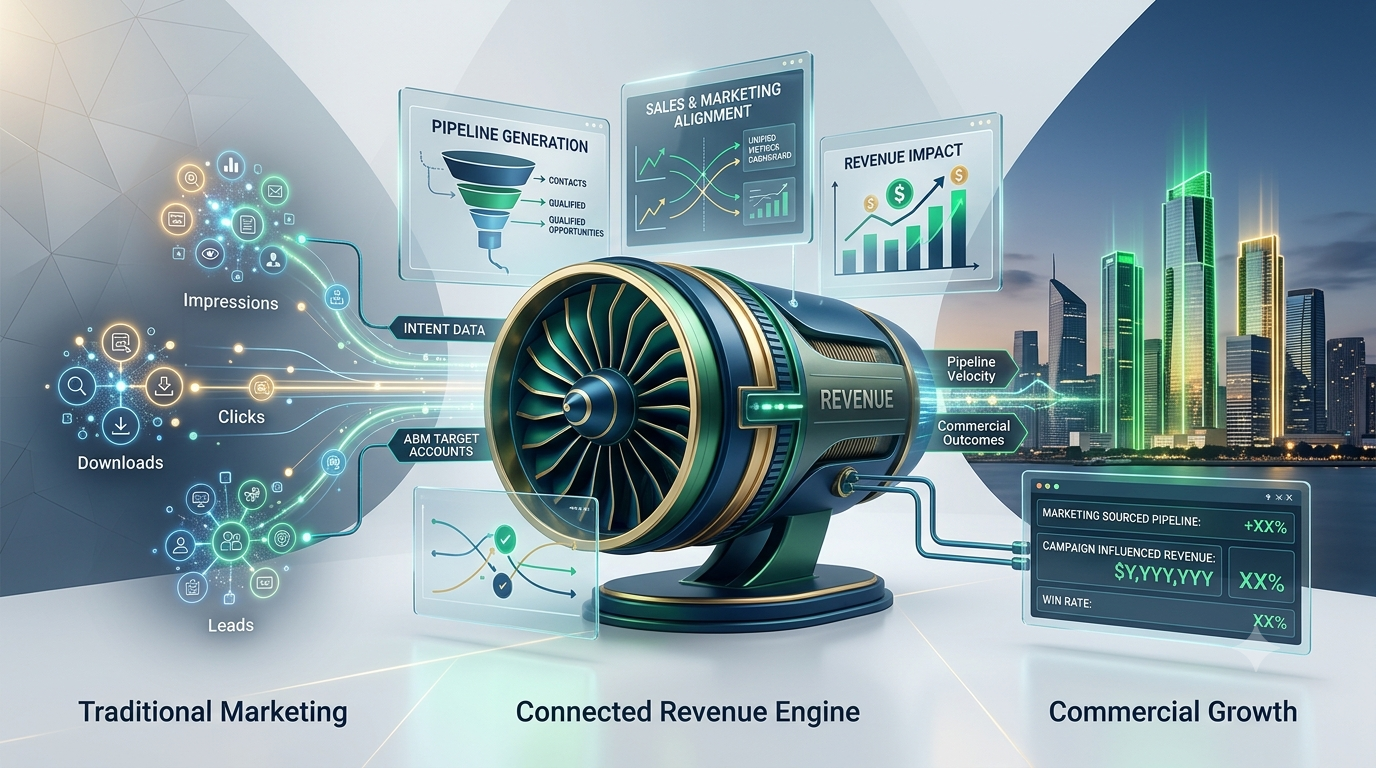

Marketing is no longer judged only by impressions, clicks, downloads, or lead volume. In modern B2B organizations, marketing is becoming a revenue function because leaders expect every campaign, content asset, and demand generation program to contribute to pipeline, sales velocity, and closed revenue.
This shift does not mean marketing should abandon brand awareness, audience education, or creative storytelling. It means those activities must connect to a measurable revenue system. Today’s buyers move across search, email, social channels, sales conversations, and peer recommendations before making a purchase decision. Marketing must therefore operate as part of one connected revenue engine rather than as a department that simply hands leads to sales.
Recent industry research reflects this change: 52% of B2B marketers now rank driving qualified pipeline as their top priority, while more than 90% include pipeline, ABM, or lead quality among their top three goals. The message is clear. Marketing’s value is increasingly defined by its contribution to commercial outcomes.
Why Marketing Is Shifting to Revenue Accountability
The traditional marketing model was built around activity. Teams measured website traffic, email opens, form fills, social engagement, and the number of leads generated. Those metrics still matter, but they no longer tell the complete story.
A lead can download an ebook, attend a webinar, or click an ad without ever becoming a serious buyer. Conversely, a smaller number of high-intent accounts may generate far more revenue than thousands of unqualified contacts. This is why revenue-focused marketing prioritizes quality, intent, and conversion potential over raw volume.
The shift is also driven by greater executive scrutiny. CFOs and CEOs want to understand how marketing spend affects customer acquisition, pipeline coverage, sales efficiency, and revenue growth. When marketing cannot connect its activity to business outcomes, budgets become harder to defend.
Buyer behavior has changed as well. B2B purchase decisions often involve multiple stakeholders, longer evaluation cycles, and more independent research. Buyers do not experience departments; they experience one journey across marketing, sales, and customer success. A disconnected organization creates friction, while a connected revenue function creates a smoother path to purchase.
What a Revenue Function Means in Practice
A revenue function is not simply a marketing team with a new title. It is an operating model where marketing, sales, customer success, and revenue operations share ownership of growth.
In this model, marketing contributes across the entire customer lifecycle:
- Creating demand among the right ideal customer profile
- Identifying accounts and buyers showing real purchase intent
- Nurturing prospects with relevant, useful content
- Supporting sales with insights, enablement, and qualified opportunities
- Measuring pipeline contribution and revenue influence
- Improving retention, expansion, and customer lifetime value
The goal is not to make marketers responsible for closing deals alone. Instead, it is to ensure marketing is accountable for the quality of demand it creates and the revenue outcomes it influences.
This approach requires a shared definition of success. Marketing, sales, and leadership must agree on what qualifies as a good lead, when a lead is sales ready, which accounts deserve priority, and how pipeline contribution will be measured.
From Lead Generation to Revenue Generation
Lead generation remains important, but it is no longer the end goal. The more strategic objective is revenue generation.
A lead generation program may produce a high number of contacts, but a revenue generation program asks deeper questions:
- Are these contacts from accounts that match the ideal customer profile?
- Do they show genuine buying intent?
- Will sales accept and actively work these leads?
- Are the leads progressing through the pipeline?
- How much pipeline and revenue did the campaign influence?
This is the difference between filling a database and building a pipeline. A revenue-first approach connects campaign performance to opportunity creation, deal progression, and closed won revenue.
The Lead Crafters explores this transition in its article on the shift from lead generation to revenue generation, emphasizing sales and marketing SLAs, closed-loop reporting, and revenue-focused measurement.
The Role of Revenue Operations
Revenue operations, commonly called RevOps, provides the structure that makes marketing a true revenue function. RevOps aligns people, processes, data, and technology across marketing, sales, and customer success.
Without RevOps, teams often work from separate systems and conflicting definitions. Marketing may call a contact an MQL, sales may consider it unqualified, and customer success may have no visibility into the promises made during the sales process. These gaps create poor handoffs, inaccurate reporting, and lost revenue opportunities.
A strong RevOps function creates one source of truth for customer and prospect data. It standardizes lead stages, qualification criteria, attribution models, and reporting dashboards. It also helps teams understand which channels, campaigns, and content types create the highest quality pipeline.
The Lead Crafters explains that a unified revenue operations strategy aligns sales, marketing, and customer success around shared data, processes, and goals across the full revenue lifecycle.
Marketing Metrics That Prove Revenue Impact
To operate as a revenue function, marketing needs metrics that reflect business impact rather than activity alone. Vanity metrics can still support campaign optimization, but they should not be the primary measure of success.
Important revenue marketing metrics include:
- Marketing sourced pipeline
- Marketing influenced pipeline
- Pipeline conversion rate
- MQL to SQL conversion rate
- SQL to opportunity conversion rate
- Cost per qualified opportunity
- Pipeline coverage
- Average deal size
- Sales cycle length
- Campaign influenced revenue
- Customer acquisition cost
- Return on marketing investment
Marketing sourced pipeline measures opportunities created directly by marketing activity. Marketing influenced pipeline includes opportunities where marketing played a meaningful role, even if sales sourced the deal. Both metrics matter, but they should be reported clearly and consistently.
A revenue-focused dashboard should show not only how many leads marketing generated, but also how many became sales accepted opportunities, how much pipeline they created, and how those opportunities progressed. The Lead Crafters highlights metrics such as marketing sourced pipeline, MQL to SQL conversion, campaign pipeline contribution, and content performance as essential measures for connecting marketing and sales.
Intent Data Turns Engagement Into Revenue Signals
One of the biggest enablers of revenue marketing is intent data. Intent data helps marketing understand which accounts and buyers are actively researching relevant topics, comparing solutions, or showing signs of purchase readiness.
Instead of treating every content download equally, marketers can prioritize accounts based on behavioral and contextual signals. For example, repeated engagement with content about a specific business problem, combined with the right company size, industry, and job role, can indicate stronger buying potential.
Intent data becomes most valuable when it activates action. Marketing can use it to:
- Prioritize high intent accounts for sales outreach
- Personalize email and advertising campaigns
- Build relevant content journeys
- Improve lead scoring models
- Trigger timely sales follow up
- Identify accounts entering an active buying cycle
- Reduce wasted outreach to low intent contacts
However, intent data alone does not create revenue. It must connect to clean data, clear qualification rules, sales follow up, and closed loop reporting. Research shows that although most organizations use third party intent data, only a small fraction consider it highly effective, revealing a persistent gap between data availability and activation.
First Party Data Builds a Durable Revenue Engine
First party data is another foundation of revenue focused marketing. It includes information collected directly from your audience through website behavior, email engagement, webinar attendance, content downloads, survey responses, sales conversations, and CRM records.
First party data is valuable because it reflects real interactions with your brand. It helps marketing understand what buyers care about, which topics drive engagement, which offers convert, and which accounts are moving toward a purchase decision.
A strong first party data strategy includes:
- Clear consent and preference management
- Accurate contact and account records
- Behavioral tracking across channels
- CRM integration
- Lead scoring and account scoring
- Segmentation based on firmographics and behavior
- Regular data cleansing and enrichment
- Privacy compliant data practices
Clean and connected data allows marketing to personalize experiences without relying on guesswork. It also helps sales understand which prospects are most likely to convert and what topics matter most to them.
Content Must Support the Buyer Journey
Content remains central to revenue marketing, but its purpose has evolved. Content should not exist only to attract traffic. It should educate buyers, build trust, address objections, and move prospects toward a commercial conversation.
Different content types serve different stages of the buyer journey:
| Buyer Stage | Content Purpose | Examples |
|---|---|---|
| Awareness | Help buyers understand a problem | Blog posts, industry reports, educational guides |
| Consideration | Help buyers evaluate approaches | Comparison guides, webinars, case studies |
| Decision | Help buyers choose a solution | Product pages, demos, ROI calculators, customer stories |
| Expansion | Support retention and growth | Onboarding resources, best practice guides, customer education |
High quality research, executive insights, and practical resources often perform better than lightweight content when the goal is qualified pipeline. Industry research found that research reports and executive level insights continue to outperform lighter content formats in generating qualified pipeline.
For SEO, content should target the questions buyers actually ask during their research process. This includes problem aware searches, solution comparison searches, and decision stage searches. The goal is to create content that earns visibility, builds authority, and supports conversion.
Sales and Marketing Alignment Is Non Negotiable
Marketing cannot become a revenue function in isolation. It requires deep alignment with sales.
The old model of marketing generating leads and sales working them separately creates predictable problems. Marketing may complain that sales ignores leads. Sales may complain that marketing sends unqualified contacts. Both teams may use different definitions of a qualified opportunity. The result is wasted budget, slow follow up, and lost pipeline.
Strong alignment starts with a shared revenue playbook. Marketing and sales should agree on:
- Ideal customer profile and buyer personas
- Lead qualification criteria
- Lead scoring thresholds
- Handoff requirements
- Response time expectations
- Follow up sequences
- Disqualification reasons
- Pipeline stages and definitions
- Reporting metrics
- Campaign feedback loops
Alignment also requires shared accountability. Marketing should be measured on pipeline quality and revenue contribution, while sales should be measured on follow up speed, conversion discipline, and feedback on lead quality.
Research on B2B pipeline performance shows that high performing teams define lead quality before delivery, measure SQL conversion rather than MQL volume, hold lead sources accountable to downstream results, and treat the sales marketing handoff as joint accountability.
Account Based Marketing Supports Revenue Focus
Account based marketing, or ABM, fits naturally into a revenue function because it focuses marketing effort on the accounts most likely to generate revenue.
Instead of broadcasting messages to a broad audience, ABM identifies high value target accounts and creates personalized campaigns for the people involved in the buying decision. This approach is especially useful for B2B companies with longer sales cycles, larger deal sizes, and multiple stakeholders.
An effective ABM program includes:
- A clearly defined ideal customer profile
- Account selection based on fit and intent
- Persona level messaging
- Coordinated marketing and sales outreach
- Personalized content and offers
- Multi channel engagement
- Account level reporting
- Sales marketing collaboration on target accounts
ABM works best when marketing and sales share the same account list, understand the buying committee, and coordinate their outreach. The objective is not simply to reach more people. It is to engage the right people inside the right accounts at the right time.
Technology Should Connect, Not Complicate
Marketing technology plays an important role in revenue marketing, but tools alone do not create alignment. A complex stack can actually make revenue reporting harder if systems do not communicate properly.
A practical revenue technology foundation should connect:
- CRM
- Marketing automation
- Website analytics
- Intent data platforms
- Email engagement tools
- Sales engagement platforms
- Data enrichment providers
- Reporting and dashboard tools
The purpose of this stack is to create visibility across the buyer journey. Marketing should be able to see which campaigns influence pipeline. Sales should be able to see engagement history before outreach. Leadership should be able to see which channels produce the strongest commercial return.
The Lead Crafters uses engagement intelligence, AI scored intent, and CRM connected reporting to help teams understand who to contact, what to say, and which actions are most likely to move an opportunity forward.
How to Transition Marketing Into a Revenue Function
Becoming a revenue function does not happen overnight. It requires a structured transition from activity based marketing to outcome based marketing.
1. Define Revenue Goals
Start by aligning with leadership on the revenue outcomes marketing should support. These may include pipeline generation, pipeline acceleration, win rate improvement, customer acquisition, or expansion revenue.
2. Audit Your Current Funnel
Review every stage from first touch to closed won revenue. Identify where leads drop off, where sales follow up breaks down, and where reporting becomes unclear.
3. Standardize Definitions
Create shared definitions for leads, MQLs, SQLs, opportunities, pipeline stages, and disqualification reasons. Every team should use the same language.
4. Build Closed Loop Reporting
Connect marketing automation, CRM, and sales data so you can track campaign performance through pipeline and revenue. Avoid reporting only on top of funnel activity.
5. Improve Lead Quality
Use intent signals, firmographic fit, behavioral engagement, and sales feedback to improve qualification. Focus on accounts that match your ideal customer profile.
6. Create Sales Marketing SLAs
Define how quickly sales should follow up, what information marketing must provide, and how both teams will handle feedback on lead quality.
7. Personalize High Value Accounts
Use ABM for priority accounts. Build tailored campaigns that speak to the specific challenges, roles, and buying triggers of each account.
8. Optimize Continuously
Review performance regularly. Identify which channels, campaigns, content assets, and audience segments create the best pipeline. Reallocate budget toward what works.
Common Mistakes to Avoid
Many organizations attempt revenue marketing but fall into predictable traps.
- Measuring only lead volume instead of pipeline quality
- Using inconsistent lead definitions across teams
- Passing leads to sales without clear qualification criteria
- Relying on intent data without activating it in campaigns or sales workflows
- Treating attribution as a reporting exercise rather than a decision making tool
- Creating content without a conversion path
- Running ABM without sales collaboration
- Using disconnected tools that prevent a complete view of the buyer journey
- Focusing on short term campaign results while ignoring long term demand creation
Avoiding these mistakes requires discipline, shared ownership, and a willingness to measure marketing by the outcomes it creates.
The Future of Marketing Is Commercial
Marketing is becoming a revenue function because B2B growth now depends on connected execution. Buyers expect relevant experiences. Sales needs better qualified opportunities. Finance wants clear returns on marketing investment. Leadership wants predictable growth.
The most successful marketing teams will not be those that generate the most leads. They will be the teams that generate the right demand, identify the right accounts, equip sales with better context, and prove their contribution to pipeline and revenue.
This does not reduce the importance of creativity, brand, or content. It elevates them. When creative work is connected to buyer intent, clean data, sales alignment, and revenue measurement, marketing becomes one of the most powerful drivers of business growth.
The organizations that embrace this shift will build stronger pipelines, make smarter budget decisions, and create a more consistent buyer experience. The organizations that continue to measure marketing only by activity will struggle to demonstrate value in a market that increasingly rewards revenue impact.