
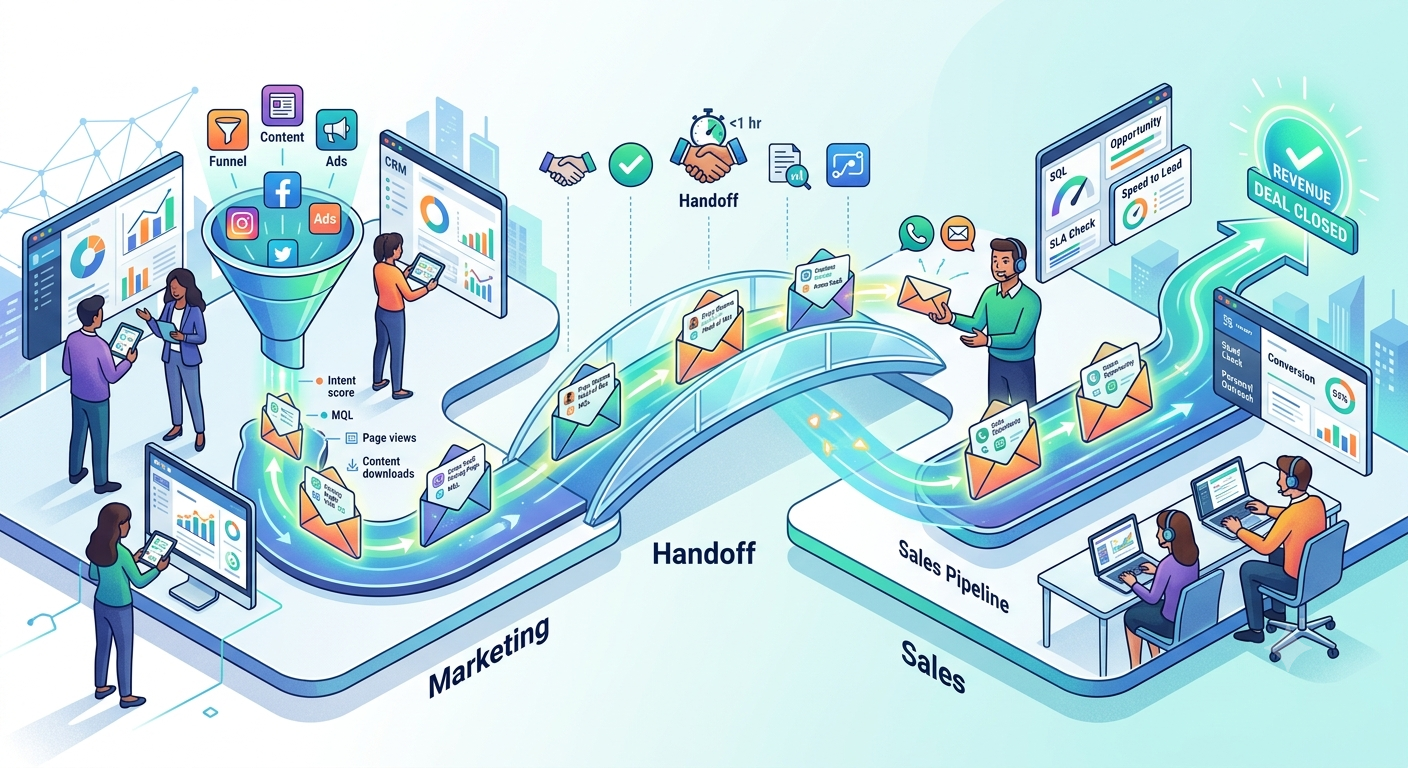

A smooth handoff from marketing to sales is where pipeline growth either accelerates or stalls. When both teams share clear definitions, context-rich lead data, and enforceable SLAs, conversion rates improve and revenue becomes more predictable.
This guide walks you through a practical framework to design, implement, and optimize marketing-to-sales handoffs that actually convert, with examples and checklists you can adapt for your B2B environment.
Why Handoffs Break (and What It Costs)
Most handoff failures trace back to three root causes:
- Unclear lead definitions. Marketing and sales use different criteria for what qualifies as an MQL or SQL, leading to rejected leads and friction.
- Missing context at transfer. Sales receives a name and email but not the intent signals, content consumed, or qualification notes that make first outreach relevant.
- Slow or inconsistent follow-up. Without a speed-to-lead SLA, high-intent leads cool off, and momentum is lost within hours.
The cost shows up in wasted ad spend, stalled opportunities, and internal blame games. Fixing the handoff process is one of the highest-ROI improvements a B2B team can make.
Step 1: Align on a Shared Lead Definition
Before optimizing the process, agree on what you are handing off.
Build a Joint MQL/SQL Definition
Bring marketing and sales leaders into one room (or call) and document:
- MQL criteria: Firmographics (industry, company size), behavior (demo request, pricing page visits), and intent signals (form answers, content depth).
- SQL criteria: Additional qualification such as budget, timeline, authority, and explicit buying intent.
- Disqualification rules: Clear reasons a lead should be rejected or recycled to nurture.
Write this into a formal Lead Definition Agreement and store it where both teams can reference it. Revisit quarterly as your ICP or product evolves.
Tip: If sales rejects more than 20–30% of MQLs, your definition is too loose. Tighten criteria or adjust scoring thresholds.
Step 2: Design the Handoff Process (5 Stages)
A repeatable, five-stage handoff ensures no lead is lost, delayed, or disputed.
Stage 1: Trigger
Define the exact event that fires the handoff:
- Lead score crosses a threshold
- Demo or contact form submission
- High-intent page sequence (e.g., pricing + case study + contact)
This trigger should be unambiguous and automated in your CRM or marketing automation platform.
Stage 2: Enrichment Pass
Before routing, marketing confirms the lead record is complete:
- Contact details (name, email, phone, LinkedIn)
- Company context (industry, size, location)
- Intent data (pages visited, content downloaded, webinar attended)
- Qualification answers (budget range, timeline, use case)
Use progressive profiling on forms to gather this without hurting conversion rates.
Stage 3: Routing
Automate assignment based on:
- Territory or region
- Account ownership (ABM lists)
- Rep capacity and role (AE vs SDR)
Manual sorting introduces delays and errors. Build rules everyone can see and audit.
Stage 4: Acceptance Window
Sales must acknowledge receipt within an agreed SLA (e.g., 1 hour for demo requests, 24 hours for other MQLs).
The rep should:
- Review the activity trail and company context
- Accept or decline the lead with a reason logged in the CRM
- Trigger a fallback rule if unaccepted (reassign to another rep or queue)
This step creates accountability and prevents leads from vanishing into a black hole.
Stage 5: First Contact
The rep makes a personalized first outreach attempt using the context marketing provided:
- Reference the specific content or problem the prospect engaged with
- Recommend a clear next step (discovery call, demo, resource send)
- Log channel, timestamp, and outcome in the CRM
Speed matters: every hour of delay reduces conversion probability significantly.
Step 3: Pass the Right Context (Not Just a Name)
A better handoff passes four things from marketing to sales:
- Contact information – name, email, phone, LinkedIn profile
- Intent signals – what problem were they asking about? Which pages did they visit?
- Qualification context – do they meet your Lead Definition Agreement? Any budget/timeline signals?
- Recommended next step – schedule a call, send a case study, book a demo
This context turns a cold call into a warm, relevant conversation.
Example Handoff Data Package
| Field | Example |
|---|---|
| Contact | Priya Sharma, Head of Marketing, Acme SaaS |
| Intent | Downloaded “B2B Lead Gen Playbook”, visited pricing page 3x |
| Qualification | 200–500 employees, SaaS, India; timeline: Q4; budget: confirmed |
| Next Step | Book 30-min discovery call; share ROI case study |
Build this into your CRM lead layout so sales sees it at a glance.
Step 4: Set and Enforce SLAs
SLAs turn good intentions into measurable behavior.
Core Handoff SLAs
- Speed to lead: Under 1 hour for demo requests and high-intent MQLs; under 24 hours for standard MQLs.
- Acceptance time: Sales acknowledges or reassigns within the same window.
- Follow-up cadence: Minimum number of touches (e.g., 6–8 attempts across email, phone, LinkedIn) before marking as “no response”.
- Recycle rules: When and how unqualified leads return to marketing nurture.
Make SLAs Visible
Create shared dashboards in your CRM or BI tool that both teams review weekly:
- MQL to SQL conversion rate
- Time from handoff to first contact
- Percentage of leads accepted vs rejected (with reasons)
- Pipeline generated from handed-off leads
When both teams look at the same numbers, blame shifts to process, not people.
Step 5: Close the Loop with Feedback
A handoff is not complete until sales reports back on outcomes.
Build a Weekly Feedback Loop
In a short, recurring meeting:
- Sales shares which leads converted, which stalled, and why
- Marketing adjusts scoring, targeting, or content based on feedback
- Both sides refine the Lead Definition Agreement as needed
This closed-loop feedback is how you continuously improve handoff quality over time.
Track Leading and Lagging Metrics
- Leading: Speed to lead, acceptance rate, first-contact quality scores
- Lagging: MQL to SQL conversion, SQL to opportunity, opportunity to closed-won
Use both to diagnose where the handoff is leaking value.
Common Handoff Mistakes (and Fixes)
| Mistake | Impact | Fix |
|---|---|---|
| Vague MQL definition | High rejection rate, friction | Document joint MQL/SQL criteria with scoring thresholds |
| Manual lead routing | Delays, misassigned leads | Automate routing by territory, capacity, and role |
| No context passed | Low first-call relevance | Enrich lead records with intent, behavior, and qualification data |
| Slow follow-up | Leads go cold | Enforce speed-to-lead SLA (<1 hour for high intent) |
| No feedback loop | Repeated mistakes | Weekly marketing–sales review of handoff metrics and outcomes |
How This Supports Revenue Operations
A disciplined handoff process is a core RevOps capability. It:
- Reduces lead decay and shortens sales cycles
- Aligns marketing and sales to shared revenue outcomes
- Creates a clean, auditable pipeline from first touch to closed-won
If you are building a lead generation engine for B2B growth, the handoff is where that engine either delivers pipeline or burns budget.
Quick Handoff Checklist
Use this as a starting point for your own playbook:
- Joint MQL/SQL definition documented and stored centrally
- Automated trigger for MQL conversion in CRM/MA platform
- Enriched lead data package (contact, intent, qualification, next step)
- Automated routing rules by territory, account, and capacity
- SLA for acceptance and first contact (with fallback rules)
- Shared dashboards for handoff metrics visible to both teams
- Weekly feedback loop to review conversions, rejections, and process tweaks
Final Thought
Better handoffs are not about more meetings or longer documents. They are about clarity, context, and accountability at the exact moment a lead moves from marketing to sales. When you nail those three elements, you stop losing deals in the gap and start building a predictable, scalable pipeline.
If you want help designing or automating this workflow for your B2B business, explore our demand generation and B2B content marketing services to align your funnel end to end.