

In the high-stakes world of B2B marketing, your database is often treated as a static asset a reliable foundation for lead generation campaigns. But here’s the unsettling truth: your B2B database is decaying at a rate of 2.1% monthly, which translates to roughly 22.5% annually. That means if you have 10,000 contacts today, you’ll lose over 2,200 of them within a year simply due to data decay. Most marketing teams don’t realize this until their outreach campaigns start failing, their email metrics tank, or their sales team complains about “bad leads.”
This article cuts through the optimism bias and reveals why database decay happens faster than most professionals expect, how it sabotages your SEO and lead generation efforts, and most importantly what you can do to build a revenue-ready database that actually scales.
The Hidden Cost of Ignoring Data Decay in B2B Marketing
Database decay isn’t just an IT problem it’s a business growth problem. When your database ages without maintenance, you’re not just losing contacts; you’re losing money, credibility, and competitive advantage.
The Financial Impact
Consider these reality-check numbers:
- 22.5% annual decay rate means you need to replace nearly a quarter of your database every year just to maintain current size
- For a team with 50,000 contacts, that’s 11,250 lost contacts annually
- If each qualified lead costs $150 to acquire through inbound marketing, you’re effectively losing $1.68 million in acquired value every year
Yet most B2B marketing budgets allocate zero resources to database hygiene. The result? Marketing-generated leads deteriorate in quality, sales conversion rates drop, and the perceived value of marketing efforts diminishes.
The SEO Connection You’re Not Seeing
Here’s where it gets even more critical for your SEO strategy: outdated database content directly impacts your website’s search performance. When you publish blog content, case studies, or resource pages using stale statistics, outdated customer examples, or old industry data, your content begins decaying in search rankings.
According to recent B2B SEO audits, pages that haven’t been updated in over a year are significantly less likely to rank first on Google. This creates a vicious cycle: your database decays → you publish outdated content → your SEO rankings drop → your inbound lead quality deteriorates → your sales team gets worse leads → revenue stagnates.
Why B2B Data Decays at 2.1% Monthly: The Root Causes
Understanding why data decays is the first step to fixing it. The 2.1% monthly decay rate isn’t random it’s driven by predictable, measurable factors that most marketing teams ignore.
1. Job Changes and Role Transitions
In the B2B world, professionals move jobs frequently. According to industry data, B2B professionals change roles at an average rate of 15-20% annually. When someone leaves a company:
- Their email address becomes inactive
- Their phone number may change
- Their role title becomes inaccurate
- Their buying influence disappears
If your database doesn’t automatically flag these changes, you’re wasting outreach budgets on dead contacts.
2. Company Changes and Organizational Shifts
Companies don’t stay static either. They:
- Merge with other organizations
- Split into separate entities
- Rebrand entirely
- Change their business models
- Move to new domains
A contact at “Company X” might suddenly be at “Company X acquired by Company Y,” making your segmentation and targeting completely misaligned.
3. Email Address Evolution
Even within the same company, email addresses change:
- Employees switch from personal emails (gmail.com) to corporate emails
- Companies migrate to new email providers
- Employees get new email addresses after promotions or role changes
- Old email addresses get deactivated without forwarding
This is especially problematic for B2B databases that rely on email for lead nurture journeys and email marketing effectiveness.
4. outdated Contact Information
Basic contact details become stale:
- Phone numbers change due to company reorganizations
- Physical addresses update when companies relocate
- Social media profiles become inactive or change usernames
- Direct mail addresses become invalid
5. Lack of Continuous Verification
Most B2B databases are broadcast-and-forget systems. You acquire contacts through inbound marketing, add them to your database, and never verify them again. Without cadenced verification, enrichment, and governance protocols, your database becomes a one-time asset instead of a living, revenue-ready system.
How Database Decay Sabotages Your Inbound and Outbound Marketing Strategies
Database decay doesn’t just affect your email metrics it creates systemic problems across your entire marketing operation, impacting both inbound and outbound strategies.
Inbound Marketing: The Quality Crisis
Inbound marketing relies on high-quality, verified data to convert visitors into leads. When your database decays:
| Problem | Impact on Inbound Marketing |
|---|---|
| Invalid email addresses | Lower email conversion rates, higher bounce rates |
| Outdated role information | Misaligned content personalization, poor lead nurture journeys |
| Stale company data | Incorrect segmentation, wasted ad spend on wrong audiences |
| Inactive contacts | Inflated lead counts, false performance metrics |
Your SEO content creation efforts become less effective because you’re targeting the wrong personas with outdated messaging. Your blog content focused on lead generation stops converting because the data informing your content strategy is wrong.
Outbound Marketing: The Efficiency Drain
Outbound strategies like SDR outreach, cold email campaigns, and direct sales efforts depend entirely on accurate, current contact information. Database decay creates:
- Lower response rates: Outdated emails mean messages never reach humans
- Wasted sales hours: SDRs spend time on dead leads instead of active prospects
- Damaged reputation: High bounce rates and invalid emails hurt your sender score
- Missed pipeline opportunities: Real buyers with current information are overlooked
The outbound vs inbound math for B2B RevOps becomes distorted when your database is decaying. You might think you need more outbound investment because inbound isn’t working, but the real problem is poor data quality.
The SEO Content Decay Connection: Why Your Blog Posts Lose Rankings
There’s a critical but often overlooked relationship between database decay and content decay. When your database is stale, the content you create based on that data becomes stale too.
How Stale Data Creates Stale Content
Consider this scenario:
- Your database shows a customer at “Company X” with “CEO” role
- You write a case study about “CEO at Company X”
- Six months later, that person is no longer CEO and Company X merged with Company Y
- Your case study now contains outdated statistics and irrelevant examples
- Google detects the content is no longer authoritative and drops your rankings
This is content decay in action: once-dominant pages lose search engine rankings due to outdated information.
The Statistics Problem
B2B SEO content relies heavily on statistics and data points. When your database decays:
- You reference old industry statistics that no longer reflect current market conditions
- Your case studies use outdated revenue figures or growth rates
- Your benchmark data doesn’t match current buyer behavior
- Your predictions become inaccurate
Search engines prioritize current, authoritative content. Pages with outdated data get penalized in rankings, which directly impacts your B2B SEO strategy for 2026.
The Personalization Gap
Modern SEO optimization requires personalization based on accurate user data. When your database is decaying:
- Your content recommendations are misaligned with current buyer intent
- Your meta descriptions and SEO titles target wrong personas
- Your keyword mapping uses outdated search terms
- Your hyperlinks point to irrelevant resources
This creates a personalization in marketing outreach crisis where your content feels generic instead of tailored to specific buyer needs.
Building a Revenue-Ready Database: The Cadenced Framework Solution
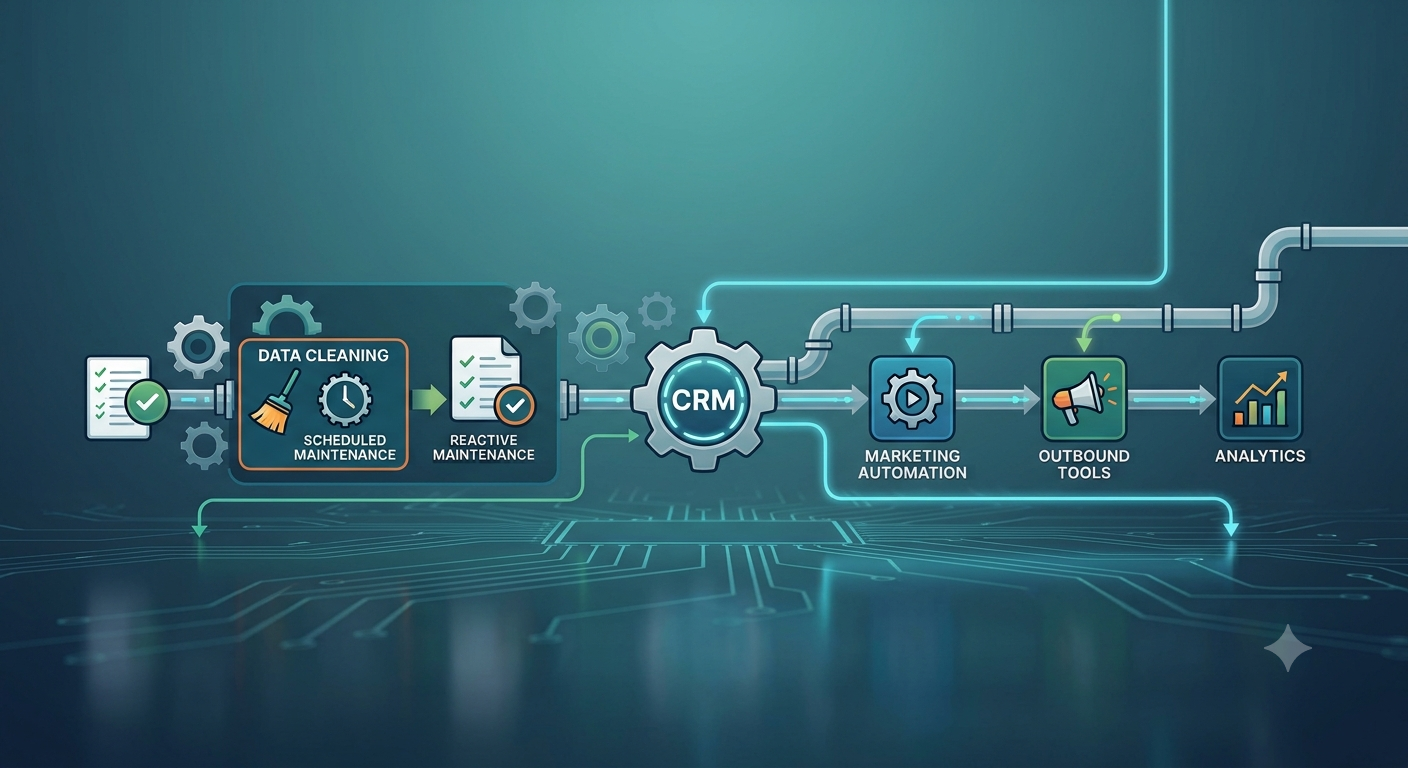
The good news? Database decay is predictable and manageable. Apollo.io’s research reveals a cadenced framework that covers verification, enrichment, and governance to keep databases revenue-ready.
Phase 1: Continuous Verification
What it is: Regularly validating contact information to ensure accuracy
How to implement:
- Set up automated email verification tools that check validity monthly
- Use phone number verification services to confirm contact numbers
- Implement domain validation to catch company changes
- Create automated alerts for inactive contacts
Key metric: Maintain a bounce rate below 2% and email validity above 95%
Phase 2: Strategic Enrichment
What it is: Adding missing data points and updating existing information
How to implement:
- Integrate with CRM systems to automatically sync role changes
- Use data enrichment APIs to update company information
- Implement social media profile verification
- Add behavioral data from your marketing automation platforms
Key metric: Achieve 90%+ data completeness on critical fields (email, phone, role, company)
Phase 3: Governance Protocols
What it is: Establishing rules and processes for database maintenance
How to implement:
- Create monthly database audit schedules
- Define data hygiene standards and compliance requirements
- Set up automated segmentation for outdated contacts
- Establish lead scoring criteria that account for data freshness
Key metric: Reduce data decay rate to below 1.5% monthly through proactive governance
Technology Stack Recommendations
For B2B marketing professionals working with marketing automation platforms and CMS systems, consider these tools:
- Email verification: ZeroBounce, NeverBounce, or Hunter.io
- Data enrichment: Apollo.io, Clearbit, or Validity
- CRM integration: Salesforce, HubSpot, or Microsoft Dynamics
- Automation: Zapier, Marketo, or Pardot for workflow automation
Integrating Database Hygiene with Your SEO Content Strategy
The most powerful approach is to integrate database hygiene with your SEO content creation workflow. This creates a feedback loop where clean data improves content quality, and quality content attracts better leads.
Step 1: Data-Driven Content Planning
Use your verified database to inform content strategy:
- Analyze current buyer personas from your clean database
- Identify trending topics based on actual engagement data
- Map keywords to verified role titles and company types
- Create content that addresses current pain points from real contacts
This ensures your SEO content strategy is grounded in accurate, current data rather than outdated assumptions.
Step 2: Content Refresh Based on Database Updates
When your database updates reveal new information:
- Update case studies with current customer data
- Refresh statistics with verified industry data
- Adjust persona targeting based on role changes
- Update hyperlinks to current resources
This prevents content decay and maintains your Google rankings.
Step 3: Lead Nurture Journey Optimization
Clean database data enables better lead nurture journey design:
- Personalize content based on verified role titles
- Segment campaigns by current company information
- Time outreach based on actual engagement patterns
- Measure effectiveness with accurate conversion data
This improves email marketing effectiveness and increases sales lead quality.
The Hybrid Inbound and Outbound Model: Leveraging Clean Data
Modern B2B marketing increasingly uses hybrid inbound and outbound marketing models that combine both strategies. Database hygiene is critical for making these models work effectively.
How Clean Data Enables Hybrid Success
| Hybrid Component | Database Hygiene Impact |
|---|---|
| Inbound lead capture | Higher conversion rates with verified forms |
| Outbound prospecting | Better response rates with current contacts |
| Lead scoring | More accurate scoring with fresh data |
| Sales alignment | Better handoff with verified contact information |
| Campaign optimization | Accurate metrics with valid engagement data |
When your database is clean, you can optimize marketing-generated leads more effectively and improve the sales and marketing team alignment that’s critical for B2B success.
The Data-Driven Marketing Advantage
Data-driven marketing requires accurate data as its foundation. Without clean databases:
- Your analytics are skewed
- Your predictions are wrong
- Your personalization fails
- Your automation breaks
- Your ROI calculations are misleading
Investing in database hygiene is investing in the credibility of your entire data-driven marketing operation.
Action Plan: 30-Day Database Cleanup Strategy
Ready to fix your decaying database? Here’s a practical 30-day action plan:
Week 1: Assessment and Audit
- Run a full database health audit
- Identify contacts with missing or outdated information
- Calculate your current decay rate
- Set baseline metrics for improvement
Week 2: Verification Implementation
- Deploy email verification tools
- Set up phone number validation
- Verify domain information for all companies
- Create automated alerts for inactive contacts
Week 3: Enrichment and Updates
- Integrate with CRM for automatic role updates
- Enrich missing data points using APIs
- Update company information and rebranding changes
- Add behavioral data from marketing automation
Week 4: Governance and Maintenance
- Establish monthly audit schedules
- Create data hygiene standards documentation
- Set up automated segmentation for outdated contacts
- Define lead scoring criteria that account for data freshness
Expected outcome: Reduce decay rate from 2.1% to below 1.5% monthly and improve email validity to 95%+.
Conclusion: Your Database Is Your Most Valuable SEO Asset
B2B databases decay faster than you think 2.1% monthly, 22.5% annually. This isn’t theoretical; it’s happening to your database right now, silently sabotaging your SEO content, lead generation strategies, and sales effectiveness.