

Introduction
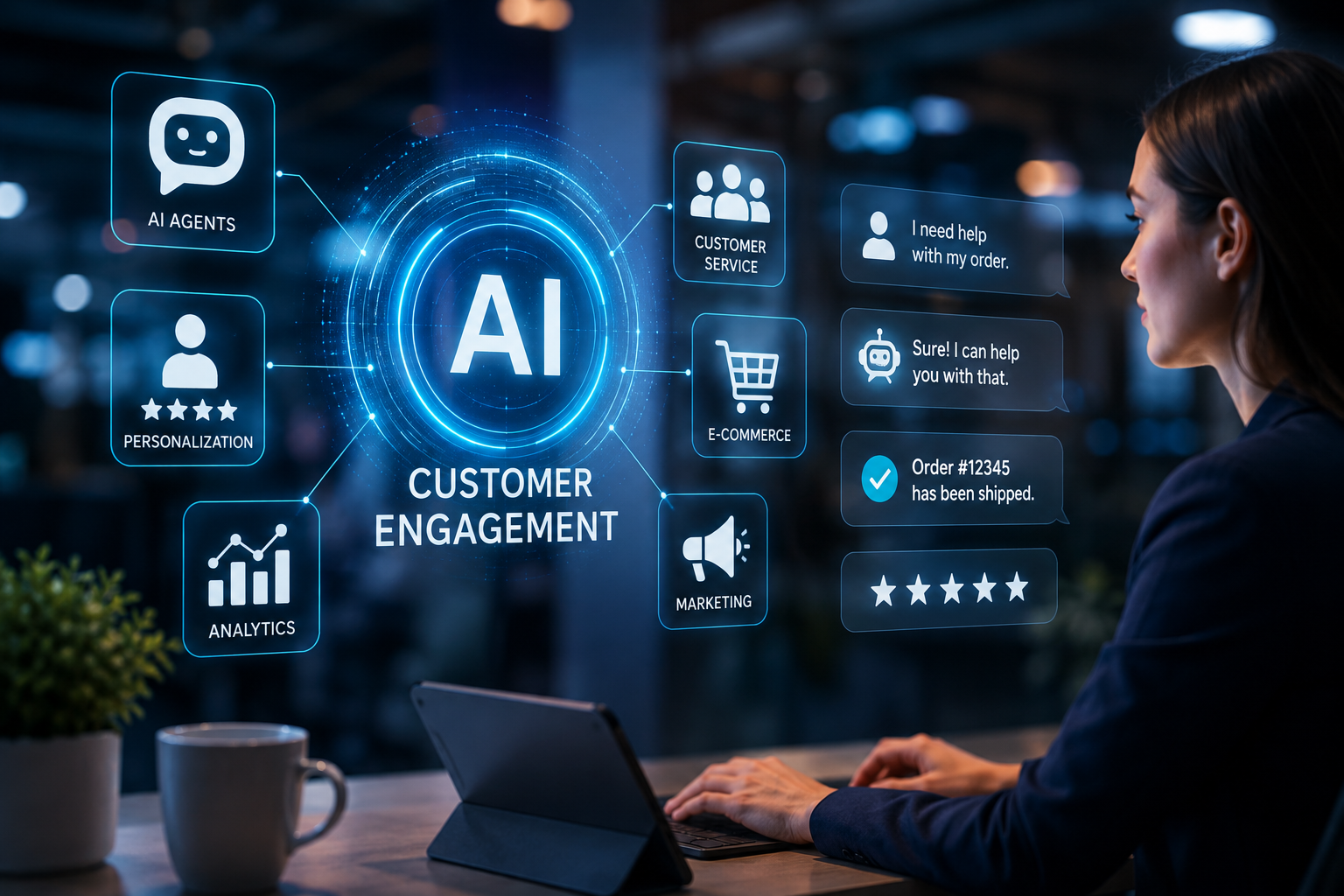
Enterprise artificial intelligence is moving into a new phase. Instead of treating AI as an experimental technology or a productivity tool for individual employees, businesses are increasingly investing in AI as part of their core customer engagement strategy.
The shift is particularly visible in customer service, marketing, sales, contact centers, personalization, and digital commerce. Companies are investing in AI agents that can understand customer questions, access business information, recommend next steps, automate workflows, and in some cases resolve customer issues without human intervention.
Recent industry developments show how quickly this market is changing. Salesforce reported that adoption of AI agents among customer service organizations increased from 39% in 2025 to 66% in 2026. Its research also found that 70% of organizations using AI agents reported measurable value within 60 days.
At the same time, Adobe’s 2026 customer engagement research found that 56% of organizations identified delivering more personalized customer experiences as a top AI investment goal over the following 18 months.
These developments point toward an important industry move: enterprise AI investments are shifting from isolated automation projects toward complete customer engagement ecosystems.

Enterprise AI Is Moving From Experimentation to Execution
For several years, enterprises experimented with generative AI through chatbots, content generation tools, employee assistants, and basic automation. Many of these initiatives remained disconnected from the systems that actually run customer relationships.
That is changing.
Businesses are now looking at AI through a broader business lens. Instead of asking, “Where can we use AI?”, companies are increasingly asking, “Which customer outcomes can AI improve?”
This difference is significant.
Modern enterprise AI systems can potentially connect customer data, CRM records, product information, knowledge bases, marketing platforms, service systems, and business workflows.
The result is an AI-powered customer engagement model where the technology does more than generate a response. It can understand context, determine an appropriate action, complete a workflow, and escalate the interaction when human judgment is required.
Microsoft, for example, has been expanding AI capabilities across Dynamics 365 Customer Service and Microsoft 365. Its 2026 Service Agent release enables customer service employees to investigate issues, navigate processes, and complete tasks within conversational experiences.
This represents a broader industry trend: AI is becoming embedded inside customer engagement infrastructure rather than operating as a separate tool.
AI Agents Are Becoming the New Customer Engagement Layer
One of the biggest developments in enterprise AI is the rise of AI agents.
Traditional chatbots typically follow predefined rules. A customer asks a question, the system searches for a matching response, and the conversation follows a relatively fixed path.
AI agents are designed to operate differently.
They can understand natural language, retrieve information, reason about a request, use connected tools, and execute defined actions.
For customer engagement, this means an AI agent could potentially:
- Answer product questions
- Check an order status
- Schedule an appointment
- Process certain service requests
- Recommend products or services
- Retrieve account information
- Create or update support cases
- Qualify leads
- Route complex issues to employees
- Follow up with customers
- Personalize recommendations
- Support sales representatives
Research from CB Insights identifies customer service as one of the leading areas for AI agent adoption and highlights multimodal agents that combine voice, text, images, and documents as an important direction for 2026.
This is especially important because customer engagement is no longer limited to websites and email. Customers interact with companies through messaging apps, mobile applications, social platforms, voice channels, websites, and physical locations.
AI agents could become the connective layer between these channels.

Industry Move: Salesforce Expands Its AI Customer Service Strategy
One of the clearest examples of this industry movement comes from Salesforce.
In June 2026, Salesforce announced a definitive agreement to acquire Fin, formerly Intercom, for approximately $3.6 billion. Salesforce said Fin’s AI agent technology can resolve customer queries across channels including live chat, email, WhatsApp, SMS, phone, and Slack.
The deal illustrates how strategic customer engagement has become in the AI market.
Salesforce also reported that Agentforce had reached $1.2 billion in annual recurring revenue in its fiscal first quarter of 2027, representing 205% year-over-year growth.
The broader lesson is important for enterprises.
AI customer service is increasingly being viewed as a strategic platform rather than an add-on feature.
Companies are looking for technology that can connect:
Customer data + AI agents + workflows + CRM + human employees + business outcomes
This could fundamentally change how businesses design customer service organizations.
Personalization Is Becoming a Major AI Investment Priority
Customer expectations are also pushing companies toward AI-powered personalization.
Customers increasingly expect companies to understand their previous interactions, preferences, behavior, and current needs.
However, traditional personalization systems often depend on predefined customer segments and historical rules.
AI can potentially make personalization more dynamic.
Instead of placing customers into broad groups such as “high-value customer” or “frequent buyer,” AI systems can analyze multiple signals and generate context-specific recommendations.
Adobe’s 2026 customer engagement research found that 56% of organizations identify more personalized customer experiences as a top goal for AI investments. Another 46% prioritize improving customer satisfaction, loyalty, and engagement.
This means AI investment is increasingly connected to the entire customer journey.
For example, an AI system could recognize that a customer:
- Visited a product page.
- Compared two products.
- Downloaded a buying guide.
- Contacted support.
- Returned to the website.
- Started a purchase.
- Abandoned the transaction.
Rather than treating each interaction separately, an AI-powered engagement platform could potentially understand the complete journey.
That creates opportunities for more relevant marketing, sales, and service interactions.

Unified Customer Data Will Determine AI Success
There is, however, a major problem facing enterprise AI adoption: data fragmentation.
AI cannot create high-quality customer experiences from incomplete or unreliable information.
Customer information is often spread across:
- CRM platforms
- Marketing automation systems
- Customer service platforms
- Ecommerce systems
- Data warehouses
- Contact center applications
- Email platforms
- Mobile applications
- Analytics tools
When these systems are disconnected, AI may not have enough context to provide an accurate response.
Salesforce’s 2026 India marketing research found that 81% of marketers in India have adopted AI, while 86% said they would trust AI to respond to customers to help scale engagement. However, disjointed or irrelevant data remains a major obstacle.
This creates a fundamental rule for enterprise AI:
Better AI requires better customer data.
Companies that invest heavily in AI without improving data quality, integration, governance, and accessibility may struggle to generate meaningful customer engagement results.
India Is Becoming an Important Market for AI-Powered Engagement
India provides a strong example of how enterprise AI is changing customer service.
Microsoft’s customer story on Air India describes an AI-powered customer service system handling approximately 40,000 customer queries per day across more than 1,300 different types of questions.
This demonstrates how AI can address the scale challenges faced by large customer-facing organizations.
Indian enterprises operate in an environment characterized by:
- Large customer volumes
- Multiple languages
- Mobile-first consumers
- High digital adoption
- Price-sensitive markets
- 24/7 service expectations
- Increasing demand for personalized experiences
AI can potentially help companies scale customer engagement without requiring every interaction to be handled manually.
Salesforce’s India research also indicates that Indian service leaders increasingly view AI as a major opportunity to reinvent customer service.
This makes India an important market to watch as enterprise AI investment moves from experimentation toward operational deployment.
The Rise of AI-Powered Omnichannel Engagement
Another major change is the movement from individual AI tools toward omnichannel AI.
Customers do not think in terms of company departments.
A customer might begin with a Google search, continue through a website, ask a question through WhatsApp, speak with a contact center representative, and later receive an email.
Historically, these interactions could exist in separate systems.
AI investments are increasingly focused on connecting them.
Microsoft’s Copilot Studio documentation describes customer-facing agents that can interact with customers using generative AI and hand conversations to existing customer engagement platforms when human support is needed.
This creates a hybrid engagement model:
AI handles routine interactions → AI gathers context → Human handles complex decisions → AI supports follow-up
The objective is not necessarily to eliminate human interaction.
Instead, enterprises can use AI to make human interaction more informed and efficient.
AI Is Changing the Role of Customer Service Employees
Enterprise AI investments will also change customer service jobs.
The future customer service representative may spend less time answering repetitive questions and more time handling complex situations.
AI can potentially handle:
- Information retrieval
- Case summaries
- Routine questions
- Basic troubleshooting
- Customer history analysis
- Call transcription
- Knowledge searches
- Follow-up reminders
Employees can then focus on:
- Complex problem solving
- Relationship management
- Escalations
- Negotiation
- Empathy
- Strategic customer support
This creates an important distinction between AI replacing customer service and AI augmenting customer service.
The strongest enterprise models are likely to combine both.
Salesforce’s research found that customer satisfaction was the most improved KPI reported by organizations after implementing AI agents, ahead of several operational metrics.
That suggests the value of AI may ultimately be measured by customer outcomes, not simply automation volume.

AI Investment Is Also Creating New Security Requirements
More powerful AI creates more powerful risks.
When AI agents receive access to customer records, CRM platforms, internal applications, or financial systems, organizations must carefully control what those agents are allowed to do.
Security is therefore becoming an essential part of customer engagement AI.
Recent enterprise security developments demonstrate this concern. Reuters reported in August 2026 that Obsidian Security raised $85 million at a $1.1 billion valuation as businesses increasingly seek to secure AI agents accessing sensitive enterprise data.
Enterprises should consider:
- Identity management
- Access controls
- Data encryption
- Human approval requirements
- AI monitoring
- Audit trails
- Prompt injection protection
- Data privacy
- Model governance
- Regulatory compliance
AI should not automatically receive unrestricted access simply because it can technically connect to a system.
The future of enterprise AI will depend not only on intelligence but also on governance.
Adobe Is Building AI Around Customer Experience Orchestration
Adobe is another major example of the industry shift.
In June 2026, Adobe announced general availability of CX Enterprise Coworker, an agentic AI solution designed to coordinate workflows across analytics, content creation, customer journey orchestration, and other enterprise functions. Adobe said its enterprise applications are used by more than 20,000 global brands.
Earlier in 2026, Adobe also introduced Adobe CX Enterprise, positioning agentic AI around the entire customer lifecycle, from acquiring prospects to driving conversion and loyalty.
This reflects another major development.
AI is moving beyond customer service into customer experience orchestration.
That means marketing, advertising, content, analytics, sales, commerce, and service can increasingly operate as interconnected parts of one AI-supported customer journey.
What Enterprise AI Investments Mean for B2B Companies
The impact is not limited to consumer brands.
B2B companies are also positioned to benefit from AI-powered customer engagement.
AI can support B2B organizations across the entire revenue cycle.
Marketing
AI can analyze buyer behavior, personalize campaigns, generate content variations, and identify engagement patterns.
Lead Generation
AI can help prioritize accounts and prospects based on fit, intent, engagement, and historical behavior.
Sales
AI can summarize account activity, recommend next actions, prepare sales representatives for meetings, and identify opportunities.
Customer Success
AI can monitor customer health signals, identify potential churn risks, and automate routine communications.
Customer Support
AI agents can answer technical questions, retrieve documentation, and resolve common support issues.
Account-Based Marketing
AI can help coordinate personalized engagement across multiple stakeholders within a target account.
For B2B organizations, the biggest opportunity may come from connecting these activities.
Instead of treating marketing, sales, and customer service as separate AI projects, companies can build a connected AI engagement ecosystem.
The Future Will Be Outcome-Based
Enterprise AI investment is entering an accountability phase.
Early AI projects were often measured by:
- Number of users
- Number of prompts
- Number of AI-generated outputs
- Number of automated tasks
Those metrics are useful, but they do not necessarily demonstrate business value.
Future AI investments will increasingly be measured against outcomes such as:
- Customer satisfaction
- Customer retention
- Revenue per customer
- Conversion rate
- Cost per interaction
- Resolution rate
- Customer lifetime value
- Sales productivity
- Response time
- First-contact resolution
Adobe’s research highlights the growing emphasis on personalization and engagement, while Salesforce reports measurable value from AI agents across customer service organizations.
This means enterprise leaders need to connect AI investments directly to measurable business objectives.
What Comes Next for Customer Engagement?
The next stage of enterprise AI is likely to involve increasingly autonomous customer engagement.
Instead of waiting for customers to initiate every interaction, AI systems could identify customer needs and recommend proactive actions.
For example:
Traditional model:
Customer has a problem → Customer contacts company → Agent investigates → Problem is resolved.
AI-powered model:
AI detects a potential issue → AI analyzes customer context → AI recommends or initiates an appropriate action → Customer receives proactive assistance → Human takes over when necessary.
This model could transform customer experience from reactive service into proactive engagement.
However, successful implementation will require more than purchasing an AI platform.
Companies will need strong data foundations, clear governance, employee training, workflow redesign, security controls, and continuous measurement.
Key Takeaways for Enterprise Leaders
The current wave of enterprise AI investment provides several important lessons.
1. AI is becoming a core customer engagement technology.
Organizations are moving beyond experimentation and integrating AI into service, marketing, sales, and customer experience platforms.
2. AI agents are changing customer service.
The evolution from chatbots to autonomous agents could significantly change how businesses manage customer interactions.
3. Personalization is a major investment priority.
Organizations increasingly want AI to deliver experiences that respond to individual customer needs in real time.
4. Data quality is critical.
Disconnected customer information can limit the effectiveness of even sophisticated AI systems.
5. Human-AI collaboration will remain important.
AI can automate routine interactions while employees focus on complex and relationship-driven situations.
6. Security and governance cannot be ignored.
AI agents with access to enterprise systems require strong permissions, monitoring, and accountability.
7. ROI will become more important.
Enterprises will increasingly evaluate AI based on measurable customer and business outcomes rather than adoption alone.
Conclusion
Enterprise AI investments are changing the definition of customer engagement.
The biggest shift is not simply that businesses are using AI to answer customer questions. The more important development is that AI is becoming embedded throughout the customer journey.
From marketing personalization and lead generation to customer service, sales assistance, commerce, and customer success, AI agents are increasingly connected to the systems that manage customer relationships.
Recent moves by Salesforce, Microsoft, Adobe, and other enterprise technology companies show that the market is moving toward integrated, agentic customer engagement platforms.
For businesses, the competitive advantage will not necessarily come from adopting the most advanced AI model.
It will come from combining high-quality data, intelligent AI agents, connected workflows, strong governance, and human expertise to create better customer outcomes.
The future of customer engagement is therefore unlikely to be simply human versus AI.
It will be human expertise amplified by AI, operating across a connected customer experience ecosystem.
FAQ
Enterprise AI investments are strategic investments by organizations in artificial intelligence technologies that improve business operations, customer service, marketing, sales, analytics, and customer experience.
AI is changing customer engagement by enabling faster responses, personalized experiences, automated customer service, proactive support, intelligent recommendations, and connected customer journeys.
AI agents are software systems capable of understanding requests, accessing relevant information, using connected tools, and completing specific tasks with limited human intervention.
Customer data provides the context AI needs to understand customer behavior and deliver relevant experiences. High-quality and unified data is essential for reliable AI-powered customer engagement.
AI is more likely to transform customer service roles than completely replace human employees. AI can handle repetitive tasks while employees focus on complex issues, relationship management, empathy, and problem solving.
AI can connect marketing, sales, and service data to provide more personalized experiences, identify buying signals, prioritize opportunities, automate workflows, and support revenue teams throughout the customer journey.
The future is likely to involve AI agents working across customer service, marketing, sales, commerce, and customer success while collaborating with human employees and using unified customer data.