
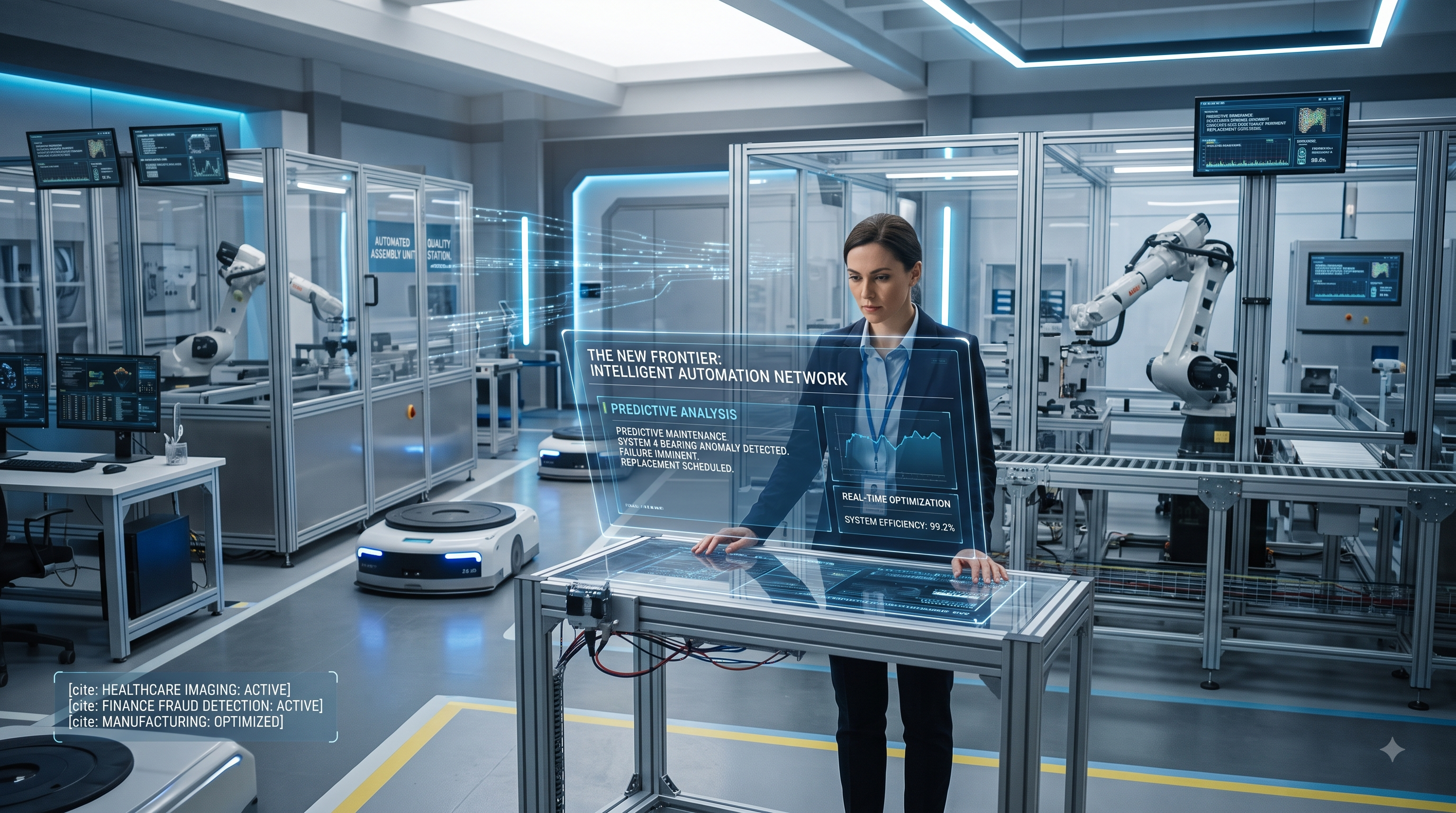

We are living in an era defined by rapid, unprecedented technological transformation. For decades, the concepts of Artificial Intelligence (AI) and automation existed primarily within the realms of science fiction and academic research laboratories. Today, they are the foundational pillars of the modern global economy. From the way we work and communicate to how we manufacture goods, diagnose diseases, and manage our personal lives, the convergence of AI and automation is fundamentally rewiring the architecture of human society.
To truly understand the magnitude of this shift, we must look beyond the buzzwords and examine the intricate ways these technologies are being deployed across various sectors. We must explore not only the immense benefits and efficiencies they offer but also the complex ethical, economic, and social challenges they present. This deep dive aims to demystify the synergy between AI and automation, charting their trajectory from basic rule-based systems to the highly sophisticated, learning, and adaptive algorithms that define our present and future.
Demystifying the Duo: The Distinction Between AI and Automation
A common misconception in mainstream discourse is the interchangeable use of the terms “automation” and “AI.” While they are highly complementary and frequently overlap in modern applications, they represent fundamentally different paradigms of technology.
Automation, at its core, is the process of setting up a system to follow a predefined set of rules or instructions to complete a task with minimal human intervention. It is the digitization of the assembly line. Traditional automation is highly effective for repetitive, predictable, and rule-based tasks. Think of automated email marketing workflows, robotic arms welding car parts on an assembly line, or software that automatically categorizes financial transactions based on merchant codes. Automation asks, “What are the steps?” and then executes them relentlessly. It does not think; it merely performs.
Artificial Intelligence, on the other hand, represents a monumental leap forward. AI is designed to simulate human cognitive functions. It involves systems that can learn from data, identify complex patterns, adapt to new and unforeseen information, and make informed decisions or predictions. Machine Learning (ML) and Deep Learning, subsets of AI, enable software to improve its performance over time without being explicitly programmed for every possible scenario. AI asks, “What is the desired outcome, and what can I learn from this data to achieve it?”
“While automation provides the muscle for executing tasks at scale, Artificial Intelligence provides the brain, enabling systems to navigate complexity, adapt to change, and unlock entirely new realms of possibility.”
The true magic happens when these two forces combine to create Intelligent Automation (IA). By injecting cognitive capabilities into automated workflows, organizations can automate not just routine manual tasks, but complex processes that require judgment, interpretation, and analysis. An example is a system that not only automatically routes customer service emails (automation) but also reads the email, understands the customer’s sentiment, and drafts a highly personalized, accurate response (AI).
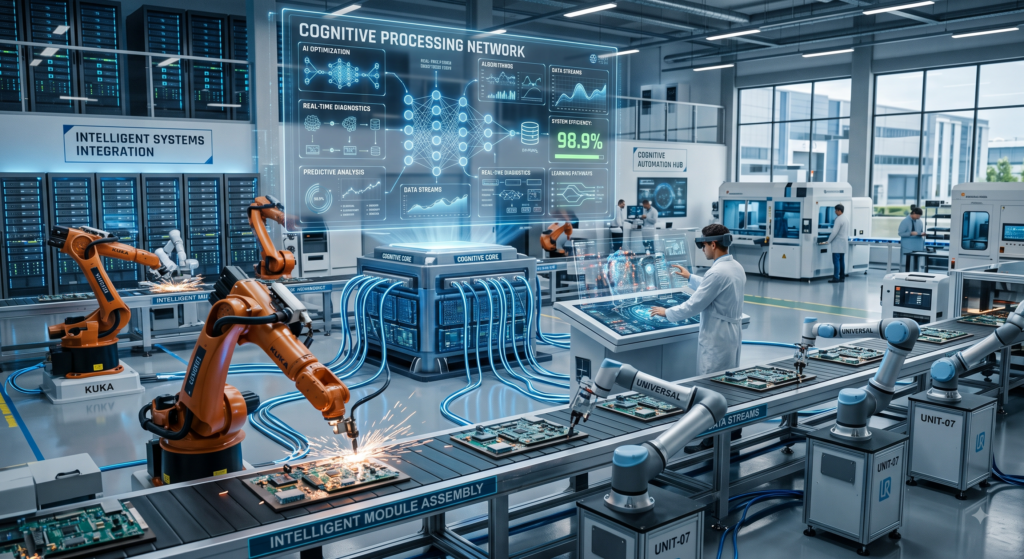
Intelligent systems are blending physical automation with cognitive processing power.
The Evolution: From Assembly Lines to Neural Networks
To appreciate our current position, we must acknowledge the journey. The first wave of automation was mechanical, driven by the Industrial Revolution. The invention of the steam engine and mechanized looms replaced manual human and animal labor with tireless machines. This physical automation reshaped global economies and urbanization.
The second wave arrived with the advent of computing and the digital revolution. Business Process Automation (BPA) and Robotic Process Automation (RPA) emerged as software “bots” that could navigate digital interfaces, move files, extract data, and fill out forms. This was the era of the “swivel chair” automation, freeing human workers from mundane data entry and administrative drudgery.
We are now deep into the third wave: the Cognitive Era. Fuelled by an explosion of digital data (Big Data), massive advancements in computational power (GPUs and specialized AI chips), and breakthroughs in neural network architectures (like the Transformer models that power modern Large Language Models), AI has moved from a theoretical discipline to a practical powerhouse. Generative AI, capable of creating original text, code, images, and audio, has dominated the conversation, proving that AI is no longer confined to analytical tasks but is encroaching on the domain of human creativity.
INTELLIGENT AUTOMATION NETWORK
Industry Transformations: Where the Magic Happens
The impact of AI and automation is not a distant promise; it is a present reality unfolding across every major industry. Let us examine a few key sectors experiencing revolutionary shifts.
Healthcare: Precision, Speed, and Lifesaving Insights
In healthcare, the stakes are literally life and death. AI algorithms are currently analyzing medical imaging—such as X-rays, MRIs, and CT scans—with a level of accuracy and speed that often surpasses human radiologists. These systems can detect the earliest, most subtle signs of tumors, fractures, or neurological anomalies that might be missed by the naked eye. Beyond diagnostics, automation is streamlining hospital administration, managing patient scheduling, and optimizing supply chains for critical medications. Furthermore, AI is accelerating drug discovery, simulating millions of molecular combinations to identify viable candidates for new treatments in a fraction of the time it took traditional pharmacological research.
Finance: Security, Speed, and Personalization
The financial sector has always been heavily reliant on data, making it a prime candidate for AI integration. Algorithmic trading systems now execute millions of trades per second, leveraging AI to analyze market sentiments, news feeds, and historical data to capitalize on micro-fluctuations in asset prices. Perhaps more importantly for the average consumer, AI acts as a silent guardian against fraud. Advanced machine learning models continuously monitor transaction patterns in real-time, instantly flagging and halting anomalous behavior that suggests credit card theft or account takeover. Automation handles the massive volume of compliance reporting and KYC (Know Your Customer) processes, dramatically reducing overhead costs.
Manufacturing and Supply Chain: The Rise of the Smart Factory
Manufacturing is the traditional home of automation, but AI is turning factories “smart.” Predictive maintenance is a game-changer; AI models analyze sensor data from industrial machinery (vibration, temperature, acoustic emissions) to predict exactly when a part will fail. This allows for maintenance to be scheduled proactively, preventing catastrophic breakdowns and costly unplanned downtime. In the supply chain, AI optimizes logistics, calculating the most efficient delivery routes, predicting demand spikes based on weather patterns and social trends, and automating inventory management with autonomous robots navigating massive warehouses.
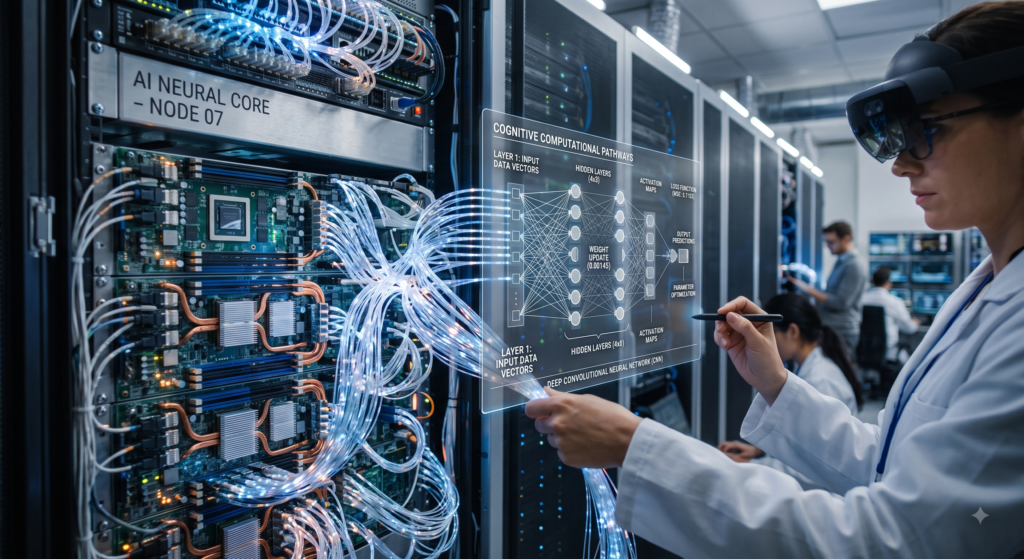
The sophisticated computational pathways powering modern machine learning algorithms.
The Economic Impact and The “Future of Work” Debate
No discussion of AI and automation is complete without addressing the profound economic implications, specifically the future of employment. The narrative often vacillates between utopian visions of a leisure society where machines do all the work and dystopian fears of mass technological unemployment. The reality is far more nuanced.
It is undeniable that automation will displace certain jobs, particularly those heavily reliant on routine, repetitive physical or cognitive tasks. Data entry clerks, basic customer service representatives, and assembly line workers face significant disruption. However, history demonstrates that technological revolutions ultimately create more jobs than they destroy; they simply change the nature of the work.
AI is generating entirely new categories of employment. We are seeing a massive demand for machine learning engineers, data scientists, AI ethicists, prompt engineers, and automation consultants. Furthermore, AI acts as an augmenting force for many professions. A doctor is not replaced by an AI diagnostic tool; rather, a doctor using AI will replace a doctor who does not. A lawyer augmented by AI can review thousands of legal documents for precedent in hours instead of weeks, allowing them to focus on high-level strategy and client counseling.
MACHINE LEARNING ALGORITHM PATHWAYS
The critical challenge for society is managing the transition. The skills gap is widening. Educational institutions and corporate training programs must urgently pivot to focus on uniquely human skills that AI cannot easily replicate: complex problem solving, emotional intelligence, critical thinking, creativity, and adaptability. Massive investments in reskilling and upskilling the current workforce are not just ethical imperatives; they are economic necessities to ensure widespread prosperity in the AI era.
Navigating the Challenges: Ethics, Bias, and Security
As we hand over more decision-making power to algorithms, we must confront severe ethical and security challenges. The “Black Box” problem is a major concern: many advanced deep learning models arrive at conclusions through processes so complex that even their creators cannot fully explain how a specific decision was reached. This lack of transparency is unacceptable in high-stakes areas like criminal justice (e.g., algorithmic sentencing recommendations) or lending (e.g., automated mortgage approvals).
Furthermore, AI systems are only as objective as the data on which they are trained. If historical training data contains human biases—whether regarding race, gender, or socioeconomic status—the AI will learn, amplify, and automate those biases. We have already seen instances of biased AI in recruitment software prioritizing certain demographics, or facial recognition systems failing disproportionately for people of color. Establishing robust frameworks for AI fairness, continuous auditing of algorithms, and ensuring diverse representation in training data are paramount.
Security is another critical frontier. As our physical and digital infrastructure becomes deeply intertwined with AI, the surface area for cyberattacks expands exponentially. Hackers are already using AI to generate sophisticated phishing campaigns, automate vulnerability discovery, and create deepfakes for social engineering. Conversely, cybersecurity defense mechanisms must leverage AI to detect and neutralize these rapid, automated threats in real-time. It is an ongoing arms race between malicious actors and security professionals, both armed with artificial intelligence.
Conclusion: Embracing the Augmented Future
We are standing at the precipice of a new epoch. AI and automation are not transient trends; they are the fundamental building blocks of the 21st-century economy. The journey ahead is complex, requiring us to navigate turbulent economic shifts, address profound ethical dilemmas, and continuously adapt our skillsets.
However, the potential for positive impact is staggering. We have the opportunity to cure intractable diseases, solve complex logistical and environmental challenges, democratize access to education and legal services, and free human beings from drudgery to pursue higher creative and intellectual endeavors. By approaching AI and automation not with fear, but with a commitment to responsible development, ethical deployment, and inclusive economic policies, we can forge a future where technology amplifies the very best of human potential.