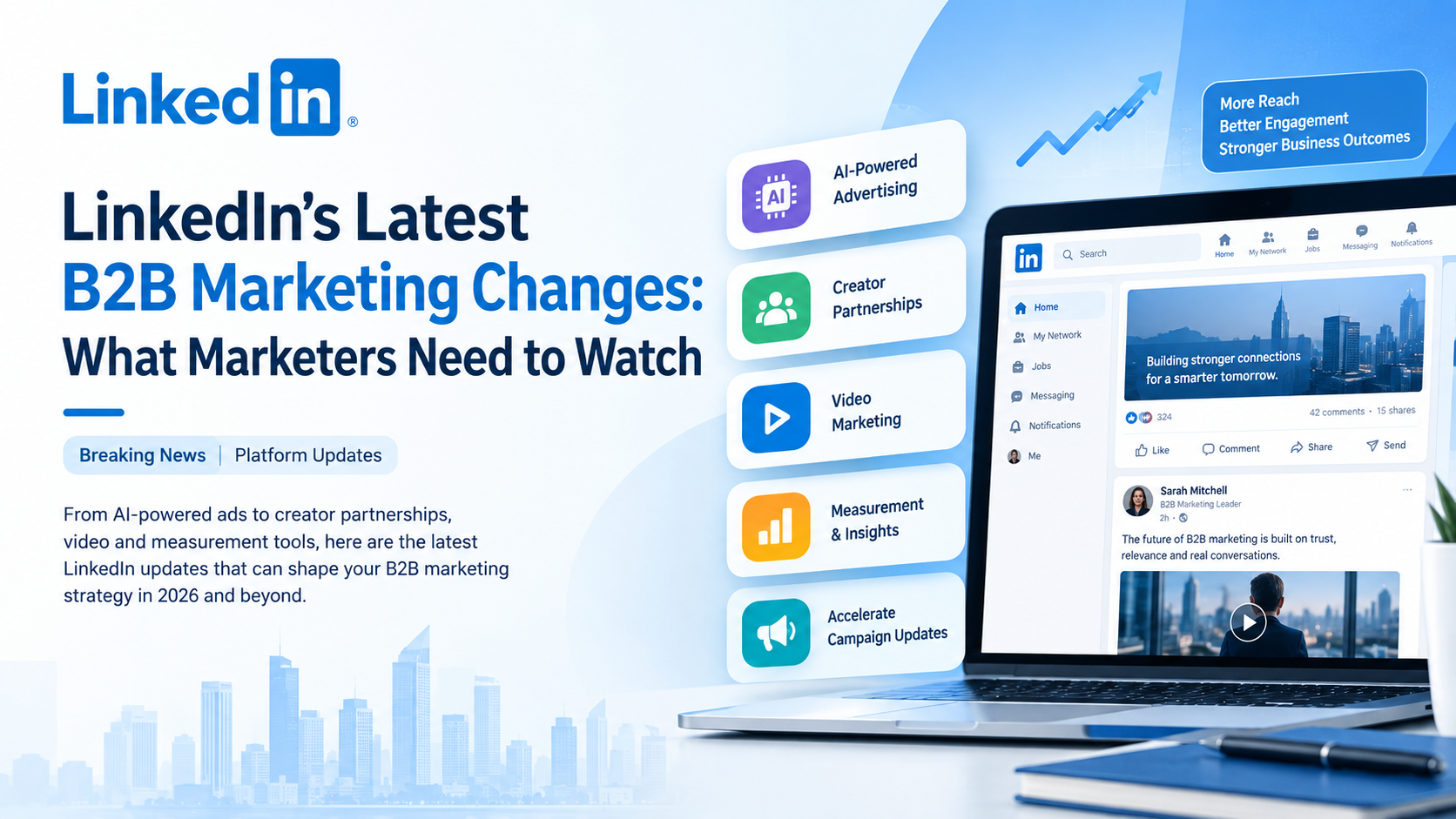

LinkedIn continues to evolve from a professional networking platform into a major B2B marketing, advertising, content, and demand generation ecosystem. During 2026, the platform introduced and expanded several changes that are relevant to B2B marketers, including AI-powered advertising capabilities, creator partnerships, video advertising, measurement tools, collaborative content, and changes to its Accelerate campaign experience.
For B2B marketers, these updates are more than product announcements. They indicate where LinkedIn is directing its marketing ecosystem: toward stronger content quality, trusted voices, full-funnel measurement, video, AI-assisted campaign management, and business outcomes.
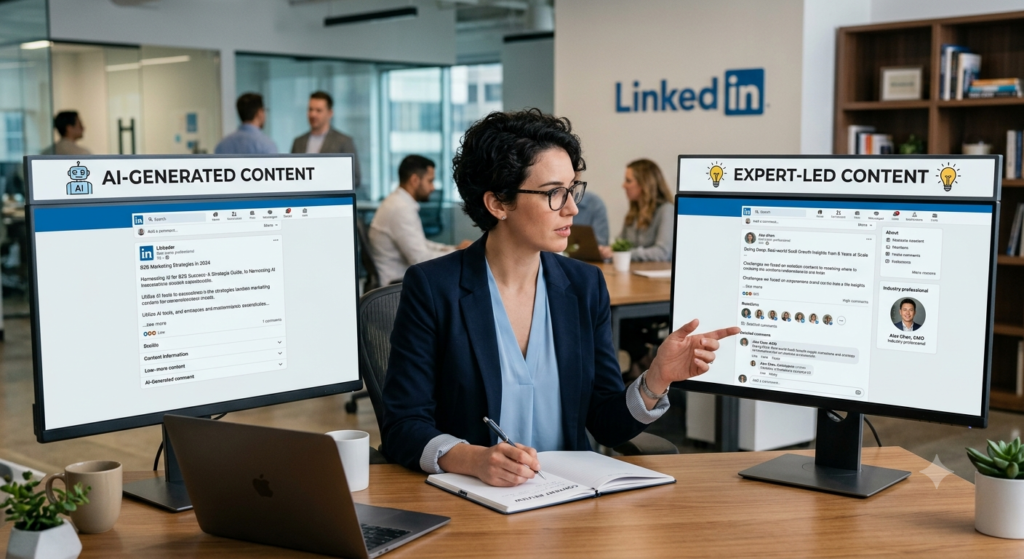
LinkedIn has also taken steps to address the growing volume of AI-generated content. In September 2026, LinkedIn reported that more than one million members had used its “Seems like AI slop” feedback option within the first two weeks of launch. The company said that views of content classified as AI slop had decreased by 40% following a combination of automation defenses, improved classifiers, profile verification investments, and AI tools focused on proofreading rather than rewriting.
For B2B marketing teams, these developments make it important to reassess how LinkedIn content, paid campaigns, thought leadership, creators, and measurement are being used.
LinkedIn Is Putting Greater Emphasis on Content Quality
One of the most important platform developments for marketers is LinkedIn’s increased focus on content quality.
AI has made it easier for businesses to produce large volumes of posts, articles, comments, and promotional material. However, greater publishing volume does not automatically create greater value for a professional audience.
LinkedIn’s September 2026 update about AI-generated content provides a clear indication that the platform is actively working to reduce the visibility of content it considers low quality or overly automated. LinkedIn said its combination of automation defenses, classifiers, verification investments, and other measures had reduced views of AI-slop-classified content by 40%.
What this means for B2B marketers
B2B companies should focus less on producing large quantities of generic AI-generated posts and more on developing content that demonstrates:
- Original industry knowledge
- First-hand experience
- Specific examples
- Expert commentary
- Useful data
- Clear opinions supported by evidence
- Real customer or campaign insights
- Human perspectives
AI can still be useful for research, outlining, editing, summarization, and content production. However, the final content should provide information that is genuinely useful to the audience.
Collaborative Posts Expand B2B Content Opportunities
LinkedIn introduced Collaborative Posts in 2026 and began expanding the feature globally to professionals and brands. Company Pages can use Collaborative Posts to co-author content with customers, partners, and creators.
This creates another potential avenue for B2B companies to distribute content through multiple professional networks.
Instead of publishing a case study only from a company Page, for example, a business could collaborate with a customer, technology partner, industry expert, or creator.
This approach can help transform a company announcement into a broader conversation.
Potential B2B use cases
Collaborative Posts could be used for:
- Customer success stories
- Industry research
- Product discussions
- Expert interviews
- Partner announcements
- Webinar promotions
- Event content
- Industry predictions
- Research reports
- Educational content
The key consideration is relevance. A collaboration should add credibility, expertise, or another useful perspective rather than simply combine audiences.
For B2B marketers, this also reinforces the growing importance of employee advocacy and third-party voices.
Creator Marketing Is Becoming More Important in B2B
LinkedIn has expanded its creator-focused marketing ecosystem during 2026.
In June, LinkedIn announced Creator Marketplace and BrandWorks as tools designed to help brands work with creators and develop custom activations. LinkedIn stated that 77% of B2B marketers surveyed said buyers need to trust and know a brand before they are willing to engage.
LinkedIn also expanded creator sponsorship and video opportunities during March 2026. The company introduced Premium Creator Sponsorships with Top Voices 360 and expanded BrandLink capabilities. It also announced additional publisher inventory and more flexible Connected TV buying.
This reflects a broader change in B2B content strategy.
The traditional model was largely:
Company → Content → Buyer
The emerging model increasingly includes:
Company → Experts → Creators → Professional Communities → Buyer
For B2B organizations, creators do not necessarily need to be celebrities. A creator could be an industry analyst, consultant, practitioner, executive, engineer, salesperson, researcher, or subject matter expert with a relevant professional audience.
Why this matters
B2B purchases often involve multiple stakeholders. Different people may consume different types of information before engaging with a vendor.
An expert-led video may create awareness.
A technical post may support consideration.
A customer story may provide validation.
A product demonstration may answer practical questions.
Creator and expert content can therefore support multiple stages of the buyer journey.
LinkedIn’s B2B creators and video update
Video Is Becoming a Larger Part of LinkedIn’s B2B Marketing Strategy
Video continues to receive significant attention from LinkedIn’s marketing organization.
LinkedIn’s 2026 updates included expanded BrandLink capabilities, premium creator sponsorships, publisher video inventory, and additional Connected TV buying options.
LinkedIn reported that 81% of B2B CMOs surveyed believed video accelerates sales cycles compared with other formats, while 79% agreed that video accelerates lead conversion. The research was conducted among 1,299 B2B marketers in the United States, United Kingdom, France, Germany, and India between January 14 and February 5, 2026. These figures are survey findings, not guarantees of campaign performance.
For marketers, this makes video worth considering across more than awareness campaigns.
B2B video formats to consider
B2B marketers can experiment with:
- Short expert videos
- Product demonstrations
- Customer interviews
- Executive commentary
- Industry trend videos
- Webinar clips
- Event highlights
- Research explainers
- Product comparison content
- Educational video series
The biggest opportunity may be making complex B2B topics easier to understand.
A 60-second explanation from a subject matter expert can sometimes communicate an idea more effectively than a long promotional post.
LinkedIn Is Moving Toward Full-Funnel Measurement
Another major development is LinkedIn’s increasing emphasis on measurement and business outcomes.
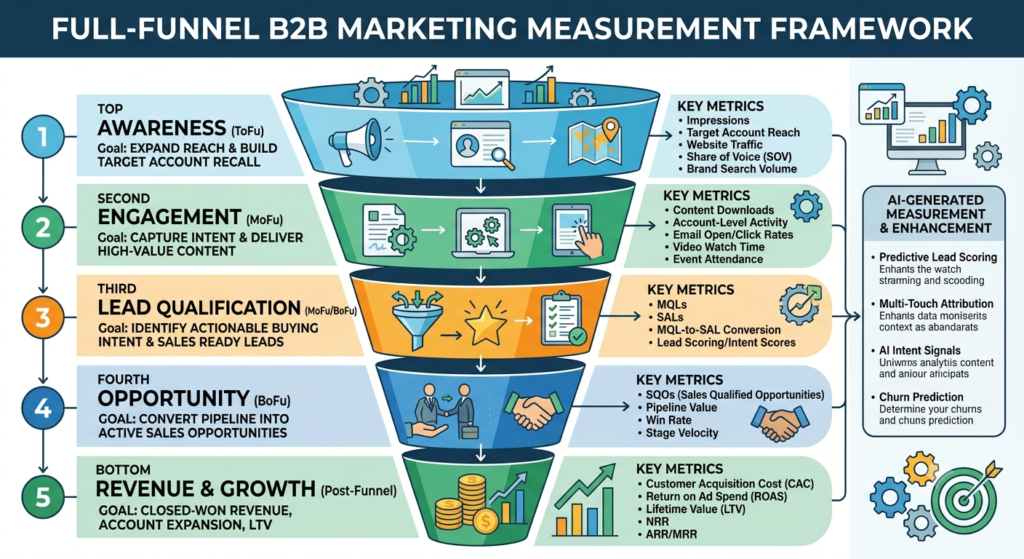
LinkedIn’s Marketing Solutions product updates now highlight Measurement Insights, which provides advertisers with a centralized view of full-funnel performance at the account level. LinkedIn has also introduced enhancements to Brand Lift Testing and improvements to conversion tracking through Google Tag Manager and Conversions API.
This is significant for B2B marketing teams because B2B campaigns often have long buying cycles.
A campaign may generate awareness months before an opportunity becomes visible in the CRM.
Looking only at clicks or immediate lead submissions can therefore provide an incomplete view of performance.
Metrics B2B marketers should connect
Instead of evaluating LinkedIn campaigns using only:
- Impressions
- Likes
- Clicks
- CTR
- Cost per click
Marketing teams can also examine:
- Qualified leads
- Target-account engagement
- Website conversions
- Opportunity creation
- Pipeline influence
- Account engagement
- Customer acquisition
- Revenue contribution
The goal is not to eliminate engagement metrics. Rather, engagement should be connected to the larger buyer journey.
LinkedIn Marketing Solutions Product Updates
LinkedIn’s Accelerate Campaign Changes Matter for Paid Marketers
One of the most important platform changes for LinkedIn advertisers in 2026 involves Accelerate campaigns.
LinkedIn announced that Accelerate campaigns as a standalone campaign type would no longer be available beginning August 4, 2026. LinkedIn stated that the core creation capabilities of Accelerate are being made available through Classic campaigns. Active Accelerate campaigns can continue running, but from January 5, 2027, advertisers will no longer be able to extend their run dates or add budget to those campaigns.
This change means advertisers should review existing campaign structures and understand how their current workflows translate into Classic campaigns.
What marketers should review
B2B advertising teams should check:
- Existing Accelerate campaigns
- Campaign objectives
- Audience signals
- Conversion tracking
- Budget structures
- Creative assets
- Optimization settings
- Reporting workflows
- Campaign timelines
LinkedIn’s documentation also explains that Accelerate uses signals such as company industry, job title, and other audience attributes to help optimize campaigns.
The broader direction is clear: AI-assisted campaign capabilities are not necessarily disappearing. Instead, LinkedIn is integrating core capabilities into its broader campaign infrastructure.
AI Is Becoming Part of the Advertising Workflow
AI is increasingly embedded into LinkedIn advertising.
LinkedIn’s Accelerate experience included AI-supported capabilities such as drafting ad text and helping select creative assets. LinkedIn’s documentation describes AI features for drafting introductory text and headlines and scoring or ranking available images.
At the same time, LinkedIn’s broader platform direction suggests that marketers should not confuse AI assistance with fully automated marketing strategy.
AI can help with execution.
Marketing teams still need to determine:
- Who the ideal customer is
- Which accounts matter
- What problem should be addressed
- Which message is credible
- What proof should be presented
- What conversion action makes sense
- How leads will be qualified
- How campaign performance connects to revenue
The strategic layer remains critical.
LinkedIn Is Also Investing in AI Search Visibility
LinkedIn’s marketing content in 2026 has also addressed AI search.
LinkedIn published guidance in August 2026 specifically about helping B2B marketers improve visibility in AI search. Its marketing blog described LinkedIn as the most-cited domain in AI-generated answers and provided recommendations for structuring LinkedIn content for AI discovery.
This creates an additional reason for B2B brands to treat LinkedIn content as an information asset rather than simply a social media post.
A strong LinkedIn post can potentially contribute to:
- Brand visibility
- Professional discovery
- Thought leadership
- Search visibility
- AI-generated answers
- Website traffic
- Buyer education
This makes content structure increasingly important.
B2B marketers should use clear headings, specific terminology, useful explanations, original insights, and factual supporting information.
LinkedIn’s Focus on Authenticity Could Change Content Strategy
LinkedIn has repeatedly highlighted authenticity and trusted voices throughout its 2026 marketing updates.
Its NewFronts 2026 recap emphasized a shift from attention metrics toward confidence, accountability, and measurable business impact. The company also highlighted creators, executives, employees, and partnerships as important ways for brands to create more authentic discovery experiences.
For B2B marketers, this means corporate content does not have to sound like corporate advertising.
A technical leader can explain a market development.
A sales leader can discuss a common buyer challenge.
A campaign manager can share an operational lesson.
A customer can describe a real implementation experience.
A founder or executive can explain why an industry change matters.
These approaches can make B2B marketing more informative and less promotional.
What B2B Marketers Should Watch Next
Based on LinkedIn’s 2026 product and marketing updates, there are several areas B2B marketers should continue monitoring.
1. AI-assisted campaign management
AI is becoming increasingly integrated into campaign creation, optimization, and creative development. Marketers should understand what is automated and where human oversight remains necessary.
2. Content quality signals
The platform’s focus on AI-generated content quality suggests that publishing large volumes of generic material may become less useful. Original expertise should remain central to content strategy.
3. Creator partnerships
Creator Marketplace, BrandWorks, Top Voices 360, and BrandLink indicate that creator-led B2B marketing is becoming a more established part of LinkedIn’s ecosystem.
4. Video and CTV
LinkedIn is expanding video opportunities both within LinkedIn and across premium publisher and connected TV environments.
5. Full-funnel measurement
Measurement Insights and related measurement improvements indicate that marketers are being encouraged to connect campaign activity with broader business outcomes.
6. AI search visibility
As buyers increasingly use AI-powered search and answer engines, LinkedIn content may become part of a broader B2B discovery strategy.
How B2B Marketing Teams Can Adapt
The best response to platform changes is not to rebuild the entire marketing strategy every time LinkedIn introduces a new feature.
Instead, teams can create a flexible system.
Start with a clearly defined ICP.
Then develop content around the problems, questions, and buying concerns of that audience.
Use subject matter experts to add credibility.
Test multiple content formats, including text, documents, images, and video.
Use paid promotion when content and audience fit justify it.
Connect conversion tracking with CRM data.
Review performance across the funnel rather than focusing exclusively on immediate engagement.
Finally, keep monitoring LinkedIn’s official product updates because features, availability, and campaign workflows can change.
LinkedIn Marketing Solutions Product Updates
Final Thoughts
LinkedIn’s latest B2B marketing changes point toward a platform that is becoming increasingly focused on quality, trusted voices, video, AI-assisted marketing, measurement, and business outcomes.
For B2B marketers, the important question is not simply which new LinkedIn feature to try next.
The bigger question is how each platform development fits into the buyer journey.
Collaborative Posts can support partnerships and shared expertise.
Creator tools can introduce trusted third-party voices.
Video can explain complex B2B topics and support buyer education.
Measurement Insights can help marketers understand performance across the funnel.
AI tools can accelerate campaign execution.
Content-quality initiatives can reinforce the importance of original expertise.
And changes to Accelerate campaigns demonstrate why marketing teams need to keep their campaign infrastructure current.
LinkedIn’s platform is continuing to evolve, and B2B marketing teams that regularly review these changes can make more informed decisions about content, advertising, demand generation, and measurement.
The platform update cycle is not slowing down. For marketers, staying current is becoming part of the job itself.
Frequently Asked Questions
Key developments in 2026 include Collaborative Posts, expanded creator marketing capabilities, video and CTV advertising developments, Measurement Insights, AI-assisted advertising tools, and changes to the Accelerate campaign experience.
LinkedIn announced that Accelerate campaigns as a standalone campaign type would no longer be available starting August 4, 2026. Its core creation capabilities are being incorporated into Classic campaigns. Existing Accelerate campaigns can continue serving, but advertisers cannot extend their run dates or add budget after January 5, 2027.
AI can support research, editing, drafting, and other marketing workflows. However, LinkedIn has increased its focus on content quality and reported reduced views for content classified as AI slop. B2B marketers should therefore prioritize original expertise, useful information, and human perspectives rather than relying on high-volume generic AI content.
LinkedIn has expanded creator sponsorships, BrandLink, publisher video opportunities, and CTV advertising options. The platform’s 2026 research also indicates that many surveyed B2B marketers view video as an important part of the buying journey.
In addition to impressions, clicks, and engagement, B2B marketers can track qualified leads, account engagement, conversions, opportunities, pipeline influence, and other business outcomes. LinkedIn’s Measurement Insights is designed to provide a centralized view of full-funnel performance at the account level.