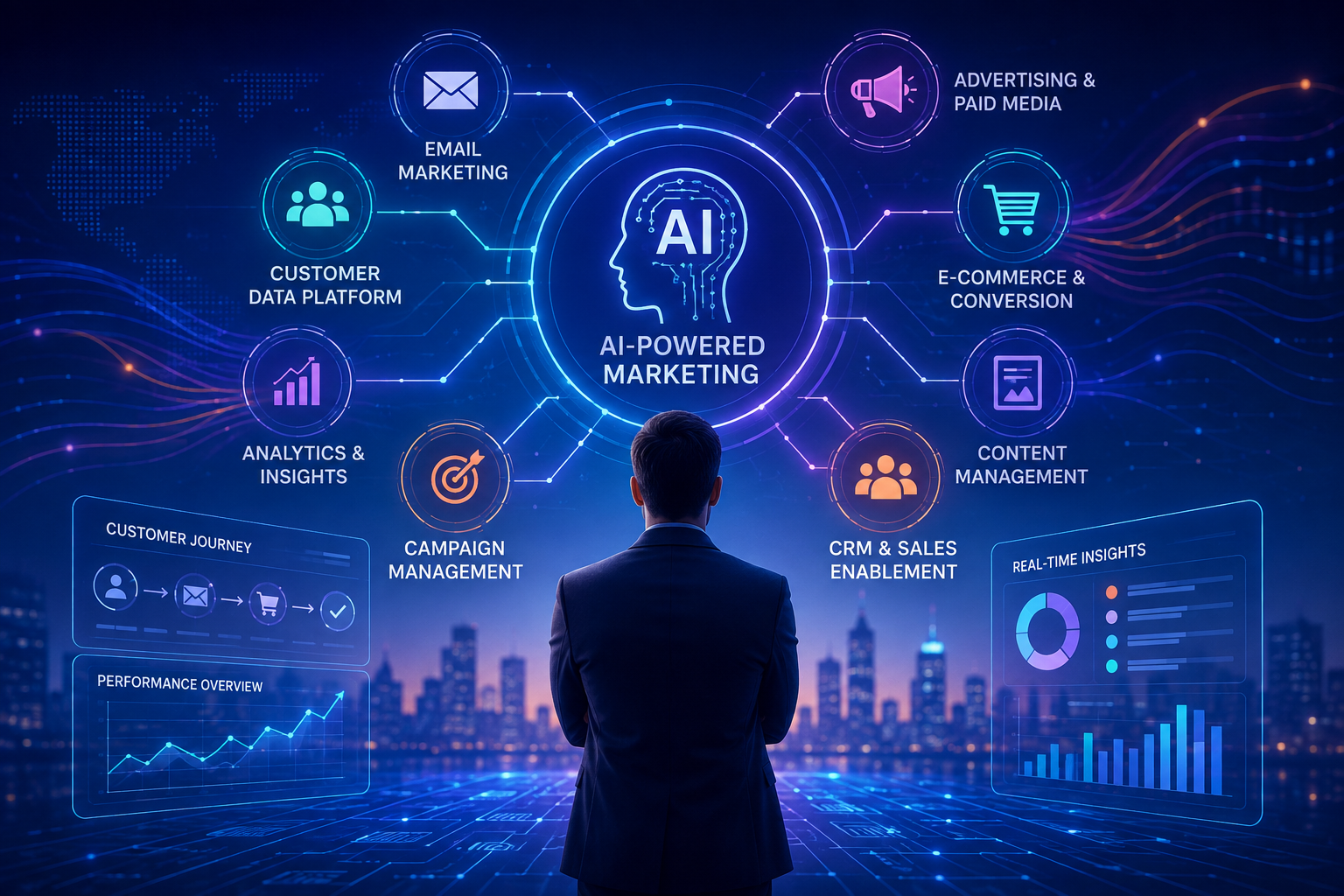
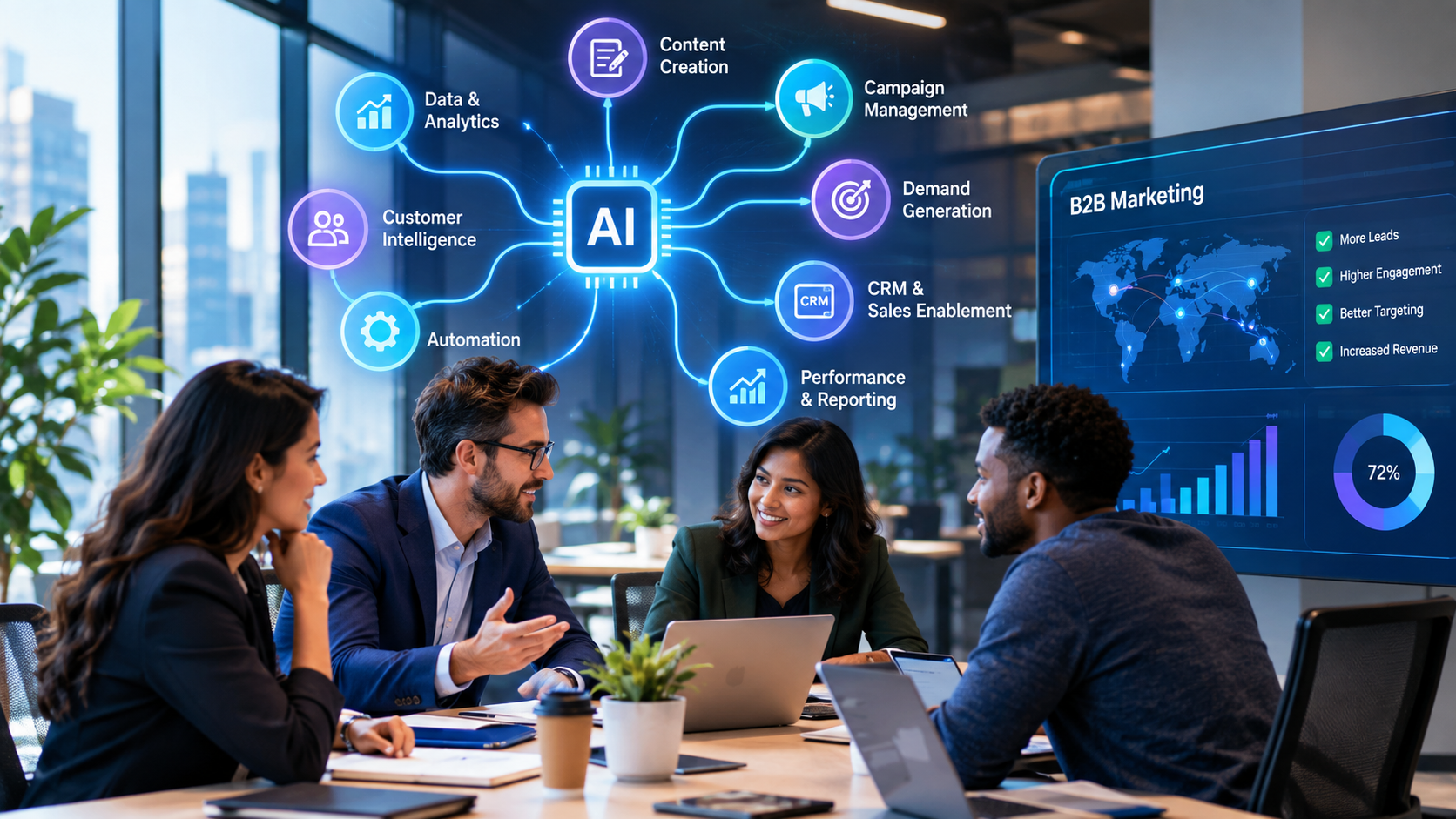

Artificial intelligence is no longer being treated as a separate technology initiative inside marketing agencies. In 2026, AI is increasingly influencing how agencies organize teams, build services, manage client relationships, price work, acquire technology companies, and deliver B2B marketing programs.
The shift is particularly visible across large agency groups and specialized B2B marketing companies. Instead of simply adding AI tools to existing workflows, agencies are beginning to redesign their operating models around automation, agentic workflows, data, technology, and human expertise.
Recent developments illustrate the scale of this change. WPP announced a multi-year plan to simplify its organizational structure and organize its operations around four core units, while connecting those units through its WPP Open agentic marketing platform. Meanwhile, B2B go-to-market company 2X acquired Knownwell, an AI platform focused on agentic AI engineering and commercial intelligence. Publicis Groupe has also expanded its strategic relationship with Microsoft to build AI-powered marketing capabilities.
These developments point toward a broader industry transformation.
The question is no longer simply whether marketing agencies will use AI. The bigger question is how agencies will restructure their businesses when AI can perform an increasing number of activities traditionally delivered through human labor.
Why AI Is Changing the Traditional Agency Model
For decades, many marketing agencies scaled by adding people, processes, and specialized teams. A larger client account often required more strategists, writers, designers, media specialists, analysts, account managers, and operations professionals.
AI changes the economics of that model.
Generative AI can assist with research, content development, analysis, reporting, campaign planning, personalization, and other repetitive activities. Agentic AI goes further by allowing software systems to execute multi-step workflows with less manual intervention.
Research from Forrester and the 4As published in June 2026 found that nine in ten US marketing agencies were using generative AI, while half were using agentic AI for marketing execution. The research also found that agencies primarily use AI to improve staff productivity and impact.
This creates an important organizational question.
If technology allows an agency to produce more work without increasing headcount at the same rate, should the agency continue operating with the same structure?
Increasingly, the answer appears to be no.
From People-Based Scaling to AI-Enabled Scaling
The traditional agency model is heavily connected to human capacity.
More campaigns require more people. More content requires more writers. More accounts require more account managers. More data analysis requires more analysts.
AI introduces another layer of capacity.
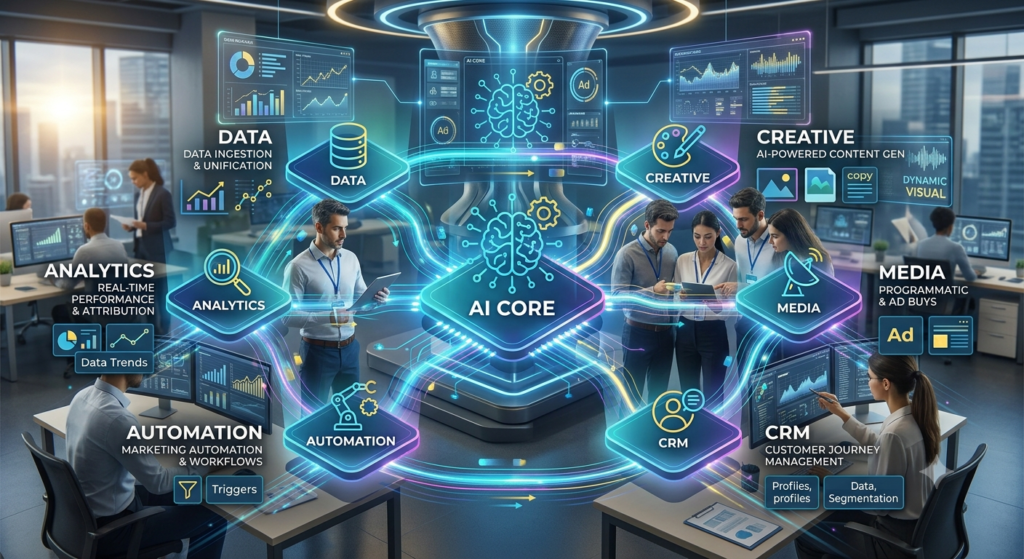
Instead of treating AI as a replacement for a specific employee, agencies are increasingly viewing it as an operational layer that supports entire teams.
For example, an AI-enabled B2B marketing workflow could potentially connect:
- Market research
- ICP development
- Account identification
- Buyer intelligence
- Content research
- Content creation
- Campaign personalization
- Lead qualification
- CRM updates
- Performance analysis
- Reporting
The human team can then focus more heavily on strategy, quality control, client relationships, creative direction, complex decision-making, and revenue outcomes.
This is one reason the emerging agency model is increasingly described through terms such as “human-agentic” or “AI-enabled.”
The objective is not necessarily to eliminate human involvement. Instead, agencies are redesigning where human involvement creates the most value.
Large Agency Groups Are Simplifying Their Structures
One of the clearest examples is WPP.
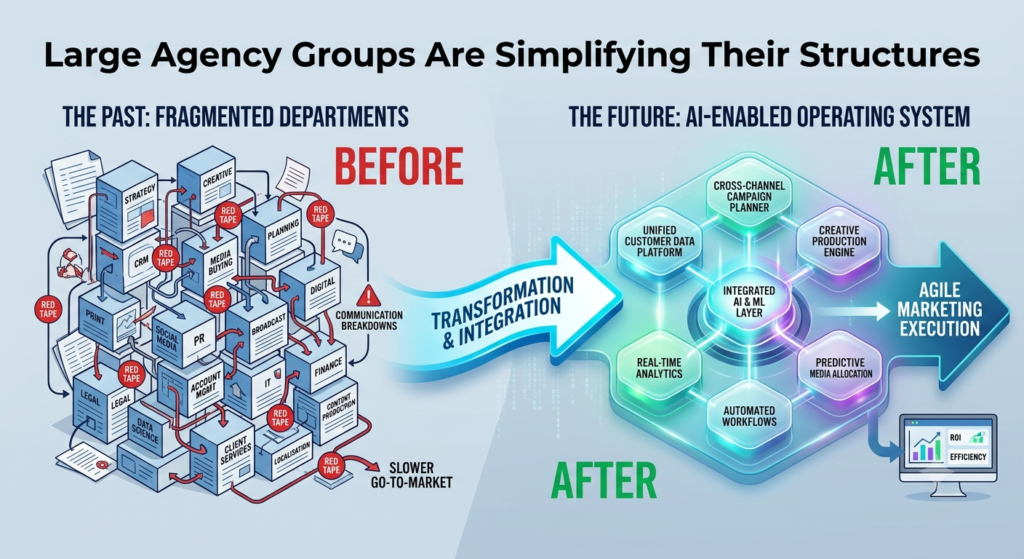
In February 2026, WPP announced its Elevate28 strategy, which includes a move toward a simplified organizational model built around four operating units: WPP Media, WPP Creative, WPP Production, and WPP Enterprise Solutions.
WPP also said its operating model would be connected through WPP Open, its agentic marketing platform.
The company’s announcement shows that AI is being considered as part of the operating infrastructure rather than simply another software tool.
WPP also stated that its Enterprise Solutions unit would consolidate capabilities covering customer experience, commerce, CRM, content transformation, technology, and data, with a focus on enterprise AI transformation.
This is significant for B2B marketing because enterprise clients increasingly expect agencies to connect marketing activity with technology, customer data, CRM systems, content operations, and measurable business outcomes.
The agency therefore becomes less of a collection of specialist departments and more of an integrated growth infrastructure.
B2B Agencies Are Also Moving Toward Human-Agentic Models
The restructuring trend is not limited to traditional advertising holding companies.
In June 2026, B2B go-to-market company 2X announced the acquisition of Knownwell, an AI-as-a-service platform focused on agentic AI engineering, commercial intelligence, and next-generation GTM systems.
The combined company described its model as a human-agentic GTM services approach, combining human expertise with production-grade AI.
This development reflects a broader movement among B2B service providers.
Instead of selling only individual services such as demand generation, content marketing, sales development, or campaign execution, some companies are attempting to combine people, technology, data, and AI into a single operating model.
For clients, this can change the conversation from:
“How many people will work on my campaign?”
to:
“What business outcomes can your combination of people, technology, data, and automation deliver?”
That is a major shift in how B2B marketing services can be positioned.
AI Is Driving Agency Consolidation and Capability Acquisitions
Another important industry move is the increasing importance of acquisitions.
Agencies have historically acquired companies to add geographic coverage, clients, creative capabilities, media expertise, technology, or specialized talent.
AI adds another acquisition category: technological capability.
The acquisition of an AI company can give an agency access to proprietary technology, AI engineering expertise, data infrastructure, automation workflows, or agentic systems without having to build everything internally.
This build-versus-buy decision is becoming increasingly important.
J.P. Morgan’s 2026 analysis of advertising and marketing services noted that pressure for measurable ROI and competition from self-service platforms are pushing agencies toward build-or-buy decisions around capabilities.
For B2B agencies, acquisitions can therefore become a way to move faster into areas such as:
- AI agents
- Revenue intelligence
- Intent data
- Customer data platforms
- Marketing automation
- AI-powered content operations
- Predictive analytics
- CRM intelligence
- Automated campaign optimization
- Buyer journey orchestration
The result could be a more technology-intensive agency market.
Publicis and Microsoft Highlight the Rise of Strategic AI Partnerships
Partnerships are another important part of the restructuring story.
In April 2026, Publicis Groupe and Microsoft announced an expanded strategic partnership focused on building an AI-powered marketing solution that brings together legacy systems, AI agents, and identity-based data.
The development reflects another industry direction: agencies increasingly need access to technology ecosystems rather than relying only on internally developed tools.
For large B2B marketing organizations, this could create a network of interconnected capabilities.
An agency may provide strategy and execution while relying on partnerships for cloud infrastructure, AI models, CRM platforms, analytics, data collaboration, advertising technology, and marketing automation.
This creates a new role for agencies.
They can become technology orchestrators that connect multiple platforms into a usable marketing system.
B2B Clients Are Becoming More Selective About Agency Spend
AI is also changing the client side of the relationship.
Forrester reported in July 2026 that 93% of B2B brand and communications marketers surveyed use agencies in some capacity. However, the research also found that B2B marketers were becoming more selective about agency investment as AI-driven efficiencies made it easier to bring some work in-house.
This creates pressure on agencies.
If a client can use AI to produce basic content, conduct research, analyze data, or automate parts of campaign execution internally, the agency must provide value that goes beyond basic production.
This may include:
- Specialized industry expertise
- Proprietary data
- Advanced buyer intelligence
- Strategic planning
- Complex campaign orchestration
- Revenue operations expertise
- AI implementation
- Marketing transformation
- Human relationship management
- Creative differentiation
- Measurement and attribution
The agency’s competitive advantage increasingly depends on what it can add beyond what a client can achieve using general-purpose AI tools.
The Agency Workforce Is Changing
AI-driven restructuring does not necessarily mean every agency will simply reduce headcount.
The composition of agency teams can change even when overall demand remains strong.
Some traditional production roles may become smaller or more technology-assisted, while demand increases for roles involving:
- AI strategy
- AI operations
- Data engineering
- Marketing technology
- Prompt and workflow design
- AI governance
- Revenue intelligence
- Automation architecture
- Strategic consulting
- Creative direction
- Client transformation
- Data privacy and compliance
This means agencies need to rethink talent development.
An employee who previously spent most of their time producing content may increasingly be expected to manage AI-assisted workflows, validate outputs, interpret data, and contribute strategic recommendations.
The value of human expertise does not disappear. Instead, the skills associated with that expertise change.
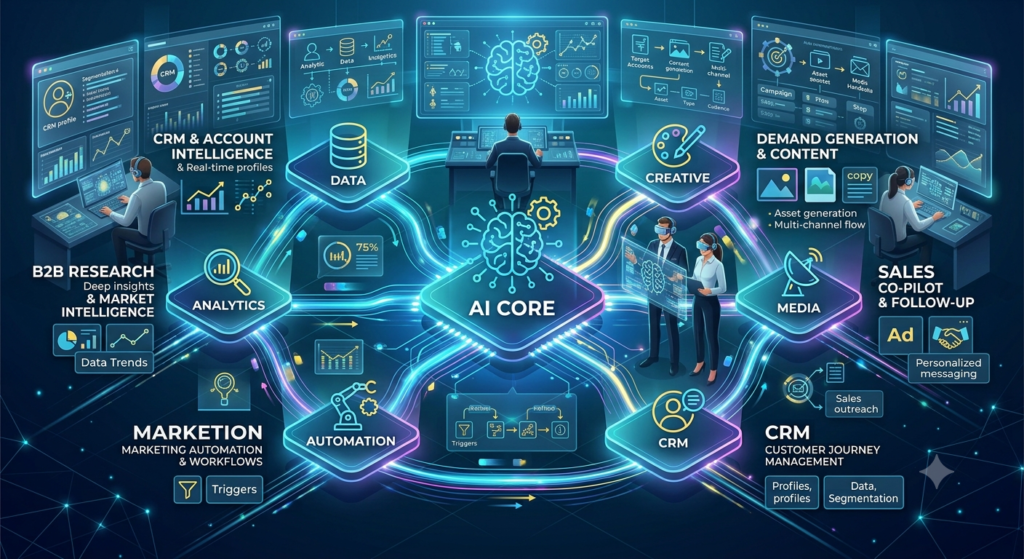
The Biggest Shift May Be From Execution to Orchestration
One of the most important developments in the agency industry is the movement from execution toward orchestration.
AI can increasingly perform individual marketing tasks.
The bigger opportunity is connecting those tasks into a coordinated workflow.
Consider a B2B account-based marketing campaign.
An AI-enabled workflow could identify target accounts, monitor buying signals, research stakeholders, recommend content, personalize messaging, update CRM records, analyze engagement, and prioritize follow-up.
But someone still needs to determine:
- Which accounts matter?
- What does the ideal customer profile look like?
- Which buying signals are meaningful?
- What messaging is appropriate?
- What data can legally be used?
- When should a human salesperson intervene?
- How should campaign success be measured?
This is where strategy and human judgment remain important.
Agencies that can coordinate AI, people, data, platforms, and business objectives may increasingly compete on their ability to orchestrate the entire system.
Efficiency Alone Is Not Enough
There is also a warning behind the AI restructuring trend.
Forrester’s 2026 research found that many agencies are heavily focused on productivity and cost efficiency. The research warned that excessive emphasis on efficiency could undermine creativity, differentiation, and long-term brand growth.
This is particularly relevant for B2B marketing.
AI can make it easier to create more content, generate more variations, automate more messages, and process more data.
But more output does not automatically mean better marketing.
If every agency uses similar AI models and similar prompts, basic content production can become increasingly commoditized.
The competitive difference may therefore shift toward proprietary insight, original thinking, strong positioning, quality data, brand knowledge, and the ability to turn information into meaningful customer experiences.
Why Data Is Becoming More Important
AI-powered marketing depends heavily on data.
An agency may have access to advanced AI technology, but poor data can still produce poor results.
For B2B marketing, relevant data can include:
- Company information
- Industry classification
- Employee count
- Technology adoption
- Buyer roles
- Intent signals
- Engagement history
- CRM activity
- Campaign responses
- Website behavior
- Content interaction
- Account-level activity
As agencies automate more workflows, data quality becomes increasingly important.
Bad data can create bad targeting, irrelevant personalization, inaccurate scoring, and inefficient campaign execution.
This means data hygiene, validation, governance, and integration are becoming strategic capabilities rather than back-office activities.
AI Governance Will Become Part of the Agency Offering
As AI becomes more deeply integrated into client campaigns, governance will become increasingly important.
Agencies must consider questions around:
- Data privacy
- Copyright
- Accuracy
- Bias
- Security
- Human oversight
- Brand safety
- Regulatory requirements
- Transparency
- Model selection
- Client data access
Forrester’s 2026 research identified accuracy and bias, legal concerns, and privacy and security risks among significant barriers to deeper AI adoption inside agencies.
This means AI governance could become another specialized agency capability.
The agencies working with enterprise B2B organizations will increasingly need to demonstrate not only what their AI systems can do, but also how those systems are controlled.
What This Means for B2B Marketing Agencies
The restructuring underway across the industry could lead to several changes in the B2B agency model.
1. Smaller Production Layers
Automation can reduce the amount of manual work required for repetitive marketing tasks.
2. Larger Technology and Strategy Functions
Agencies may invest more heavily in AI architecture, data, automation, consulting, and strategic capabilities.
3. More Integrated Services
Instead of separate content, demand generation, data, and sales development teams, agencies may build integrated GTM units.
4. More Outcome-Based Engagements
Clients may increasingly expect agencies to connect their work to pipeline, revenue, qualified opportunities, customer acquisition, and other measurable outcomes.
5. More AI Partnerships and Acquisitions
Agencies can continue building capabilities internally while also acquiring or partnering with specialist AI and technology companies.
6. Greater Human Oversight
AI may handle more execution, but strategic decisions, client relationships, complex judgment, creative direction, and governance remain important human responsibilities.
What B2B Marketing Leaders Should Watch Next
The next stage of agency transformation is likely to be less about AI experimentation and more about operational integration.
B2B marketing leaders should watch several areas closely.
First, monitor how agencies package AI capabilities. A simple claim that an agency “uses AI” says little about its actual capabilities.
Second, examine how AI connects with the agency’s data and technology infrastructure.
Third, ask whether automation improves business outcomes or simply increases output.
Fourth, understand where humans remain involved in the workflow.
Finally, examine how the agency measures performance.
A mature AI-enabled marketing operation should be able to explain not only which AI tools it uses, but how those tools contribute to a measurable marketing process.
The New Agency Model Is Still Taking Shape
The restructuring of B2B marketing agencies around AI is still an evolving story.
Some agencies are simplifying organizational structures. Others are acquiring AI companies. Some are building proprietary platforms, while others are expanding partnerships with major technology providers.
At the same time, clients are becoming more selective about which activities they outsource.
The common thread is a shift away from the traditional model where agency growth depends primarily on adding people to deliver more execution.
AI makes production more scalable. That forces agencies to reconsider where their value comes from.
The emerging model is likely to combine human expertise, AI agents, proprietary data, technology platforms, strategic consulting, creative thinking, and measurable business outcomes.
For B2B marketing, this could fundamentally change how agencies support the buyer journey.
The agency of the future may not simply execute a campaign after receiving a brief. It may help design the operating system behind the campaign, connect data across the revenue organization, deploy AI-powered workflows, monitor buyer signals, coordinate human intervention, and continuously optimize the process.
That makes AI more than a marketing technology trend.
It becomes an industry structure issue.
And as agencies continue to reorganize around AI, the biggest question will not be how much work machines can perform.
It will be how effectively agencies combine machines, people, data, and strategy to create measurable value for B2B businesses.
Frequently Asked Questions (FAQs)
B2B marketing agencies are restructuring around AI to improve productivity, automate repetitive processes, integrate data more effectively, and deliver more scalable marketing services. AI is increasingly being incorporated into campaign execution, analytics, content workflows, customer intelligence, and go-to-market operations.
AI is shifting agencies from traditional people-based production models toward technology-enabled operating models. Agencies are increasingly combining human expertise with AI tools, automation, data platforms, and agentic workflows to manage larger and more complex marketing operations.
Agentic AI refers to AI systems that can perform multiple connected tasks with limited human intervention. In B2B marketing, this can include researching accounts, analyzing buyer signals, creating campaign recommendations, updating workflows, monitoring engagement, and supporting optimization.
AI adoption does not necessarily mean replacing entire teams. Instead, many agencies are using AI to automate repetitive work and allow employees to focus more on strategy, creativity, client relationships, quality control, and complex decision-making. The effect on specific roles can vary by agency and service.
Acquiring AI companies can give agencies access to specialized technology, engineering talent, data capabilities, automation systems, and AI expertise. It can also allow agencies to expand their AI capabilities faster than building every technology internally.
AI can support several parts of demand generation, including audience research, account identification, content personalization, engagement analysis, lead scoring, campaign optimization, and reporting. Human oversight remains important for strategy, messaging, data quality, and decision-making.
AI can improve efficiency by reducing manual and repetitive work. However, increased efficiency does not automatically guarantee better marketing results. Agencies still need strong strategy, accurate data, creative differentiation, effective targeting, and appropriate measurement.
AI systems depend on the quality of the information they process. Inaccurate, outdated, or incomplete B2B data can result in poor targeting, incorrect personalization, unreliable scoring, and inefficient campaign decisions. Data validation and governance therefore become important parts of AI-enabled marketing operations.
Skills in AI strategy, marketing technology, data analysis, automation, AI governance, workflow design, strategic consulting, creative direction, and revenue operations are becoming increasingly relevant. Human skills such as communication, judgment, creativity, and client management also remain important.
Companies can examine how an agency uses AI across its actual workflows rather than simply looking for an “AI-powered” label. Important areas include data management, AI governance, human oversight, technology integration, campaign execution, reporting capabilities, and how the agency connects marketing activity with measurable business objectives.
AI is changing how many traditional services are delivered, but it does not automatically make those services obsolete. Content, demand generation, research, analytics, and campaign management can become more automated while strategic planning, creative development, customer understanding, and business decision-making continue to require human involvement.
The emerging model combines human expertise with AI, automation, data, marketing technology, and strategic services. Agencies are increasingly moving toward integrated go-to-market support rather than focusing only on individual production tasks.