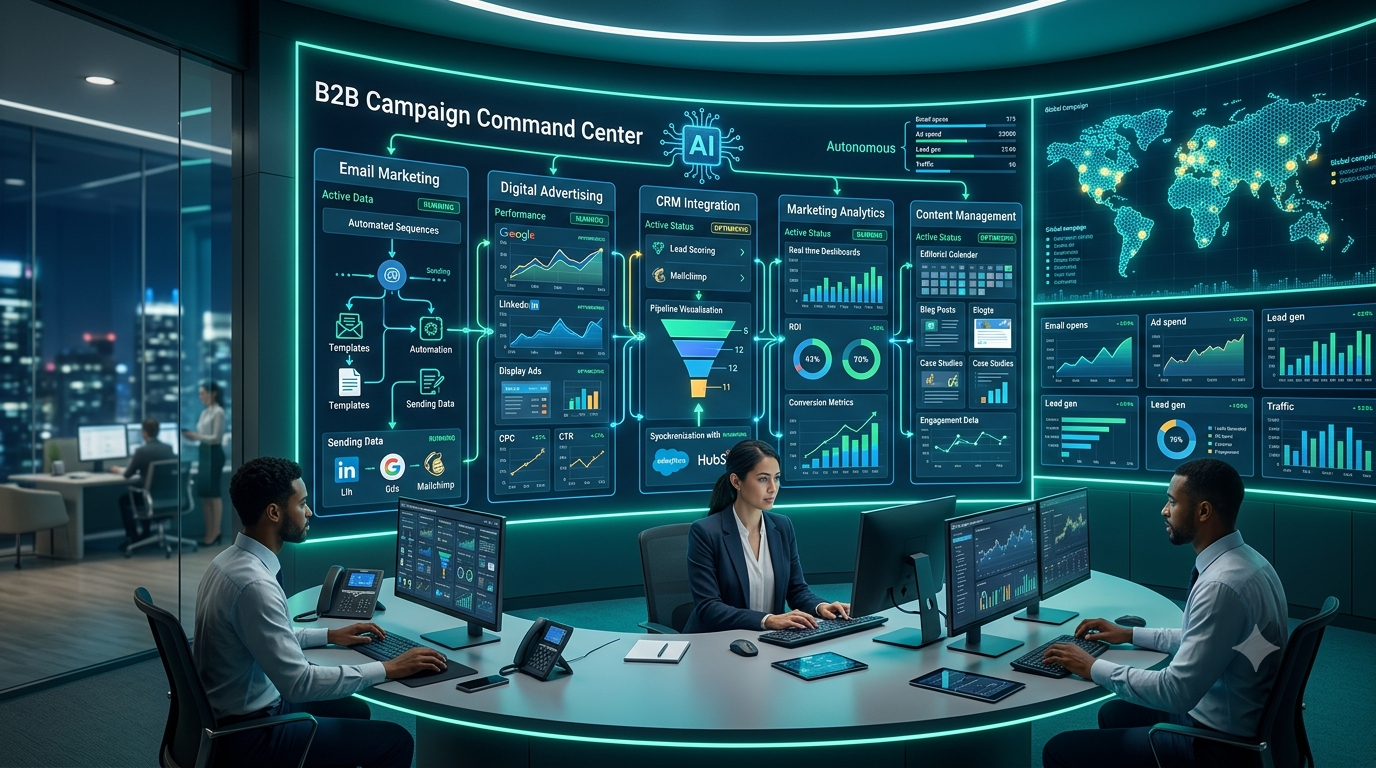
AI Agents Are Moving Beyond Chat: How Autonomous Workflows Are Changing B2B Marketing

Artificial intelligence is entering a new phase in B2B marketing. For several years, generative AI was primarily used as an assistant for writing content, summarizing information, generating ideas, creating emails, and answering questions. Today, the conversation is shifting from AI that responds to instructions toward AI agents that can plan tasks, use tools, make decisions within defined boundaries, and execute multi-step workflows.
This transition is often described as the move from conversational AI to agentic AI.
The difference is significant. A chatbot generally waits for a user to ask a question and then produces an answer. An AI agent can be given a goal and a set of tools, then determine the steps required to complete that goal. In a marketing environment, that could involve researching accounts, evaluating prospects, checking CRM information, preparing campaign assets, analyzing engagement signals, and recommending or triggering the next action.
The technology is developing rapidly. Forrester reported in September 2026 that AI agents for marketing have moved into active implementation, while its research also highlighted the resources required to implement, maintain, use, and monitor agentic systems.
At the same time, BCG’s 2026 CMO research found that while 96% of surveyed CMOs said AI is driving end-to-end transformation, only about one-third reported having completed the underlying work. BCG also reported that just under one-third had moved to agent-led workflows, while 8% said they were running campaigns in which multiple agents operate autonomously.
These developments suggest that AI agents are no longer simply a futuristic concept. They are becoming part of the conversation around how B2B marketing operations are designed and executed.
What Are AI Agents?
An AI agent is a software system that can use artificial intelligence to pursue a defined objective through multiple steps.
Instead of simply generating a response, an agent can potentially:
- Understand a business objective
- Break a task into smaller actions
- Access approved data sources
- Use external tools
- Analyze information
- Make decisions based on predefined rules
- Execute actions
- Monitor results
- Adjust the workflow based on new information
- Escalate decisions to a human when required
The exact capabilities depend on the model, tools, integrations, permissions, and workflow architecture.
For B2B marketing teams, this means AI can potentially move beyond content generation and become part of campaign operations.
For example, instead of asking an AI tool to “find some companies that match this ICP,” an agent-based workflow could potentially research companies, compare them against ICP requirements, identify relevant decision-makers, verify available information, check existing CRM records, assign account priorities, and prepare the results for human review.
That is a fundamentally different workflow.
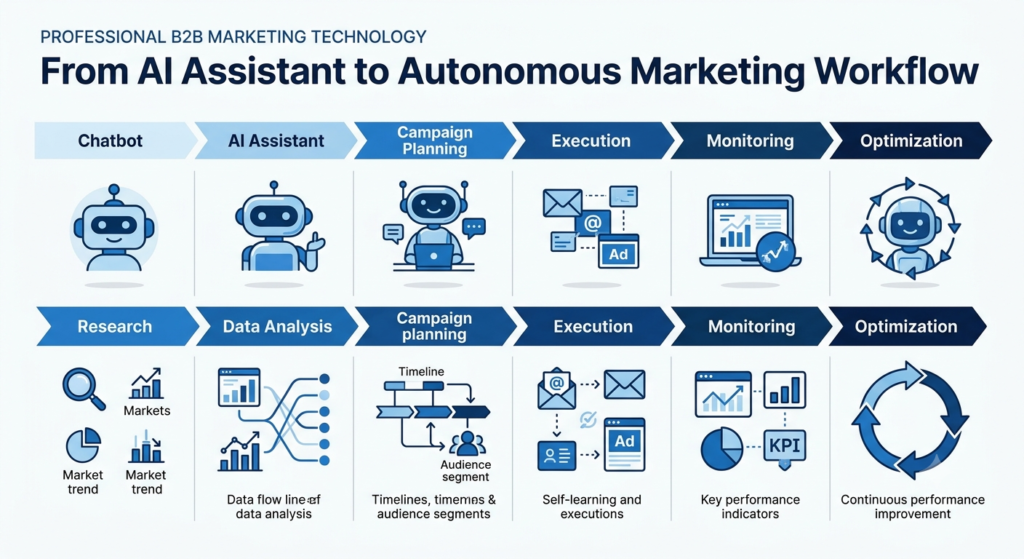
From AI Assistant to AI Agent
The easiest way to understand the change is to compare traditional AI assistance with agentic workflows.
Traditional AI Assistant
A marketer provides an instruction.
The AI produces an output.
The marketer reviews the output and decides what to do next.
The marketer then provides another instruction.
This creates a series of human-led interactions.
AI Agent Workflow
A marketer defines the objective, constraints, data sources, and permissions.
The agent determines the steps required.
It performs approved actions through connected tools.
It evaluates the results.
It continues the workflow or requests human intervention when necessary.
The distinction is not that humans disappear from the process. Instead, the human role can shift from manually executing every step toward defining objectives, reviewing important decisions, managing exceptions, and improving the overall system.
OpenAI’s September 2026 announcement of its Agents API illustrates this broader direction. The platform is designed around agents that can work with tools, maintain context across longer sessions, execute tasks in environments, and coordinate multiple subagents.
Why Autonomous Workflows Matter for B2B Marketing
B2B marketing involves many interconnected processes.
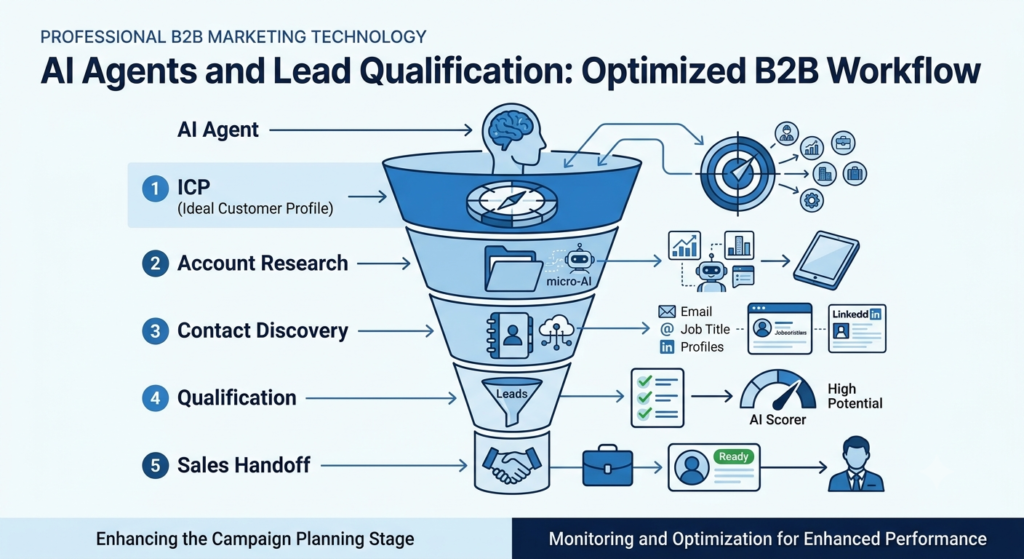
A typical campaign can include ICP development, account research, contact discovery, database validation, segmentation, content creation, email deployment, engagement tracking, lead scoring, CRM updates, reporting, and sales handoff.
Many of these processes involve repetitive actions.
AI agents could potentially connect several of these steps into a single workflow.
For example:
Campaign objective → ICP analysis → account research → contact discovery → data validation → segmentation → personalized messaging → campaign execution → engagement monitoring → lead qualification → CRM update → sales notification
Traditionally, multiple people and systems may be involved across this process.
An agentic architecture can potentially coordinate some of these activities automatically, while humans retain control over important decisions.
This is where autonomous workflows could become particularly relevant to B2B organizations.
AI Agents and Account Research
Account research is one area where agentic workflows could have a practical impact.
B2B marketers often need to understand:
- Company size
- Industry
- Geography
- Technology environment
- Business model
- Recent company developments
- Buying signals
- Existing relationships
- Relevant decision-makers
- Potential business challenges
An AI agent can potentially gather information from approved sources, organize it, and produce a structured account profile.
The value is not simply faster research.
The bigger opportunity is creating a repeatable research process that follows the same criteria across a large number of accounts.
Human researchers can then focus on reviewing higher-value accounts, resolving ambiguous information, and improving the research methodology.
AI Agents and Lead Qualification
Lead qualification is another area where autonomous workflows could become important.
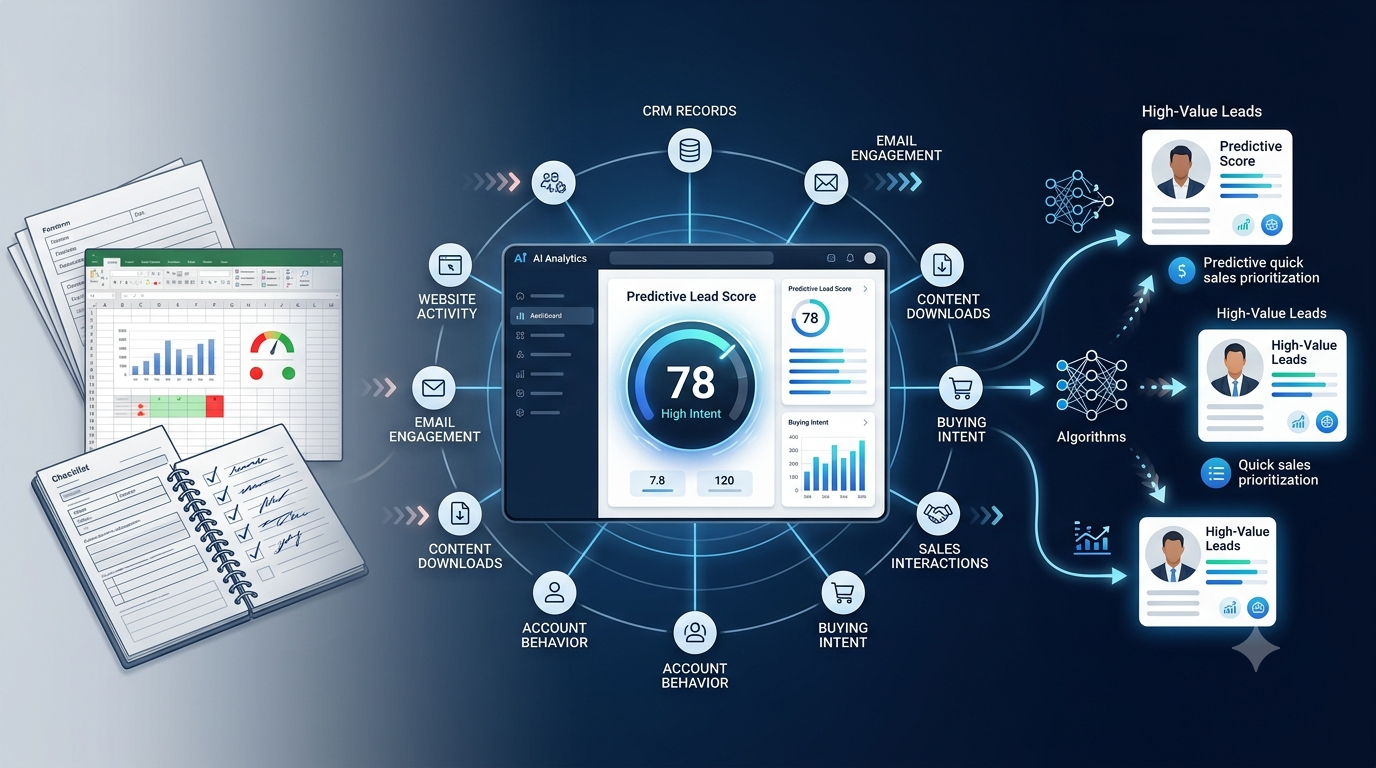
Traditional lead scoring often relies on predefined attributes and engagement signals. An agent could potentially evaluate a broader set of information and provide context around why a prospect appears relevant.
For example, an agentic qualification workflow could examine:
Firmographic fit + role relevance + engagement + account activity + campaign response + intent signals + existing CRM information
The result could be a more contextual qualification process.
However, human oversight remains important, particularly when qualification affects sales prioritization.
An AI system should not automatically determine that every high-scoring contact is sales-ready simply because multiple signals are present. Data quality, outdated information, false positives, and incomplete context can all affect the result.
AI Agents and Email Marketing
Email marketing is another area where autonomous workflows could influence campaign operations.
Instead of using AI only to write an email, an agent could potentially support the broader process.
A workflow might include:
- Identify the target segment.
- Review previous engagement.
- Select an approved message framework.
- Personalize the content within defined guidelines.
- Check the email against compliance and brand rules.
- Prepare campaign variations.
- Monitor engagement.
- Identify changes in performance.
- Recommend adjustments.
- Send performance information to the reporting system.
This does not mean every B2B company should allow an AI agent to send campaigns without human approval.
Marketing teams still need governance around brand voice, data privacy, consent, compliance, deliverability, and campaign strategy.
The important change is that AI can potentially coordinate more of the operational workflow rather than only contributing individual pieces of content.
Multi-Agent Marketing Systems
One of the more interesting developments is the emergence of multi-agent systems.
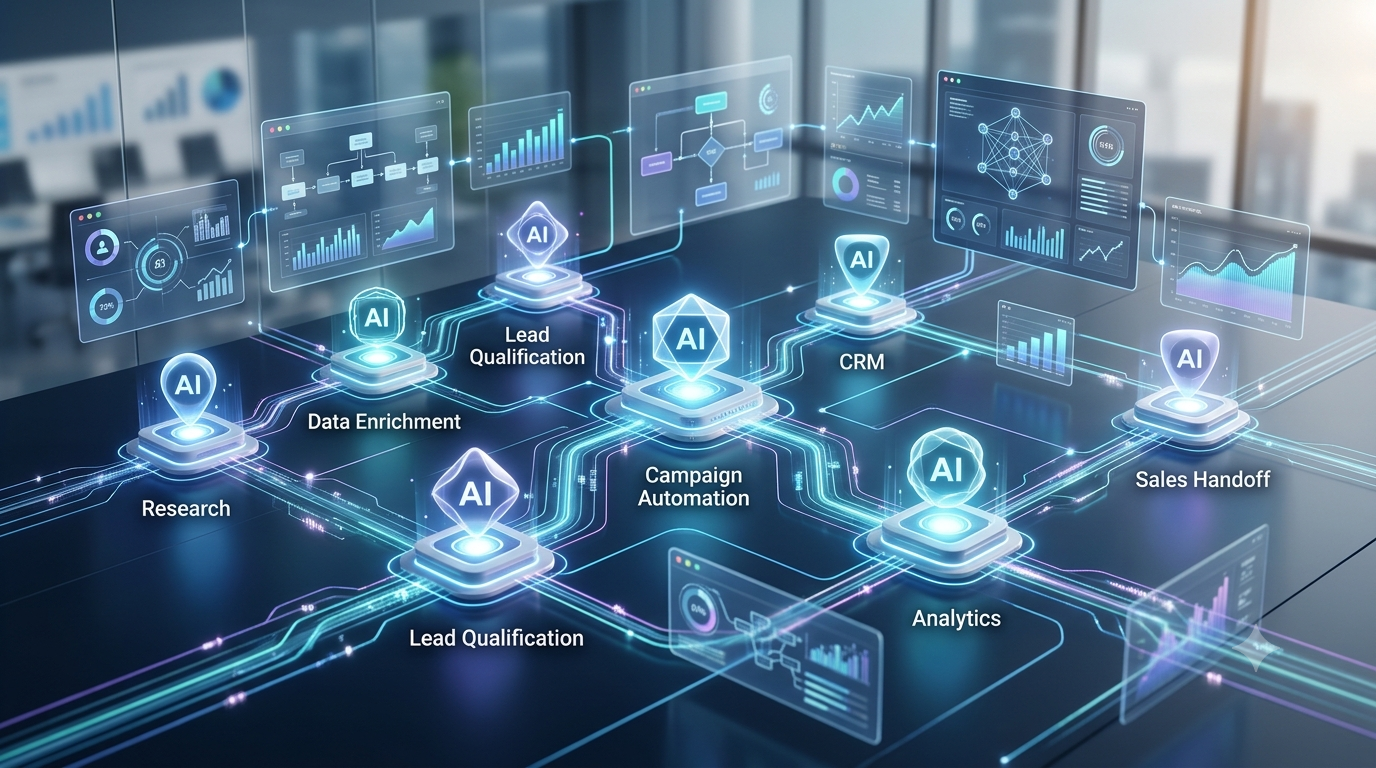
Instead of asking one AI agent to perform every task, organizations can potentially assign different responsibilities to specialized agents.
For example:
Research Agent: Finds and organizes account information.
Data Agent: Checks records and identifies missing or inconsistent information.
Content Agent: Develops messaging based on approved frameworks.
Campaign Agent: Coordinates campaign activities.
Analytics Agent: Monitors engagement and campaign performance.
Sales Intelligence Agent: Identifies potentially important accounts or contacts for sales review.
A coordinating agent can potentially manage the overall workflow.
Google’s Agent2Agent, or A2A, initiative is designed around the idea that AI agents should be able to communicate and collaborate across systems. Google describes A2A as a protocol intended to support collaboration between agents rather than treating each agent as an isolated tool.
What This Means for B2B Demand Generation
Demand generation teams operate across multiple stages of the buyer journey.
They need to create awareness, identify target accounts, engage audiences, capture intent, nurture prospects, and support sales teams.
AI agents could potentially connect these activities.
Imagine a workflow where an agent continuously monitors approved account signals. When a target company displays a relevant signal, the system could investigate the account, compare it against the ICP, review previous engagement, identify relevant contacts, and recommend an appropriate campaign action.
This creates a more dynamic approach to demand generation.
Instead of relying entirely on static campaign lists, marketing operations can potentially respond to changing account-level information.
The goal is not simply more automation.
The goal is better coordination between data, campaigns, sales activity, and buyer signals.
AI Agents Could Change Marketing Operations Roles
The rise of autonomous workflows could also change the responsibilities of marketing operations professionals.
Many marketing teams spend substantial time moving information between systems, checking records, preparing reports, building lists, and monitoring campaign activity.
As more of these activities become automated, marketing professionals may spend more time on:
- Strategy
- Workflow design
- Data governance
- Campaign architecture
- AI supervision
- Quality assurance
- Brand governance
- Experimentation
- Buyer intelligence
- Sales and marketing alignment
This does not necessarily mean fewer people are required.
Instead, the nature of the work can change.
Marketing teams may increasingly need people who understand both marketing strategy and how AI-powered workflows operate.
The Data Challenge Behind Agentic Marketing
AI agents cannot compensate for poor data indefinitely.
If CRM records are inaccurate, account information is outdated, contact information is incomplete, or campaign signals are inconsistent, an autonomous workflow can potentially scale those problems.
This makes data hygiene even more important.
Before implementing an agentic marketing workflow, organizations should evaluate:
Data quality: Is the underlying information accurate?
Data access: Can the agent access only the information it needs?
Data permissions: What actions is the agent allowed to perform?
System integration: Can the agent work reliably across the required platforms?
Auditability: Can marketers understand why an action was taken?
Human review: Which decisions require approval?
A strong AI strategy therefore begins with strong operational foundations.
Human Oversight Still Matters
Autonomous does not mean uncontrolled.
Marketing involves decisions that can affect brand reputation, customer relationships, compliance, and revenue.
For that reason, B2B companies should define clear boundaries around what an AI agent can do.
For example, an organization might allow an agent to:
- Research accounts
- Summarize information
- Categorize leads
- Identify data inconsistencies
- Draft messages
- Monitor campaign metrics
- Prepare reports
But require human approval before the agent:
- Sends sensitive communications
- Changes major campaign strategy
- Deletes customer records
- Makes significant budget changes
- Modifies compliance-related settings
- Takes actions involving important customer relationships
This creates a human-in-the-loop model where AI handles repetitive operational work while people retain control over important decisions.
The Agentic AI Adoption Gap
Despite the growing attention around AI agents, adoption is not the same as successful implementation.
BCG’s 2026 CMO survey illustrates this gap. While 96% of surveyed CMOs said AI is driving transformation, only about one-third said they had completed the underlying work. The report also found that many organizations remain at the stage where generative AI assists humans with individual tasks rather than operating complete agent-led workflows.
For marketing leaders, this is an important distinction.
Buying an AI platform is not the same as building an agentic marketing operation.
Companies need:
- Clear use cases
- Clean data
- Defined workflows
- Appropriate integrations
- Security controls
- Human oversight
- Performance measurement
- Employee training
- Continuous optimization
Without these foundations, AI agents can create additional complexity rather than removing it.
What B2B Marketing Teams Should Watch Next
Several developments will shape the next stage of agentic marketing.
Greater Integration Across Martech
AI agents will increasingly need access to CRM, marketing automation, analytics, content, advertising, research, and sales systems.
The more effectively these systems communicate, the more useful autonomous workflows can become.
More Specialized Agents
Rather than one general-purpose AI system handling everything, organizations may increasingly use specialized agents for research, content, analytics, operations, and sales intelligence.
Better Agent Collaboration
Protocols such as Google’s A2A point toward an ecosystem where agents from different systems can potentially communicate and collaborate.
Stronger Governance
As agents gain more ability to take actions, companies will need stronger controls around permissions, security, privacy, compliance, monitoring, and audit trails.
New Marketing Performance Metrics
Traditional metrics such as open rates, clicks, MQLs, and conversion rates will remain relevant, but organizations may also measure workflow efficiency, agent accuracy, human intervention rates, response time, automation coverage, and cost per completed workflow.
What Comes Next for B2B Marketing?
AI agents are changing the conversation around marketing automation.
The previous generation of automation focused heavily on predefined rules.
The current generation of generative AI focuses heavily on producing and interpreting information.
Agentic AI introduces another layer: systems that can potentially plan and execute multi-step work toward a defined objective.
For B2B marketing, this could influence account research, demand generation, lead qualification, campaign execution, content operations, customer intelligence, reporting, and sales handoffs.
But successful adoption will depend on more than technology.
Organizations will need clean data, well-designed processes, clear objectives, strong governance, reliable integrations, and people who understand how to supervise AI-driven workflows.
The companies exploring agentic AI today are therefore not simply asking, “Can AI write this for us?”
A more important question is becoming:
“Which parts of our marketing workflow can AI responsibly coordinate from beginning to end?”
That shift from AI as an assistant to AI as a workflow participant could become one of the most important developments in B2B marketing automation.
Final Takeaway
AI agents are moving beyond the chatbot interface and into the operational layer of marketing.
The next stage of B2B automation is not simply about generating more content or answering more questions. It is about connecting AI with data, tools, systems, and workflows so that repetitive multi-step processes can be coordinated with less manual intervention.
For B2B marketing leaders, the opportunity is to identify practical workflows where AI can create measurable efficiency while maintaining appropriate human oversight.
The future of marketing automation may not be one AI tool doing everything.
It may be a connected ecosystem of specialized agents, marketing platforms, data systems, and human experts working together.
That is where autonomous workflows could move B2B marketing next.
Frequently Asked Questions
AI agents are AI-powered systems designed to perform multi-step tasks toward a defined objective. Depending on their tools and permissions, they can research information, analyze data, coordinate workflows, use business applications, and recommend or execute actions.
A chatbot typically responds to user prompts. An AI agent can potentially plan multiple steps, use tools, interact with connected systems, evaluate results, and continue working toward a defined objective.
AI agents are more likely to change how marketing teams work than simply eliminate the need for marketers. They can automate repetitive operational activities while marketers continue to manage strategy, creativity, governance, relationships, and important business decisions.
AI agents can potentially support account research, contact discovery, data validation, segmentation, lead qualification, engagement monitoring, campaign coordination, and CRM updates. Their usefulness depends heavily on data quality, integrations, and workflow design.
Autonomous workflows require appropriate permissions, monitoring, security controls, data governance, and human oversight. Organizations should determine which actions AI can perform independently and which require human approval.
Multi-agent marketing involves multiple AI agents with different responsibilities working together. For example, one agent could conduct research, another could analyze data, and another could monitor campaign performance while a coordinating system manages the overall workflow.
AI agents depend on the information available to them. Inaccurate, outdated, or incomplete data can lead to incorrect recommendations or actions. Strong data governance and database hygiene are therefore important foundations for agentic marketing.