

Introduction
The marketing industry is entering a new era where successful campaigns are no longer judged only by reach, impressions, or advertising spend. Brands are increasingly expected to create experiences that people remember, participate in, share, and discuss.
In 2026, some of the most interesting campaign launches are combining cultural relevance, creator partnerships, entertainment, technology, community participation, and strong storytelling. The result is a new generation of marketing campaigns that are setting higher expectations for what brand communication can achieve.
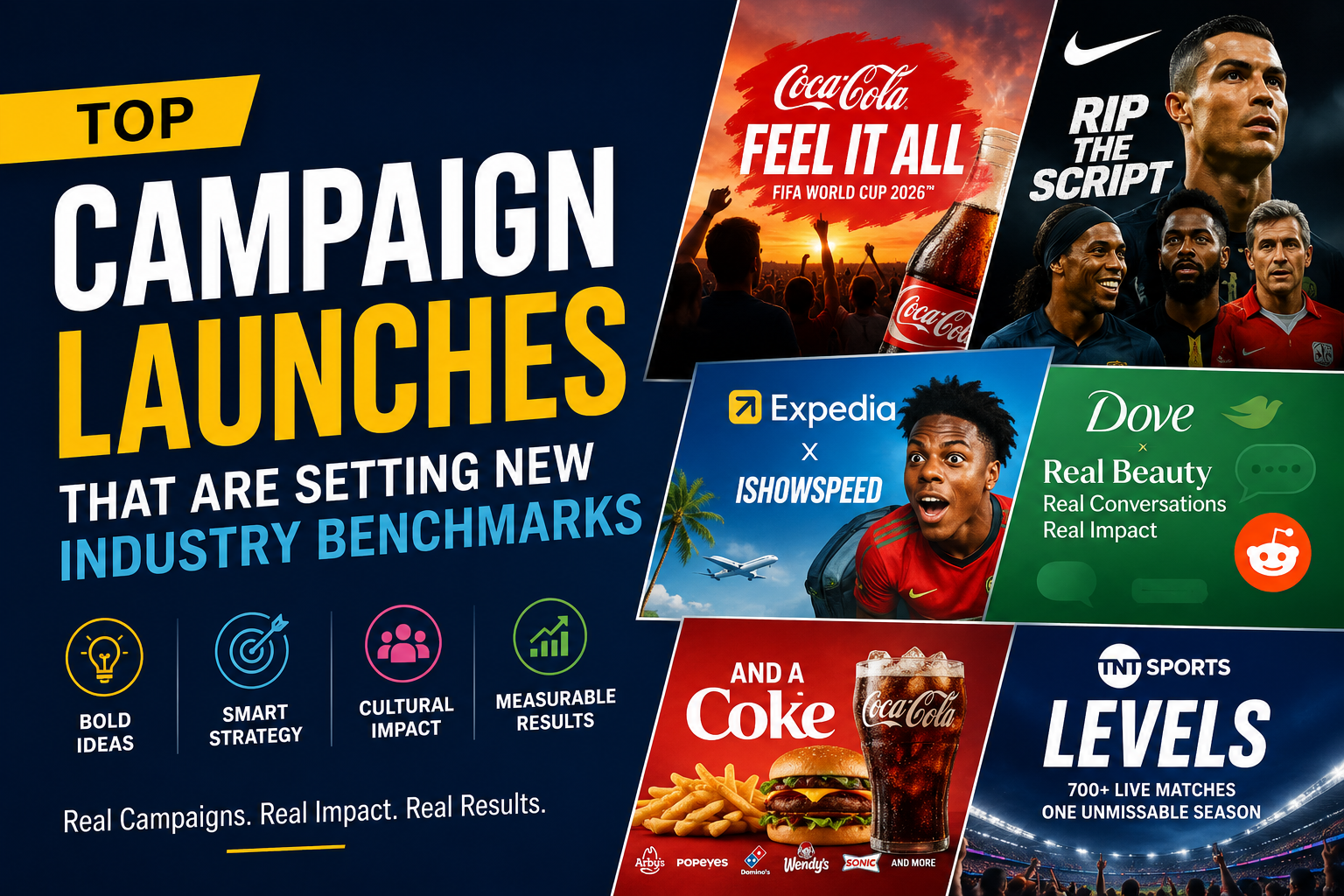
From Coca-Cola’s global FIFA World Cup campaign to Nike’s football-focused “Rip the Script” campaign and Expedia’s creator-led approach with IShowSpeed, marketers are experimenting with new ways to turn campaigns into cultural moments. Industry coverage of first-half 2026 campaigns has highlighted a broader movement toward authenticity, emotional storytelling, creators, and human-centered brand communication.
These campaigns are important because they demonstrate that the strongest marketing strategies are increasingly built around ideas rather than individual advertisements. A campaign can begin with a film, but its impact can extend into social media, creator content, live experiences, communities, retail, search, and conversations between consumers.
Here are some of the top campaign launches that are helping define the next benchmark for modern marketing.
1. Coca-Cola’s “Feel It All” Campaign Makes Emotion the Main Character
Coca-Cola’s FIFA World Cup 2026 campaign is one of the clearest examples of how a global brand can build a campaign around a universal human emotion.
The campaign, titled “Feel It All,” was developed around the emotional rollercoaster of football fandom. Coca-Cola launched its first film, “Bubbling Up,” in January 2026, followed by “Uncanned Emotions” in April and “No Better Feeling” in June.
The campaign demonstrates an important shift in sports marketing. Instead of focusing exclusively on players, trophies, or product visibility, Coca-Cola put fans and their emotions at the center.
The final film, “No Better Feeling,” used the tension surrounding a VAR decision to demonstrate the emotional journey from anticipation to uncertainty and finally celebration. The campaign featured José Mourinho and J Balvin and positioned Coca-Cola as part of the emotional experience surrounding football.
The strategy is particularly effective because football does not require much explanation. Fans already understand the feeling of waiting for a goal, fearing a decision, celebrating a victory, or experiencing disappointment.
That gives the brand an emotional territory that can travel across countries and cultures.
Why It Sets a Benchmark
The campaign demonstrates how brands can use major cultural events without making the event feel like a simple sponsorship opportunity.
Rather than saying “Coca-Cola sponsors the World Cup,” the creative asks consumers to associate the brand with the emotions surrounding the tournament.
That is a much stronger form of brand positioning.
Learn more: Coca-Cola’s FIFA World Cup 2026 campaign announcement
2. Nike’s “Rip the Script” Challenges Traditional Sports Advertising
Nike has continued to use football’s biggest global stage as an opportunity for major cultural storytelling.
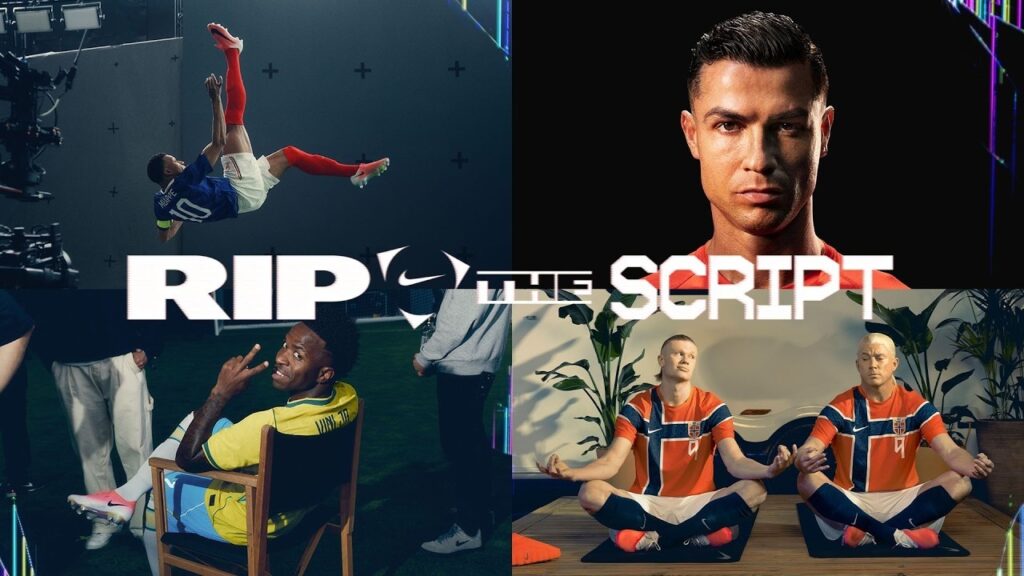
Its 2026 “Rip the Script” campaign focuses on the idea that elite footballers should trust instinct rather than follow a predetermined script. The campaign features major football personalities including Cristiano Ronaldo, Ronaldinho, Didier Drogba and Eric Cantona, alongside entertainment figures such as Channing Tatum, Travis Scott and Kim Kardashian.
The concept is simple, but the execution is designed for modern social feeds.
Today’s audiences are exposed to an enormous volume of polished advertising. Simply placing famous people inside a traditional commercial is no longer enough.
Nike’s approach instead connects celebrity, sport, culture, personality, and entertainment through one central creative idea.
The campaign also reflects an important change in sports marketing. Football campaigns increasingly have to compete not only with other brands but also with creator content, entertainment platforms, streaming services, memes, and fan communities.
A campaign therefore needs to feel like content that belongs in the feed rather than an advertisement interrupting the feed.
Why It Sets a Benchmark
Nike’s approach demonstrates the value of a strong creative premise.
The best campaign concepts can be summarized in a few words and immediately understood. That makes them easier to adapt into videos, social posts, creator collaborations, outdoor advertising, interviews, and fan conversations.
For marketers, this is an important lesson: build the idea first, then build the content ecosystem around it.
3. Expedia Turns a Creator Into a Media Channel
Creator marketing has moved far beyond sponsored posts.
One of the most notable examples in 2026 is Expedia’s partnership with livestreaming creator IShowSpeed. The collaboration demonstrates how brands are increasingly willing to work with creators whose content is unpredictable, personality-driven, and built around real-time audience engagement.
IShowSpeed has a massive audience across platforms such as YouTube and Twitch, making the partnership fundamentally different from buying a traditional television advertisement.
Instead of simply borrowing a creator’s audience, Expedia is participating in the creator’s media environment.
That distinction matters.
Traditional advertising gives brands control over the message. Creator marketing often requires brands to give up some control in exchange for authenticity, reach, and cultural relevance.
Expedia’s decision to work with a creator known for chaotic and unscripted livestreaming illustrates how brands are becoming more comfortable with this trade-off. Financial Times reporting described the partnership as a risk from a brand perspective, but one that could provide access to younger audiences at a scale traditional marketing may struggle to achieve.
Why It Sets a Benchmark
The campaign represents a shift from influencer advertising to creator-powered media.
The creator is no longer simply an individual promoting a product. The creator can become the channel, entertainment format, distribution network, and audience relationship.
That is likely to become increasingly important as younger consumers spend more time on creator platforms.

4. Dove Shows the Power of Community-Led Brand Communication
Dove’s approach to its long-running Real Beauty platform provides another important lesson for marketers.
Rather than constantly replacing its positioning with new marketing messages, Dove continues to evolve a recognizable brand idea across new cultural environments.
In 2026, Dove extended its Real Beauty approach into Reddit, creating a campaign designed around the platform’s highly conversational and direct community culture. Marketing Dive highlighted the campaign as an example of a brand adapting its established purpose to a new environment rather than simply copying the same advertising format across platforms.
This is important because every social platform has its own culture.
A campaign that works on Instagram may feel artificial on Reddit. A campaign designed for TikTok may not translate naturally to LinkedIn.
Dove’s approach recognizes that effective platform marketing requires understanding the community instead of simply distributing the same creative everywhere.
Why It Sets a Benchmark
The campaign demonstrates that brand consistency does not mean content uniformity.
A strong brand can maintain the same core belief while changing the way it communicates that belief depending on the audience and platform.
For marketers, this creates a useful framework:
Consistent brand idea + platform-specific execution = stronger cultural relevance.
5. Coca-Cola’s “And a Coke” Brings Competitors Into One Cultural Idea
Another notable Coca-Cola campaign in 2026 took a different approach by bringing together multiple restaurant brands under one campaign.
The “And a Coke” campaign brought together 13 foodservice partners, including Arby’s, Culver’s, Domino’s, Five Guys, Jack in the Box, Jimmy John’s, Panda Express, Popeyes, Sonic, Wendy’s, Whataburger, White Castle and Wingstop.
The insight behind the campaign is remarkably simple.
People may order different meals from different restaurants, but the phrase “and a Coke” can connect those experiences.
Instead of treating each restaurant as an isolated marketing partner, Coca-Cola built a larger cultural narrative around the shared ordering experience.
This is an example of ecosystem marketing.
The campaign does not depend entirely on Coca-Cola talking about itself. Instead, it uses the brands, environments, customers, and habits surrounding the product to create a broader story.
Why It Sets a Benchmark
The campaign demonstrates the value of partnerships that are based on consumer behavior rather than simply media buying.
When brands collaborate around a genuine consumer insight, the campaign can feel bigger than any individual participant.
6. TNT Sports Uses Scale as the Creative Story
Not every benchmark campaign needs to be built around a social cause or emotional insight.
TNT Sports’ “LEVELS” campaign demonstrates how scale itself can become the creative idea.
Launched ahead of the 2026/27 football season, the campaign promotes a schedule featuring more than 700 live matches. The 60-second campaign includes sports personalities, footballers and broadcast talent and was distributed across television, cinema, radio, digital and social media.
The campaign turns the sheer amount of sports content available into the message.
That is a useful approach for media and entertainment brands because the product itself can become the creative proposition.
Why It Sets a Benchmark
The campaign shows how marketers can transform a complicated product proposition into a simple consumer-facing idea.
Instead of communicating a long list of broadcast rights, TNT Sports uses “LEVELS” to create a memorable shorthand for the scale of its offering.
What These Campaigns Have in Common
Although these campaigns come from very different industries, several patterns connect them.
1. They Start With a Human Insight
The strongest campaigns are not simply built around products.
Coca-Cola focuses on football emotions. Dove focuses on authentic conversations. Nike focuses on instinct and individuality. Expedia focuses on the way audiences consume creator-led entertainment.
The product remains important, but the human idea comes first.
2. They Are Designed for Multiple Formats
Modern campaigns cannot depend on one 30-second television commercial.
Successful campaigns need assets that can work across social media, video platforms, creator channels, websites, retail environments, outdoor advertising, PR, and community discussions.
This makes campaign architecture increasingly important.
3. Creators Are Becoming Part of the Media Strategy
Creator marketing is becoming a central part of brand communication.
Business Insider reported that U.S. creator marketing ad spending is projected to reach $44 billion in 2026, compared with $37 billion in 2025.
That growth reflects a fundamental change in how consumers discover products and brands.
Creators are not simply distribution partners. They can become storytellers, entertainers, community leaders, and media properties.
4. Cultural Relevance Matters More Than Advertising Volume
A campaign can spend millions of dollars and still disappear from public conversation.
The campaigns setting new benchmarks are finding ways to become relevant to something consumers already care about.
That could be football, creator culture, community identity, entertainment, social conversations, or everyday behavior.
5. Measurement Is Expanding Beyond Clicks
Modern campaign measurement increasingly needs to consider more than impressions and clicks.
Brands should examine:
- Brand awareness
- Engagement quality
- Video completion
- Search demand
- Social conversation
- Creator engagement
- Community participation
- Website behavior
- Lead generation
- Sales impact
- Customer retention
This broader measurement approach helps marketers understand whether a campaign actually changed audience behavior.
The Rise of Campaign Ecosystems
One of the biggest changes visible across these campaigns is the movement from individual advertisements to campaign ecosystems.
A campaign may begin with a hero video, but the video is only one part of the strategy.
The broader ecosystem could include creator collaborations, short-form videos, social conversations, experiential activations, influencer content, digital experiences, partnerships, PR coverage, search activity, email campaigns, and user-generated content.
This creates multiple entry points for consumers.
Someone may discover the campaign through TikTok.
Another person may see it on YouTube.
Someone else may encounter it through an influencer.
Another consumer may experience it inside a retail environment.
The campaign works because all of these experiences connect to one central idea.
That is becoming one of the defining characteristics of high-performing modern marketing.
What Marketers Can Learn From These Campaign Launches
The biggest lesson from 2026’s standout campaigns is that marketers should stop thinking about campaigns as collections of advertisements.
A campaign is increasingly an experience architecture.
The central question is no longer simply:
“How do we get people to see this advertisement?”
Instead, marketers should ask:
“How do we create something people want to experience, discuss, share, search for, and remember?”
That shift changes the entire planning process.
Creative teams need stronger consumer insights.
Media teams need to think about distribution as part of the creative strategy.
Social teams need to understand communities.
PR teams need to identify cultural conversations.
Data teams need to measure behavior.
And brand teams need to make sure that every activation contributes to a recognizable central idea.
The Future of Campaign Marketing
The next generation of marketing campaigns will likely become even more connected to creators, communities, artificial intelligence, personalization, live experiences, and cultural events.
AI will also influence campaign development by helping brands generate creative variations, identify audience trends, analyze conversations, personalize content, and optimize campaign performance.
However, technology alone will not create meaningful campaigns.
The campaigns generating the strongest attention in 2026 demonstrate that human relevance remains critical. Marketing may become more automated, but audiences still respond to emotion, humor, identity, entertainment, authenticity, and stories that reflect their experiences.
This is especially important as consumers become increasingly exposed to AI-generated content.
When content becomes easier to produce, the value of a genuinely distinctive idea increases.
Authenticity can become a competitive advantage.
Conclusion
The top campaign launches of 2026 are demonstrating that modern marketing is becoming more cultural, participatory, creator-driven, and emotionally intelligent.
Coca-Cola is using football emotion to strengthen its connection with global audiences. Nike is using sport, celebrity, and instinct to build a campaign designed for cultural conversation. Expedia is showing how creators can function as powerful media channels. Dove continues to demonstrate the value of maintaining a strong brand platform while adapting to new communities. Coca-Cola’s “And a Coke” campaign shows the potential of ecosystem partnerships, while TNT Sports demonstrates how product scale itself can become a creative proposition.
These campaigns are not setting new benchmarks simply because they are large or expensive.
They are setting new benchmarks because they understand how modern audiences consume culture.
The most successful marketers will increasingly be those who can connect a clear brand idea with the right audience, platform, creator, community, and cultural moment.
In an increasingly crowded digital environment, the brands that stand out will not necessarily be the ones that say the most.
They will be the ones that give people something worth remembering.
Frequently Asked Questions
Some notable campaign launches include Coca-Cola’s “Feel It All” FIFA World Cup campaign, Nike’s “Rip the Script” campaign, Expedia’s creator-led campaign with IShowSpeed, Dove’s community-focused Real Beauty work, Coca-Cola’s “And a Coke” campaign, and TNT Sports’ “LEVELS” campaign. These campaigns stand out for combining strong creative ideas with culture, creators, partnerships, entertainment, and audience engagement.
A successful marketing campaign usually combines a clear brand message, strong audience insight, creative storytelling, effective distribution, and measurable business objectives. The strongest campaigns also create content that audiences want to watch, discuss, share, or participate in.
Cultural trends help brands connect with conversations that audiences already care about. When a campaign is relevant to sports, entertainment, social conversations, creators, or changing consumer behavior, it has a greater opportunity to become part of the wider cultural conversation.
Creators provide brands with access to established communities and highly engaged audiences. Instead of simply using creators as advertising spokespeople, modern campaigns increasingly treat creators as storytellers, media channels, and community leaders.
Social media allows campaigns to reach audiences quickly and encourages interaction through comments, shares, short-form videos, memes, creator content, and user-generated content. It also gives brands opportunities to extend a campaign beyond its original launch.
Storytelling helps audiences understand and remember a brand message. A strong story can create an emotional connection that is more memorable than a campaign focused only on product features, discounts, or promotional messages.
Most modern campaigns benefit from a multi-platform strategy. However, brands should not simply publish identical content everywhere. The central campaign idea should remain consistent while the format, tone, and execution are adapted to the culture of each platform.
Campaign performance can be measured using metrics such as reach, engagement, video completion, website traffic, search demand, leads, conversions, sales, brand awareness, social sentiment, creator engagement, and customer retention. The most important metrics depend on the campaign’s objectives.
An integrated marketing campaign connects multiple channels around one central idea. These channels may include social media, digital advertising, email marketing, content marketing, influencer marketing, public relations, events, outdoor advertising, websites, and retail experiences.
Brands can improve authenticity by understanding their audience, using genuine consumer insights, working with relevant creators, participating in communities thoughtfully, and avoiding messaging that feels disconnected from the brand’s actual values or customer experience.
No. A large budget can provide greater reach, but budget alone does not guarantee campaign success. A distinctive idea, strong cultural insight, effective targeting, and compelling storytelling can help smaller campaigns compete for attention.
The future of marketing campaigns will likely involve greater use of artificial intelligence, creator partnerships, personalization, community marketing, interactive experiences, real-time content, and data-driven optimization. However, human creativity, cultural relevance, emotional storytelling, and authenticity will remain important differentiators.
The biggest lesson is that modern campaigns need to be more than advertisements. The strongest campaigns create an ecosystem of content and experiences that audiences can discover, interact with, discuss, and share across multiple channels.
Consumers now discover brands through many different touchpoints. A person may first encounter a campaign through a creator, then see a short-form video, search for the brand, visit its website, and later encounter the campaign offline. A campaign ecosystem helps connect these experiences into one consistent brand story.
The most important element is a strong central idea that connects the brand with a meaningful audience insight. Technology, media spend, celebrities, and distribution can amplify an idea, but they cannot replace a compelling concept.