


B2B marketing conversations have changed considerably in 2026.
The biggest discussions are no longer limited to lead generation, email campaigns, website traffic, or marketing qualified leads. Those areas still matter, but marketers are increasingly asking deeper questions.
Where do buyers discover brands when AI can answer their questions before they visit a website? How much influence do creators and industry experts have on B2B purchasing decisions? Is more content actually helping, or is it adding to an already crowded information environment? How should marketing teams measure influence when buyers research across search engines, social platforms, AI tools, communities, videos, and private conversations?
These questions are shaping the B2B marketing conversation right now.
Recent research from LinkedIn, HubSpot, Content Marketing Institute, G2, Google, and other organizations points toward a marketing environment where AI, credibility, buyer intelligence, video, personalization, and measurable business impact are increasingly connected.
Here are the conversations getting the most attention across the B2B marketing ecosystem.
1. AI Search Is Changing Where B2B Discovery Happens
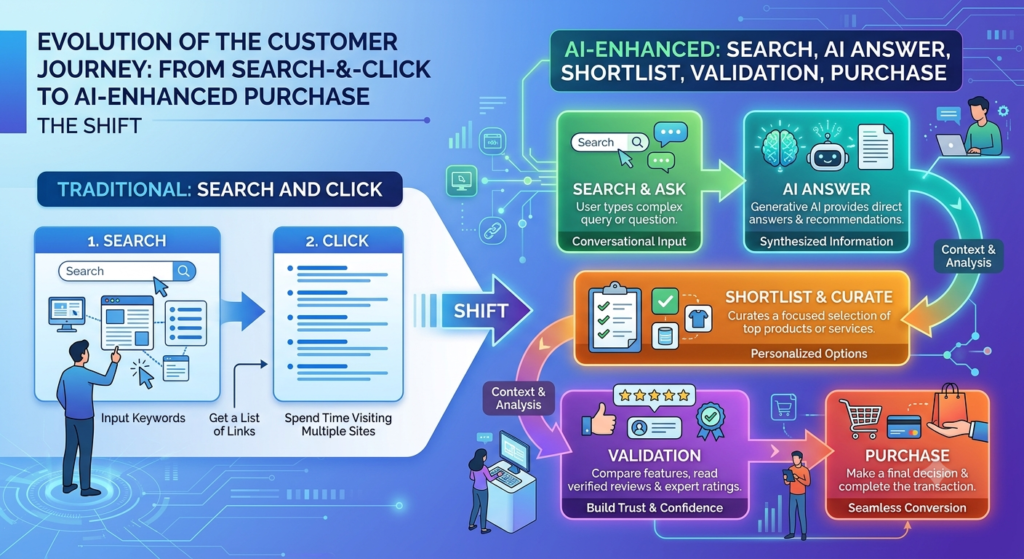
One of the biggest conversations in B2B marketing is the shift from traditional search toward AI-assisted discovery.
For years, the basic digital discovery model was straightforward:
Search → Click → Website → Content → Conversion
That journey is becoming less predictable.
AI search tools can summarize information, compare vendors, answer questions, identify relevant solutions, and help buyers build an initial shortlist without requiring them to visit multiple websites.
LinkedIn described this shift in January 2026, noting that discovery increasingly happens inside AI-generated answers, summaries, and assistants, sometimes without a website click.
G2’s 2026 AI Search Insight Report provides another indication of the change. In its survey of more than 1,000 B2B software buyers and decision-makers, 71% said they use AI chatbots for software research, while 51% said they start their software research with an AI chatbot more often than Google.
This does not mean traditional search has disappeared. G2 also reports that 80% of surveyed buyers still use Google somewhere during their buying journey.
The important conversation is therefore not “SEO is dead.”
The more relevant question is:
Can your brand be discovered, understood, and accurately represented across both traditional search and AI-generated answers?
That is pushing B2B marketers toward approaches such as:
- Answer Engine Optimization
- Strong first-party content
- Expert-led articles
- Original research
- Clear product and service information
- Structured website content
- Customer proof
- Consistent brand positioning
- Content that directly answers buyer questions
For B2B companies, this makes brand visibility increasingly dependent on the information available across the wider digital ecosystem.
Useful resource: LinkedIn: How LinkedIn Marketing Is Adapting to AI-Led Discovery
2. The AI Conversation Is Moving From Content Creation to AI Agents
Another major B2B marketing conversation is moving beyond generative AI for writing.
In the early stages of AI adoption, marketers often focused on using AI to generate blog ideas, email drafts, social posts, headlines, images, and campaign variations.
That is still happening, but the conversation is becoming more operational.
Marketers are increasingly exploring AI for:
- Campaign analysis
- Audience research
- Lead qualification
- Personalization
- Data analysis
- Workflow automation
- Content distribution
- Performance monitoring
- Forecasting
- Campaign optimization
HubSpot’s 2026 State of AI in Marketing reports that 86% of marketers use AI agents, with 76% saying their use of agents has increased over the previous six months.
LinkedIn’s 2026 B2B Marketing Insights also reported that 95% of B2B marketers in its 2025 benchmark use AI at least weekly, while 65% use it daily.
This changes the strategic question.
Instead of asking:
“How can we use AI to create more content?”
Marketing teams are asking:
“Which parts of our marketing workflow should AI handle, and where should humans remain involved?”
That distinction matters.
More automation does not automatically mean better marketing. AI can increase production speed, but strategy, positioning, customer understanding, creative judgment, governance, and relationship building still require human involvement.
Content Marketing Institute’s 2026 B2B research found that 95% of surveyed B2B marketers use AI-powered applications, but most organizations were still in exploratory or developing stages of implementation.
The conversation is therefore shifting from AI experimentation toward AI maturity.
3. Are We Creating Too Much Content?
The B2B industry has spent years being told to create more content.
More blogs.
More ebooks.
More social posts.
More webinars.
More videos.
More newsletters.
But 2026 is bringing a different question:
Does the market really need more content?
HubSpot’s 2026 State of Marketing found that 56% of marketers believe the internet is now flooded with AI-generated content. The same report found that 62.7% believe brands need more unique, human-centered content to compete with AI-generated material.
This is creating an important tension.
AI makes content production easier, but easier production can increase content volume across the entire market.
That means generic content becomes easier to ignore.
A B2B buyer does not necessarily need another article explaining what lead generation is. They may need:
- A specific benchmark
- An original perspective
- A practical framework
- A customer example
- Industry-specific insight
- A useful comparison
- A first-hand lesson
- Data that helps them make a decision
The competitive advantage may therefore move from content production toward content usefulness.
For B2B marketing teams, that means every piece of content should have a reason to exist.
Before publishing, marketers can ask:
What does this content tell the audience that they cannot easily find somewhere else?
That simple question can improve editorial quality.
4. Human Expertise Is Becoming More Valuable
The rise of AI is creating another conversation around human expertise.
If everyone has access to tools that can generate polished paragraphs, summaries, and social posts, what makes one B2B brand more credible than another?
The answer increasingly involves people.
LinkedIn’s 2026 Global B2B Marketing Outlook found that 83% of surveyed B2B marketers said credibility matters more than traditional brand messaging. The same research found that 70% of marketers said buyers rely more on peer voices and experts than brand-produced content.
This is helping explain the growth of:
- Executive thought leadership
- Industry creators
- Subject matter experts
- Employee voices
- Customer stories
- Expert interviews
- Founder-led content
- Professional communities
The role of the company page is not disappearing. Instead, B2B brands are increasingly building a network of credible people around the brand.
That can make expertise more visible and give buyers more opportunities to evaluate how a company thinks.
5. B2B Video Is No Longer Just a Brand Awareness Tool
Video is another conversation receiving significant attention.
B2B marketing has traditionally relied heavily on written content, presentations, whitepapers, webinars, case studies, and email.
Those formats remain important, but video is becoming more integrated into the buying journey.
LinkedIn reported in March 2026 that 81% of B2B CMOs surveyed believed video accelerates sales cycles compared with other formats, while 79% agreed that video accelerates lead conversion. The research surveyed 1,299 B2B marketers across the United States, United Kingdom, France, Germany, and India.
This does not mean every B2B company needs to become a media company.
Instead, marketers can use video where it adds clarity or credibility.
For example:
Awareness
Short expert videos can explain an industry problem.
Consideration
Product demonstrations can show how a solution works.
Evaluation
Customer interviews can provide social proof.
Decision
Executive videos can address common objections.
Retention
Educational videos can help customers use a product or service more effectively.
The bigger shift is that video is increasingly becoming part of the entire buyer journey rather than a format reserved for awareness campaigns.
6. Creator Marketing Is Entering B2B Conversations
The word “creator” has traditionally been associated with consumer marketing.
That is changing.
B2B buyers also follow experts, analysts, consultants, founders, technology specialists, researchers, and industry commentators.
LinkedIn’s 2026 research found that 56% of B2B buyers who use creators rely on creator input during the final stage of the buying process to validate recommendations.
That is significant because it suggests creator influence is not necessarily limited to early awareness.
A trusted expert can become part of the validation process.
For B2B marketers, the opportunity is not simply paying someone to promote a product.
It can involve building meaningful relationships with people who already understand the audience.
Potential formats include:
- Expert interviews
- Co-created research
- Industry discussions
- LinkedIn video series
- Podcast appearances
- Event collaborations
- Roundtable conversations
- Thought leadership partnerships
The focus should remain on expertise and relevance.
A creator with a large audience is not automatically useful for every B2B campaign. Audience alignment, credibility, subject expertise, and buyer relevance all matter.
7. Demand Generation Is Moving Beyond Lead Volume
Another conversation gaining importance is the difference between generating leads and generating demand.
A campaign can generate hundreds of form fills without creating meaningful pipeline.
That has pushed B2B marketers to look beyond simple lead counts.
Instead, teams are increasingly examining:
- Account engagement
- Content consumption
- Buyer intent
- Sales acceptance
- Pipeline contribution
- Opportunity creation
- Conversion velocity
- Customer acquisition cost
- Revenue influence
LinkedIn’s 2026 B2B insights specifically identified demand generation as evolving beyond leads toward long-term pipeline health.
This creates a more useful conversation between marketing and sales.
Instead of asking:
“How many leads did marketing generate?”
Teams can ask:
“Which accounts are showing meaningful buying activity, and what should happen next?”
That is a more connected way to think about demand generation.
8. Measurement Is Becoming a Bigger Part of the Marketing Conversation
As marketing channels multiply, measurement becomes harder.
A buyer might:
- See a LinkedIn post.
- Watch a video.
- Search the company on Google.
- Ask an AI chatbot about the category.
- Read a third-party article.
- Visit the website.
- Download a report.
- Return through email.
- Speak with sales.
- Become an opportunity weeks later.
Which channel gets credit?
The answer is rarely simple.
HubSpot’s 2026 State of Marketing identifies measuring marketing ROI as the top challenge cited by 33% of marketers in its survey.
This is why B2B teams are increasingly discussing measurement frameworks that combine quantitative and qualitative signals.
Instead of measuring only:
Clicks + Downloads + Leads
marketers can build a broader picture:
Engagement + Intent + Account Activity + Pipeline + Revenue
This also makes marketing reporting more useful for leadership.
The objective is not to prove that every marketing interaction directly created revenue. The objective is to understand how different interactions contribute to buyer progression.
9. Personalization Is Becoming More Data-Dependent
Personalization remains another major topic, but the conversation has changed.
Adding a prospect’s first name to an email is no longer considered meaningful personalization.
B2B buyers increasingly expect content and communication to reflect their industry, role, challenges, buying stage, and interests.
HubSpot reports that 93.2% of surveyed marketers say personalized or segmented experiences have led to more leads and purchases. At the same time, only 65% said they have high-quality audience data.
That creates a clear challenge.
Better personalization requires better data.
If the database contains outdated job titles, incorrect company information, duplicate records, invalid email addresses, or incomplete firmographic information, even sophisticated personalization can become ineffective.
This puts data quality, enrichment, verification, segmentation, and governance back into the center of B2B marketing discussions.
AI can help process data faster, but the underlying data still needs to be reliable.
10. The B2B Buyer Journey Is Becoming Less Linear
Perhaps the biggest conversation connecting all these trends is the changing B2B buyer journey.
The traditional funnel suggests a relatively predictable progression:
Awareness → Consideration → Decision
Today’s journey can be much more fragmented.
A buyer may discover an idea through social media, research it through an AI assistant, discuss it internally, watch a YouTube video, read reviews, visit a vendor website, speak to peers, return to search, and only later engage with sales.
McKinsey’s 2026 B2B research, based on its survey of nearly 4,000 buyers and sellers across 13 countries, describes AI and agentic technology as changing established B2B sales playbooks while emphasizing that understanding customer needs and building trusted relationships remain important.
This means marketing teams need to think less about forcing buyers through a predetermined funnel and more about being useful across multiple buyer touchpoints.
The question becomes:
Can your brand provide the right information wherever the buyer happens to be researching?
What These Conversations Mean for B2B Marketers
Although these conversations cover different areas, they are connected by a common theme.
B2B marketing is becoming more buyer-led, more data-informed, and more dependent on credibility.
AI is changing discovery.
Video is changing communication.
Creators are changing trust.
Data is changing personalization.
Measurement is changing accountability.
And demand generation is becoming increasingly connected to revenue rather than simply lead volume.
For marketing teams, this does not necessarily mean abandoning the channels and strategies that already work.
It means adapting them.
A strong B2B content strategy can still include blogs, email, social media, webinars, whitepapers, events, and search. The difference is that these assets now need to work together across a more complex buyer journey.
A Practical B2B Marketing Checklist for 2026
As these conversations continue to develop, B2B marketing teams can review five areas:
1. AI Visibility
Can buyers discover and understand your brand through AI-powered search and answer engines?
2. Content Quality
Does your content provide original insight, useful evidence, or genuine expertise?
3. Human Credibility
Are real experts, customers, executives, and industry voices visible in your marketing?
4. Buyer Intelligence
Are you measuring meaningful engagement rather than relying exclusively on lead volume?
5. Data Quality
Can your marketing systems support accurate segmentation, personalization, targeting, and reporting?
These areas provide a practical framework for evaluating whether a B2B marketing strategy is keeping pace with the conversations shaping the industry.
Final Thoughts: From More Marketing to More Meaningful Marketing
The most interesting B2B marketing conversation right now is not simply about which new platform marketers should use.
It is about how buyers are changing the way they discover information, evaluate companies, build trust, and make decisions.
AI is accelerating that change, but it is not eliminating the fundamentals.
Buyers still need useful information.
They still need credible expertise.
They still need evidence.
They still need confidence.
And they still need a reason to trust the company behind the message.
The opportunity for B2B marketers is to combine technology with those fundamentals.
Use AI to improve speed and intelligence. Use data to understand audiences. Use video and social content to make expertise accessible. Use creators and customer voices to strengthen credibility. Use measurement to understand what contributes to pipeline.
Most importantly, focus less on simply producing more marketing and more on creating marketing that helps buyers make better-informed decisions.
That is where the B2B marketing conversation is heading.
Frequently Asked Questions
The major B2B marketing conversations include AI-powered search, AI agents, content quality, video marketing, creator influence, demand generation, marketing measurement, personalization, data quality, and the changing B2B buyer journey.
AI is changing B2B marketing across search, content creation, audience research, personalization, campaign analysis, lead qualification, automation, and reporting. Marketers are increasingly moving from using AI only for content creation toward integrating AI into broader marketing workflows.
Yes. Traditional search remains an important source of B2B discovery. However, marketers also need to consider how their content appears in AI-generated answers and other emerging discovery experiences. A strong strategy should address both traditional search visibility and AI-driven discovery.
AI has made it easier to produce large amounts of generic content. As content volume increases, original research, expert opinions, customer experiences, proprietary data, practical insights, and industry-specific perspectives can help a brand provide information that is more useful and differentiated.
Video is increasingly being used across the B2B buyer journey, including awareness, education, product evaluation, customer proof, and decision support. Short-form videos, expert interviews, product demonstrations, webinars, and customer stories can all support different stages of the buying process.
B2B creators can provide industry expertise, independent perspectives, education, and credibility. Rather than focusing only on audience size, B2B marketers should consider whether a creator’s expertise, audience, and subject matter align with the company’s target buyers.
Demand generation is increasingly moving beyond lead volume toward buyer engagement, account activity, intent, pipeline contribution, opportunity creation, and revenue influence. This allows marketing teams to focus more closely on the quality and progression of demand.
Accurate data supports targeting, segmentation, personalization, lead qualification, campaign execution, and reporting. Incomplete or outdated information can reduce campaign effectiveness and make it harder for marketing and sales teams to identify and engage the right buyers.
B2B personalization means tailoring marketing experiences based on relevant information such as industry, company characteristics, job role, business challenges, interests, engagement, and buying stage. Effective personalization goes beyond simply adding a prospect’s name to an email.
B2B marketers can combine traditional campaign metrics with business-oriented indicators such as account engagement, qualified opportunities, pipeline contribution, conversion rates, customer acquisition cost, sales velocity, and revenue influence.
Yes. B2B buyers can now research through search engines, AI tools, social networks, videos, communities, third-party websites, reviews, and conversations with colleagues before speaking with a sales representative. This creates a more fragmented and less predictable journey.
B2B marketers should focus on being discoverable across traditional and AI-powered search, creating useful and original content, building credible expert voices, using data responsibly, improving buyer intelligence, and connecting marketing activity to meaningful business outcomes.