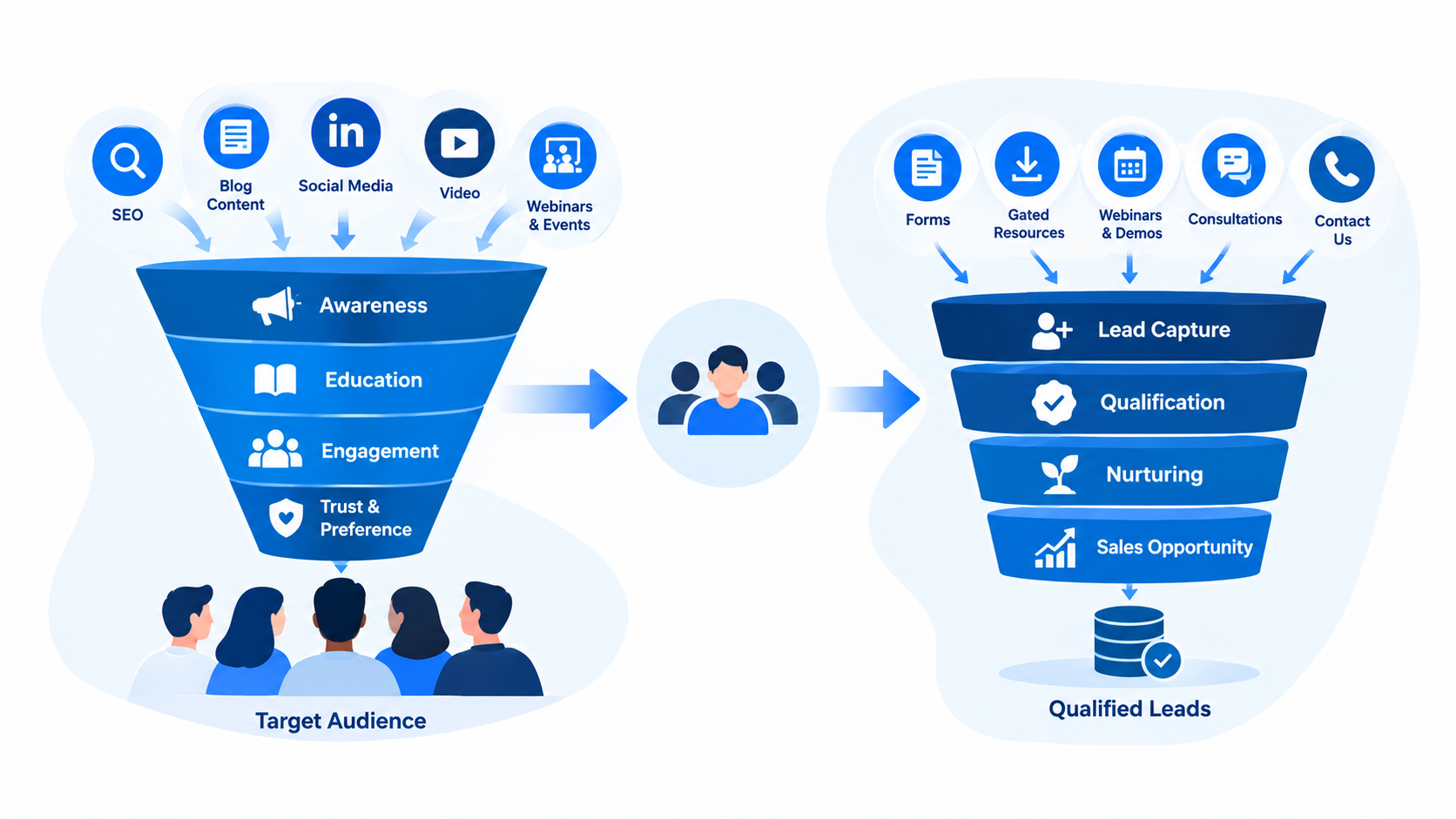
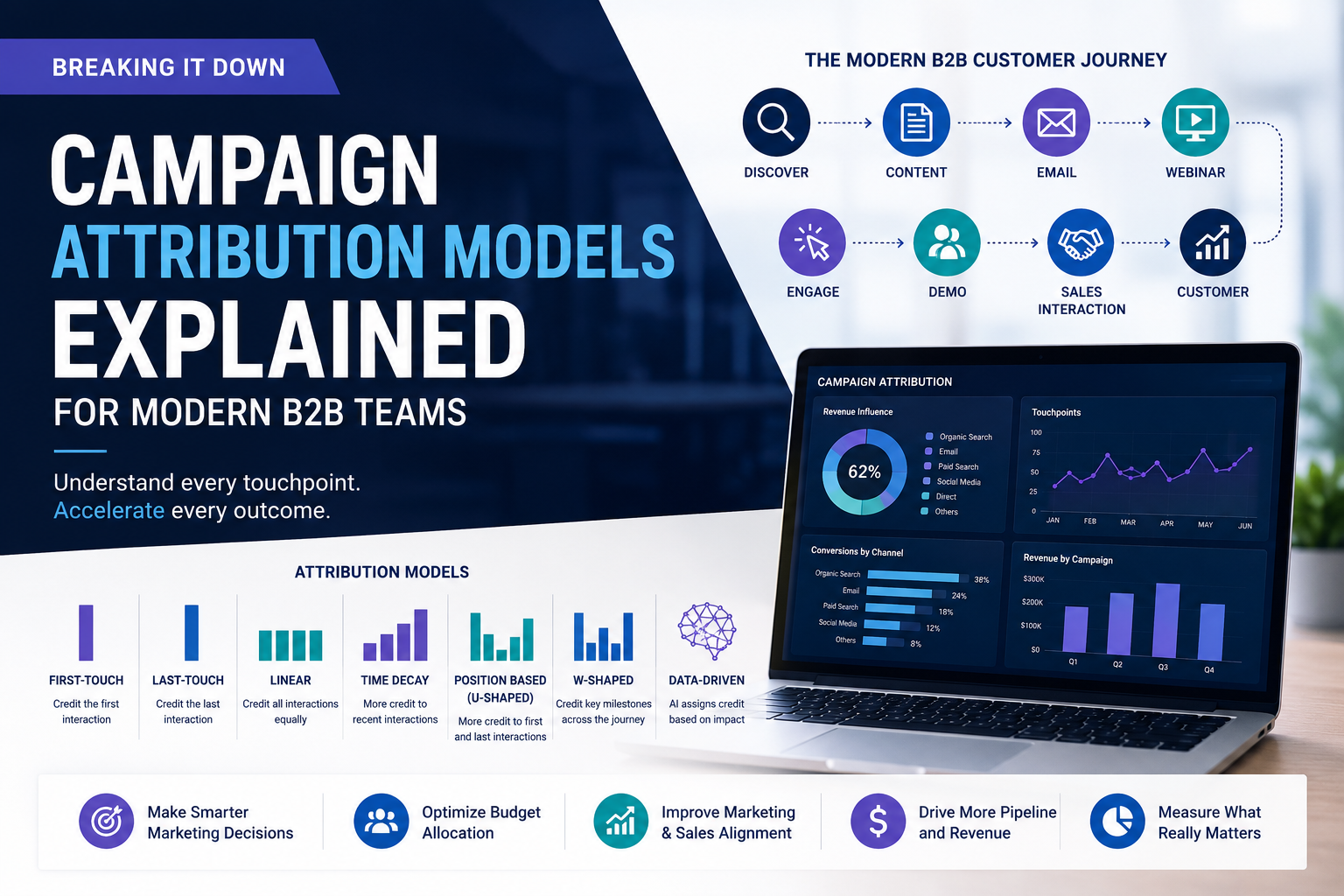

In today’s B2B marketing landscape, buyers rarely convert after a single interaction. Instead, they move through a long and complex journey involving blog articles, webinars, email campaigns, social media, paid advertising, whitepapers, case studies, product demos, and conversations with sales teams.
A prospect might first discover your company through a LinkedIn post, download an industry report a week later, attend a webinar after receiving an email invitation, and finally request a demo after seeing a retargeting ad.
The question is:
Which marketing activity deserves credit for generating that customer?
This is where campaign attribution becomes one of the most valuable measurement strategies for modern marketing teams.
Without attribution, organizations often invest more budget into channels that appear successful while underestimating campaigns that actually influenced the buying decision.
This guide breaks down campaign attribution models, explains when to use each model, and helps modern B2B marketers choose the right approach.
What Is Campaign Attribution?
Campaign attribution is the process of assigning credit to different marketing touchpoints that influence a lead before conversion.
Rather than asking:
“Where did this customer come from?”
Modern attribution asks:
“What combination of marketing interactions helped create this customer?”
Every touchpoint contributes differently.
Examples include:
- Organic search
- Paid search
- LinkedIn campaigns
- Display advertising
- Email nurturing
- Webinars
- Whitepapers
- Podcasts
- Events
- Sales outreach
- Referral traffic
- Direct website visits
Attribution helps marketing teams understand which of these interactions actually influence pipeline and revenue.
Why Attribution Matters More Than Ever
Modern B2B buying committees often involve multiple stakeholders.
Research consistently shows that enterprise purchases involve several decision-makers, each interacting with different marketing assets throughout an extended buying cycle.
Without attribution:
- Marketing ROI becomes unclear.
- Budget allocation becomes inaccurate.
- High-performing campaigns are overlooked.
- Sales and marketing alignment weakens.
- Leadership lacks confidence in reporting.
Accurate attribution enables smarter decisions and stronger collaboration.
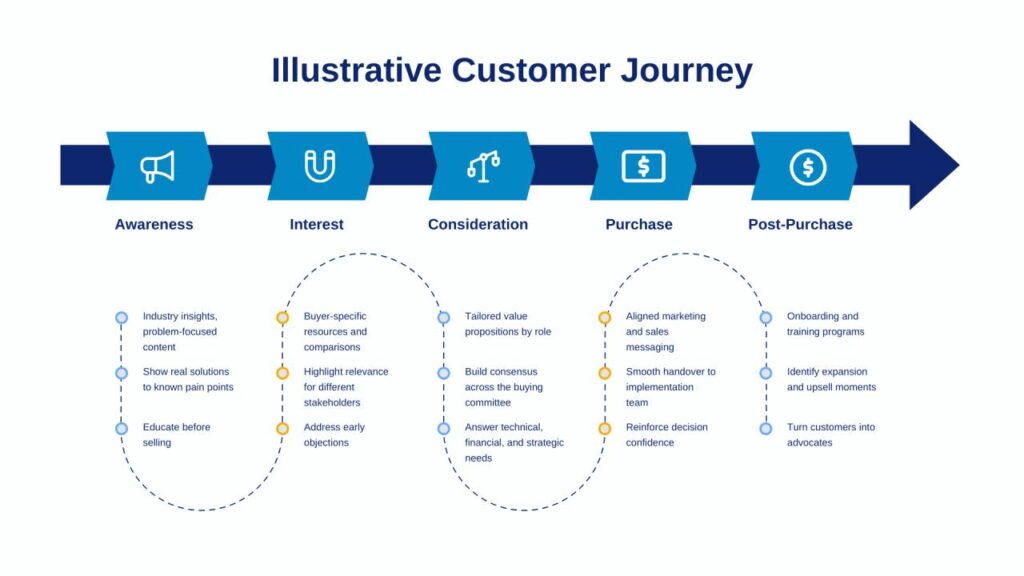
Typical Modern B2B Customer Journey
The journey may look like this:
| Day | Customer Action | Marketing Channel |
|---|---|---|
| Day 1 | Google Search | Organic Search |
| Day 4 | Reads Blog | Content Marketing |
| Day 8 | Downloads Whitepaper | Lead Magnet |
| Day 12 | Opens Email | Email Marketing |
| Day 18 | Attends Webinar | Events |
| Day 25 | Requests Demo | Sales |
| Day 35 | Purchases | CRM |
Attribution identifies which of these interactions deserve recognition.
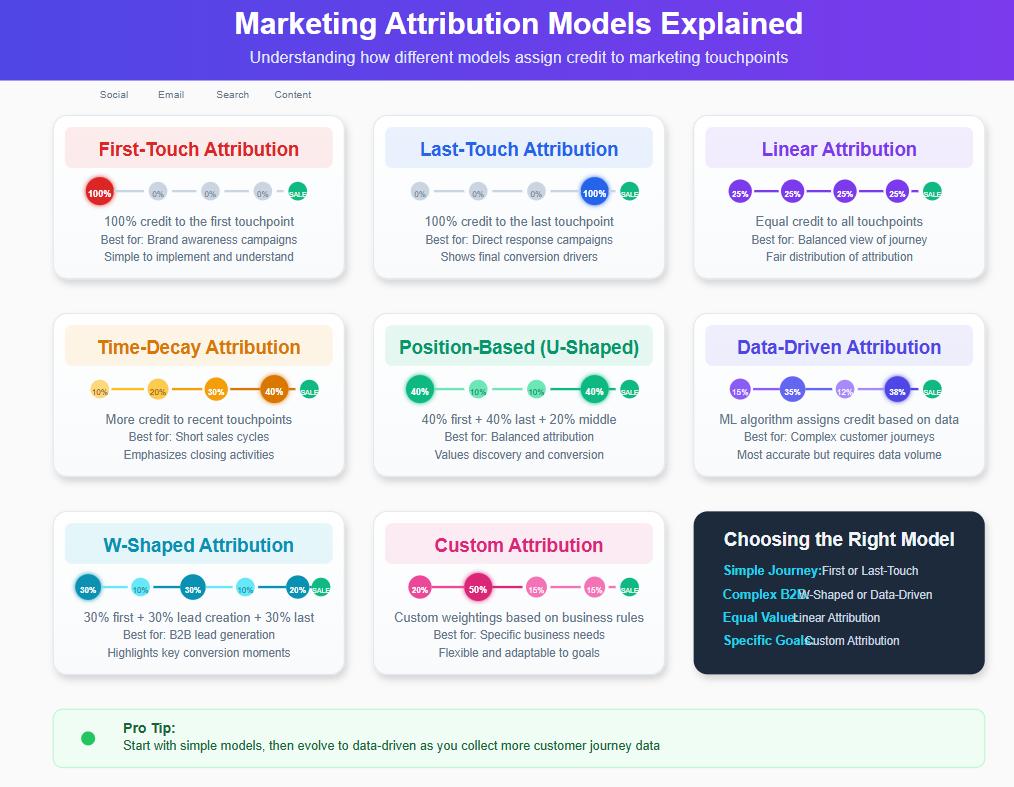
The Most Common Attribution Models
Let’s break each model down.
1. First-Touch Attribution
First-touch attribution gives 100% of the credit to the first marketing interaction.
Example:
| Customer Journey | Attribution Credit |
|---|---|
| Google Search | ✅ 100% |
| Blog | 0% |
| 0% | |
| Webinar | 0% |
| Demo | 0% |
Credit goes entirely to:
Google Search
Advantages
- Easy to understand
- Measures awareness campaigns
- Useful for demand generation
Disadvantages
- Ignores everything after the first interaction
- Doesn’t reflect long buying journeys
Best for:
- Brand awareness campaigns
- New audience acquisition
2. Last-Touch Attribution
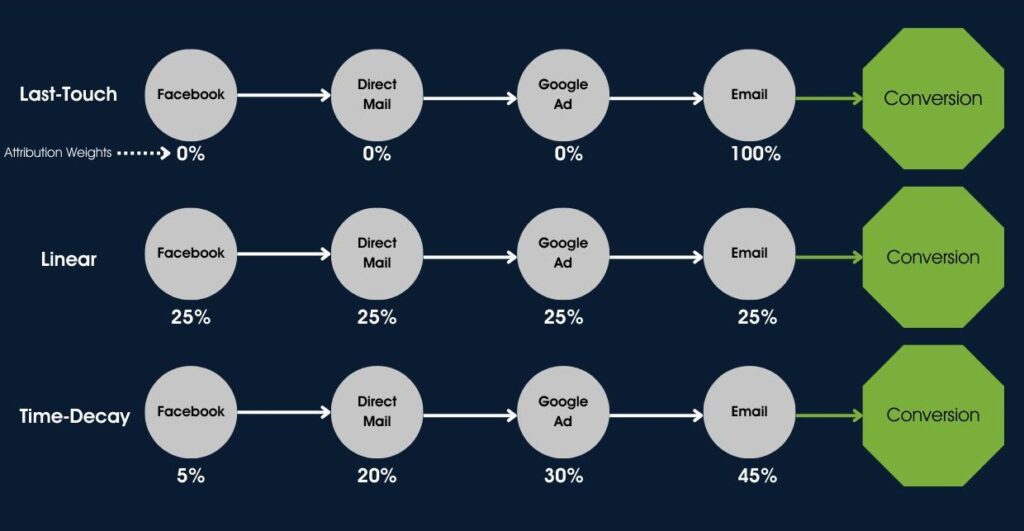
Last-touch gives all credit to the final interaction before conversion.
Example:
| Customer Journey | Attribution Credit |
|---|---|
| Google Search | 0% |
| Blog | 0% |
| 0% | |
| Webinar | 0% |
| Product Demo | ✅ 100% |
Credit:
Demo Request
Advantages:
- Simple reporting
- Easy CRM integration
- Useful for measuring conversion campaigns
Disadvantages:
- Ignores earlier marketing efforts
- Can undervalue content marketing
3. Linear Attribution
Linear attribution distributes credit equally across every touchpoint.
Example:
| Touchpoint | Credit |
|---|---|
| Google Search | 20% |
| Blog | 20% |
| 20% | |
| Webinar | 20% |
| Product Demo | 20% |
Benefits:
- Recognizes the entire customer journey
- Balanced reporting
- Easy explanation
Limitations:
- Assumes every interaction is equally important
- Not always realistic
4. Time Decay Attribution
This model gives increasing credit to interactions closer to conversion.
Example:
| Customer Touchpoint | Credit Assigned | Why It Receives This Credit |
|---|---|---|
| Blog Article | 5% | Introduced the prospect to the brand |
| Whitepaper Download | 10% | Increased product awareness |
| Email Nurture | 20% | Continued engagement |
| Webinar Attendance | 25% | Demonstrated buying intent |
| Product Demo | 40% | Final interaction before conversion |
This reflects the idea that recent interactions often have a stronger influence on the purchase decision.
Ideal for:
- Long sales cycles
- Enterprise software
- B2B technology companies
5. Position-Based Attribution (U-Shaped)
One of the most popular B2B models.
Typical credit distribution:
| Touchpoint | Credit |
|---|---|
| First Website Visit | 40% |
| Blog | 10% |
| 10% | |
| Webinar | 0% |
| Product Demo (Lead Conversion) | 40% |
Benefits:
- Rewards acquisition
- Rewards conversion
- Still values nurturing
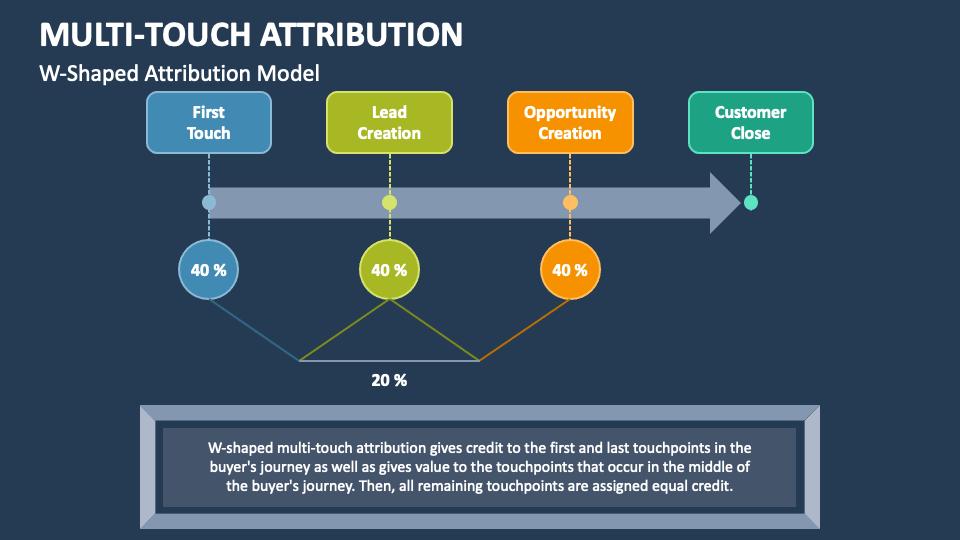
6. W-Shaped Attribution
Designed specifically for B2B demand generation.
Credit is divided among:
| Marketing Milestone | Credit |
|---|---|
| First Touch | 30% |
| Lead Created | 30% |
| Opportunity Created | 30% |
| Remaining Touchpoints | 10% |
Each milestone receives significant credit, with the remaining percentage spread across other interactions.
This model aligns well with CRM stages and provides visibility into how marketing contributes throughout the funnel.
7. Full-Path Attribution
Full-path attribution expands on W-shaped models by including:
| Stage | Credit |
|---|---|
| First Touch | 22.5% |
| Lead Creation | 22.5% |
| Opportunity Creation | 22.5% |
| Closed Deal | 22.5% |
| Remaining Touchpoints | 10% |
Every major revenue milestone receives credit.
Marketing and sales activities are both included.
Best suited for organizations with mature CRM and marketing automation systems.
8. Data-Driven Attribution
The most advanced model.
Instead of fixed percentages, machine learning analyzes historical customer journeys to determine the actual contribution of each interaction.
It considers:
- Conversion probability
- Historical behavior
- Channel performance
- Customer segments
- Campaign influence
Large organizations increasingly adopt data-driven attribution for more accurate insights.
Comparing Attribution Models
| Attribution Model | Best For | Complexity |
|---|---|---|
| First Touch | Brand Awareness | Low |
| Last Touch | Conversion Tracking | Low |
| Linear | Balanced Reporting | Medium |
| Time Decay | Long Sales Cycles | Medium |
| Position-Based | Lead Generation | Medium |
| W-Shaped | Demand Generation | High |
| Full Path | Revenue Attribution | High |
| Data-Driven | Enterprise Analytics | Very High |
Attribution Challenges in Modern B2B
Even the best attribution models face real-world limitations.
Common challenges include:
Cross-Device Behavior
Buyers switch between mobile, desktop, and tablet, making it difficult to connect all interactions to a single journey.
Long Sales Cycles
B2B purchases often take months, with numerous touchpoints across different channels.
Offline Interactions
Events, phone calls, conferences, and face-to-face meetings are harder to capture within digital attribution systems.
Multiple Decision-Makers
Buying committees consist of several stakeholders, each engaging with different content and campaigns.
Data Quality
Incomplete CRM records, duplicate contacts, and inconsistent campaign tagging can distort attribution insights.
Best Practices for Modern B2B Attribution
To build a reliable attribution strategy:
- Define clear campaign goals.
- Use consistent UTM parameters across channels.
- Integrate CRM with marketing automation.
- Align marketing and sales on lifecycle stages.
- Track both online and offline interactions where possible.
- Regularly audit data quality and attribution settings.
- Compare insights from multiple attribution models instead of relying on a single view.
Recommended Attribution Tools
Several platforms support advanced attribution reporting:
- HubSpot Marketing Hub
- Salesforce Marketing Cloud
- Google Analytics 4 (GA4)
- Adobe Analytics
- Bizible (Adobe Marketo Measure)
- Dreamdata
- HockeyStack
These tools help connect campaign performance to pipeline and revenue, especially when integrated with CRM and marketing automation systems.
Which Attribution Model Should You Choose?
There is no universal best model. The right choice depends on your business goals and marketing maturity.
- For startups or teams with simple reporting needs: Start with First-Touch or Last-Touch attribution to gain quick insights.
- For growing B2B marketing teams: Linear or Position-Based attribution provides a more balanced view of the customer journey.
- For organizations focused on demand generation: W-Shaped or Full-Path attribution aligns well with lead, opportunity, and revenue milestones.
- For enterprise businesses with robust data infrastructure: Data-Driven attribution offers the most sophisticated analysis, provided you have enough historical data and integrated systems.
Many successful organizations compare multiple attribution models to understand both top-of-funnel influence and bottom-of-funnel conversion performance.
Final Thoughts
Campaign attribution has evolved from a simple reporting metric into a strategic capability for modern B2B marketing teams. As customer journeys become more complex, relying on a single touchpoint to measure success no longer provides an accurate picture of marketing performance.
By understanding the strengths and limitations of different attribution models, marketers can make better budgeting decisions, optimize campaigns with greater confidence, and demonstrate marketing’s contribution to revenue.
Whether you’re just beginning with first-touch reporting or implementing advanced data-driven attribution, the goal remains the same: connect every meaningful interaction to business outcomes. Organizations that invest in accurate attribution are better equipped to improve campaign effectiveness, strengthen sales and marketing alignment, and drive sustainable growth in an increasingly competitive B2B environment.