

The B2B Sales Conversation Starts Long Before the First Meeting
When a prospect books a meeting with a salesperson, it can be tempting to think that the sales process has just begun.
In reality, the buyer may have been researching the company for weeks or even months.
Before agreeing to a sales conversation, a B2B buyer may have seen a LinkedIn post, searched Google for a business problem, read several industry articles, watched a video, downloaded a report, visited a company’s website, compared competitors, discussed potential solutions with colleagues, and used AI tools to gather additional information.
The sales meeting is therefore not always the beginning of the buyer journey.
It is often the point where a long period of independent research begins to turn into a direct conversation.
This shift is important for both marketing and sales teams. If a business only thinks about the buyer when a lead enters the CRM, it may miss most of the activity that influenced the buyer’s decision before that point.
Modern B2B buyers also move between multiple channels during their research. McKinsey’s B2B Pulse research has found that buyers use an average of ten channels across the purchasing journey, showing how fragmented the modern B2B buying experience has become.
The important question is not simply how many leads a campaign generates.
The bigger question is:
How does a buyer move from discovering a company to becoming confident enough to have a sales conversation?
Let’s break down that journey.
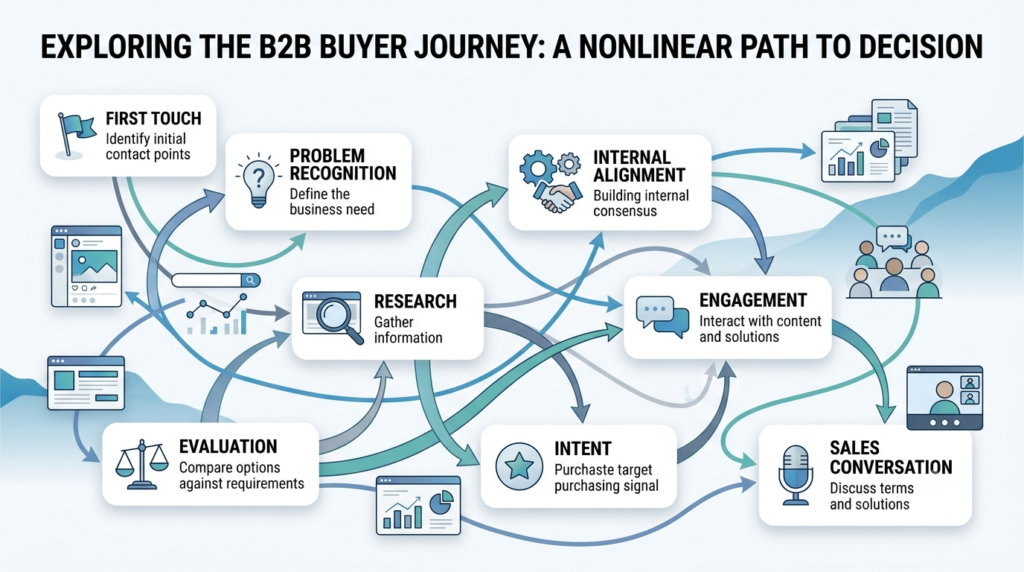
The B2B Buyer Journey Is Not a Straight Line
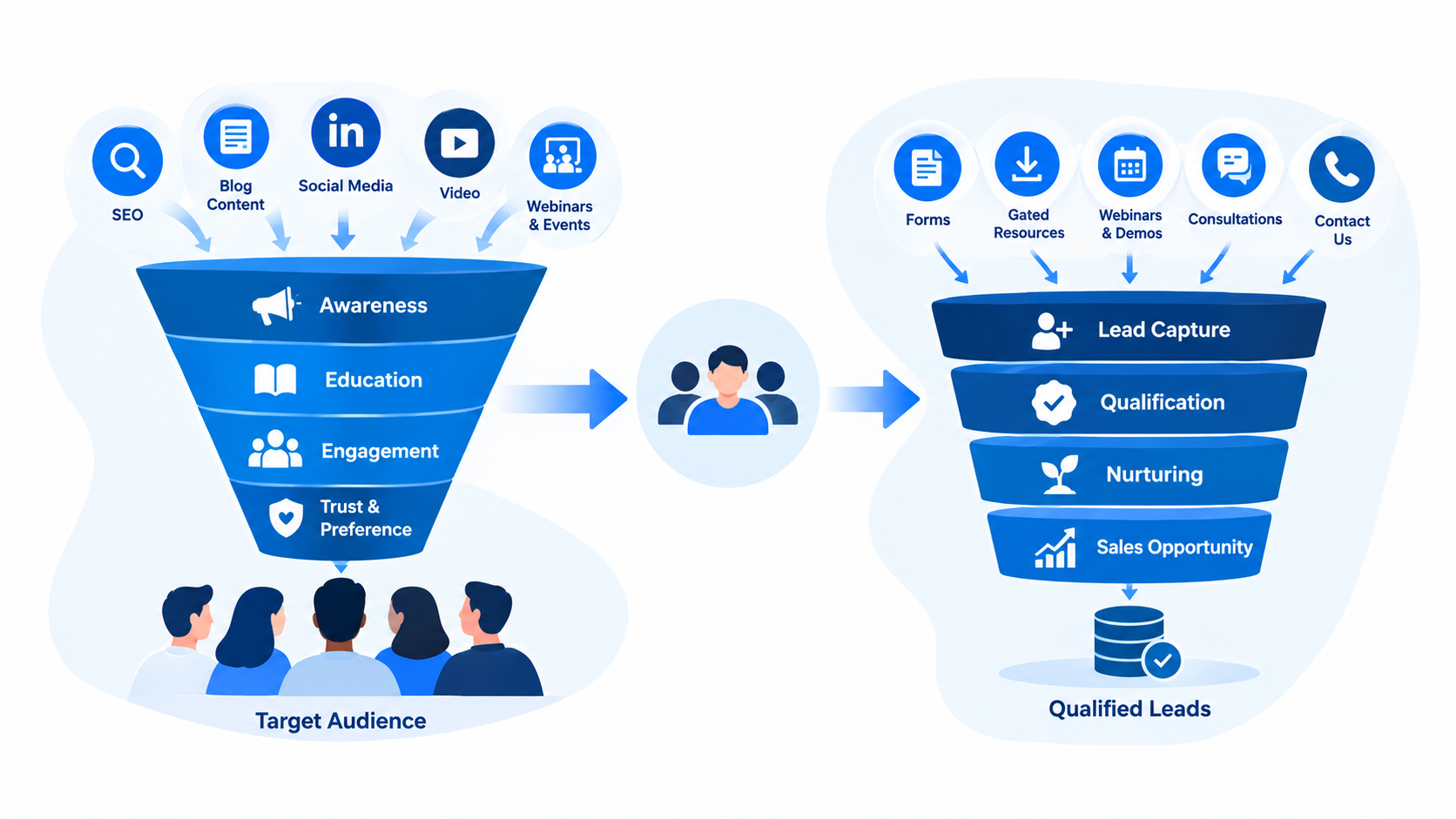
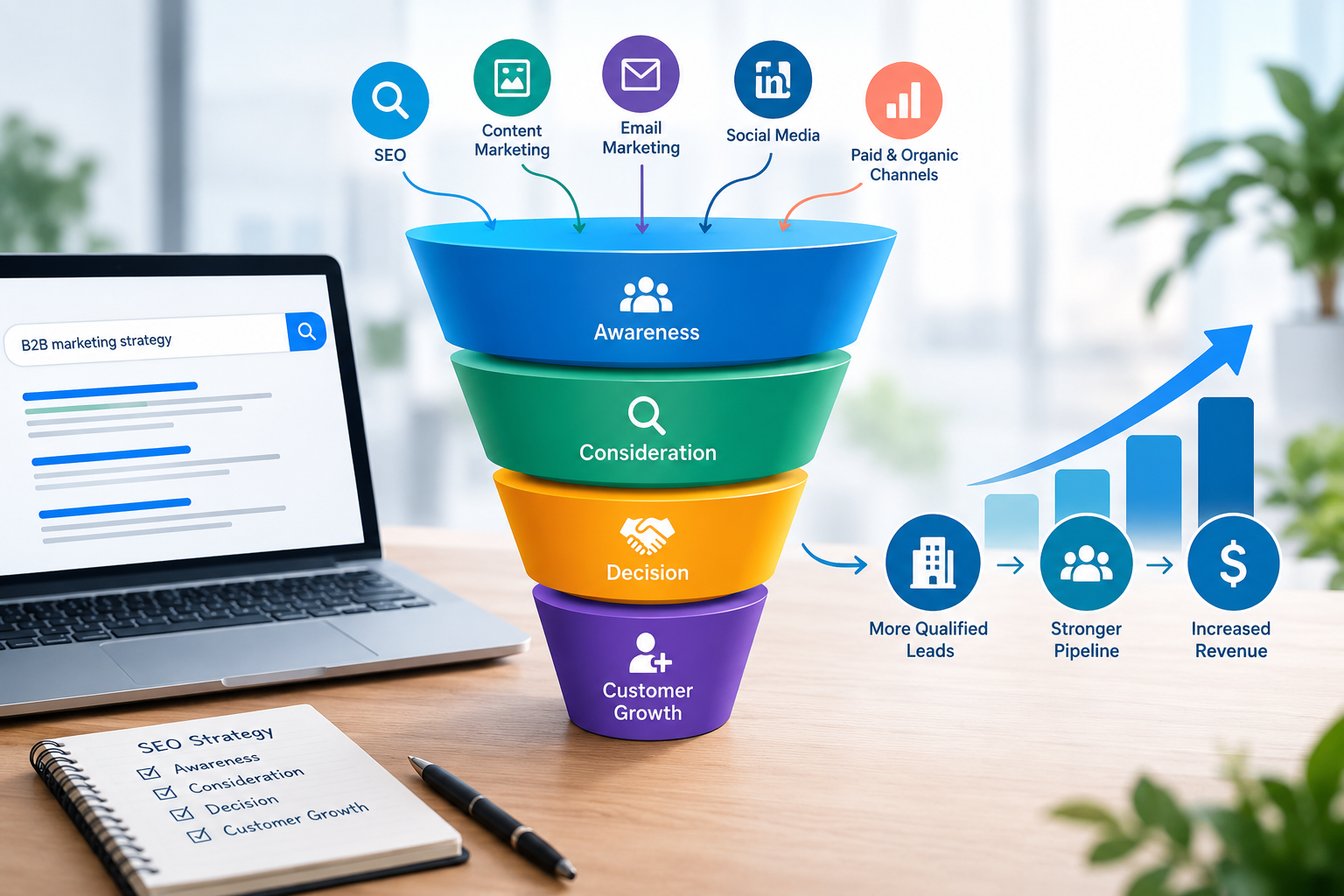
The traditional B2B funnel often presents the buyer journey as a simple sequence:
Awareness → Interest → Consideration → Decision → Purchase
The reality is much more complicated.
A buyer may discover a company through LinkedIn, leave the website, return through Google several days later, read a case study, compare another vendor, discuss the problem with their manager, search for reviews, and then return to the original company’s website.
They may even move backward.
A buyer who was evaluating vendors might return to the research stage after discovering a new requirement from an internal stakeholder.
This is why modern B2B marketing needs to support the buyer across different stages instead of assuming that every prospect follows exactly the same path.
Gartner describes B2B buying as a nonlinear process in which buying groups work through different tasks before reaching a confident decision.
A useful way to think about the journey is:
First Touch → Problem Recognition → Research → Engagement → Evaluation → Internal Alignment → Intent → Sales Readiness → Sales Conversation
These stages are useful as a framework, but they should not be treated as a rigid sequence.
1. First Touch: The Buyer Encounters Your Brand
Every B2B buyer journey has a first interaction, but that interaction can happen almost anywhere.
A prospect might see a LinkedIn post while scrolling through their feed. Another person might find a blog through Google. Someone else might discover the company through an industry publication, webinar, podcast, email, event, referral, or video.
The buyer may not even be looking for a vendor at this point.
They may simply be interested in a business problem or an industry trend.
Imagine a marketing leader responsible for generating qualified pipeline.
They see an article discussing why B2B companies are generating large numbers of leads but struggling to convert those leads into opportunities.
The person may not immediately search for an agency.
Instead, they may think:
“We are seeing the same problem.”
That is the first important moment.
The job of the first touch is not necessarily to generate a meeting. It is to create recognition and relevance.
Good first-touch content gives the buyer a reason to remember the company.
That content can include educational LinkedIn posts, industry articles, research-based insights, short videos, podcasts, newsletters, webinars, infographics, or commentary on important industry developments.
At this stage, the brand is essentially answering one question:
“Why should I pay attention to you?”
2. Problem Recognition: The Buyer Starts Connecting the Dots
After the first interaction, the buyer may begin thinking more seriously about the problem.
The question changes from:
“Is this interesting?”
to:
“Could this be happening in our organization?”
This is where content that explains business problems becomes particularly valuable.
For example, a company experiencing weak sales pipeline may start investigating several possible causes.
Perhaps its ICP is too broad.
Perhaps its database contains outdated contacts.
Perhaps marketing is generating leads that sales does not consider qualified.
Perhaps campaigns are reaching the wrong job functions.
Perhaps the organization is measuring lead volume instead of buyer engagement and intent.
At this stage, buyers are not necessarily ready to speak with sales.
They are trying to understand what is happening.
That distinction is important.
If a company immediately responds to every early interaction with a sales pitch, it can create unnecessary friction.
Educational content should instead help buyers understand the problem.
Articles such as “Why Your MQL Volume Is Growing but Pipeline Is Not” or “What Causes B2B Lead Quality to Decline?” can be more useful at this stage than a direct product pitch.
The buyer needs clarity before they need a vendor.
3. Research: The Buyer Starts Looking for Answers
Once a business problem becomes important enough, research begins.
The buyer may search Google, LinkedIn, industry publications, review platforms, YouTube, online communities, vendor websites, and increasingly, generative AI platforms.
Gartner reported in 2026 that B2B buyers are increasingly using generative AI to gather information about vendors and products. Its research also found that many buyers still turn to sales representatives to validate information and support purchasing decisions.
This creates a major opportunity for B2B content teams.
Your website is no longer the only place where your brand needs to be discoverable.
A buyer could encounter your brand through an article on an industry publication, a LinkedIn post, a Google result, a customer story, a YouTube video, or an AI-generated recommendation before visiting your website.
During research, the buyer may want answers to questions such as:
- What are the available approaches to solving this problem?
- Which technologies or services can help?
- What are other companies doing?
- What mistakes should we avoid?
- What does implementation involve?
- Which vendors specialize in this area?
- What kind of results are realistic?
This is why SEO, thought leadership, social media, video content, case studies, and third-party visibility all contribute to the B2B buying journey.
The buyer may not remember every article they read.
But repeated exposure can build familiarity and credibility.

4. Engagement: The Buyer Starts Giving You Signals
Research eventually creates measurable engagement.
The buyer may visit your website several times, read multiple articles, download a report, watch a video, subscribe to a newsletter, attend a webinar, view a case study, or explore a specific service page.
These actions can provide useful behavioral signals.
However, marketers should be careful not to treat every interaction as buying intent.
Someone downloading an industry report does not automatically mean they are ready for a sales call.
They could simply be conducting research.
The more meaningful signal often comes from patterns of behavior.
For example, consider a visitor who:
- Reads an educational blog.
- Returns a few days later.
- Views a service page.
- Reads a case study.
- Checks another solution page.
- Returns through an email.
- Visits a contact or consultation page.
That pattern tells a much more useful story than a single content download.
The key question for marketing teams becomes:
What is the buyer doing over time?
5. Evaluation: The Buyer Begins Comparing Vendors
At some point, research turns into evaluation.
The buyer now understands the problem and is looking at possible solutions.
The question changes from:
“How can we solve this?”
to:
“Who can help us solve this?”
This is one of the most important stages of the B2B buyer journey.
The buyer may compare several vendors based on their experience, expertise, service capabilities, technology, customer results, pricing, implementation process, responsiveness, scalability, security, and overall fit.
This is where generic marketing claims become less effective.
Statements such as “industry-leading solutions” or “best-in-class service” do not provide enough information for a buyer making a serious purchasing decision.
Buyers want evidence.
They want to see how a company approaches the problem.
They want to understand the process.
They want to know whether similar organizations have achieved meaningful results.
This is why case studies, customer stories, comparison guides, demonstrations, implementation explainers, FAQs, ROI information, and detailed service pages are so important.
A strong evaluation-stage asset should help the buyer answer:
“Why should we seriously consider this company?”
6. Internal Alignment: The Buyer Takes the Research Inside the Company
One of the biggest misconceptions about B2B purchasing is that the person researching a solution is always the person making the final decision.
In reality, B2B purchases often involve multiple stakeholders.
A marketing leader may discover a solution, but the final buying group could include sales leadership, finance, procurement, IT, operations, security, and senior management.
Each stakeholder can have a different question.
A marketing leader may ask whether the solution can improve pipeline.
A sales leader may want to know whether the resulting leads will be useful to sales representatives.
Finance may focus on cost and expected return.
Procurement may want clear commercial terms.
IT may need to understand technology, security, and integration requirements.
Leadership may want to know how the investment contributes to broader business objectives.
This means B2B content needs to be easy to share internally.
A useful case study should not only explain what a company did. It should also make the business impact understandable to someone who was not part of the original research.
A one-page overview can help an internal champion explain the opportunity to leadership.
A technical document can answer questions from IT.
A pricing or implementation guide can help procurement understand the commercial process.
The buyer journey therefore extends beyond the individual.
It becomes a buying group journey.

7. Intent: The Buyer Starts Showing Commercial Interest
As the buying process develops, the buyer’s behavior may become increasingly specific.
Instead of simply reading educational content, they may begin exploring information connected to an actual purchasing decision.
For example, they might repeatedly visit a service page, read multiple case studies, review pricing information, download technical documentation, attend a product-focused webinar, request additional information, or complete a contact form.
No single action should automatically be interpreted as a guaranteed buying signal.
Context matters.
A visitor checking pricing once may still be conducting early research.
A visitor who has repeatedly engaged with solution-specific content and then requests a consultation is showing a much stronger indication of sales readiness.
This is where marketing automation, CRM data, lead scoring, account intelligence, and behavioral analysis can help teams identify meaningful patterns.
The objective is not simply to identify who clicked.
It is to understand who may be moving closer to a decision.
8. Sales Readiness: The Buyer Decides a Conversation Is Worthwhile
Eventually, the buyer may reach a point where digital research is no longer enough.
They have read the content.
They have compared vendors.
They have discussed the problem internally.
They may have narrowed their options.
Now they need answers specific to their organization.
This is where a sales conversation becomes valuable.
The buyer may want to ask:
Can your approach work for our company?
How would implementation work in our environment?
What information would you need from us?
What kind of results could we realistically expect?
How would your approach differ from another vendor?
What happens after we start?
These questions cannot always be answered effectively through generic website content.
They require context.
That is the point at which a sales conversation becomes less about introducing the company and more about understanding the buyer.
9. The Sales Conversation Should Build on the Buyer’s Research
When a buyer finally speaks with sales, the conversation should not feel like the buyer has been sent back to the beginning.
One of the biggest mistakes sales teams can make is repeating information the buyer has already spent weeks researching.
Instead of starting with a long company introduction, the salesperson should try to understand the buyer’s current situation.
For example:
Less effective approach:
“Let me start by telling you about our company and all of the services we provide.”
More useful approach:
“I understand you’re exploring ways to improve the quality of your B2B pipeline. I’d like to understand how you’re currently approaching targeting and qualification and where you’re seeing the biggest challenges.”
The second approach recognizes that the buyer has already done research.
The salesperson’s role is now to add context, expertise, and clarity.
That is where marketing and sales alignment becomes critical.
If marketing knows what content the buyer consumed and sales understands the buyer’s potential business challenge, the first conversation can start at a much more useful level.
The Modern B2B Buyer Uses Many Channels
The buyer journey is also becoming increasingly fragmented.
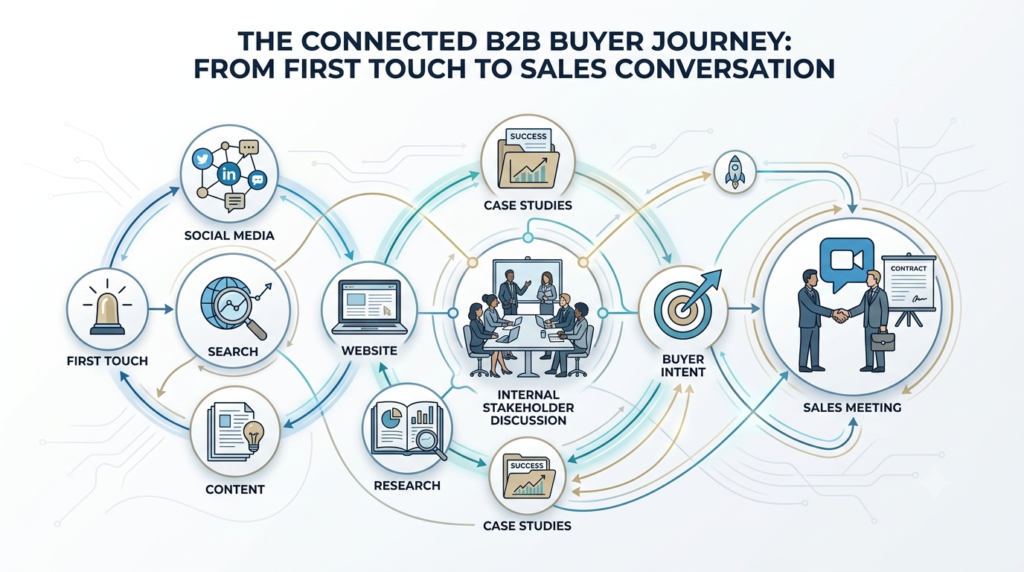
A single buyer may interact with a company through:
LinkedIn → Google → Blog → Email → Webinar → Case Study → Website → AI Research → Sales
These interactions do not necessarily happen in that order.
A buyer may see a LinkedIn post today and return to a case study three weeks later.
Another buyer may discover the company through Google and immediately request a meeting.
Someone else may hear about the company from a colleague and then consume several pieces of content before contacting sales.
This means B2B marketers need to build connected experiences instead of treating every marketing channel as a separate activity.
A LinkedIn post should connect naturally to useful content.
A blog should lead readers toward relevant resources.
A case study should provide evidence for buyers evaluating solutions.
An email should give the recipient a useful reason to return.
The website should make it easy to move from research to action.
Each interaction should make the next step easier.
Why Content Still Matters After the Buyer Finds Your Company
It is easy to think of content marketing as an awareness activity.
In reality, content can influence almost every stage of the B2B buying journey.
An educational blog can help a buyer identify a problem.
A research report can help them understand the market.
A webinar can demonstrate expertise.
A case study can provide evidence.
A comparison article can support vendor evaluation.
An implementation guide can reduce perceived risk.
An ROI-focused resource can help an internal champion justify an investment.
A sales enablement document can help move the final decision forward.
This is why B2B content should not be measured only by traffic.
A page with fewer visitors but strong engagement from relevant decision-makers can be more valuable than a high-traffic article that attracts people who will never become customers.
A Practical Framework for Understanding the B2B Buyer Journey
The following framework can help marketing and sales teams connect buyer behavior with content and sales activity.
| Buyer Stage | What the Buyer Is Thinking | What the Brand Should Provide |
|---|---|---|
| First Touch | “What is this?” | Relevant educational content and useful industry insights |
| Problem Recognition | “Could this problem affect us?” | Research, examples, explanations, and problem-focused content |
| Research | “How can we solve it?” | Guides, articles, webinars, videos, and expert resources |
| Engagement | “Is this company worth exploring?” | Useful website experiences and relevant follow-up content |
| Evaluation | “Which option is right for us?” | Case studies, comparisons, proof, demonstrations, and detailed information |
| Internal Alignment | “Can we justify this internally?” | ROI evidence, one-pagers, implementation information, and stakeholder-specific resources |
| Intent | “Should we contact a vendor?” | Clear next steps, consultations, demos, assessments, and commercial information |
| Sales Readiness | “Can this company solve our situation?” | Relevant sales engagement and expert guidance |
| Sales Conversation | “What should we do next?” | Discovery, recommendations, solution mapping, and clear next steps |
This framework can also help marketing teams identify gaps.
If a company produces plenty of awareness content but has very little evaluation-stage content, buyers may struggle to move forward.
If a company has strong case studies but poor educational content, it may have difficulty attracting buyers in the first place.
The complete journey needs support.
What Should B2B Marketing Teams Measure?
A modern B2B buyer journey cannot be understood through lead volume alone.
Marketing teams should look at how people discover, engage with, evaluate, and eventually interact with the company.
At the awareness stage, useful indicators include organic visibility, social reach, brand searches, website discovery, and content impressions.
During engagement, teams can examine returning visitors, content consumption, video engagement, webinar participation, and email interactions.
During consideration and evaluation, more commercially relevant signals can include case study views, solution-page visits, comparison-content engagement, pricing-page activity, and high-intent form submissions.
At the sales-readiness stage, teams can track meeting requests, qualified leads, sales acceptance, opportunity creation, and conversion rates.
Finally, the most important measurement connects marketing activity to business outcomes such as pipeline, opportunity conversion, customer acquisition cost, and revenue.
The objective is not to prove that every blog generated a sale.
The objective is to understand how different interactions contribute to the buyer’s overall journey.
What This Means for B2B Marketers
The biggest lesson is simple:
The buyer does not experience your marketing funnel the same way your marketing team sees it.
Your team may organize campaigns into awareness, consideration, and conversion.
The buyer experiences a series of questions.
Who are you?
Do you understand my problem?
Can you help solve it?
Who else uses your solution?
Can I trust you?
Will this work for our company?
Can I justify this internally?
What happens if we move forward?
Every piece of content should help answer one or more of these questions.
When a buyer receives useful answers consistently, confidence grows.
And confidence is one of the most important ingredients in a B2B purchasing decision.
The Real Goal Is Not More Leads. It Is Better Buyer Progress.
B2B marketing is often judged by the number of leads generated.
But lead volume alone does not tell the full story.
A database containing thousands of contacts does not necessarily represent a healthy pipeline.
A stronger B2B marketing strategy focuses on whether the right accounts and people are progressing through the buying journey.
A buyer who discovers the brand, understands the problem, researches possible solutions, evaluates the company, shares information internally, demonstrates meaningful intent, and eventually requests a sales conversation is much more valuable than someone who simply fills out a form without any genuine buying interest.
The role of marketing is therefore broader than generating leads.
Marketing helps create understanding.
Content helps create confidence.
Digital experiences help buyers conduct research.
Data helps identify meaningful behavior.
Sales adds human context.
Together, these activities help the buyer move forward.
Final Takeaway: The First Touch Matters More Than It Looks
A B2B sales conversation may last 30 or 60 minutes.
But the buyer’s decision to take that meeting may have been influenced by dozens of interactions that happened before it.
A LinkedIn post may have introduced the problem.
A Google search may have introduced the company.
A blog may have explained the solution.
A case study may have provided evidence.
An email may have brought the buyer back.
An internal discussion may have created urgency.
A comparison may have narrowed the shortlist.
And eventually, the buyer may decide that speaking with sales is the logical next step.
That is the modern B2B buyer journey.
It is not a straight line.
It is not controlled entirely by marketing.
And it does not begin when a lead enters the CRM.
It begins with the first moment a buyer encounters a problem, a question, an insight, or a brand that gives them a reason to pay attention.
For B2B companies, the goal should be to make every interaction useful enough to support the next step.
The better the journey, the better the conversation that comes at the end of it.
Frequently Asked Questions About the B2B Buyer Journey
The B2B buyer journey is the process a business decision-maker or buying group follows from discovering a business problem to researching solutions, evaluating vendors, aligning internally, showing purchase intent, and eventually having a sales conversation or making a purchasing decision.
The main stages typically include first touch, problem recognition, research, engagement, solution evaluation, internal alignment, purchase intent, sales readiness, and the sales conversation. The exact sequence can vary because modern B2B buyers often move between stages rather than following a straight path.
A B2B buyer can discover a company through many channels, including Google search, LinkedIn, industry publications, webinars, email campaigns, videos, events, referrals, podcasts, and increasingly, AI-powered research tools.
There is no universal timeline. The length depends on factors such as the complexity of the solution, purchase value, number of stakeholders, internal approval requirements, industry, budget, and urgency. A simple purchase may move quickly, while an enterprise B2B purchase can involve a much longer research and evaluation process.
B2B buyers commonly look for information about the problem they are trying to solve, potential solutions, vendor expertise, customer results, pricing, implementation, technology, security, support, and expected business outcomes. Case studies, research reports, comparison content, detailed service pages, and educational articles can help answer these questions.
A buyer may be sales-ready when they have developed a clear understanding of their problem, researched potential solutions, evaluated vendors, involved relevant stakeholders, and demonstrated stronger commercial intent. Signals can include requesting a consultation, demo, proposal, assessment, pricing information, or additional vendor-specific information.
Modern B2B buyers often research independently, compare multiple vendors, involve different stakeholders, return to previous information, and use multiple digital and human channels. As a result, buyers can move backward and forward between research, evaluation, and decision-making stages.
Content helps buyers understand their problems, research possible solutions, evaluate vendors, build internal business cases, and reduce purchasing uncertainty. Different content formats serve different stages, including blogs for education, research reports for market understanding, case studies for proof, and implementation guides for decision support.
Marketing teams can analyze patterns such as repeated website visits, engagement with solution pages, case study consumption, pricing-page activity, webinar participation, content downloads, email engagement, and high-intent form submissions. Intent is usually more meaningful when several relevant behaviors occur together rather than relying on one isolated action.
Sales teams should build on the buyer’s existing knowledge instead of repeating basic company information. A strong sales conversation should focus on understanding the buyer’s specific situation, validating their requirements, answering unresolved questions, explaining relevant solutions, and helping them determine the appropriate next step.
Marketing helps buyers move toward sales readiness by providing relevant information, building brand familiarity, demonstrating expertise, addressing objections, and providing evidence that supports evaluation. The goal is not simply to generate more leads but to help the right buyers progress toward meaningful conversations.
Marketing and sales alignment helps ensure that buyers receive a consistent experience throughout the journey. When sales understands the buyer’s potential interests and marketing understands the questions buyers face during evaluation, both teams can create a smoother transition from digital research to human conversation.