
The End of the “All-in-One” Platform: Why 2026 is the Year of Multi-Agent AI Architecture

For the past three years, the B2B tech landscape has been obsessed with the “god model”—the idea that a single, monolithic AI could ingest a complex prompt and spit out a fully formed marketing campaign, a perfect block of code, or a flawless data analysis.
By mid-2026, the verdict is in: that approach doesn’t scale for complex enterprise work.
When you ask a single AI model to execute a 15-step B2B workflow—say, extracting data from a technical whitepaper, applying strict brand formatting rules, generating targeted ad copy, and building the custom HTML/CSS landing page to host it—it inevitably hallucinates or loses the thread. The context window gets muddy, and the output requires heavy human remediation.
The solution driving enterprise automation this year isn’t a smarter singular AI. It is Multi-Agent Systems (MAS).
The Shift from Prompts to Pipelines
Instead of one AI trying to do everything, organizations are deploying networks of highly specialized, narrow-focus AI agents. Each agent is responsible for a single, discrete task. They don’t just answer questions; they collaborate, hand off data, and verify each other’s work autonomously.
Think of it as moving from a brilliant but chaotic solo founder to a highly disciplined, structured corporate department.
What Does an Agentic B2B Workflow Look Like?
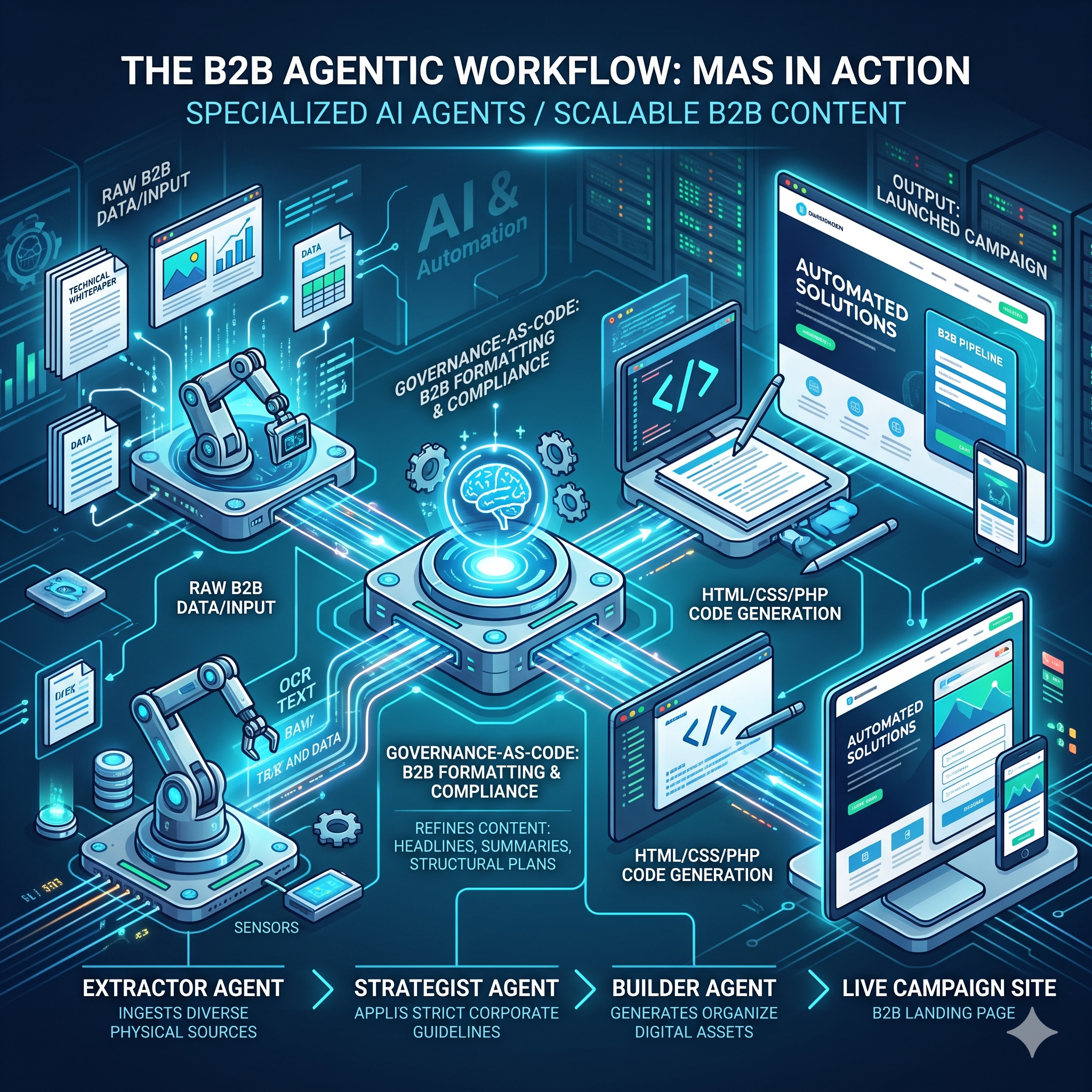
Let’s break down a typical B2B marketing and development pipeline. In a MAS architecture, the process is divided among specialized digital workers:
- The Extractor Agent: Its only job is data ingestion. You feed it a PDF report or a screenshot of a technical chart. Using advanced OCR and visual processing, it extracts the raw text and data points with zero creative license, ensuring the foundational data is perfectly clean.
- The Strategist Agent: This agent receives the raw text. It has been pre-configured with Governance-as-Code to follow your company’s strict B2B formatting rules. It translates the technical data into executive summaries, landing page abstracts, and high-conversion headlines.
- The Deployment Agent: Finally, the approved copy is passed to a specialized coding agent. This agent generates the responsive HTML/CSS structure, applies the necessary styling (like sticky headers and UI animations), and preps the PHP/MySQL backend hooks for the lead-capture form.
Explore how these specialized agents interact and hand off data within a typical B2B pipeline:
Key insight: The true power of MAS isn’t just speed; it’s auditability. If the final landing page has an error, you don’t have to guess where the AI failed. You can check the exact handoff between the Strategist and the Deployment agent to fix the logic.
The Infrastructure Mandate: You Cannot Automate Chaos
The organizations pulling ahead in 2026 realize that deploying agentic AI is fundamentally an engineering and infrastructure challenge, not a software subscription.
To make this work, your backend must be immaculate. Agents need well-documented APIs to communicate. Your databases must be structured so agents can retrieve historical context without hallucinating. And your frontend interfaces must be adaptable enough to present dynamic, AI-generated insights to human overseers cleanly.
We are no longer just writing code to run software; we are writing code to manage digital employees.
The era of “experimenting with AI” is over. It is time to build the factory.