
Introduction
LinkedIn is continuing to expand its role in B2B marketing as businesses look for more effective ways to build brand awareness, reach decision-makers, generate qualified leads, and connect marketing activity with revenue.
During 2026, LinkedIn has introduced and highlighted several platform updates covering advertising creation, event marketing, campaign measurement, AI search visibility, content strategy, and B2B demand generation. Together, these developments point toward a broader shift in how companies can use LinkedIn across the entire buyer journey.
Rather than treating LinkedIn as simply a social network for publishing company updates, B2B marketers can increasingly use the platform as part of an integrated marketing and demand generation system. LinkedIn’s own marketing resources now emphasize areas such as brand building, demand generation, measurement, video, events, creators, and AI visibility.
For B2B organizations, this matters because modern buyers rarely move directly from seeing an advertisement to contacting sales. They research brands, consume educational content, compare providers, watch videos, participate in events, search for recommendations, and involve multiple stakeholders before making a purchasing decision.
LinkedIn’s latest updates are designed to support more of those interactions.
What Is New for B2B Marketers on LinkedIn?
The latest developments can be grouped into several major areas:
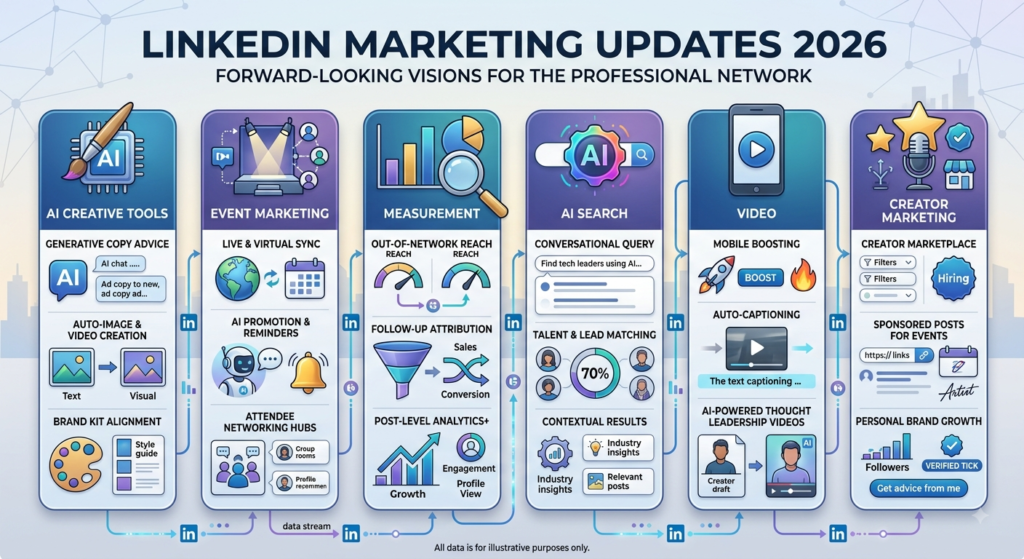
- AI-assisted advertising and creative development
- New event marketing capabilities
- Improved campaign measurement and incrementality
- Greater focus on AI search visibility
- Stronger emphasis on video and creator-led content
- More sophisticated approaches to B2B demand generation
- Greater integration between brand awareness and lead generation
These changes give marketers more opportunities to move prospects from initial awareness toward deeper engagement.
1. LinkedIn Expands AI-Powered Ad Creation Tools
One of the most notable LinkedIn marketing developments in 2026 is the expansion of creative tools designed to make advertising development faster and easier.
In July 2026, LinkedIn highlighted new creative capabilities that include AI-assisted drafting, brand kits, and ad variants. These tools are intended to help marketers move more efficiently from a blank page to advertising creative that aligns with their brand.
For B2B marketing teams, creative production can often become a bottleneck.
A campaign may require multiple headlines, descriptions, visual concepts, calls to action, and variations for different audiences. Traditionally, marketers may need to coordinate between strategy, copywriting, design, demand generation, and advertising teams before launching a campaign.
AI-assisted creative tools can help reduce some of that production friction.
Why This Matters for B2B Lead Generation
B2B advertising usually requires multiple messages because different members of a buying committee have different priorities.
For example:
- A CFO may care about cost and return on investment.
- A CIO may focus on technology integration and security.
- A marketing leader may prioritize pipeline and campaign performance.
- A sales leader may focus on lead quality and conversion.
- An operations executive may care about efficiency and scalability.
A single advertisement may not communicate effectively to every stakeholder.
The ability to create and test variations can therefore help B2B marketers build more relevant campaigns for specific audiences.
However, marketers should not allow automation to replace strategy. AI can accelerate production, but positioning, audience understanding, proof points, and brand differentiation still require human judgment.
This is particularly important as LinkedIn continues to focus on content quality and authenticity. Recent reporting indicates that LinkedIn is taking additional steps to reduce the impact of generic, overly AI-generated content on the platform.
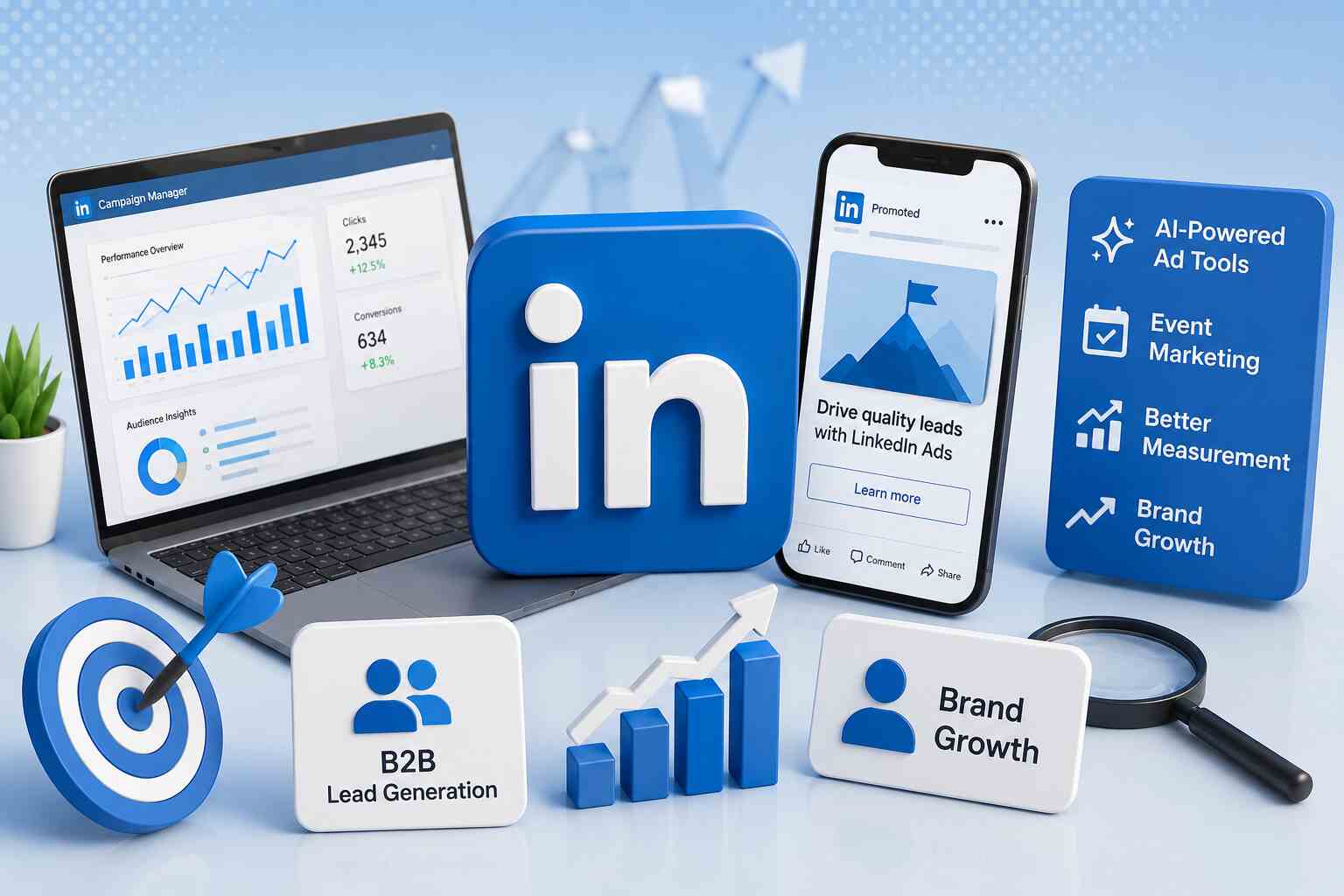
Recommended image: LinkedIn Ads campaign dashboard with AI-assisted creative concepts, headline variations, and B2B targeting elements.
2. New LinkedIn Event Features Support Full-Funnel B2B Marketing
Events are another area receiving significant attention.
In April 2026, LinkedIn announced new event marketing features designed to support the full event lifecycle, including promotion, lead capture, measurement, and extending the value of events beyond the live experience.
This is important because B2B events can generate valuable buying signals.
A prospect who registers for a webinar, attends a product demonstration, downloads an event resource, or interacts with event content may demonstrate stronger intent than someone who simply viewed a standard social post.
LinkedIn’s event updates aim to help marketers capture and use these interactions more effectively.
From Event Registration to Revenue
A modern B2B event campaign can follow a journey such as:
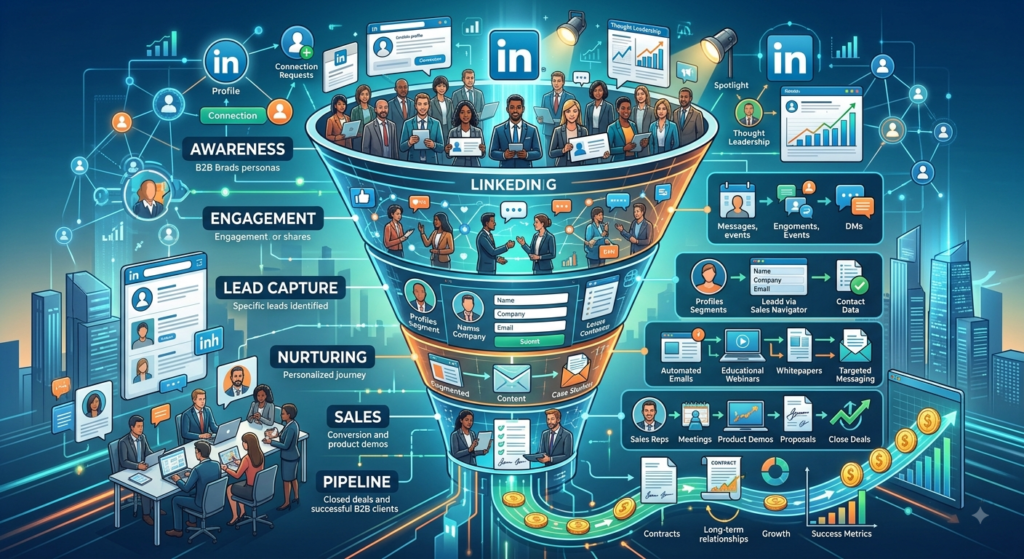
Awareness → Event Promotion → Registration → Attendance → Engagement → Lead Capture → Nurturing → Sales Conversation → Pipeline
The event itself is only one part of that journey.
For example, a software company could promote a webinar about AI automation. Before the event, it could target relevant decision-makers with LinkedIn advertising. During the event, it could capture registrations and engagement. After the event, it could continue promoting related content to attendees and prospects.
This creates more opportunities to keep the brand visible throughout the buying process.
LinkedIn’s focus on event measurement also reflects a wider B2B marketing trend: marketers are increasingly expected to demonstrate how campaigns influence pipeline rather than simply report impressions or registrations.
Recommended image: B2B event marketing funnel showing LinkedIn promotion, registration, attendance, lead capture, nurturing, and pipeline.
3. LinkedIn Is Putting More Emphasis on Measurement and Incrementality
Lead generation numbers alone do not tell the complete story.
A campaign may generate hundreds of leads, but marketers still need to understand:
- Which campaigns influenced buying decisions?
- Which audiences were most valuable?
- Did advertising create additional demand?
- Did LinkedIn contribute to conversions that may not have happened otherwise?
- How did advertising influence other channels?
- Which activities contributed to pipeline?
LinkedIn has been developing measurement capabilities around these questions.
In June 2026, LinkedIn published information about new approaches to helping marketers prove incremental impact from LinkedIn campaigns. The goal is to move beyond basic reporting and provide marketers with a clearer understanding of the additional impact generated by advertising.
This is a significant development for B2B marketers because attribution has always been difficult in long sales cycles.
A B2B buyer might see a LinkedIn advertisement in January, read an article in February, attend a webinar in March, visit the website in April, speak with sales in May, and become a customer months later.
A simple last-click attribution model could give most of the credit to the final interaction while ignoring the earlier brand and demand generation activities.
Why Incrementality Matters
Incrementality asks a different question:
What additional business impact did the marketing activity actually create?
That perspective can help companies make better budget decisions.
Instead of asking only, “How many leads did LinkedIn generate?” marketers can begin asking:
“How did LinkedIn change the likelihood of a prospect moving toward a business outcome?”
That is a much more strategic question for B2B marketing leaders.
4. LinkedIn Is Adapting to AI Search
Artificial intelligence is also changing how people discover information.
Buyers increasingly use AI-powered search and answer engines to research technologies, vendors, products, services, and industry topics.
LinkedIn has responded by publishing guidance around improving the visibility of LinkedIn content in AI search. Its June 2026 marketing guidance discusses how marketers can structure posts, use relevant URLs, establish content authority, and combine posts with articles to improve visibility in AI-driven discovery environments.
This creates a new opportunity for B2B brands.
Historically, companies optimized content primarily for traditional search engines.
Now, marketers need to think about how their expertise can become visible across multiple discovery environments.
Building AI-Visible B2B Content
B2B companies can strengthen their content by focusing on:
- Clear subject-matter expertise
- Original research
- Useful statistics
- Expert commentary
- Consistent terminology
- Strong author credibility
- Detailed educational content
- Supporting articles
- Relevant internal and external links
- Real customer examples
- Clear answers to buyer questions
This approach can also strengthen traditional SEO.
For example, instead of publishing a generic article titled “Benefits of CRM Software,” a B2B technology company could publish:
“How Enterprise CRM Teams Can Reduce Lead Leakage Across Marketing and Sales”
The second topic is more specific and demonstrates stronger subject-matter positioning.
5. Video Is Becoming More Important for B2B Brand Growth
LinkedIn has also continued to emphasize video as an important part of modern B2B marketing.
LinkedIn’s 2026 B2B marketing insights identify video as one of the forces shaping the future of B2B marketing. The company has also highlighted the growing role of creators and trusted human voices in B2B communication.
This reflects a broader change in how buyers consume information.
A decision-maker may not want to read a long product brochure immediately. They may first watch a short explanation, listen to an expert, view a customer story, or consume a quick industry analysis.
B2B Video Content Ideas
Companies can use LinkedIn video for:
- Product demonstrations
- Customer success stories
- Executive interviews
- Industry commentary
- Webinar clips
- Educational tutorials
- Behind-the-scenes content
- Research summaries
- Expert opinions
- Event highlights
- Frequently asked questions
Video can also support multiple stages of the buyer journey.
An educational video can create awareness. A product demonstration can build consideration. A customer story can provide social proof. A detailed webinar can support evaluation.
Suggested video: Use a short LinkedIn-hosted video or company-created B2B marketing video explaining how LinkedIn’s latest advertising and lead-generation tools work.
LinkedIn Marketing Video Resources
6. Creator-Led Marketing Is Becoming More Important
Another important development is the growing role of creators and individual experts in B2B marketing.
LinkedIn’s 2026 B2B research emphasizes that people increasingly buy from people, not simply from corporate brands. The platform argues that trusted human voices can play an important role in building credibility and thought leadership.
This presents an opportunity for B2B companies to move beyond corporate-page-only strategies.
For example, a cybersecurity company could publish product announcements on its company page while its CTO discusses emerging security risks from a personal profile.
A marketing technology company could publish research through its corporate account while its CMO explains the implications through videos and posts.
The combination creates two layers of communication:
Brand authority + Human credibility
That combination can be particularly valuable when buyers are researching complex products.
7. LinkedIn Is Moving Beyond Lead Volume Toward Lead Quality
One of the most important strategic changes is the increasing focus on quality over quantity.
LinkedIn’s own 2026 B2B marketing insights emphasize the need for higher-quality demand generation rather than simply generating large volumes of leads.
This is an important distinction for B2B organizations.
Generating 1,000 low-quality leads may create more operational work than generating 100 highly relevant prospects.
Sales teams want leads that fit the company’s ideal customer profile, show meaningful interest, and have a realistic path toward a purchasing conversation.
What High-Quality LinkedIn Leads Look Like
A strong B2B lead may have several characteristics:
- Fits the target industry
- Matches the ideal company size
- Has a relevant job function
- Holds an appropriate seniority level
- Engages with high-intent content
- Registers for relevant events
- Downloads valuable resources
- Visits important website pages
- Demonstrates repeated engagement
- Has a potential business need
The most effective LinkedIn strategies therefore combine audience targeting, content, engagement, lead capture, nurturing, and measurement.
8. What These LinkedIn Updates Mean for B2B Marketers
Taken together, LinkedIn’s 2026 developments suggest that the platform is becoming more closely connected to the complete B2B marketing journey.
The emphasis is moving from individual features toward an integrated system.
A company can potentially use LinkedIn to:
Build Brand Awareness
↓
Reach Target Accounts
↓
Educate Buyers With Content
↓
Generate Engagement
↓
Capture Leads
↓
Promote Events
↓
Nurture Prospects
↓
Measure Marketing Impact
↓
Influence Pipeline
This is especially relevant for account-based marketing and demand generation teams.
Instead of treating every LinkedIn activity as a separate campaign, companies can connect their activities around common audiences and business objectives.
How B2B Companies Can Use the New Features
Businesses should consider several practical steps when adapting to LinkedIn’s latest capabilities.
1. Review Your LinkedIn Advertising Strategy
Look at existing campaigns and identify opportunities to create more creative variations.
Test different:
- Headlines
- Value propositions
- Calls to action
- Visual concepts
- Audience segments
- Content formats
The objective should not be to create more advertisements simply because tools make production easier. The goal should be to create more relevant experiences for specific audiences.
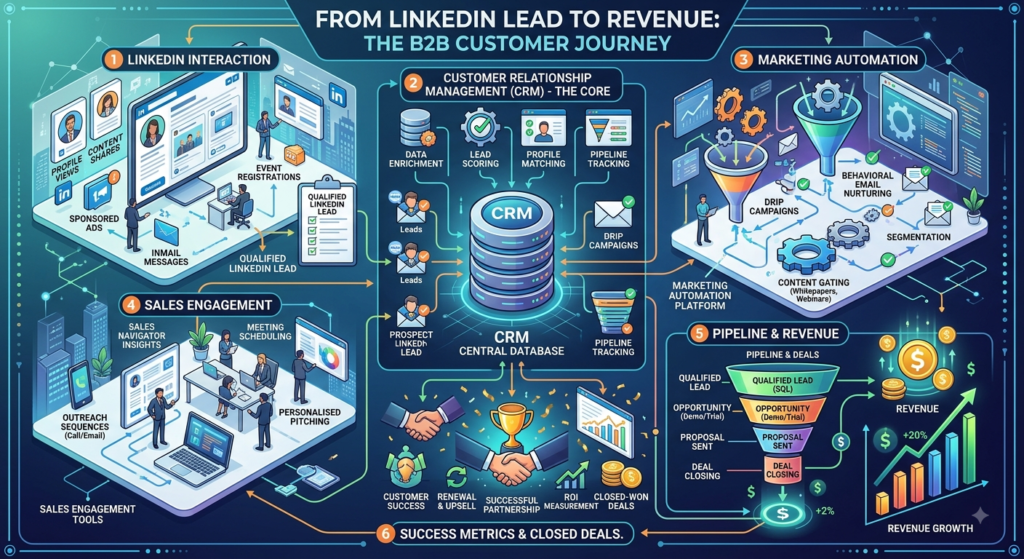
2. Connect LinkedIn Campaigns With Your CRM
Lead generation becomes more valuable when lead data can move efficiently into the sales and marketing workflow.
Companies should connect LinkedIn lead activity with their CRM and marketing automation systems wherever possible.
This helps marketing teams track what happens after a lead is generated.
3. Create a Full-Funnel Event Strategy
Do not treat a webinar or virtual event as a single-day campaign.
Build content before the event, during the event, and after the event.
Use event participation as an engagement signal and continue relevant communication after the event.
4. Invest in Executive and Employee Thought Leadership
Corporate content is important, but individual expertise can add credibility.
Encourage executives, subject-matter experts, sales leaders, and other knowledgeable employees to participate in LinkedIn conversations.
5. Build Content for AI and Traditional Search
Create detailed content that answers specific buyer questions.
Use clear headings, useful examples, original insights, authoritative sources, and strong internal linking.
6. Measure Business Impact
Do not stop at:
- Impressions
- Likes
- Followers
- Clicks
Track metrics such as:
- Marketing-qualified leads
- Sales-qualified leads
- Pipeline influenced
- Conversion rate
- Cost per qualified lead
- Account engagement
- Event-to-opportunity conversion
- Revenue contribution
This provides a much clearer picture of whether LinkedIn activity is supporting business growth.
LinkedIn’s Changing Role in B2B Demand Generation
The evolution of LinkedIn reflects a larger change taking place across B2B marketing.
Buyers have more information than ever before. They can research vendors independently, compare alternatives, consult industry experts, use AI tools, watch product demonstrations, and seek opinions from peers.
As a result, brands need to be visible throughout the buyer journey.
LinkedIn is positioned to support many of those interactions because it combines professional identity, content, advertising, events, creators, audience targeting, and measurement within the same ecosystem.
Its latest developments indicate that the platform is investing in making those capabilities more connected.
LinkedIn’s own marketing research has also emphasized the importance of brand, demand generation, measurement, events, video, and trusted human voices in modern B2B marketing.
What B2B Marketers Should Watch Next
The next stage of LinkedIn’s development will likely be closely connected to artificial intelligence, measurement, personalization, content discovery, and automation.
Marketers should pay attention to how LinkedIn evolves:
- AI-assisted campaign creation
- Automated creative testing
- AI-powered audience insights
- AI search visibility
- Advanced measurement
- Event-to-pipeline tracking
- Video advertising
- Creator partnerships
- Account-based marketing
- Lead quality optimization
The key challenge will be balancing automation with authenticity.
More automation can make marketing teams faster, but more automated content can also make brands sound similar.
For B2B companies, differentiation will therefore become increasingly important.
Final Thoughts
LinkedIn’s latest platform developments represent more than a collection of new marketing features. They reflect a broader transformation in how B2B companies approach brand building, demand generation, lead generation, events, content, and measurement.
AI-assisted creative tools can help marketers produce campaigns faster. New event capabilities can help companies turn events into longer customer journeys. Improved measurement can help marketers understand campaign impact. AI search guidance can help brands improve discoverability. Video and creator-led strategies can make B2B communication more human.
For marketers, the opportunity is not simply to adopt every new feature.
The bigger opportunity is to connect these capabilities into a cohesive B2B growth strategy.
Companies that combine strong brand positioning, useful content, high-quality targeting, human expertise, lead nurturing, and meaningful measurement can use LinkedIn as more than a lead source. They can use it as an important part of their overall demand generation engine.
As LinkedIn continues evolving in 2026, B2B marketers should watch these updates closely and evaluate how each new capability can contribute to better buyer engagement, stronger brand visibility, higher-quality leads, and ultimately, measurable business growth.
Frequently Asked Questions
LinkedIn has introduced and highlighted updates across AI-assisted advertising creative, event marketing, campaign measurement, AI search visibility, video, creators, and B2B demand generation.
LinkedIn provides tools including advertising, Lead Gen Forms, professional audience targeting, event capabilities, content distribution, and integrations that can support B2B lead generation. LinkedIn has long positioned Lead Gen Forms and advertising as core components of its B2B lead-generation offering.
B2B marketers need more than large lead volumes. High-quality prospects that fit an ideal customer profile and demonstrate meaningful engagement are more valuable to sales teams and can contribute more effectively to pipeline. LinkedIn’s 2026 B2B marketing guidance highlights the shift toward quality-focused demand generation.
Yes. LinkedIn’s 2026 B2B marketing insights identify video as an important part of how modern buyers consume information, making video increasingly relevant for B2B education, thought leadership, product communication, and brand building.
Businesses should first review their current LinkedIn strategy, identify their highest-value audiences, create relevant content and creative variations, connect lead data to their CRM, use events and video strategically, and measure outcomes beyond clicks and impressions.