


Introduction
Not long ago, many B2B marketers could design campaigns around a single buyer persona. The goal was simple. Identify the decision maker, understand their pain points, nurture them through the sales funnel, and convert them into a customer.
That approach is becoming increasingly outdated.
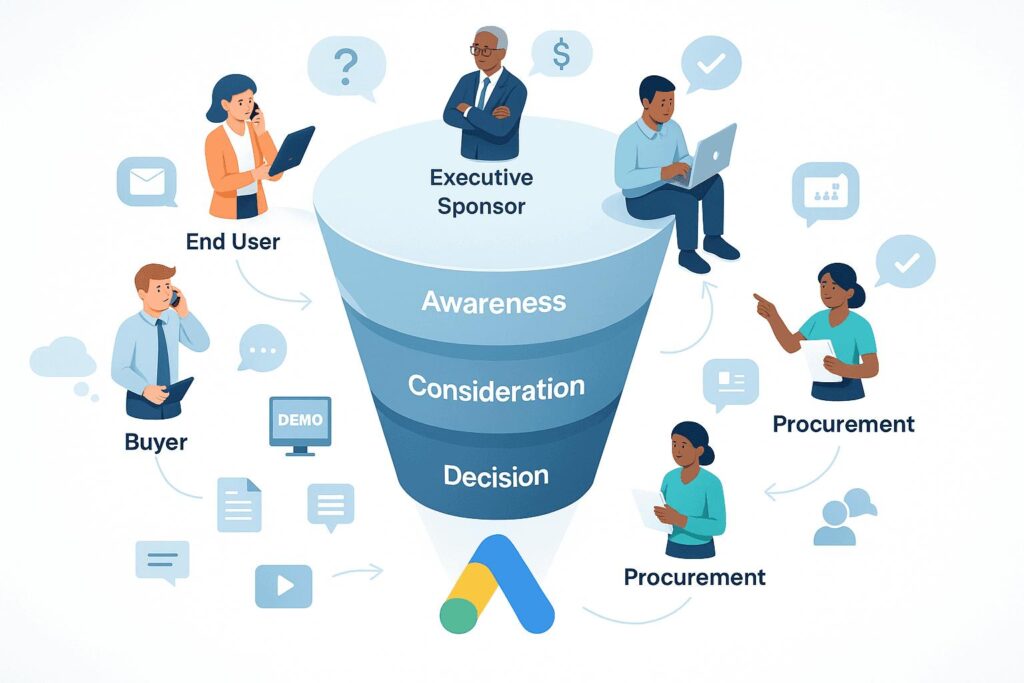
Today’s B2B purchasing decisions involve multiple stakeholders from different departments, each bringing unique priorities, concerns, and expectations. A software purchase may involve an IT manager evaluating technical compatibility, a finance executive reviewing costs, an operations leader assessing workflow impact, and a security specialist ensuring compliance requirements are met. In many organizations, procurement teams and executive leadership also participate before the final approval is granted.
This group of decision makers is known as the buying committee, and it has fundamentally changed how organizations evaluate vendors and solutions.
For marketers, this shift represents one of the biggest changes in modern demand generation. Successful campaigns can no longer rely on generic messaging or single audience targeting. Instead, every campaign must educate, engage, and build trust across multiple roles throughout the buying journey.
Companies that recognize this shift are redesigning everything from email marketing and content creation to account based marketing, lead nurturing, and sales enablement. Those that fail to adapt often struggle with declining engagement, longer sales cycles, and lower conversion rates.
In this article, we explore why buying committees have become the new standard in B2B purchasing and how marketers can build campaigns that resonate with every stakeholder involved in the decision-making process.
What Is a Buying Committee?
A buying committee is a group of individuals within an organization who collectively evaluate, influence, and approve business purchases. Unlike consumer purchases, where one person often makes the final decision, B2B investments usually affect multiple departments. As a result, organizations seek input from everyone who may be impacted.
Typical buying committee members include:
- Executive leadership
- Department managers
- Technical specialists
- IT teams
- Security professionals
- Procurement officers
- Finance leaders
- End users
- Operations managers
- Compliance teams
Each member has different objectives.
For example:
| Stakeholder | Primary Concern |
|---|---|
| CEO | Business growth and strategic value |
| CFO | Budget, ROI, and financial risk |
| CIO | Technology integration |
| IT Manager | Implementation and maintenance |
| Security Team | Compliance and cybersecurity |
| Procurement | Vendor evaluation and pricing |
| Department Head | Operational efficiency |
| End User | Ease of use and productivity |
This diversity of priorities creates a much more complex buying process.
A marketing campaign focused only on product features may satisfy technical teams but fail to convince executives. Likewise, a campaign centered solely on cost savings may not answer the security team’s concerns.
Modern campaigns must therefore provide value to every member of the committee.
Why Buying Committees Have Become Larger
Several market trends have contributed to the expansion of buying committees.
1. Technology Has Become More Complex
Businesses now invest in cloud platforms, artificial intelligence, cybersecurity, automation, analytics, and integrated software ecosystems. These investments often affect multiple departments simultaneously.
For example, implementing a customer relationship management platform impacts:
- Sales
- Marketing
- Customer Success
- Finance
- IT
- Data teams
Since the investment influences many functions, more stakeholders become involved in the purchasing decision.
2. Organizations Want to Reduce Risk
Large purchases involve significant financial commitments.
Executives increasingly seek consensus before approving investments because failed implementations can result in:
- Budget overruns
- Operational disruptions
- Security vulnerabilities
- Employee dissatisfaction
- Lost productivity
By involving experts from multiple departments, organizations reduce the likelihood of costly mistakes.
3. Digital Research Empowers Every Stakeholder
Modern buyers conduct extensive research before engaging with vendors.
They compare:
- Product reviews
- Analyst reports
- Industry blogs
- Customer testimonials
- Case studies
- Product demonstrations
- Webinars
Different committee members consume different types of content.
A technical architect may download implementation guides, while a CFO prefers ROI calculators or financial case studies. A department manager may look for customer success stories from similar organizations.
This behavior means marketers need diverse content formats tailored to each stakeholder’s interests.
4. Hybrid Work Has Increased Collaboration
Remote and hybrid work models have transformed how organizations make purchasing decisions.
Instead of hallway conversations or in-person meetings, buying committees now collaborate through:
- Microsoft Teams
- Slack
- Zoom
- Shared documentation
- Digital workspaces
As information becomes easier to share internally, more employees contribute opinions during vendor evaluations.
Marketing content often circulates throughout these digital channels, making clarity and relevance even more important.
The Evolution of B2B Decision Making
The B2B buying journey has evolved dramatically over the last decade.
Previously, vendors controlled much of the buying process through direct sales interactions. Today, buyers complete a significant portion of their research independently before contacting sales.
This shift has changed the role of marketing.
Instead of simply generating leads, marketing now supports buyers throughout their entire decision-making journey by providing educational content, thought leadership, comparison resources, and proof of business value.
A modern buying journey often follows this pattern:
- A business problem is identified.
- Internal discussions begin across departments.
- Multiple stakeholders research possible solutions.
- Vendors are shortlisted.
- Buying committee members evaluate content independently.
- Product demonstrations are scheduled.
- Security, finance, and procurement conduct assessments.
- Executive leadership approves the investment.
- Purchase negotiations begin.
Notice that marketing influences nearly every stage before sales conversations become serious.
This is why content quality has become one of the strongest competitive advantages in B2B marketing.
Why Traditional Campaigns No Longer Work
For many years, B2B marketing followed a predictable formula. Marketers identified a target audience, created a single value proposition, launched email campaigns, and handed qualified leads to the sales team. While this approach delivered results in the past, it struggles to meet the expectations of today’s buying committees.
A single message rarely addresses the concerns of every stakeholder involved in a purchase. An IT manager wants to understand integration capabilities, while a finance executive focuses on return on investment. A security professional needs compliance information, and an operations leader is interested in productivity gains. Sending identical messaging to all of them reduces engagement and makes campaigns less effective.
Modern buyers also spend more time researching independently before contacting vendors. They compare competitors, read analyst reports, watch product demonstrations, and consult colleagues. If your campaign only offers promotional content, it is unlikely to influence these informed buyers.
Several common characteristics make traditional campaigns less effective today:
- Generic messaging for all audiences
- One-dimensional buyer personas
- Limited personalization
- Sales-focused content with little educational value
- Minimal engagement beyond email
- Lack of alignment between marketing and sales
Organizations that continue relying on these methods often experience:
- Lower email engagement
- Longer sales cycles
- Reduced lead quality
- Lower conversion rates
- Missed opportunities within target accounts
The solution is not simply creating more content. It is creating relevant content for every stakeholder at every stage of the buying journey.
The Rise of Multi Stakeholder Marketing
The emergence of buying committees has given rise to a new marketing approach known as multi stakeholder marketing.
Instead of targeting one decision maker, marketers now build campaigns that educate and influence an entire group of stakeholders.
This approach recognizes that every participant has different priorities, consumes different types of content, and enters the buying process at different times.
For example, consider a company evaluating a marketing automation platform.
| Stakeholder | Questions They Ask | Content That Helps |
|---|---|---|
| CEO | Will this support business growth? | Executive summary, industry trends |
| CFO | What is the financial return? | ROI calculator, pricing guide |
| CMO | Can this improve campaign performance? | Case studies, benchmark reports |
| IT Manager | Will it integrate with existing systems? | Technical documentation |
| Security Team | Is customer data protected? | Compliance guide, security documentation |
| Operations Manager | Will implementation disrupt workflows? | Deployment roadmap |
Each of these stakeholders requires unique messaging.
When campaigns provide answers to everyone’s questions, buying committees move through the evaluation process with greater confidence.
How Buying Committees Are Changing Content Strategy
Content marketing remains one of the most powerful tools in B2B marketing, but its role has evolved significantly.
Instead of creating content solely to generate leads, marketing teams now produce resources that help buying committees make informed decisions.
This means developing content for every stage of the buying journey.
| Buying Journey Stage | Buyer Mindset | Recommended Content Types | Marketing Goal |
|---|---|---|---|
| Awareness Stage | Buyers recognize a business challenge but may not know the best solution. | • Industry reports • Blog articles • Trend analysis • Educational videos • Infographics • Research studies | Educate prospects, build brand awareness, and establish thought leadership rather than focusing on selling. |
| Consideration Stage | Buying committees compare different solutions, vendors, and approaches to address their business needs. | • Whitepapers • Solution guides • Product comparison articles • Expert webinars • Industry benchmark reports • Interactive tools | Demonstrate expertise, answer key questions, and help buyers evaluate available options with confidence. |
| Decision Stage | Organizations narrow their vendor list and seek proof that a solution will deliver business value. | • Customer success stories • ROI calculators • Product demonstrations • Security documentation • Pricing information • Implementation guides | Reduce uncertainty, reinforce trust, address stakeholder concerns, and support the final purchasing decision. |
Personalization Is No Longer Optional
One of the biggest changes in B2B campaign strategy is the growing importance of personalization.
Personalization today extends far beyond using a recipient’s first name in an email.
Successful marketers personalize based on:
- Industry
- Company size
- Job role
- Department
- Business challenges
- Buying stage
- Previous engagement
- Geographic region
- Technology stack
For example, imagine two stakeholders from the same company download the same whitepaper.
A marketing director may later receive:
- Case studies
- Campaign performance benchmarks
- Lead generation insights
Meanwhile, the IT director could receive:
- Integration documentation
- API specifications
- Security certifications
- Deployment guides
Both contacts belong to the same buying committee, yet their follow-up experiences should be completely different.
Marketing automation platforms now make this level of personalization easier through behavioral tracking, segmentation, and dynamic content.
Organizations that deliver relevant experiences consistently build stronger relationships with buying committees and improve campaign performance.
Account Based Marketing Is Becoming More Important
Buying committees naturally align with Account Based Marketing (ABM).
Instead of generating thousands of individual leads, ABM focuses on engaging high-value accounts through coordinated marketing and sales efforts.
Within an ABM strategy, marketers identify key stakeholders inside each target account and deliver tailored messaging to each role.
For example, an enterprise cybersecurity campaign might include:
- Executive reports for CISOs
- Technical documentation for security engineers
- Financial analysis for procurement teams
- Compliance resources for legal departments
- Business value presentations for executive leadership
Rather than treating every lead equally, ABM recognizes that meaningful engagement across multiple stakeholders increases the likelihood of winning complex deals.
When marketing and sales collaborate closely, they can monitor engagement from different committee members and identify accounts showing strong buying intent.
Example: A Buying Committee in Action
Imagine a manufacturing company planning to implement a new supply chain management platform.
The buying committee includes:
- Chief Operations Officer
- IT Director
- Finance Manager
- Procurement Lead
- Warehouse Manager
- Security Officer
A successful campaign might deliver:
- A thought leadership article discussing supply chain trends.
- An industry webinar highlighting operational improvements.
- A manufacturing case study with measurable results.
- A product demonstration tailored to operational workflows.
- A security compliance guide for technical reviewers.
- An ROI calculator for financial stakeholders.
Each asset answers a different question while supporting the same purchasing decision.
By the time the committee meets to evaluate vendors, your organization has already established credibility with multiple decision makers.
Measuring Campaign Success with Buying Committees
Traditional B2B marketing metrics such as email opens, click-through rates, and form submissions still provide useful insights, but they no longer tell the complete story. When multiple stakeholders influence a purchasing decision, marketers need a broader view of campaign performance.
Instead of asking, “Did one prospect engage with our content?” marketing teams should ask, “How many stakeholders within the target account engaged with our campaign?”
This account-centric approach provides a more accurate picture of buying intent.
Key Metrics That Matter
1. Account Engagement
Rather than focusing only on individual leads, measure engagement across the entire account.
Track metrics such as:
- Number of stakeholders engaged
- Departments represented
- Repeat website visits
- Content downloads
- Webinar attendance
- Product page visits
If five people from the same company interact with your content over several weeks, that account may represent a stronger opportunity than one individual who downloads multiple assets.
2. Buying Committee Coverage
Evaluate whether your campaigns are reaching every key decision maker.
For example:
| Stakeholder | Engaged? | Recommended Next Step |
|---|---|---|
| CEO | Yes | Share executive success stories |
| CFO | No | Send ROI calculator and pricing guide |
| IT Director | Yes | Provide technical documentation |
| Security Team | No | Share compliance and security resources |
| Procurement | Yes | Deliver implementation timeline |
This analysis helps marketing and sales identify gaps before opportunities stall.
3. Content Performance by Role
Different content resonates with different audiences.
Monitor which assets perform best for each stakeholder group.
Examples include:
- Executives prefer industry reports.
- Finance teams engage with ROI calculators.
- IT teams download implementation guides.
- Marketing leaders read benchmark reports.
- Procurement teams review pricing documentation.
Understanding these patterns enables better personalization in future campaigns.
4. Sales and Marketing Alignment
Campaign success should not stop at lead generation.
Marketing and sales should review:
- Sales accepted leads
- Pipeline influenced
- Opportunity creation
- Deal progression
- Revenue contribution
- Customer acquisition cost
When both teams work from the same account data, follow-up becomes more relevant and timely.
Best Practices for Marketing to Buying Committees
Organizations that consistently generate qualified pipeline often follow a similar set of principles.
Build Multiple Buyer Personas
Avoid relying on a single decision-maker profile.
Develop detailed personas for:
- Executive leadership
- Finance
- Operations
- IT
- Procurement
- Security
- End users
Each persona should include:
- Business objectives
- Pain points
- Preferred content formats
- Common objections
- Success metrics
The more accurately you understand each audience, the more effective your campaigns become.
Create Role-Specific Content
One whitepaper cannot answer every stakeholder’s questions.
Instead, create complementary assets such as:
- Executive summaries
- Technical implementation guides
- Financial justification templates
- Industry case studies
- Customer testimonials
- Product comparison sheets
- Compliance documentation
These resources help each stakeholder evaluate your solution from their own perspective.
Personalize Every Touchpoint
Modern marketing platforms allow campaigns to adapt based on:
- Job title
- Industry
- Company size
- Previous engagement
- Buying stage
- Website activity
Dynamic landing pages, personalized emails, and targeted advertising improve engagement because they deliver relevant information at the right time.
Invest in Account Based Marketing
Account Based Marketing works especially well for enterprise sales where buying committees are common.
Coordinate marketing and sales efforts to:
- Identify strategic accounts
- Map key stakeholders
- Deliver personalized campaigns
- Track engagement across departments
- Prioritize accounts showing buying intent
This collaborative approach improves conversion rates and strengthens customer relationships.
Enable Your Sales Team
Marketing content should support sales conversations.
Provide representatives with:
- Industry-specific presentations
- Competitive comparison documents
- Customer success stories
- ROI calculators
- Security documentation
- Frequently asked questions
Equipped with the right resources, sales teams can address stakeholder concerns more effectively.
Common Mistakes to Avoid
Even experienced marketing teams sometimes overlook the complexity of buying committees.
Avoid these common pitfalls.
Treating Every Buyer the Same
Different stakeholders require different messaging.
A generic campaign often satisfies no one.
Ignoring Technical Decision Makers
Executive messaging may generate interest, but technical teams often determine whether implementation is feasible.
Provide sufficient technical documentation early in the buying process.
Focusing Only on Lead Volume
High lead numbers do not necessarily translate into revenue.
Quality engagement across multiple stakeholders is often a stronger indicator of future pipeline.
Poor Sales and Marketing Communication
When sales teams are unaware of marketing engagement, valuable context is lost.
Regular collaboration improves follow-up conversations and customer experiences.
Stopping After the First Conversion
Downloading an eBook is only the beginning.
Continue nurturing stakeholders with relevant content throughout the evaluation process.
Future Trends Shaping Buying Committee Marketing
Buying committees will continue evolving as technology advances.
Several trends are already influencing the future of B2B campaigns.
Artificial Intelligence
AI enables marketers to:
- Predict buying intent
- Recommend personalized content
- Score accounts
- Identify high-value prospects
- Automate campaign optimization
These capabilities help marketing teams engage buying committees more efficiently.
First-Party Data
As privacy regulations become stricter and third-party cookies decline, first-party data becomes increasingly valuable.
Organizations should focus on collecting data through:
- Website interactions
- Webinar registrations
- Newsletter subscriptions
- Product demonstrations
- Customer communities
High-quality first-party data supports better personalization.
Intent Data
Intent signals help marketers identify companies actively researching relevant solutions.
Combining intent data with account engagement provides a clearer picture of buying readiness.
Interactive Content
Interactive experiences improve engagement because they encourage active participation.
Examples include:
- ROI calculators
- Assessments
- Product configurators
- Interactive demos
- Benchmark tools
These assets often generate richer insights than static content.
Greater Marketing and Sales Collaboration
Organizations increasingly recognize that revenue generation requires shared ownership.
Future campaigns will integrate:
- Marketing automation
- CRM systems
- Sales intelligence
- Customer success platforms
- Revenue analytics
This unified approach provides consistent experiences throughout the customer lifecycle.
Frequently Asked Questions
A buying committee is a group of stakeholders who collectively evaluate and approve business purchases. Members often represent executive leadership, finance, IT, operations, procurement, and security.
Buying committees reduce business risk by incorporating multiple perspectives before significant investments are approved.
The number varies depending on the purchase, company size, and industry. Enterprise software purchases commonly involve several stakeholders across different departments.
Successful marketers create personalized, role-specific content, implement Account Based Marketing strategies, align with sales teams, and nurture stakeholders throughout the buying journey.
Every stakeholder has different priorities. Personalized messaging increases relevance, builds trust, and improves campaign performance.
Final Thoughts
The modern B2B buying process is no longer driven by a single decision maker. Organizations now rely on diverse buying committees that evaluate solutions from strategic, financial, operational, technical, and security perspectives before approving investments.
This shift requires marketers to rethink traditional campaign strategies. Generic messaging and one-size-fits-all content are no longer enough to influence complex purchasing decisions.
The most successful organizations build campaigns around the needs of every stakeholder. They create educational content, personalize experiences, align closely with sales teams, and measure engagement at the account level rather than focusing only on individual leads.
As artificial intelligence, intent data, and Account Based Marketing continue to evolve, understanding buying committee behavior will become one of the most valuable competitive advantages in B2B marketing.
Organizations that embrace this approach today will be better positioned to generate qualified pipeline, shorten sales cycles, and build stronger customer relationships in the years ahead.
Building campaigns for today’s buying committees requires more than great creative. It demands the right strategy, personalized content, and a deep understanding of every stakeholder involved in the purchasing process.
If your organization is looking to improve demand generation, strengthen account engagement, and connect with high-value B2B decision makers, partnering with an experienced marketing team can help you turn complex buying journeys into measurable business growth.