
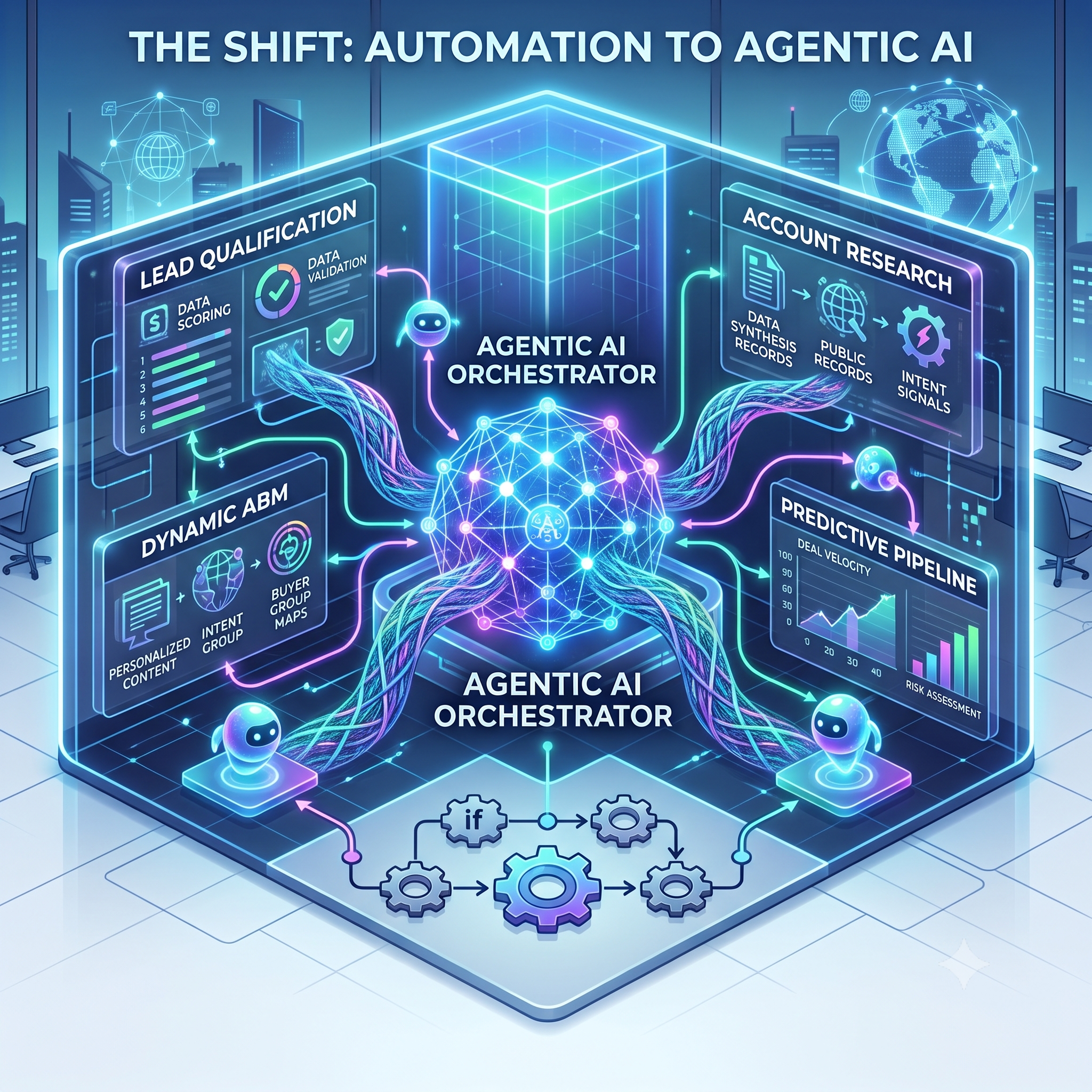

For the last decade, B2B marketing and RevOps teams have been locked in an arms race of automation. We built labyrinthine “if/then” sequences, triggered emails based on page views, and scored leads using rigid point systems. It was efficient, but it was fundamentally blind. Rule-based automation only works when the buyer behaves predictably—and in 2026, the enterprise buying committee is anything but predictable.
Enter the era of Agentic AI.
We are moving away from software that simply executes a predefined step to autonomous systems that accept a goal and figure out the steps required to achieve it. This shift from simple automation to agentic workflow orchestration is fundamentally rewriting the economics of B2B revenue engines.
The Core Difference: From “If/Then” to “Perceive and Act”
Traditional generative AI (like drafting an email with a prompt) is a useful tool. Agentic AI is an autonomous operator.
When an enterprise lead downloads a whitepaper today, a standard automated workflow adds them to a generic nurture track. An agentic workflow, however, operates entirely differently:
- Perception: The AI agent instantly researches the lead’s company, analyzing recent earnings calls, tech stack data, and hiring trends.
- Planning: It determines the highest-value angle for outreach based on the specific context of that account’s buying group (now averaging 6 to 10 decision-makers).
- Action: It scores the lead, drafts a highly personalized communication, logs the enriched data directly into the CRM, and schedules the SDR follow-up—all within seconds of the initial conversion.
The agent doesn’t need a human to build the sequence; it only needs the human to define the objective and set the guardrails.
The Real Roadblock: It’s Not the AI, It’s Your Data
According to recent 2026 market data, while over 40% of enterprise applications are embedding task-specific AI agents, a significant portion of pilot programs fail. The culprit is rarely the underlying AI model.
Agentic AI thrives on context, making data hygiene the critical bottleneck for enterprise adoption.
If an autonomous agent is relying on a CRM plagued by duplicate records, outdated firmographics, and disconnected intent signals, it will execute flawlessly on terrible intelligence. Transitioning to an agentic model requires RevOps leaders to stop viewing data cleansing as a quarterly housekeeping task and start treating it as the foundational infrastructure of their revenue engine.
Structuring the Autonomous Revenue Engine
The teams winning the B2B landscape in 2026 aren’t bolting AI agents onto every broken process. They are strategically deploying them to eliminate high-friction bottlenecks:
- Inbound Lead Qualification at Scale: Agents are reducing the “speed-to-lead” metric from hours to minutes, ensuring zero decay in buyer intent.
- Predictive Pipeline Management: Instead of waiting for historical reporting, agents are continuously monitoring deal velocity and flagging at-risk accounts before the end of the quarter.
- Dynamic ABM: Agents are adapting outreach mid-flight based on how an account interacts with content, rather than waiting for an arbitrary 7-day sequence delay.
The Human in the Loop
Agentic AI isn’t about replacing the marketing or sales team; it’s about elevating them from task execution to strategic orchestration. The future belongs to the RevOps leaders who can build clean data environments and direct autonomous agents with precision. The technology is here—the competitive advantage lies entirely in how you architect the workflow.