
Introduction
B2B marketing has never been short on data. Marketers have access to website analytics, CRM records, email engagement, advertising data, content downloads, social interactions, firmographic information, and customer behavior. Yet having more data does not automatically lead to better campaign decisions.
The real challenge is understanding which accounts are actively researching a problem, what they are interested in, and when they are most likely to engage with a solution.
This is where B2B intent data becomes valuable.
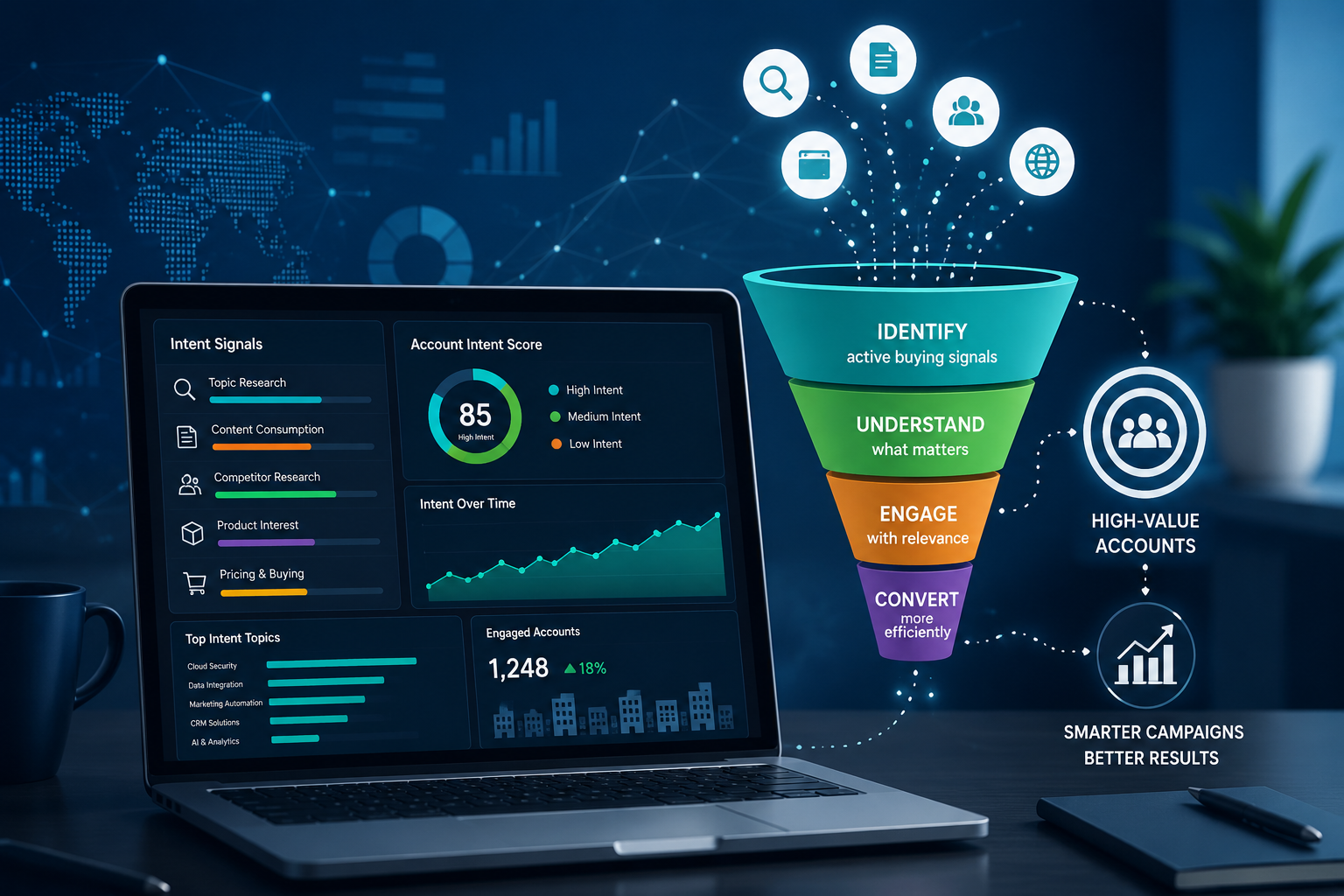
Intent data provides behavioral signals that can help marketing and sales teams understand whether an account may be researching a particular topic, solution, product category, or business problem. These signals can come from a company’s own digital properties or from external websites and research environments.
Instead of treating every prospect equally, marketers can use intent signals to make more informed decisions about audience targeting, messaging, content, advertising, lead nurturing, account prioritization, and sales follow-up.
The result is a shift from simply asking, “Who fits our ideal customer profile?” to asking a more useful question:
“Which accounts that fit our ideal customer profile are showing signs that they are actively researching a problem we can solve?”
That distinction can fundamentally change how B2B campaigns are planned and executed.
What Is B2B Intent Data?
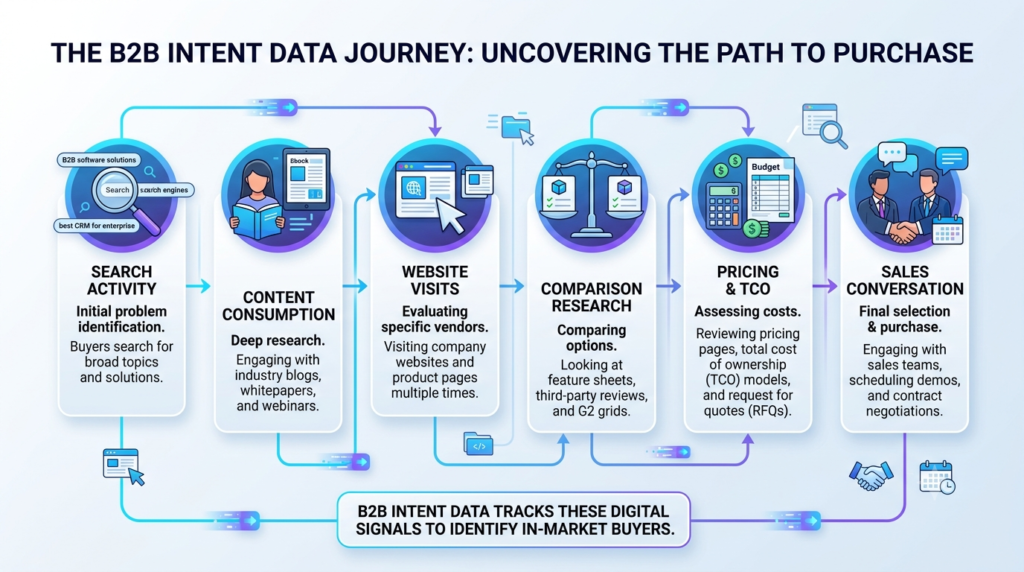
B2B intent data is behavioral information that indicates an organization may be interested in a particular business problem, product, service, or solution.
For example, imagine a company that sells cybersecurity software. A target account may suddenly begin researching topics such as:
- Cloud security platforms
- Endpoint security solutions
- SIEM alternatives
- Cybersecurity compliance
- Enterprise threat detection
- Security monitoring software
The account may not have visited the vendor’s website. It may not have downloaded an eBook. It may not have submitted a contact form.
Traditional lead generation could therefore miss the opportunity.
Intent data can provide an additional layer of visibility by identifying research activity around relevant topics. When this information is combined with account fit and first-party engagement, marketers can develop a stronger picture of potential buying activity.
Intent data should not be treated as proof that an account is ready to purchase. It is a signal that becomes more useful when combined with other information such as CRM activity, website engagement, account characteristics, buying-group information, and previous interactions.
Why Intent Data Matters for Modern B2B Campaigns
Traditional B2B campaigns often begin with an audience definition based on job title, industry, company size, geography, revenue, or technology stack.
These criteria are important, but they mainly answer the question of who could potentially buy.
Intent data helps answer another question:
Who may be actively exploring a solution right now?
That difference matters because not every company in your target market has the same level of urgency.
A technology company with 2,000 employees may perfectly match your ideal customer profile. However, if it has no current need for your solution, aggressive sales outreach may have little impact.
Another company with 800 employees may be actively researching your category, reading comparison articles, reviewing competitors, and visiting relevant content. That account may represent a much stronger campaign opportunity even though it has a lower theoretical fit based on company size.
Intent data helps marketers move from broad targeting toward more contextual targeting.
The Main Types of Intent Data
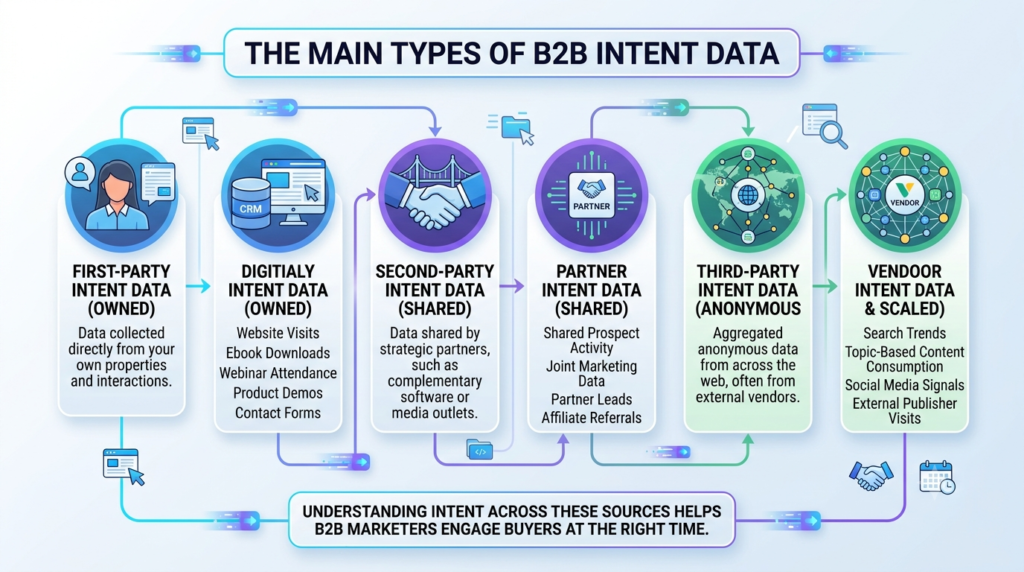
Understanding where intent data comes from is essential because different sources provide different levels of visibility.
1. First-Party Intent Data
First-party intent data comes directly from your own digital properties and systems.
Examples include:
- Website visits
- Product page views
- Pricing page visits
- Whitepaper downloads
- Webinar registrations
- Email clicks
- Demo requests
- Case study engagement
- Video views
- Landing page interactions
- CRM activity
First-party data is particularly valuable because it represents direct engagement with your brand.
For example, suppose an account has visited your pricing page twice, downloaded a case study, watched a product video, and clicked three emails within ten days.
Individually, each activity may not mean much.
Together, they create a stronger behavioral picture.
2. Second-Party Intent Data
Second-party intent data generally comes through a direct relationship or data-sharing arrangement with another organization.
Review platforms, industry partners, publishers, and other specialized sources can provide insights into research behavior.
This can be particularly useful for understanding how potential buyers compare vendors or investigate solutions outside your own website.
3. Third-Party Intent Data
Third-party intent data comes from external digital environments and can help marketers discover research activity happening outside their own properties.
This is one of the biggest advantages of intent data because first-party analytics only show what happens after an account interacts with your brand.
Third-party signals can potentially reveal that a target account is researching your category before it ever reaches your website.
For B2B marketers, this can create an opportunity to enter the conversation earlier.
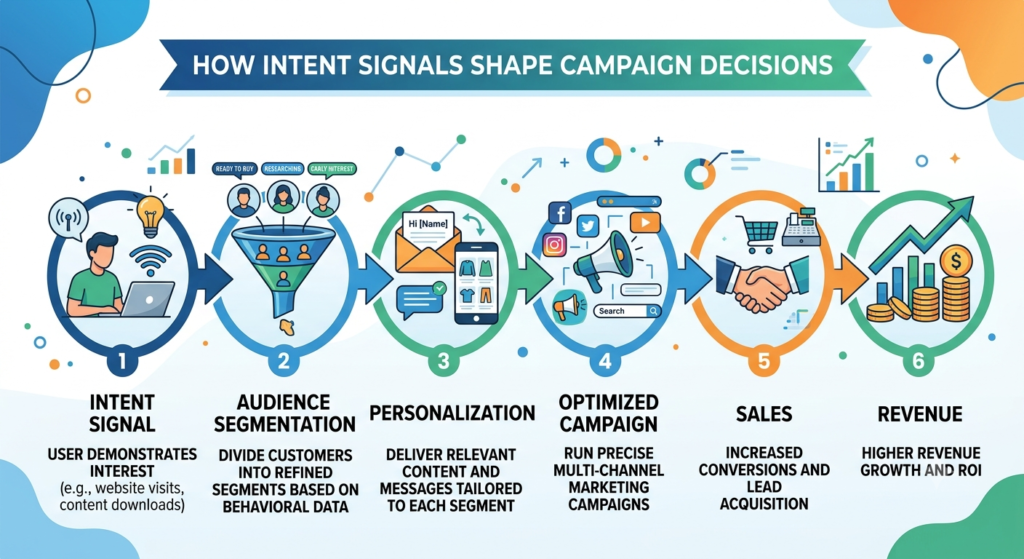
How Intent Signals Shape Campaign Decisions
Intent data becomes powerful when it changes what marketers actually do.
Collecting intent data without changing campaign strategy creates little value.
Here are some of the most important campaign decisions influenced by intent signals.
1. Smarter Audience Segmentation
One of the first applications of intent data is audience segmentation.
Instead of creating one large campaign for everyone in your target market, you can divide accounts based on their level and type of research activity.
For example:
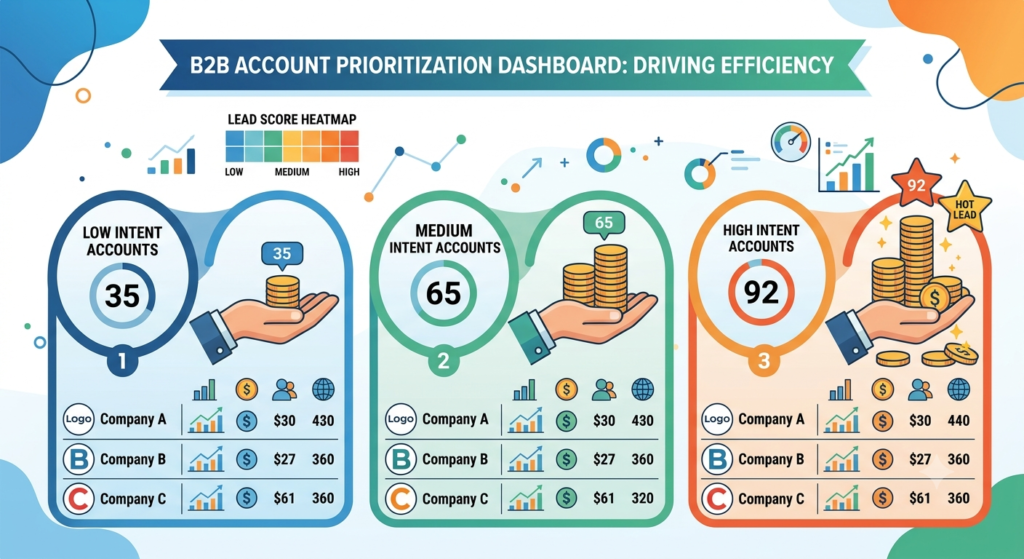
Low Intent
Accounts that fit the ICP but show limited research activity.
Moderate Intent
Accounts researching relevant topics or interacting with educational content.
High Intent
Accounts demonstrating repeated research, competitor activity, product interest, pricing engagement, or multiple buying signals.
This approach allows marketers to create different experiences for different audience segments.
Low-intent accounts may receive educational content.
Moderate-intent accounts may receive webinars, guides, and case studies.
High-intent accounts may receive product comparisons, ROI content, consultations, or sales outreach.
This creates a more relevant campaign journey.
2. Better Campaign Timing
Timing is one of the biggest challenges in B2B marketing.
A company can be an excellent prospect today but have no reason to buy your solution until six months from now.
Intent data can help identify changes in research behavior.
For example, imagine an account that normally shows very little activity. Suddenly, several employees begin researching your category within a short period.
That increase in activity may indicate that something has changed.
Perhaps the company is:
- Evaluating new vendors
- Preparing for a technology investment
- Replacing an existing system
- Expanding into a new market
- Responding to a business challenge
- Preparing a new project
The campaign response should change accordingly.
Instead of waiting for a form submission, marketing teams can increase relevant content exposure, advertising, email nurturing, and sales coordination.
3. More Relevant Messaging
Generic messaging is one of the biggest weaknesses in B2B campaigns.
An account researching “B2B data quality” should not necessarily receive the same message as an account researching “CRM migration.”
Both may fit the same ICP, but their immediate problems are different.
Intent data can help marketers understand the topics attracting attention and adjust messaging around those interests.
For example:
Generic message:
“Improve your B2B marketing performance with our platform.”
Intent-informed message:
“See how enterprise marketing teams can improve database accuracy and reduce wasted outreach.”
The second message connects more directly with a potential problem.
That relevance can make campaigns more useful and less disruptive.
4. Better Content Recommendations
Intent data can also influence content strategy.
Suppose your data shows that target accounts are increasingly researching:
- Account-based marketing
- Lead scoring
- Revenue attribution
- Marketing automation
- B2B database management
Instead of producing content based entirely on internal assumptions, marketers can use those signals to identify areas where the audience is actively showing interest.
The result could be a content sequence such as:
Awareness:
“Complete Guide to B2B Account-Based Marketing”
Consideration:
“ABM vs. Traditional Demand Generation”
Decision:
“How to Calculate the ROI of an ABM Program”
The campaign becomes connected to the buyer’s potential information needs.
5. Stronger Account-Based Marketing
Intent data and account-based marketing can work particularly well together.
ABM starts with a defined group of target accounts. Intent data can help marketers determine which accounts within that group deserve greater attention.
Imagine an ABM list containing 500 companies.
Without intent data, the marketing team might distribute resources relatively evenly.
With intent data, the team may discover that:
- 70 accounts show strong category interest
- 140 accounts show moderate research activity
- 290 accounts show little or no relevant activity
The marketing team can then create different campaign strategies for each segment.
High-intent accounts could receive personalized advertising, executive-level content, sales alerts, and direct outreach.
Moderate-intent accounts could receive educational campaigns.
Low-intent accounts could remain in long-term awareness programs.
This helps teams prioritize resources rather than treating every target account identically.
6. More Effective Lead and Account Prioritization
Not every engagement deserves the same level of follow-up.
A single content download does not necessarily mean that an account is ready for a sales conversation.
However, a combination of signals can provide stronger context.
Consider this example:
An account downloads one blog resource.
That is a useful engagement signal.
Now consider another account that:
- Researches your category repeatedly
- Visits your product pages
- Reads comparison content
- Downloads a case study
- Visits pricing information
- Has multiple contacts engaging with your content
The second account provides a much richer set of signals.
Intent data can therefore help sales and marketing teams prioritize accounts based on a combination of activity, relevance, and timing rather than relying on one isolated action.
7. Better Paid Media Targeting
Intent data can also improve B2B advertising strategies.
Instead of advertising to every company that fits a broad demographic or firmographic profile, marketers can create audiences around relevant intent signals.
For example, an enterprise software company could prioritize advertising toward accounts researching:
- Enterprise software migration
- Cloud modernization
- Digital transformation
- Workflow automation
- Competitor alternatives
The goal is not simply to increase impressions.
The goal is to increase the probability that advertising reaches accounts with a relevant business need.
Intent data can therefore help reduce wasted advertising spend and create more focused campaign audiences.
8. Better Sales and Marketing Alignment
Intent data can also help solve one of the oldest problems in B2B organizations: disagreement between sales and marketing.
Marketing may say:
“We generated hundreds of leads.”
Sales may respond:
“Most of these leads are not ready.”
Intent data can introduce another layer of context.
Instead of sending every engagement to sales, marketing can identify accounts showing stronger combinations of intent, fit, and engagement.
Sales representatives can then receive information such as:
- Account is researching a relevant topic
- Research activity increased recently
- Multiple contacts are engaging
- Account visited high-value pages
- Competitor-related research increased
- Specific product category is attracting attention
This gives sales teams more context for prioritization and outreach.
Intent Data Should Not Operate Alone
One of the most important lessons for marketers is that intent data should not become another isolated score.
Intent is a signal, not a guarantee.
A company researching a topic may simply be conducting research for an article, evaluating the market for a future project, or gathering information for a colleague.
That is why strong B2B campaign strategies combine intent with other data.
A practical framework can include:
Intent + ICP Fit + Engagement + Buying Stage + Business Context
For example:
An account may have high intent but poor ICP fit.
Another account may have excellent ICP fit but very low intent.
A third account may have strong fit, high intent, multiple engaged contacts, and recent website activity.
The third account is likely to deserve more campaign attention.
This type of combined analysis is more reliable than treating an intent score as a standalone buying prediction.
How to Build an Intent-Driven B2B Campaign
A practical intent-driven campaign can follow a simple process.
Step 1: Define Your Ideal Customer Profile
Start by identifying the accounts that are most valuable to your business.
Consider:
- Industry
- Company size
- Revenue
- Geography
- Technology environment
- Business model
- Typical pain points
- Buying roles
Intent data becomes much more useful when it is applied to the right accounts.
Step 2: Identify Important Intent Topics
Create a list of topics connected to your products and services.
Include:
- Problem-based keywords
- Product categories
- Competitor terms
- Alternative solutions
- Industry challenges
- Technology terms
- Solution-related searches
Focus on buyer problems rather than only your product name.
Step 3: Combine First-Party and External Signals
First-party data tells you how an account interacts with your brand.
External intent data can help show what the account is researching beyond your properties.
Combining both sources can provide broader visibility into the buyer journey.
Step 4: Create Intent-Based Segments
Build segments such as:
- Emerging interest
- Active research
- Evaluation
- High intent
- Re-engagement
Each segment should have a defined campaign strategy.
Step 5: Match Content to Buying Stage
Early-stage researchers need education.
Mid-funnel buyers need evidence.
Late-stage buyers need confidence.
For example:
Early Stage:
Educational articles, industry reports, videos, guides
Consideration Stage:
Webinars, comparison guides, case studies, solution briefs
Decision Stage:
ROI calculators, demos, implementation guides, customer references
Stage-based personalization helps prevent marketers from pushing sales messages too early.
Step 6: Create Sales Triggers
Define the signals that should trigger sales involvement.
For example:
- Significant increase in account activity
- Multiple engaged contacts
- Repeated product page visits
- Pricing page activity
- Competitor research
- Demo request
- High combined intent and account-fit score
This creates a clearer transition between marketing engagement and sales action.
Common Mistakes When Using Intent Data
Intent data can create significant value, but poor implementation can create more noise.
Mistake 1: Treating Every Signal as Buying Intent
A single article view does not necessarily indicate purchase intent.
Look for patterns rather than isolated actions.
Mistake 2: Ignoring Account Fit
A company may show strong interest in a topic but still be a poor customer fit.
Always evaluate intent alongside ICP criteria.
Mistake 3: Using the Same Message for Every Intent Level
An early researcher and a buyer comparing vendors should not receive identical messaging.
Match communication to the likely stage.
Mistake 4: Waiting Too Long to Act
Intent signals become less useful if marketing and sales teams cannot respond quickly.
Create clear workflows for important signals.
Mistake 5: Measuring Activity Instead of Revenue Impact
High engagement does not automatically mean high business value.
Measure whether intent-driven campaigns improve metrics such as:
- Qualified accounts
- Marketing-generated pipeline
- Opportunity creation
- Conversion rates
- Sales velocity
- Cost per opportunity
- Revenue influenced
The Future of Intent-Driven B2B Marketing
Intent data is becoming increasingly important as B2B buyers conduct more research independently.
Modern buyers may interact with search engines, review platforms, social media, industry publications, AI tools, vendor websites, communities, and peer recommendations before speaking with a salesperson.
This creates a fragmented buyer journey.
Marketing teams therefore need ways to connect behavioral signals and understand what accounts may be researching.
The next evolution is not simply collecting more signals. It is interpreting signals more intelligently.
AI and predictive analytics can help marketers identify patterns across multiple activities, distinguish stronger signals from weaker ones, and determine which accounts deserve attention.
However, technology alone will not solve the problem.
The most effective strategy combines data with human judgment.
A high-intent account still needs relevant messaging.
A relevant message still needs useful content.
Useful content still needs strong distribution.
And all of these elements need to connect to a measurable revenue strategy.
Conclusion
Intent data is changing how B2B marketers think about campaign planning.
Instead of targeting audiences solely based on who they are, marketers can also consider what those accounts are researching, how their behavior is changing, and where they may be in the buying journey.
This creates opportunities for smarter segmentation, better campaign timing, more relevant messaging, stronger ABM programs, improved advertising, and closer sales and marketing alignment.
The most important takeaway is simple:
Intent data should not replace your existing marketing data. It should make that data more actionable.
When marketers combine intent signals with ICP fit, first-party engagement, buying-stage information, CRM data, and business context, campaigns can move from broad targeting toward more intelligent account prioritization.
The goal is not to contact more companies.
The goal is to identify the right companies, understand what matters to them, and engage them with the right message at the right moment.
That is what makes intent data a powerful component of modern B2B demand generation.
Frequently Asked Questions About B2B Intent Data
Intent data is behavioral information that indicates a company may be researching a particular product, solution, business problem, or topic. It can include website activity, content engagement, research behavior, review activity, and other digital signals.
First-party intent data comes from your own channels, such as your website, emails, CRM, and content assets. Third-party intent data comes from external digital environments and can provide visibility into research activity happening outside your website.
Intent data can help marketers prioritize accounts, improve segmentation, personalize messaging, select relevant content, optimize advertising audiences, and coordinate sales follow-up.
No. Lead scoring typically evaluates a prospect or account based on characteristics and engagement. Intent data focuses specifically on behavioral signals that may indicate active research or buying interest. The two can be combined to create a more complete prioritization model.
Yes. Smaller B2B companies can begin with first-party signals such as website activity, content downloads, email engagement, and CRM data. As their programs mature, they can add external intent sources where appropriate.
The biggest mistake is treating an intent signal as definitive proof that an account is ready to buy. Intent should be combined with account fit, engagement, business context, and buying-stage information before making major campaign or sales decisions.