
Account-Based Marketing (ABM) has become an important approach for B2B organizations looking to improve targeting, strengthen customer relationships, and generate higher-quality business opportunities. Instead of reaching a broad audience and waiting for potential customers to show interest, ABM focuses on identifying specific high-value companies and developing marketing strategies that address their individual business requirements.
In traditional B2B marketing, campaigns often prioritize generating a large number of leads. However, a high volume of leads does not necessarily translate into qualified opportunities or revenue. Marketing teams may attract contacts who have little purchasing authority, operate outside the ideal customer profile, or have no immediate requirement for the product or service being offered.
An effective ABM strategy addresses this challenge by bringing sales and marketing teams together around a carefully selected group of target accounts. Every campaign, communication, and engagement activity is designed to connect with the people who influence purchasing decisions within those organizations.
However, successful Account-Based Marketing involves much more than personalized emails or targeted advertisements. It requires a combination of accurate business data, account research, buying committee identification, relevant messaging, coordinated campaign execution, and continuous performance analysis.
Understanding these elements helps organizations build an ABM framework that supports stronger engagement and more predictable B2B growth.
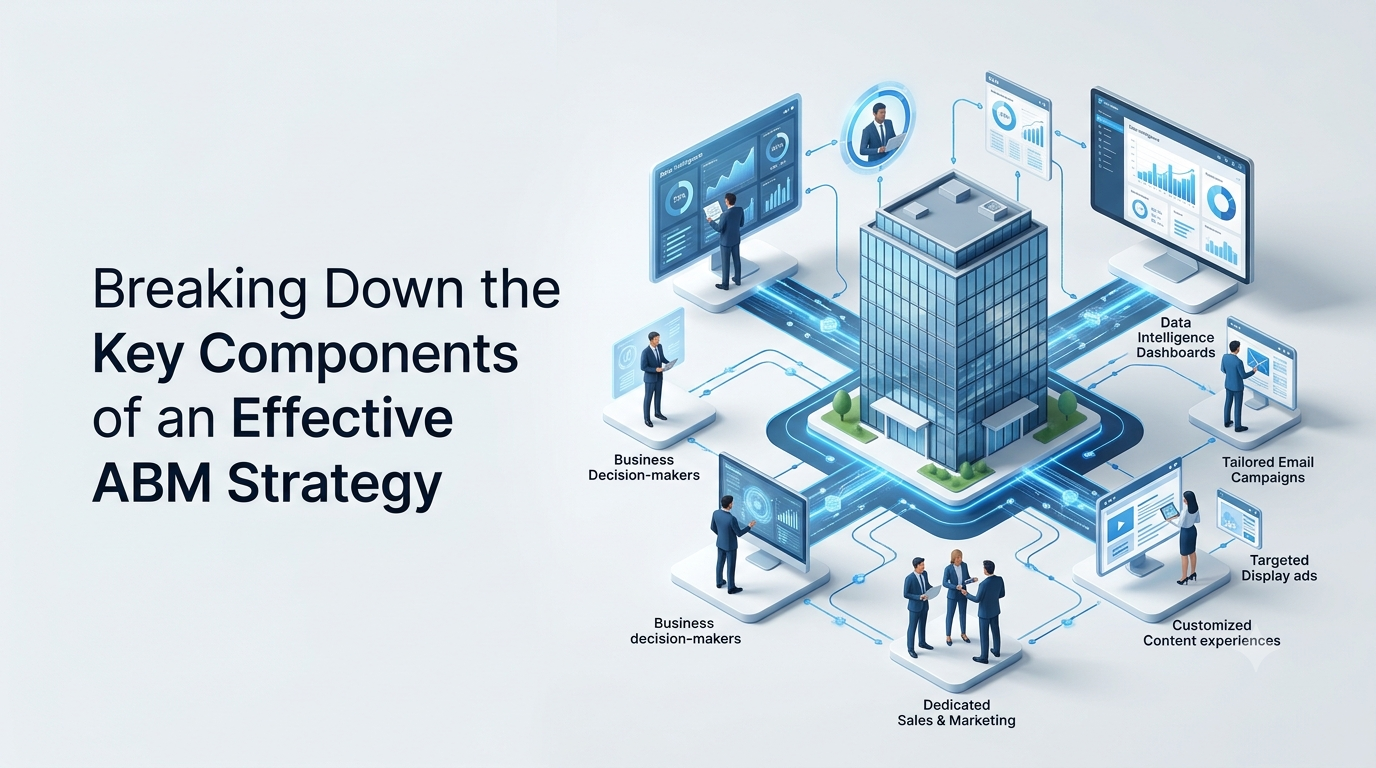
In this article, we break down the key components of an effective ABM strategy and explain how each element contributes to successful B2B marketing campaigns.
What Is Account-Based Marketing (ABM)?
Account-Based Marketing is a strategic B2B marketing approach in which businesses identify specific high-value organizations and create targeted marketing and sales activities to engage decision-makers within those companies.
Rather than treating every individual lead as an independent opportunity, ABM considers the entire organization as a potential customer. Marketing and sales teams work together to understand the company’s business priorities, identify relevant stakeholders, and deliver personalized experiences throughout the buying journey.
For example, a technology company offering enterprise software may identify 100 organizations that match its ideal customer profile. Instead of sending the same promotional message to thousands of unrelated contacts, the company develops targeted campaigns for these selected accounts.
The campaigns may address different stakeholders, including:
- Chief Executive Officers and business leaders.
- Chief Information Officers and technology executives.
- Marketing and sales directors.
- Procurement and purchasing managers.
- Department heads and operational decision-makers.
Each stakeholder receives relevant information based on their responsibilities, challenges, and influence over the purchasing process.
This makes ABM particularly valuable for organizations selling complex products or services, where purchasing decisions involve multiple departments and longer sales cycles.

1. Defining the Ideal Customer Profile (ICP)
The foundation of every effective ABM strategy is a clearly defined Ideal Customer Profile (ICP).
An ICP describes the characteristics of organizations that are most likely to benefit from a company’s products or services and become valuable long-term customers.
Without a defined ICP, businesses may spend significant resources targeting organizations that have limited purchasing potential.
Developing an accurate ICP requires understanding existing customers, successful sales opportunities, and the characteristics that contribute to profitable business relationships.
Important Factors to Consider When Defining an ICP
Industry: Identify the industries where the company’s products or services provide the greatest value. For example, a B2B technology provider may prioritize manufacturing, healthcare, financial services, or information technology companies.
Company Size: Consider employee count, annual revenue, operational scale, and organizational structure. These factors help determine whether a company has the resources and requirements to purchase the solution.
Geographic Location: Define the countries, regions, or markets where the business can effectively provide its products or services.
Technology Requirements: Understand the existing software, platforms, infrastructure, or business systems used by potential customers.
Business Challenges: Identify common problems that the company’s products or services can solve.
Purchasing Potential: Evaluate whether the organization has the budget, business need, and purchasing authority required to become a customer.
Why ICP Matters in ABM
A well-defined ICP helps marketing and sales teams focus their efforts on accounts that have a stronger likelihood of conversion.
It also improves campaign relevance, reduces unnecessary outreach, and creates a consistent foundation for account selection.
Instead of targeting companies based only on their industry or size, businesses can evaluate multiple characteristics to identify accounts that closely match their strongest customer relationships.
2. Identifying and Prioritizing Target Accounts
After defining the ideal customer profile, the next step is selecting the organizations that should receive focused marketing and sales attention.
Not every company that matches the ICP will have the same business potential. Some accounts may have immediate requirements, while others may have limited budgets, lower engagement, or longer purchasing timelines.
This makes target account prioritization an essential part of ABM planning.
How to Select the Right Target Accounts
Account Fit: Evaluate how closely each organization matches the established ICP. Consider industry, company size, revenue, location, and technology requirements.
Revenue Potential: Estimate the potential business value of each account. Organizations with larger purchasing requirements or opportunities for long-term partnerships may deserve greater attention.
Intent Signals: Identify signs that an organization may be researching solutions or preparing to make a purchasing decision. Relevant signals can include website activity, content engagement, research behavior, and interactions with sales teams.
Existing Relationships: Consider previous interactions, referrals, business connections, and historical engagement.
Market Opportunity: Evaluate the organization’s growth, expansion plans, business priorities, and potential demand for the solution.
Creating Account Tiers
Businesses can divide their target accounts into different priority levels to manage resources more effectively.
- Tier 1: Strategic Accounts: A small group of high-value organizations receiving highly personalized, account-specific campaigns and direct sales attention.
- Tier 2: High-Potential Accounts: Organizations with strong ICP alignment that receive industry-specific campaigns and personalized communication.
- Tier 3: Scalable Accounts: A broader group of qualified organizations receiving segmented campaigns and automated engagement.
This tier-based approach allows marketing teams to balance personalization with campaign scalability.
3. Building an Accurate and Enriched B2B Database
Data is one of the most important components of a successful ABM strategy. Even the most creative marketing campaign can struggle when the underlying account and contact information is inaccurate, outdated, or incomplete.
ABM requires reliable information about target organizations and the people who work within them.
A well-managed B2B database provides the foundation for account research, segmentation, personalization, and sales outreach.
What Information Should an ABM Database Include?
Company Information:
- Company name and website.
- Industry and business category.
- Employee size and revenue range.
- Headquarters and operating locations.
- Technology usage and business specialization.
Contact Information:
- Full name and professional designation.
- Department and job function.
- Verified business email address.
- Professional phone number, where available.
- LinkedIn profile or other professional information.
Account Intelligence:
- Business challenges and operational priorities.
- Relevant technology requirements.
- Previous campaign interactions.
- Engagement history and intent indicators.
- Potential purchasing requirements.
Why Data Accuracy Matters
Inaccurate contact information can lead to failed email deliveries, wasted sales efforts, and missed opportunities to connect with important decision-makers.
For ABM campaigns, data quality should involve more than collecting company names and email addresses. It should include verification, validation, standardization, and regular database maintenance.
Marketing teams should also establish processes to update records when employees change positions, companies restructure, or business information becomes outdated.
An enriched database allows organizations to build more accurate account lists, identify relevant stakeholders, and create meaningful communication strategies.
4. Identifying the Buying Committee and Key Decision-Makers
One of the biggest mistakes in B2B marketing is assuming that a single contact can represent an entire purchasing decision.
In many organizations, purchasing decisions involve multiple stakeholders with different responsibilities, priorities, and levels of influence.
This group is commonly known as the buying committee.
For example, a company evaluating a new marketing automation platform may involve the following stakeholders:
- Chief Marketing Officer: Evaluates strategic marketing objectives and expected business outcomes.
- Marketing Director: Assesses campaign functionality, performance, and operational requirements.
- IT Director: Reviews integration, security, and technical compatibility.
- Finance Manager: Evaluates pricing, budget requirements, and return on investment.
- Procurement Manager: Reviews contracts, vendors, and purchasing conditions.
Each stakeholder may evaluate the same solution from a different perspective.
How to Map the Buying Committee
Start by identifying the departments involved in purchasing decisions within the target organization.
Next, research relevant job titles and professional responsibilities to identify potential decision-makers, influencers, technical evaluators, and budget owners.
Organize contacts according to their roles and influence within the buying process.
Finally, develop messaging that addresses each stakeholder’s specific business concerns.
This approach helps marketing and sales teams establish multiple relevant connections within the same organization instead of relying on a single contact.
5. Developing Personalized Content and Messaging
Personalization is at the heart of Account-Based Marketing.
However, effective personalization goes beyond inserting a contact’s first name into an email or mentioning their company in a sales message.
It requires understanding the organization’s business challenges and delivering information that demonstrates how a particular product or service can address those requirements.
Different Content for Different Stakeholders
An effective ABM campaign should consider the needs of different decision-makers.
For example:
For Business Executives: Share strategic insights, industry trends, business outcomes, and information about improving operational efficiency.
For Marketing Leaders: Provide campaign performance insights, demand generation strategies, customer acquisition approaches, and relevant case studies.
For IT Professionals: Highlight technical capabilities, integration requirements, security considerations, and implementation processes.
For Finance Teams: Focus on cost efficiency, resource optimization, financial benefits, and measurable business value.
Content Formats That Support ABM
Organizations can use different content formats depending on the account’s interests and buying stage:
- Personalized landing pages.
- Industry-specific whitepapers.
- Case studies and customer success stories.
- Research reports and market insights.
- Email newsletters and targeted email sequences.
- Product demonstrations and explainer videos.
- LinkedIn posts and sponsored content.
- Customized presentations and business proposals.
The objective is to make every interaction relevant to the audience rather than repeatedly presenting generic product information.
6. Aligning Sales and Marketing Teams
Account-Based Marketing cannot function effectively when sales and marketing teams operate independently.
Both departments must share the same understanding of target accounts, campaign objectives, engagement history, and expected business outcomes.
Marketing teams are generally responsible for developing awareness, generating interest, delivering relevant content, and supporting account engagement.
Sales teams use these insights to establish direct conversations, understand purchasing requirements, identify opportunities, and move qualified accounts through the sales process.
When both teams work together, the organization can provide a more consistent experience throughout the buyer journey.
Key Areas of Sales and Marketing Alignment
Shared Target Account Lists: Both teams should work from the same approved account list to prevent conflicting priorities.
Defined Responsibilities: Establish clear ownership for account research, campaign execution, lead qualification, follow-ups, and reporting.
Common Qualification Criteria: Agree on what makes an account qualified and which engagement signals indicate potential buying interest.
Regular Communication: Schedule account reviews to discuss campaign performance, new opportunities, contact engagement, and potential challenges.
CRM Integration: Maintain a shared view of account activity, contact information, communication history, and opportunity status.
Sales feedback should also influence future campaign development. Direct conversations with prospects can reveal objections, purchasing requirements, and business challenges that may not be visible through digital engagement alone.
7. Creating a Multi-Channel ABM Campaign
B2B decision-makers do not rely on a single communication channel when researching products and services.
Some may discover a company through LinkedIn, while others may engage with email campaigns, industry publications, search results, webinars, or direct sales conversations.
A multi-channel ABM strategy helps businesses create consistent visibility across the channels their target accounts use.
Important Channels for ABM Campaign Execution
Email Marketing: Deliver relevant industry insights, personalized messages, research reports, and follow-up communication to identified contacts.
LinkedIn Marketing: Build professional visibility through targeted content, sponsored campaigns, executive engagement, and relevant business conversations.
Display Advertising: Use account-focused advertising to maintain brand visibility among selected organizations and relevant professional audiences.
Content Marketing: Publish blogs, case studies, whitepapers, and industry reports that address the business challenges of target accounts.
Webinars and Events: Organize educational sessions, product demonstrations, and industry discussions that create opportunities for meaningful engagement.
Sales Outreach: Support marketing activities through personalized calls, professional networking, and direct conversations with relevant stakeholders.
Why Multi-Channel Coordination Matters
Running several channels does not automatically create an effective ABM campaign.
The channels should work together rather than operate as disconnected marketing activities.
For example, a target account may first engage with a LinkedIn post, visit a relevant landing page, download a whitepaper, and later receive a personalized email from the sales team.
Coordinating these interactions helps create a consistent experience and gives marketing and sales teams a better understanding of account engagement.
8. Using Intent Data and Account Engagement Signals
Understanding which organizations are actively researching relevant solutions can help businesses prioritize their ABM activities.
Intent data refers to behavioral information that may indicate an organization’s interest in a particular product, service, topic, or business challenge.
These signals can help marketing teams identify accounts that deserve additional attention.
Common Account Intent Signals
- Increased engagement with relevant website content.
- Downloads of industry reports or whitepapers.
- Visits to product or service pages.
- Participation in webinars and online events.
- Repeated interactions with LinkedIn content.
- Research activity around specific business solutions.
- Direct inquiries or responses to campaign communication.
However, intent signals should not automatically be treated as confirmed purchasing interest.
A website visit or content download may indicate curiosity rather than immediate buying intent. Marketing and sales teams should combine behavioral information with account fit, contact relevance, and direct engagement before determining the next step.
Turning Intent Signals into Action
Businesses can use engagement data to adjust campaign messaging, prioritize follow-ups, and identify accounts that may benefit from additional information.
For instance, if several stakeholders from the same organization engage with content about database management, the sales team may consider discussing the company’s data quality requirements.
This creates a more informed approach to outreach instead of relying entirely on generic follow-up sequences.
9. Implementing Marketing Automation and CRM Integration
As ABM programs expand, manually managing every account, contact, interaction, and follow-up can become difficult.
Marketing automation and Customer Relationship Management (CRM) platforms help organizations coordinate activities and maintain visibility across the account lifecycle.
How Automation Supports ABM
Contact Segmentation: Organize contacts according to industry, job title, account tier, and engagement behavior.
Automated Email Sequences: Deliver relevant communication based on campaign participation and predefined engagement criteria.
Lead and Account Scoring: Evaluate accounts using fit, engagement, and other relevant qualification indicators.
Campaign Tracking: Monitor interactions across different channels and identify which activities generate meaningful engagement.
Sales Notifications: Alert sales teams when selected accounts demonstrate relevant activity or meet agreed engagement thresholds.
CRM Synchronization: Maintain consistent account and contact information across marketing and sales systems.
Why Integration Is Important
Without proper integration, important account information may become scattered across different platforms.
A connected CRM and marketing automation environment helps teams maintain a shared understanding of account activity.
It also supports more efficient reporting, reduces repetitive administrative tasks, and makes it easier to identify where accounts stand within the buying journey.
Automation should support human decision-making, not replace the personal communication required to develop strong B2B relationships.
10. Measuring ABM Performance and Business Outcomes
A successful ABM strategy requires continuous measurement.
Traditional marketing metrics such as email opens, website visits, and individual lead volume can provide useful information. However, they do not fully explain whether target accounts are progressing toward meaningful business opportunities.
ABM performance should be evaluated at the account level, with a focus on engagement, pipeline development, sales progression, and revenue contribution.
Important ABM Performance Metrics
Target Account Engagement Rate: Measures how many selected accounts interact with campaign activities.
Buying Committee Coverage: Tracks how effectively marketing and sales teams reach relevant stakeholders within target organizations.
Account Penetration: Evaluates the number of relevant contacts engaged within each target account.
Marketing Qualified Accounts: Measures the number of accounts meeting predefined fit and engagement criteria.
Sales Qualified Opportunities: Tracks accounts that have progressed into qualified sales conversations.
Pipeline Contribution: Measures the value of sales opportunities generated or influenced by ABM activities.
Conversion Rate: Evaluates the percentage of engaged or qualified accounts that progress to the next stage.
Average Deal Size: Helps determine whether ABM is contributing to larger business opportunities.
Sales Cycle Length: Measures the time required to move accounts from initial engagement to closed business.
Return on Investment (ROI): Evaluates the financial contribution of ABM programs against their overall costs.
Continuous Optimization
Performance analysis should not happen only at the end of a campaign.
Marketing and sales teams should regularly review account engagement, identify underperforming activities, and adjust their approach.
For example, if an account shows strong engagement with educational content but does not respond to direct sales outreach, the team may need to reconsider the messaging, timing, or contact strategy.
Continuous optimization helps organizations improve campaign relevance and allocate resources more effectively.

11. Building a Consistent ABM Framework for Long-Term Growth
ABM should not be treated as a one-time marketing campaign. It is an ongoing business strategy that requires consistent coordination, reliable data, and continuous engagement.
Once an organization establishes its initial ABM program, the next step is to develop a repeatable framework that can support future campaigns.
A practical ABM framework can include the following stages:
- Research: Understand the market, existing customers, and potential business opportunities.
- Define: Establish the ideal customer profile and identify high-value target accounts.
- Enrich: Collect, verify, and maintain relevant company and contact information.
- Map: Identify buying committee members and their individual responsibilities.
- Personalize: Develop relevant content and messaging for each account and stakeholder.
- Activate: Execute coordinated campaigns across email, LinkedIn, advertising, content, and sales outreach.
- Engage: Monitor account interactions and support meaningful follow-up activities.
- Measure: Evaluate engagement, account progression, pipeline contribution, and revenue.
- Optimize: Use campaign insights and sales feedback to improve future activities.
This structured process helps businesses maintain consistency while adapting campaigns to changing market conditions and customer requirements.
Common Mistakes Businesses Should Avoid in ABM
Even organizations with established marketing teams can experience difficulties when implementing Account-Based Marketing.
Some common mistakes include:
Targeting Too Many Accounts
Selecting an excessively large number of organizations can reduce campaign personalization and create unnecessary pressure on marketing and sales resources.
Businesses should begin with a manageable list of high-priority accounts and expand gradually.
Relying on Inaccurate Database Information
Outdated contact details, incorrect job titles, and incomplete company records can weaken targeting accuracy.
Regular data verification and database maintenance should be part of the ABM process.
Treating Every Stakeholder the Same Way
Different members of a buying committee have different priorities. Sending identical messages to executives, technical evaluators, and procurement professionals can reduce campaign relevance.
Ignoring Sales Team Feedback
ABM campaigns should reflect the information gathered through real customer conversations. Ignoring sales feedback can create a gap between marketing communication and actual purchasing requirements.
Measuring Only Lead Volume
A campaign may generate many individual leads without creating meaningful account-level engagement or pipeline opportunities.
Performance measurement should focus on account quality, buying committee coverage, opportunity progression, and revenue contribution.
Stopping Engagement Too Early
B2B purchasing decisions can involve multiple discussions, internal approvals, and extended evaluation periods.
Consistent and relevant engagement is important for maintaining relationships throughout the buying journey.
Conclusion: Bringing Every Component Together for ABM Success
An effective ABM strategy is built on the coordination of several important components. Defining the ideal customer profile, selecting the right target accounts, maintaining accurate B2B data, identifying buying committees, developing personalized content, and aligning sales and marketing teams all contribute to stronger campaign execution.
However, these components should not operate independently. Their real value comes from how effectively they work together throughout the customer journey.
Businesses that combine accurate account intelligence with relevant multi-channel engagement can create more meaningful interactions with potential customers. Marketing automation, CRM integration, and account-level performance measurement further support campaign consistency and continuous improvement.
Ultimately, Account-Based Marketing is not simply about reaching a smaller audience. It is about understanding the right organizations, connecting with the right decision-makers, and delivering relevant business value at every stage of the buying process.
For B2B organizations looking to improve lead quality, strengthen pipeline development, and build long-term customer relationships, a structured ABM strategy can provide a more focused and measurable approach to sustainable growth.
The most effective ABM programs are not defined by the number of accounts they target, but by the quality of the relationships and business opportunities they create.