
Generative AI Meets CRM: How Intelligent Systems Are Transforming Customer Data

Introduction: The Evolution of CRM in the Age of Generative AI
Customer relationship management systems have long served as the foundation of sales, marketing, and customer service operations. Businesses use CRM platforms to organize contact records, monitor sales pipelines, manage customer interactions, and measure campaign performance. However, traditional CRM systems often depend on employees to enter information, update records, interpret reports, and identify opportunities hidden within large volumes of customer data.
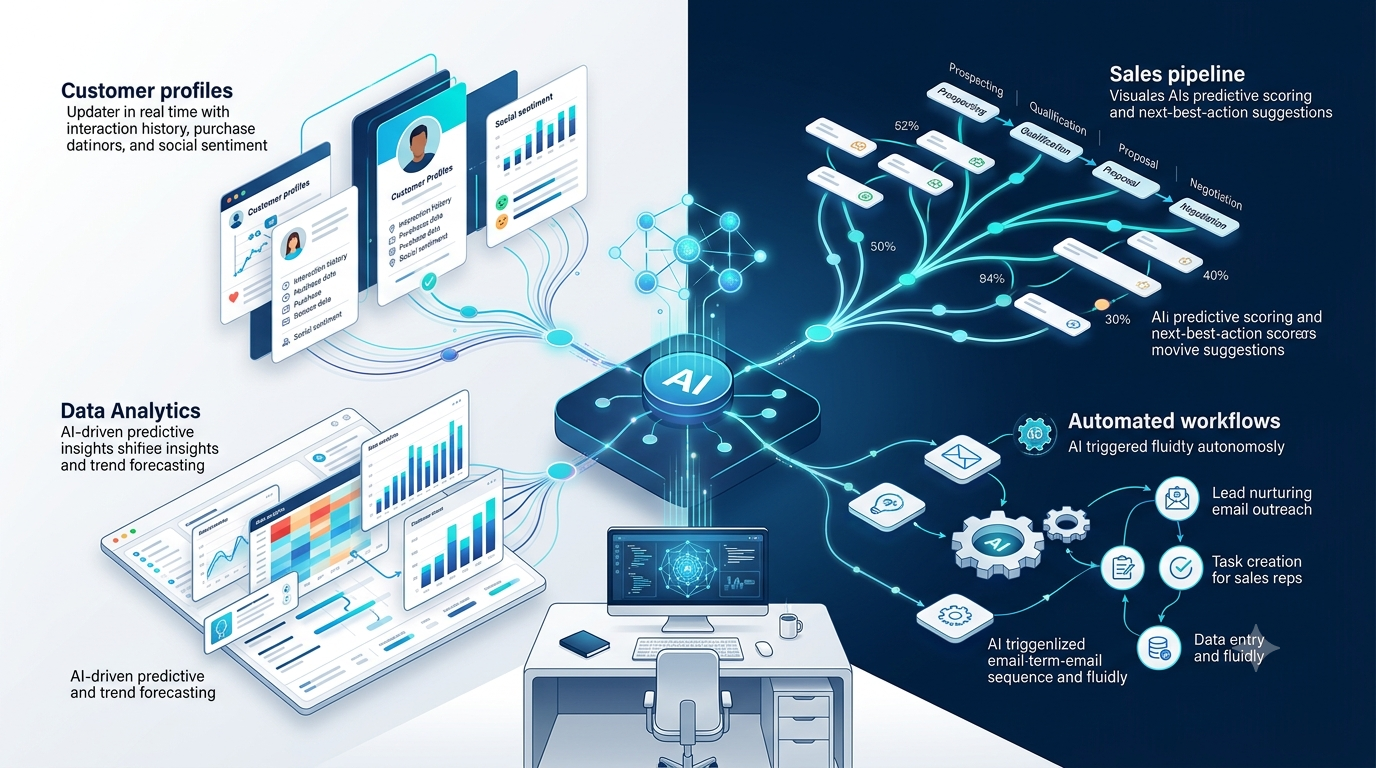
Generative artificial intelligence is beginning to change this approach. By combining large language models, automation workflows, and existing customer information, modern CRM platforms can help businesses turn fragmented records into useful insights, generate personalized communications, summarize conversations, and reduce repetitive administrative work.
The integration of generative AI into CRM is more than another software upgrade. It represents a shift toward intelligent systems that can help sales and marketing teams understand customers, recognize patterns, and make better-informed decisions.
For business-to-business organizations, where sales cycles can involve multiple stakeholders, extended evaluation periods, and numerous interactions, this development is particularly important. An AI-enabled CRM can help teams maintain context across the buyer journey and identify the information needed to move opportunities forward.
As businesses explore these capabilities, one question becomes increasingly relevant: How can organizations use generative AI to improve customer data quality and make their CRM systems more valuable?
What Happens When Generative AI Meets CRM?
Generative AI refers to artificial intelligence systems that can produce new content, including text, summaries, recommendations, and other outputs, based on the information and patterns they have learned.
When integrated into a CRM platform, these capabilities can work alongside customer records, sales activities, marketing engagement data, and service histories. Depending on the platform and its configuration, an AI assistant may help employees retrieve information, summarize account activity, draft follow-up messages, or identify incomplete records.
Traditional CRM functionality generally focuses on storing information, applying predefined rules, and presenting reports. Generative AI adds a conversational and content-generation layer that can make this information easier to understand and act upon.
For example, a sales representative preparing for a meeting might ask an AI assistant to summarize the latest interactions with a prospect. Instead of reviewing multiple notes and emails individually, the representative could receive a concise overview of the account’s challenges, previous conversations, outstanding questions, and agreed next steps.
Similarly, a marketing team could use AI to summarize engagement across several campaigns, group customer feedback by common themes, or prepare an initial draft of a campaign tailored to a particular audience.
These outputs still require appropriate data access, reliable integrations, and human review. AI can accelerate the work, but its recommendations are only as dependable as the information and controls supporting them.
1. Turning Fragmented Customer Data Into Actionable Insights
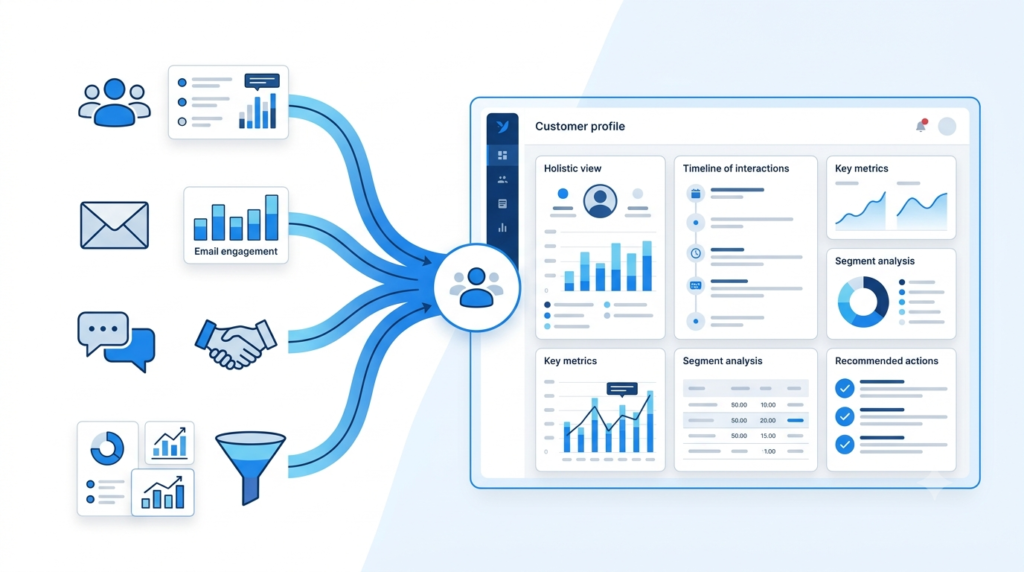
One of the biggest challenges businesses face is maintaining a consistent view of each customer. Contact details may exist in one system, campaign engagement in another, sales conversations in email, and service requests in a separate support platform.
When this information remains disconnected, teams can struggle to understand the complete customer journey. Employees may duplicate research, overlook important interactions, or contact prospects without knowing their recent engagement history.
Generative AI can help make this information easier to interpret when the relevant systems are connected and authorized data is available.
Creating More Complete Customer Profiles
AI assistants can summarize information from connected records, highlight missing details, and help employees understand the history of an account. These capabilities can make it easier to prepare for meetings and maintain continuity when accounts change hands between team members.
For instance, a B2B sales team could use an AI-generated account summary containing the prospect’s industry, company size, previous discussions, content engagement, and current sales stage. The representative would still need to verify important details, but the summary could reduce the time required to gather information manually.
Identifying Inconsistencies and Missing Information
AI can also help identify records that contain conflicting job titles, incomplete company details, outdated contact information, or inconsistent notes. Depending on the system, it may suggest corrections or route questionable records for review.
However, generative AI should not be treated as an independent source of truth. A model might produce plausible information that is not supported by the underlying records. Verified data sources and validation rules remain essential.
The strongest approach combines AI-assisted analysis with established data-quality processes, including deduplication, verification, standardization, and regular maintenance.
2. Automating Repetitive CRM Tasks
Sales and marketing professionals spend considerable time on administrative work. Updating records, writing call summaries, documenting customer interactions, preparing follow-up messages, and assigning next steps can reduce the time available for direct customer engagement.
Generative AI can help automate portions of these activities.
Automated Meeting Summaries
Where meeting transcription and CRM integration are supported, AI can convert conversations into summaries containing key discussion points, customer concerns, decisions, and follow-up actions.
A representative can review the summary, correct any mistakes, and add the approved information to the relevant account or opportunity record.
This helps maintain more consistent documentation without requiring employees to write every note from scratch.
Faster Follow-Up Communication
AI assistants can draft follow-up emails using approved CRM information and the context of a recent conversation. A message might recap the discussion, address a prospect’s stated requirements, and suggest a relevant next step.
Instead of sending identical templates to every contact, representatives can use these drafts as a starting point for more relevant communication.
Personalization must remain accurate and appropriate. Businesses should avoid including confidential details, making unsupported claims, or automatically sending sensitive communications without suitable review.
Workflow Assistance
AI can also support workflows that trigger when specific conditions occur. For example, a CRM might create a review task after an important meeting, flag an opportunity with missing information, or prepare a draft response when a service request arrives.
The workflow itself should follow clearly defined business rules, permissions, and approval requirements. AI can assist with interpretation and content generation, while conventional automation can handle predictable actions reliably.

3. Improving Personalization Across the Customer Journey
Modern buyers expect relevant communication, but personalization becomes difficult when teams manage hundreds or thousands of accounts.
Generative AI can help marketing and sales teams adapt their messaging to different industries, business challenges, buyer roles, and stages of the purchasing process.
More Relevant Marketing Campaigns
Marketing teams can use approved customer attributes and engagement signals to create initial drafts for different audience segments. For example, a campaign targeting IT decision-makers may emphasize integration, security, and operational efficiency, while a campaign for marketing leaders may focus on campaign performance, attribution, and demand generation.
AI can help produce these variations more efficiently. Marketers must still verify that the content accurately reflects the audience’s needs and that the targeting follows consent requirements and applicable privacy rules.
Contextual Sales Engagement
CRM-connected AI can help sales representatives understand which topics matter to a particular account based on documented conversations and legitimate engagement signals.
If a prospect has repeatedly discussed implementation challenges, the representative might receive a suggestion to share relevant implementation resources rather than another general product overview.
This approach supports more meaningful engagement because communication reflects the prospect’s documented interests instead of relying solely on generic demographic or firmographic information.
Consistent Messaging Across Channels
Customers may interact with a business through email, websites, webinars, social media, sales calls, and customer support. When these interactions are captured appropriately, AI can help teams maintain consistent messaging across channels.
The result is not necessarily fully autonomous personalization. In many organizations, the most practical model combines AI-generated recommendations with human judgment and approved campaign workflows.
4. Connecting Customer Data With Predictive Insights
Generative AI and predictive analytics serve different purposes, but they can complement one another inside a CRM environment.
Predictive models estimate the likelihood of an outcome, such as whether an opportunity may convert or a customer may require additional support. Generative AI can help explain the factors behind a model’s output, summarize supporting records, and present the result in language that employees can understand.
For example, a CRM might flag an opportunity because engagement has declined, a decision-maker has not responded, or a planned evaluation date has passed. An AI assistant could summarize these signals and suggest questions for the account manager to investigate.
Prioritizing Sales Opportunities
AI-supported CRM systems can help teams organize opportunities based on defined criteria, account activity, engagement history, and model-generated recommendations.
Sales managers may use these insights to decide which accounts need attention and where additional research is required.
However, an AI-generated priority score should not automatically be treated as proof that a prospect is ready to buy. Scores can be affected by incomplete records, biased historical data, or changes in buyer behavior.
Understanding Customer Intent
Engagement signals, such as repeat visits to relevant resources or participation in a webinar, may provide useful context about customer interests. When interpreted alongside other information, these signals can help teams decide what to investigate next.
Intent should not be inferred from a single activity alone. A content download or website visit does not necessarily indicate purchase readiness. Combining multiple signals with qualification criteria and direct conversations can provide a more reliable assessment.
For B2B organizations, this distinction matters because effective lead qualification requires more than activity tracking. Teams need to understand business needs, buying authority, timing, and the suitability of a proposed solution.
5. Supporting Better Lead Qualification and Account Management
Lead qualification often requires employees to gather information from several sources, compare it against ideal customer profiles, and determine whether a contact or account deserves additional attention.
Generative AI can assist by summarizing available information and organizing it against established qualification frameworks.
For example, a B2B organization using a BANT-based process may evaluate budget, authority, need, and timeline. An AI assistant could organize verified information under these four headings, identify unanswered questions, and prepare a list of points for the next sales conversation.
This can help representatives prepare more effectively without confusing missing information with a negative qualification result.
Account Research at Scale
AI-assisted research can help sales teams summarize information from approved company profiles, internal records, and other permitted sources. Representatives can use these summaries to prepare for outreach and identify topics worth exploring.
Any externally sourced information should be checked against trustworthy sources, particularly when it concerns company size, leadership changes, technology adoption, or business priorities.
Better Handoffs Between Marketing and Sales
Marketing teams often pass leads to sales with a combination of contact details, campaign engagement, and qualification notes. If the handoff is incomplete, sales representatives may need to repeat research or ask prospects questions they have already answered.
AI-generated handoff summaries can help consolidate relevant engagement, stated interests, qualification details, and recommended next steps.
This creates a more structured transition between marketing and sales while preserving the need for human verification.
6. What Major CRM Platforms Are Doing With AI
The integration of AI into customer relationship management is part of a broader movement across business software. Major CRM providers have introduced or expanded AI assistants, content-generation capabilities, predictive features, and workflow automation.
Businesses should evaluate these tools based on their existing technology stack, security requirements, and operational needs rather than assuming every AI feature is available in every subscription or region.
For organizations considering adoption, the important question is not simply which provider offers the most AI features. It is whether those capabilities solve a measurable business problem while meeting the organization’s security, compliance, and data-quality requirements.
7. The Data Privacy and Security Challenges Businesses Must Address
Although generative AI offers significant opportunities, connecting it to customer information introduces important responsibilities. CRM platforms may contain personal contact details, confidential commercial discussions, contract information, customer preferences, and other sensitive records.
Businesses must understand how this information is accessed, processed, stored, and used by AI features.
Data Access and Permissions
AI assistants should operate within clearly defined access permissions. An employee who cannot normally access a restricted account record should not gain access to that information simply by asking an AI assistant a question.
Organizations should review role-based permissions, connected applications, third-party integrations, and the data available to each AI workflow.
Data Accuracy and Hallucinations
Generative AI can produce convincing but incorrect statements. A generated summary might misinterpret a conversation, confuse two contacts, or introduce a detail that was never recorded.
Human review is especially important when AI outputs affect customer commitments, pricing, contracts, qualification decisions, or external communications.
Consent and Privacy Compliance
Businesses must consider applicable privacy laws, contractual obligations, data retention requirements, and customer consent when using personal information in AI-powered workflows.
Data minimization is a useful principle: provide the AI system only the information necessary for the task. Organizations should also establish clear policies for handling sensitive information and responding to data-access or deletion requests.
Human Oversight and Accountability
Automation should not eliminate responsibility. Businesses need to define who approves AI-generated communications, who investigates errors, and who monitors performance.
A responsible deployment includes audit trails, access controls, escalation procedures, and regular reviews of outputs and business outcomes.
8. How to Implement Generative AI in Your CRM Successfully
Businesses do not need to automate every CRM activity at once. A focused implementation strategy can help teams demonstrate value, identify risks, and expand gradually.
Step 1: Identify a Specific Business Problem
Start by identifying a repetitive task or data challenge that affects performance. Examples include time-consuming meeting notes, incomplete account records, inconsistent follow-ups, or lengthy account research.
Define a baseline before implementation so the team can compare performance afterward.
Step 2: Audit CRM Data Quality
Review duplicate records, outdated contact information, missing fields, inconsistent naming conventions, and disconnected integrations. AI cannot reliably compensate for every weakness in the underlying data.
Improve validation rules and establish ownership for ongoing data maintenance.
Step 3: Select a Suitable Use Case
Choose a task that offers clear value and manageable risk. Meeting summaries, internal account research, and draft email creation may be useful starting points because employees can review the output before it is used.
More sensitive activities, such as automated customer decisions or unsupervised external communication, require stronger safeguards.
Step 4: Review Integration and Security Requirements
Confirm that the AI capability works with the existing CRM, email tools, marketing platforms, and reporting systems. Review vendor documentation covering data processing, retention, access permissions, and available administrative controls.
Test the setup with a limited group before expanding it across the organization.
Step 5: Train Employees and Establish Guidelines
Explain what the AI system can and cannot do. Employees should know how to verify outputs, report errors, protect confidential information, and distinguish confirmed customer facts from generated suggestions.
Training should focus on improving the workflow rather than encouraging employees to accept every AI-generated response.
Step 6: Measure Performance and Refine the Process
Track meaningful metrics such as administrative time per sales representative, CRM record completeness, duplicate rates, follow-up turnaround time, and employee adoption.
Where relevant, evaluate whether AI-assisted workflows improve qualified pipeline creation, sales-cycle efficiency, customer experience, or conversion rates.
Results will vary by organization, use case, data quality, and implementation. Businesses should measure their own outcomes instead of assuming that a particular percentage improvement will apply universally.
9. Measuring the Business Value of AI-Powered CRM
The success of an AI-enabled CRM should be assessed through operational and commercial outcomes rather than the number of automated tasks alone.
Useful performance indicators include:
- CRM data completeness: The percentage of records containing the required fields.
- Data accuracy: The proportion of reviewed records that meet established validation standards.
- Administrative efficiency: The time employees spend documenting interactions and preparing routine communications.
- Follow-up speed: The time between a customer interaction and the next appropriate action.
- Sales productivity: The time representatives can devote to prospect conversations, account planning, and opportunity development.
- Marketing relevance: Engagement and conversion performance across appropriately targeted campaigns.
- Customer experience: Feedback, response quality, and consistency across interactions.
- AI output quality: The frequency of factual errors, corrections, escalations, and rejected recommendations.
A useful evaluation compares the new workflow with a clearly defined baseline. Where possible, organizations can run controlled pilots or compare similar teams to understand whether observed improvements are genuinely related to the AI deployment.
Cost should also be included. Licensing, integration, training, governance, and ongoing monitoring can affect the overall return on investment.
10. The Future of Generative AI and CRM Automation
The next stage of CRM development is likely to involve more connected AI assistants that can help coordinate activities across sales, marketing, and customer service.
Instead of only generating a summary or answering a question, a suitably configured AI agent may be able to interpret a request, gather information from permitted systems, propose a sequence of actions, and execute approved steps through connected tools.
For example, an account manager might request a review of stalled opportunities. A connected workflow could identify records meeting defined criteria, summarize recent activity, prepare suggested follow-up tasks, and present them for approval.
This kind of workflow can reduce manual coordination, but it also increases the importance of access control, testing, auditability, and clear limits on autonomous actions.
The distinction between assistance and autonomy will remain important. Some activities are suitable for automation under predefined rules, while others require human judgment because they involve negotiation, customer trust, financial commitments, or sensitive information.
Organizations that establish sound data governance and clear operating procedures today will be better positioned to evaluate more advanced capabilities as they become available.
Conclusion: Building Smarter Customer Relationships With AI
Generative AI is changing how businesses interact with CRM data. From summarizing customer conversations and improving record management to supporting personalized engagement and sales workflows, intelligent systems can help teams extract more value from information they already possess.
For B2B organizations, the opportunity is particularly relevant. Complex sales cycles require consistent records, coordinated marketing and sales activities, and a clear understanding of customer needs. AI can help employees access this context more efficiently, allowing them to spend less time on repetitive administration and more time on meaningful customer engagement.
However, successful adoption depends on more than choosing an AI-enabled platform. Businesses need accurate data, secure integrations, appropriate permissions, employee training, and measurable objectives.
The strongest CRM strategy combines the speed of automation with the judgment of experienced professionals. Generative AI can help businesses organize and interpret customer information, but trust, accountability, and sound decision-making remain essential.
As intelligent CRM capabilities continue to develop, the organizations that focus on data quality and practical business outcomes will be better equipped to turn AI experimentation into lasting operational value.
Frequently Asked Questions
Generative AI in CRM refers to the use of AI models to help summarize customer interactions, generate communications, interpret customer records, and support sales, marketing, and service workflows. Capabilities depend on the platform and connected data.
It can help employees identify missing information, summarize account histories, recognize inconsistencies, and organize information from connected systems. Data validation and human review remain important because AI-generated outputs can contain errors.
Yes. Depending on the platform, it can assist with meeting summaries, email drafts, record updates, task preparation, and workflow coordination. Businesses should establish approval requirements for actions that affect customers or sensitive records.
Potential benefits include faster account research, more consistent sales documentation, better-informed follow-ups, improved coordination between marketing and sales, and reduced administrative effort. Actual results depend on data quality, workflow design, adoption, and governance.
Safety depends on the provider’s data-handling practices, configuration, permissions, integrations, and the organization’s policies. Businesses should review security documentation, restrict access appropriately, minimize unnecessary data sharing, and confirm applicable privacy obligations.
No. Generative AI generally enhances existing CRM functionality rather than replacing the need for customer records, structured workflows, reporting, permissions, and data governance.
Generative AI creates content or summaries, while predictive AI estimates the likelihood of outcomes such as conversion or churn. Used together, they can help teams understand customer information and investigate potential opportunities.
Begin with a clearly defined, low-risk use case such as meeting summaries or internal account research. Audit data quality, review security and integration requirements, train employees, and measure performance against a baseline before expanding.