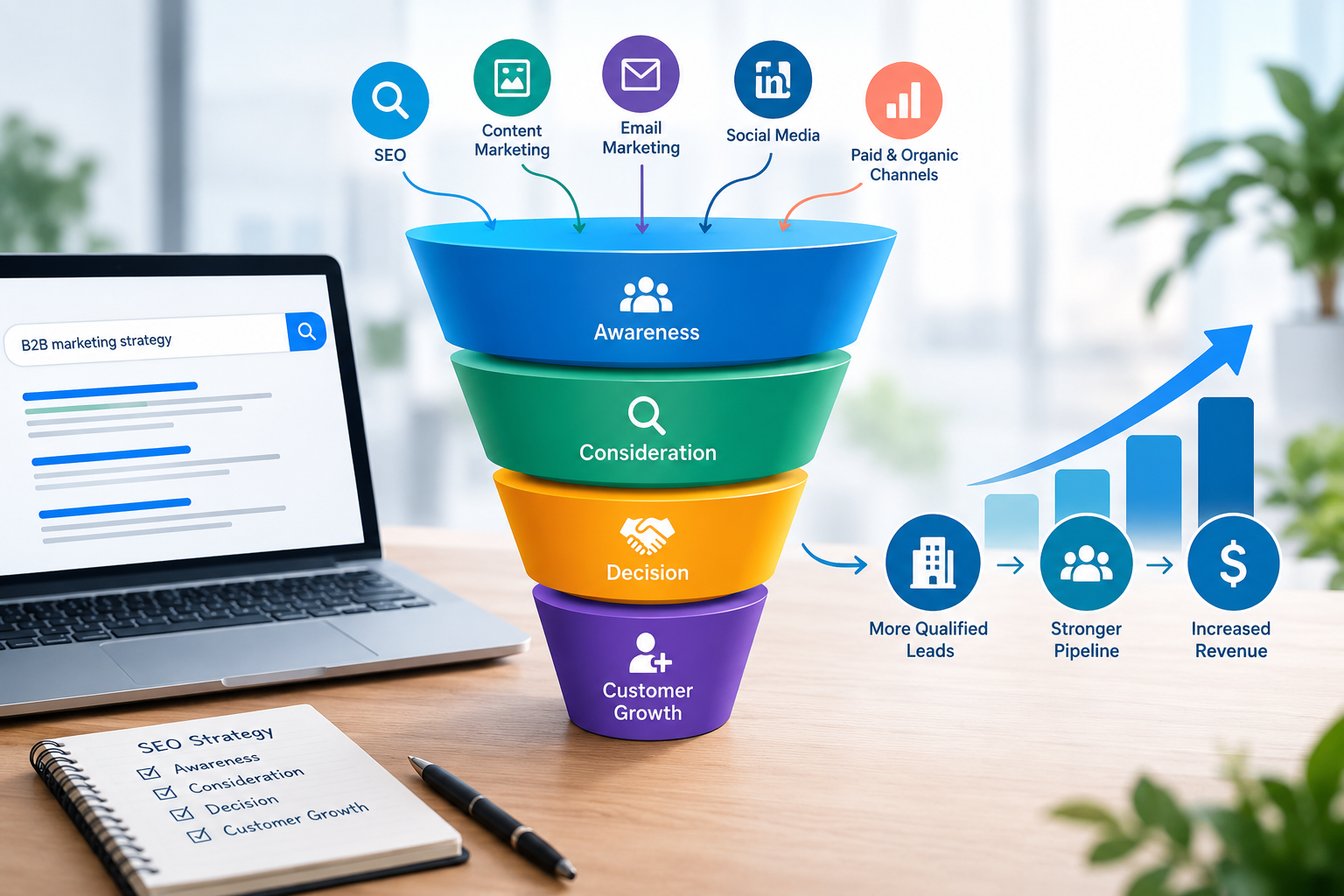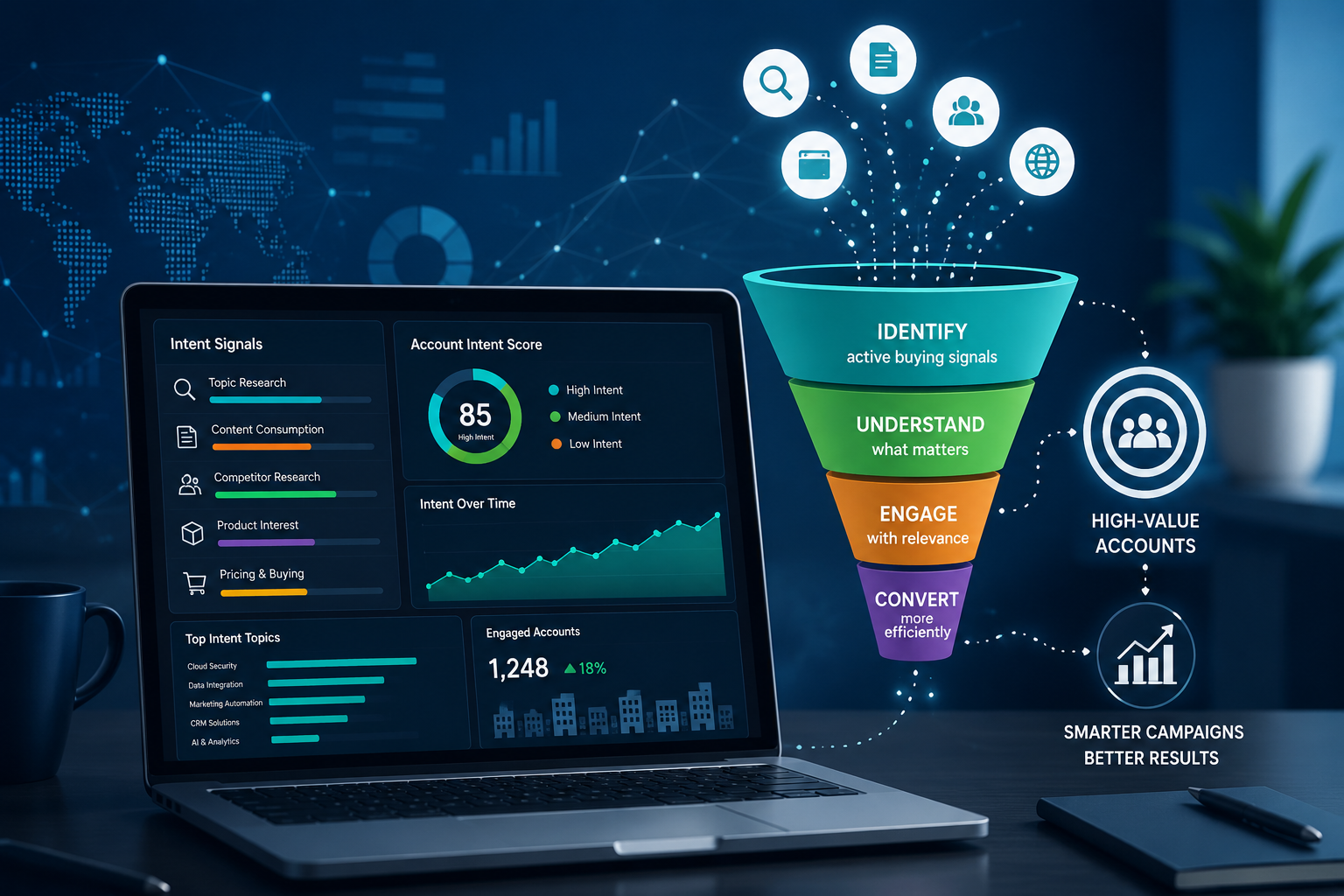

Introduction
Demand generation and lead generation are two of the most frequently used terms in B2B marketing. They often appear together in marketing strategies, campaign briefs, sales meetings, and performance reports. Because both activities are connected to acquiring potential customers, they are sometimes treated as if they mean the same thing.
They do not.
Demand generation and lead generation have different purposes, different approaches, different metrics, and different roles within the B2B buying journey. Understanding the difference is important because a business can generate thousands of leads without creating meaningful demand, just as it can build strong market awareness without generating enough identifiable prospects for sales teams to follow up with.
Salesforce describes demand generation as a broader, data-driven approach focused on building awareness and interest throughout the customer lifecycle, while lead generation specifically focuses on capturing qualified contacts.
In simple terms, demand generation creates interest, while lead generation captures that interest and turns it into identifiable prospects.
For B2B organizations, the two should not be viewed as competing strategies. They are connected parts of a larger revenue process.
This article breaks down the difference between demand generation and lead generation, explains where each strategy fits, explores common tactics and metrics, and shows how B2B marketing teams can use both to create a stronger and more sustainable pipeline.
What Is Demand Generation?
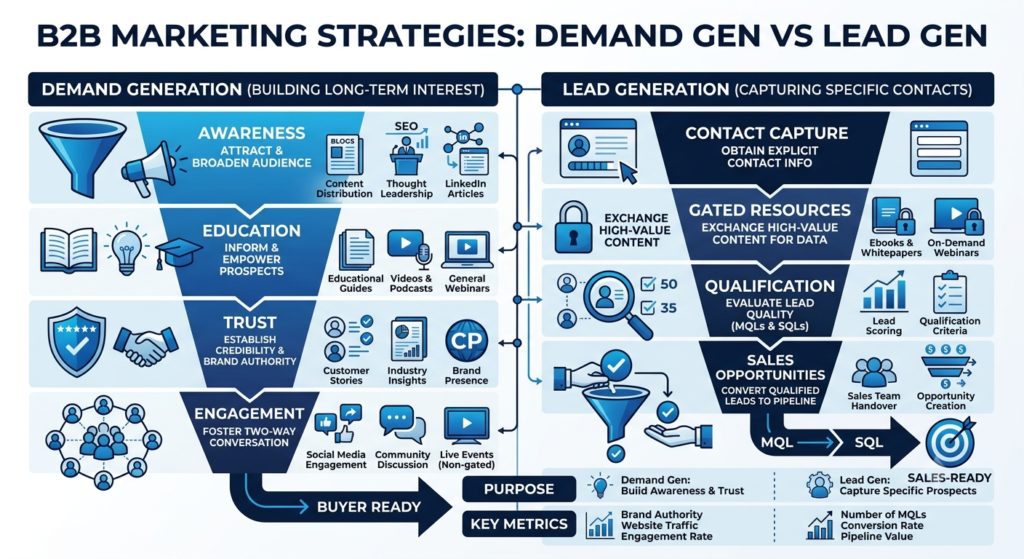
Demand generation is the broader marketing process of creating awareness, interest, education, and preference around a company, product, service, or category.
The objective is not necessarily to get a prospect to fill out a form immediately. Instead, demand generation focuses on getting the right audience to recognize a problem, understand potential solutions, trust a company, and remember the brand when they eventually enter a buying cycle.
According to HubSpot, demand generation helps businesses expand their audience, build brand awareness, educate the market, establish thought leadership, and create interest in a category or solution.
For example, imagine a B2B company offering marketing automation software.
A company publishes educational articles explaining how marketing teams can improve campaign attribution. It creates LinkedIn content about marketing operations, publishes industry research, hosts webinars, participates in podcasts, and shares expert insights.
A marketing manager may read several of those resources without submitting a form or speaking with sales.
That interaction can still be valuable.
The company is building familiarity and credibility before the buyer is ready to purchase.
That is demand generation.
Common Demand Generation Activities
Demand generation can involve multiple channels and formats, including:
- SEO-focused educational content
- Industry research and reports
- Thought leadership
- LinkedIn content
- Podcasts
- Webinars
- Events and conferences
- Video content
- Community marketing
- Public relations
- Analyst relations
- Brand campaigns
- Account-based marketing
- Social media engagement
- Ungated resources
- Educational newsletters
- Partner and influencer programs
These activities can reach potential buyers at different stages of their journey.
The important point is that demand generation is primarily focused on creating and strengthening interest, rather than simply collecting contact information.
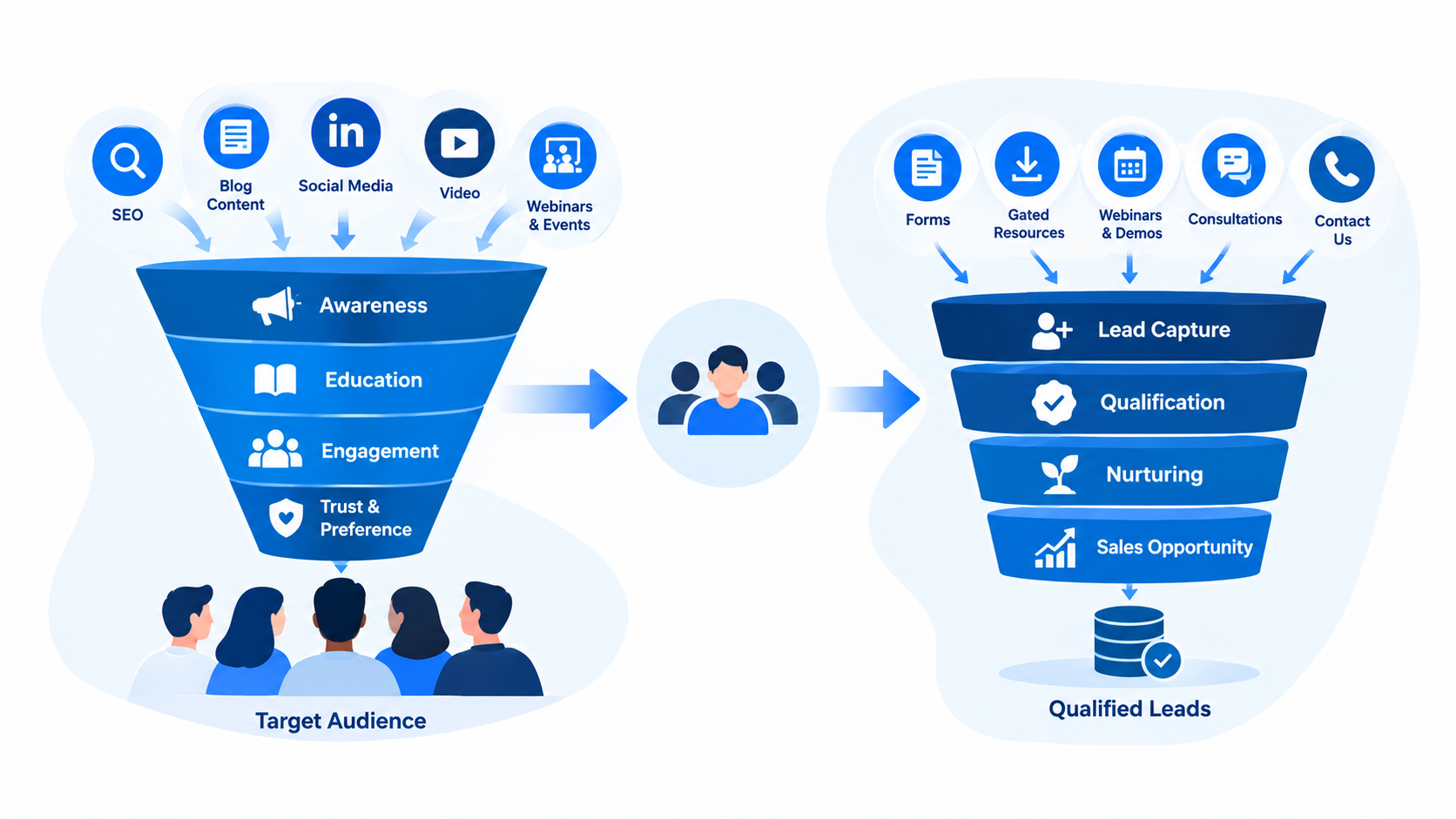
Suggested image placement: Place the image immediately after this section as a visual explanation of how demand generation creates awareness and interest before lead capture.
What Is Lead Generation?
Lead generation is the process of identifying and capturing people or organizations that have shown some level of interest in a company’s product, service, or solution.
Lead generation typically involves a conversion action.
A prospect may complete a form, request a consultation, download a gated asset, register for a webinar, request pricing information, book a meeting, respond to an email campaign, or otherwise provide information that allows the business to identify and engage with them.
Salesforce describes lead generation as a demand generation tactic in which potential customers share information with a business, creating an identifiable prospect that can be moved toward sales.
For example, suppose the same marketing automation company publishes an article about campaign attribution.
A visitor reads the article and then downloads a detailed campaign attribution guide by providing their business email, job title, company name, and other information.
The visitor has moved from anonymous audience member to identifiable prospect.
That is lead generation.
The next step may involve lead qualification, nurturing, sales development, or another engagement process depending on the company’s marketing and sales model.
Demand Generation vs Lead Generation: The Core Difference
The easiest way to understand the difference is to look at the primary objective of each activity.
Demand generation creates awareness and interest.
Lead generation captures identifiable interest.
Demand generation can happen without a prospect giving a company their contact details.
Lead generation generally requires some form of conversion or identification.
HubSpot similarly describes demand generation as the broader strategy for creating awareness and interest, while lead generation focuses on converting that interest into action and capturing contact information.
Demand Generation vs Lead Generation Comparison
| Factor | Demand Generation | Lead Generation |
|---|---|---|
| Primary objective | Build awareness, interest, trust and preference | Capture identifiable prospects |
| Main focus | Market and audience | Individual prospects or accounts |
| Typical stage | Early and middle stages of the buying journey | Conversion and pipeline creation |
| Main approach | Educate and engage | Convert and capture |
| Common content | Blogs, videos, podcasts, research, social content | Gated guides, demos, forms, consultations |
| Typical CTA | Learn more, read, watch, follow, explore | Download, register, request, book, contact |
| Key measurements | Reach, engagement, traffic, brand interest, pipeline influence | Leads, MQLs, SQLs, conversion rate, CPL |
| Time horizon | Often longer term | Often more immediate |
| Main outcome | Increased market awareness and buyer interest | Identifiable prospects for nurturing or sales |
| Relationship to sales | Creates familiarity and preference | Creates actionable prospect records |
The distinction is important because measuring both activities with the same KPIs can create misleading conclusions.
A demand generation campaign may be successful even if it produces relatively few immediate form submissions.
A lead generation campaign may produce a large number of leads but still perform poorly if those leads have little buying intent or do not match the company’s ICP.
Why Demand Generation Comes Before Many Lead Generation Activities
One of the biggest mistakes in B2B marketing is assuming that every audience member is already ready to buy.
B2B buying decisions can involve multiple stakeholders, longer consideration periods, complex requirements, budget approval, internal discussions, and extensive research.
A potential buyer may be interested in a problem today but may not be ready to purchase a solution for several months.
Demand generation gives marketers an opportunity to influence that buyer before the buying decision becomes immediate.
For example, a technology company targeting enterprise IT leaders might publish content about cybersecurity risks, operational inefficiencies, compliance challenges, and technology modernization.
The audience may not immediately request a product demonstration.
However, repeated exposure to useful content can help establish familiarity with the company.
When the organization eventually begins evaluating solutions, the company may already be recognized as a relevant source.
This is one reason demand generation should not be judged exclusively by immediate lead volume.
Salesforce notes that B2B demand generation focuses on building authority and trust and can support the customer journey from initial awareness through sales pipeline development.
Why Lead Generation Still Matters
Demand generation can create awareness, but businesses ultimately need identifiable prospects to build a measurable sales pipeline.
This is where lead generation becomes important.
Once a prospect demonstrates sufficient interest, marketers can create opportunities for conversion.
A B2B company may offer:
- A detailed industry report
- A product comparison guide
- A technical assessment
- A consultation
- A product demonstration
- A free trial
- An ROI calculator
- A webinar registration
- A buyer’s guide
- A pricing request
The conversion action provides an opportunity to collect information and understand the prospect’s requirements.
That information can then support segmentation, qualification, nurturing, account prioritization, and sales engagement.
The key is that lead generation works better when the prospect already has enough context to understand why the offer is relevant.
The Role of Content in Demand Generation
Content plays a major role in demand generation because B2B buyers often consume educational material before engaging directly with a sales team.
Demand-focused content should answer questions, explain industry challenges, provide useful insights, and help buyers understand potential solutions.
For example, a B2B data services company might create content around:
Early-stage content
“Why B2B Data Quality Impacts Revenue”
Middle-stage content
“How to Build a Reliable B2B Data Validation Process”
Late-stage content
“How to Evaluate a B2B Data Management Partner”
Each piece serves a different purpose.
The first article creates awareness around the problem.
The second educates the buyer about possible approaches.
The third supports a buyer who is actively evaluating solutions.
This creates a content journey rather than a collection of disconnected marketing assets.
HubSpot’s 2026 marketing research also identifies websites, blogs, and SEO as important channels, particularly for B2B marketing, while visual formats such as short-form video are receiving significant attention from marketers.
The Role of Lead Generation in a B2B Campaign
Lead generation becomes more important when a prospect moves from general interest toward an identifiable action.
Imagine a potential buyer reads three articles about B2B demand generation.
They then see an offer for a downloadable guide titled:
“The B2B Demand Generation Planning Guide”
The prospect provides their business email and company information to access it.
At this point, the marketing team has a new identifiable contact.
The campaign can now evaluate factors such as:
- Company size
- Industry
- Job function
- Geographic market
- Content engagement
- Website activity
- Campaign source
- Stated business need
- Buying intent
- Account fit
The contact can then enter a relevant nurturing or qualification process.
This demonstrates how demand generation and lead generation can work together rather than operating as isolated campaigns.
Demand Generation and Lead Generation Should Work Together
The debate over whether companies should focus on demand generation or lead generation can create the wrong question.
For most B2B businesses, the more useful question is:
How should demand generation and lead generation work together?
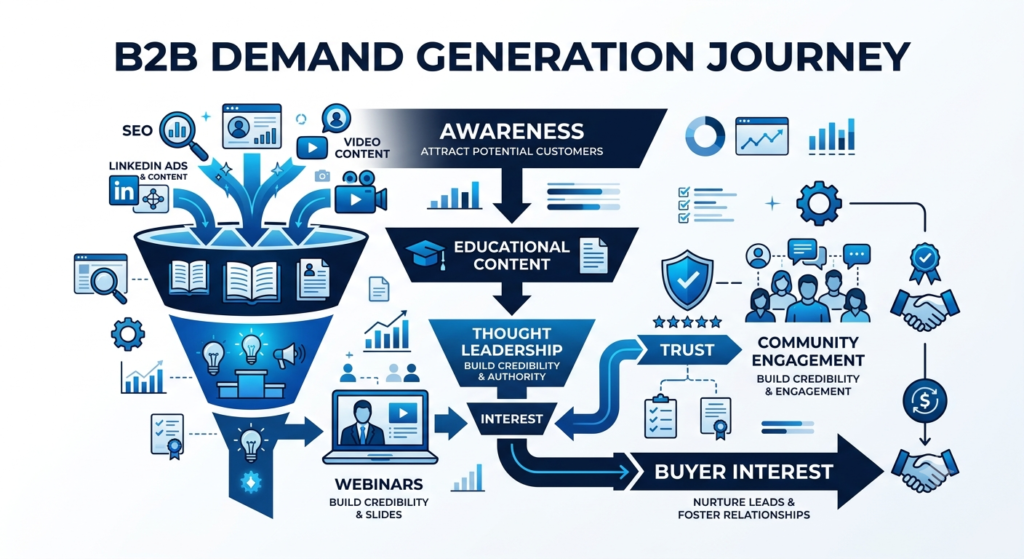
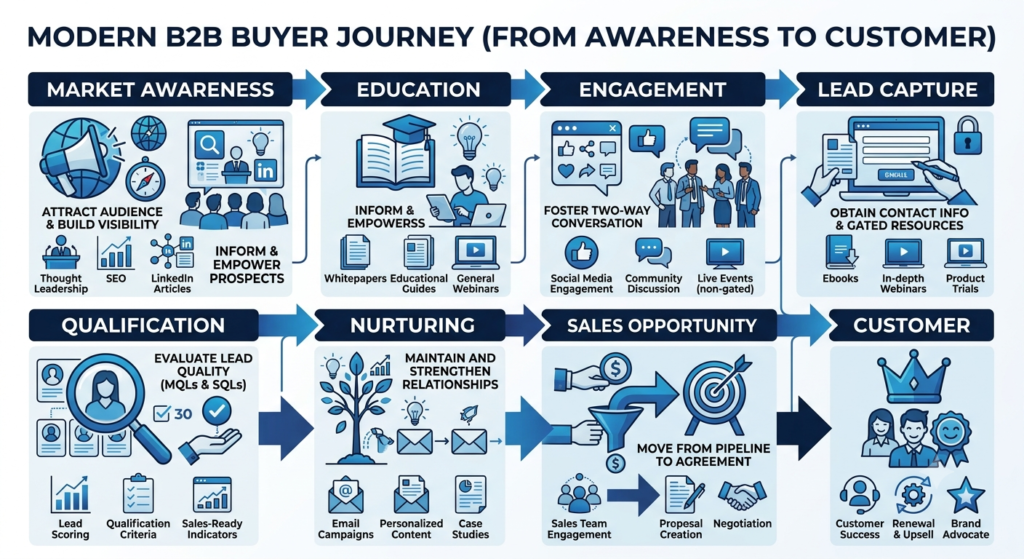
A simplified journey might look like this:
Market Awareness → Education → Engagement → Interest → Lead Capture → Qualification → Nurturing → Sales Opportunity → Customer
Demand generation can influence the early stages of the journey.
Lead generation becomes increasingly important when prospects take identifiable actions.
Lead nurturing and qualification then help determine what should happen next.
HubSpot describes the relationship in a similar way, noting that demand generation creates the audience and interest while lead generation captures that interest and helps move it toward conversion.
Example: A B2B Software Campaign
Consider a B2B software company launching a new sales intelligence platform.
Stage 1: Demand Generation
The company publishes:
- Industry research
- LinkedIn thought leadership
- SEO articles
- Short videos
- Customer insights
- Podcast interviews
- Educational webinars
The objective is to reach sales and marketing leaders and create awareness of the problem.
Stage 2: Engagement
Some prospects repeatedly interact with the company’s content.
They watch videos, visit the website, read multiple articles, or attend a webinar.
These interactions indicate growing interest, although the prospects may not yet be ready for a sales conversation.
Stage 3: Lead Generation
The company promotes a detailed buyer’s guide.
Interested prospects submit their business information to access it.
The company now has identifiable leads.
Stage 4: Qualification
Marketing and sales assess factors such as company fit, role, business need, engagement, and buying intent.
Stage 5: Nurturing
Prospects that are not immediately sales-ready receive relevant educational content.
Stage 6: Sales Engagement
Qualified prospects can be routed to the sales team for a relevant conversation.
The campaign therefore uses demand generation to create interest and lead generation to capture identifiable demand.
How to Measure Demand Generation
One reason demand generation can be misunderstood is that some of its impact is difficult to attribute to a single conversion.
Useful demand generation metrics can include:
Brand Awareness
Track changes in branded search activity, direct traffic, social reach, and other indicators of brand visibility.
Content Engagement
Measure meaningful interactions such as time spent with content, video completion, repeat visits, webinar attendance, and content consumption.
Website Performance
Analyze relevant organic traffic, returning visitors, engaged sessions, and movement through important pages.
Audience Growth
Track relevant subscriber growth, community participation, social followers, and other audience indicators.
Pipeline Influence
Where attribution systems allow it, evaluate whether accounts or contacts exposed to demand generation activities later become qualified opportunities or customers.
The goal is to understand whether marketing is creating meaningful market interest rather than simply generating activity.
How to Measure Lead Generation
Lead generation generally has more direct conversion metrics.
Important KPIs can include:
- Number of leads generated
- Marketing qualified leads
- Sales qualified leads
- Lead-to-MQL conversion rate
- MQL-to-SQL conversion rate
- SQL-to-opportunity conversion rate
- Cost per lead
- Cost per qualified lead
- Lead acceptance rate
- Meeting conversion rate
- Opportunity creation
- Pipeline generated
- Revenue influenced or sourced
However, lead volume alone should not be treated as the complete measure of campaign success.
A campaign producing 5,000 contacts may look impressive at first glance.
If only a small percentage match the ICP or progress toward meaningful sales conversations, the volume does not necessarily translate into useful pipeline.
That is why lead quality, qualification, account fit, engagement, and downstream conversion matter.
HubSpot’s 2026 marketing data shows that lead quality remains an important measurement area, while many marketers continue to identify lead generation as a significant challenge.
Common Demand Generation Mistakes
Treating Every Marketing Activity as Lead Generation
Not every marketing activity needs to produce a form submission.
An educational LinkedIn post may generate valuable awareness even if nobody immediately downloads an asset.
Gating Everything
If every piece of useful content requires an email address, prospects may never experience enough value to trust the brand.
A balanced strategy can use both ungated educational content and gated conversion assets.
Measuring Only Short-Term Results
Demand generation often requires repeated exposure and consistent publishing.
Evaluating every activity only through immediate lead volume can undervalue awareness and engagement.
Ignoring Distribution
Creating excellent content does not guarantee that the intended audience will see it.
Content needs appropriate distribution across search, social, email, communities, partnerships, events, and other relevant channels.
Common Lead Generation Mistakes
Chasing Lead Volume
A high lead count can hide poor targeting.
B2B teams should evaluate whether leads match the intended audience and have meaningful potential.
Using Generic Offers
A generic ebook may attract a broad audience but fail to generate relevant sales conversations.
Offers should connect directly to the problems and priorities of the target buyer.
Poor Follow-Up
Even a qualified lead can lose momentum when there is a significant delay between conversion and follow-up.
Marketing and sales teams should establish clear processes for routing, qualification, and engagement.
Ignoring Data Quality
Incomplete, outdated, duplicate, or inaccurate contact information can create problems throughout the sales process.
Lead generation therefore needs to be connected to data validation and CRM hygiene.
Where Account-Based Marketing Fits
Account-based marketing can connect demand generation and lead generation at the account level.
Instead of focusing only on individual contacts, an ABM program identifies target companies and develops relevant messaging for the people involved in the buying process.
For example, a B2B company may identify 100 target accounts.
Demand generation activities can build awareness among those organizations through targeted content, advertising, events, thought leadership, and personalized campaigns.
Lead generation can then capture relevant contacts from those accounts when individuals demonstrate identifiable interest.
This approach helps marketing teams think beyond individual lead counts and consider account engagement and buying groups.
Demand Capture Is Also Important
There is another concept that should not be confused with demand generation or lead generation: demand capture.
Demand generation creates or strengthens interest.
Demand capture focuses on being visible when buyers are already looking for a solution.
For example, a company ranking for a high-intent search such as “B2B lead generation agency” is attempting to capture existing demand.
A thought leadership article explaining why B2B organizations struggle with pipeline quality may contribute more to demand creation.
Both activities can be valuable.
The important distinction is understanding whether a campaign is creating new interest or responding to existing buying intent.
How B2B Companies Can Build a Balanced Strategy
A practical B2B strategy can combine both approaches.
Start With the Ideal Customer Profile
Define the industries, company sizes, locations, roles, business problems, and buying characteristics that matter most.
Build Demand With Educational Content
Create content that addresses the questions your audience asks before they are ready to speak with sales.
Create Conversion Opportunities
Once prospects have enough context, provide relevant opportunities such as guides, webinars, assessments, consultations, or demonstrations.
Connect Marketing and Sales
Define what constitutes a qualified lead and establish clear processes for lead routing and follow-up.
Improve Data Quality
Validate contact information and maintain accurate CRM records so sales teams can work with reliable data.
Measure the Full Journey
Look beyond lead volume.
Track engagement, qualification, opportunities, pipeline, and revenue alongside awareness metrics.
Continuously Refine the Strategy
Use campaign performance data to determine which audiences, messages, channels, offers, and content formats are producing meaningful business outcomes.
Final Takeaway
Demand generation and lead generation are not interchangeable terms, but they are closely connected parts of a B2B growth strategy.
Demand generation focuses on creating awareness, educating the market, building trust, and developing interest around a solution or category.
Lead generation focuses on converting that interest into identifiable prospects that can be qualified, nurtured, and potentially moved into the sales process.
The difference becomes especially important when marketing teams define campaign objectives and KPIs.
If a campaign is designed to educate an audience and build brand familiarity, demand generation metrics should play an important role.
If a campaign is designed to capture contact information and create sales-ready opportunities, lead generation metrics become more relevant.
The strongest B2B programs connect both.
Demand generation helps ensure that a company is known and understood before buyers are ready to engage. Lead generation creates identifiable opportunities when prospects take meaningful actions. Nurturing, qualification, sales engagement, and data management then help move those prospects through the revenue process.
In other words, demand generation builds the conditions for future buying activity, while lead generation creates identifiable opportunities from that interest.
For B2B marketers, understanding this distinction can lead to better campaign planning, more meaningful KPIs, stronger sales and marketing alignment, and a clearer view of how marketing contributes to pipeline growth.
Frequently Asked Questions About Demand Generation and Lead Generation
Demand generation focuses on creating awareness, interest, trust, and demand for a company’s products or services. Lead generation focuses on capturing identifiable prospects who have demonstrated interest through actions such as form submissions, content downloads, webinar registrations, consultations, or demo requests.
Demand generation and lead generation serve different purposes, so they should not be treated as competing activities. Demand generation helps create market awareness and interest, while lead generation converts relevant interest into identifiable prospects that can be qualified and nurtured.
Yes. Demand generation can contribute to lead generation by building awareness and interest that eventually encourages prospects to take a conversion action. However, not every demand generation activity needs to produce an immediate lead.
Common B2B demand generation strategies include SEO, educational content, thought leadership, webinars, podcasts, social media, industry research, video marketing, events, community marketing, account-based marketing, and email engagement.
Lead generation strategies can include gated content, webinar registrations, contact forms, consultation requests, product demonstrations, free trials, buyer’s guides, landing pages, email campaigns, outbound prospecting, and account-based lead capture.
Demand generation can be measured using metrics such as website traffic, organic visibility, content engagement, audience growth, branded search activity, returning visitors, social engagement, webinar participation, account engagement, and pipeline influence.
Common lead generation metrics include total leads, marketing qualified leads, sales qualified leads, lead conversion rate, cost per lead, cost per qualified lead, lead acceptance rate, meeting conversion rate, opportunity creation, pipeline generated, and revenue influenced or sourced.
Lead quality is important because a high number of leads does not necessarily mean a campaign is generating useful sales opportunities. Leads should be evaluated based on factors such as ICP fit, company size, industry, job role, business need, engagement, buying intent, and qualification criteria.
Content supports demand generation by educating potential buyers, addressing industry challenges, answering common questions, demonstrating expertise, and building familiarity with a brand. Blog articles, research reports, videos, webinars, podcasts, and thought leadership can all contribute to demand creation.
Demand generation can create awareness and interest, while lead generation provides opportunities for prospects to identify themselves. After lead capture, businesses can use qualification, nurturing, sales engagement, and relevant content to move prospects toward potential opportunities.
Demand capture refers to marketing activities designed to reach buyers who are already searching for a solution. Examples include SEO for high-intent keywords, paid search, product comparison content, review pages, and other channels that connect businesses with prospects who already have an active need.
Yes. A company can run demand generation activities such as thought leadership, SEO content, social media, podcasts, and educational videos without requiring visitors to submit their contact information. However, businesses that want to create an identifiable sales pipeline will generally need conversion and lead generation mechanisms as part of their broader strategy.
Both volume and quality can be useful measurements, but they answer different questions. Lead volume shows how many prospects were captured, while lead quality indicates how closely those prospects match the company’s target audience and qualification criteria. Evaluating downstream conversion and pipeline provides additional context.
Account-based marketing can combine both approaches by targeting specific companies with relevant content and campaigns. Demand generation activities can build awareness within target accounts, while lead generation can identify relevant contacts when individuals engage with conversion opportunities.
A simple way to remember it is:
Demand generation creates interest.
Lead generation captures interest.
Both can play an important role in building a B2B marketing and sales pipeline.