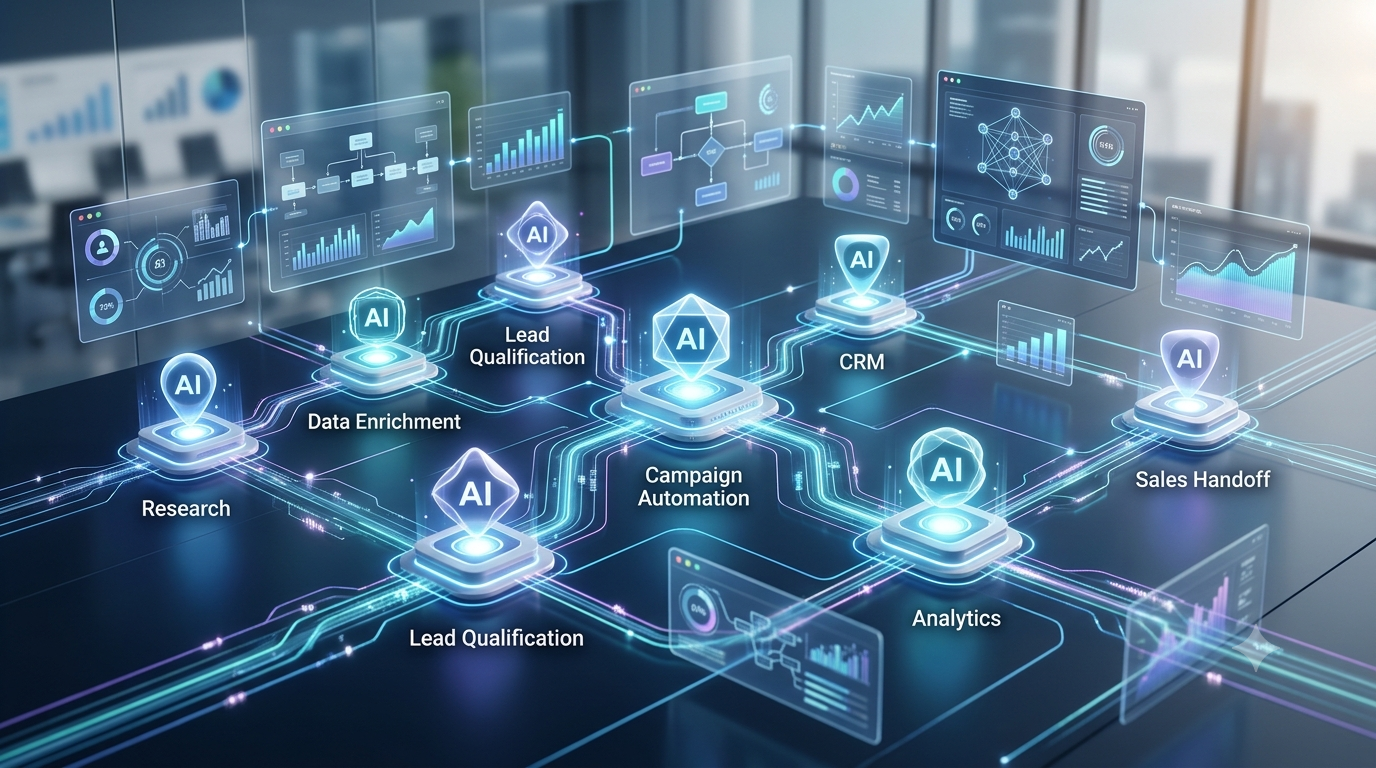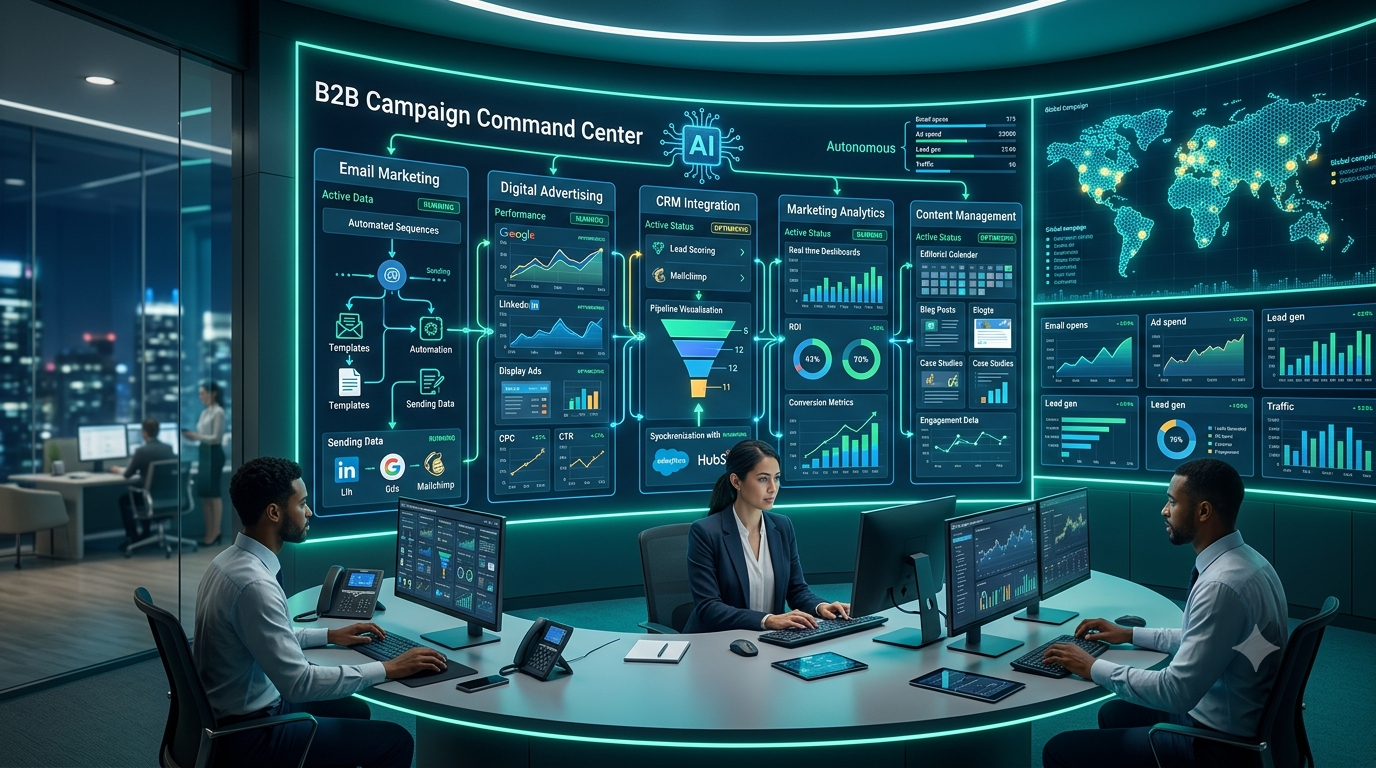


Artificial Intelligence has already changed how marketers analyse customer data, automate repetitive work, and personalise digital experiences. Over the past few years, businesses have become familiar with AI assistants that generate emails, write content, analyse reports, and recommend campaign improvements. While these capabilities remain valuable, the industry is now entering an entirely new phase.
The next major innovation is Agentic AI.
Unlike traditional AI systems that simply respond to prompts, Agentic AI can independently plan, execute, monitor, and improve complex business tasks with minimal human intervention. Instead of acting as a tool, it behaves more like a highly skilled digital teammate capable of making informed decisions within defined business objectives.
For B2B organisations, this shift is particularly significant. Marketing and sales teams are under increasing pressure to generate qualified leads, improve customer engagement, shorten sales cycles, and demonstrate measurable return on investment. Agentic AI offers a new way to achieve these goals by automating entire workflows rather than individual tasks.
From identifying high intent prospects to launching personalised campaigns and continuously optimising performance, Agentic AI is quickly becoming one of the most influential technologies in modern revenue operations.
As organisations continue investing in AI powered platforms, understanding Agentic AI is no longer optional. Revenue teams that embrace autonomous intelligence today will be better positioned to compete in increasingly complex and data driven markets.
What Is Agentic AI?
Agentic AI refers to artificial intelligence systems that can pursue goals independently by making decisions, executing actions, learning from outcomes, and adapting their behaviour over time.
Unlike conventional AI models that wait for instructions before producing an output, Agentic AI continuously works toward predefined objectives.
For example, imagine asking an AI assistant to create an email campaign.
A traditional AI model might generate the email copy once you provide a prompt.
An Agentic AI system could instead:
- Research the target audience
- Analyse historical campaign performance
- Segment prospects automatically
- Generate multiple email versions
- Schedule campaigns
- Monitor open and click rates
- Optimise subject lines
- Pause underperforming campaigns
- Launch improved variations
- Deliver a performance report
- Recommend the next marketing action
Rather than assisting marketers step by step, Agentic AI manages the entire workflow while keeping humans informed and in control.
This ability to operate autonomously makes Agentic AI fundamentally different from previous generations of AI technologies.
Why Is Agentic AI Becoming the Biggest Trend in B2B Marketing?
Several market forces are accelerating the adoption of Agentic AI across marketing organisations.
Growing Data Complexity
Modern B2B marketers collect enormous volumes of information from websites, CRM platforms, email campaigns, social media channels, advertising platforms, webinars, customer success teams, and third party intent providers.
Human teams cannot analyse every signal in real time.
Agentic AI continuously monitors these data sources, identifies meaningful patterns, and recommends or executes actions based on current business priorities.
Higher Customer Expectations
Business buyers increasingly expect personalised experiences at every stage of the purchasing journey.
Generic marketing messages no longer perform as effectively as they once did.
Agentic AI enables organisations to personalise communications at scale by understanding customer behaviour, industry trends, purchasing history, and engagement patterns.
Instead of sending identical campaigns to thousands of contacts, businesses can deliver highly relevant experiences tailored to each prospect.
Increasing Pressure on Revenue Teams
Marketing leaders are being asked to deliver measurable business outcomes rather than simply generating leads.
Revenue teams must demonstrate:
- Higher conversion rates
- Better lead quality
- Faster sales cycles
- Improved customer retention
- Increased marketing return on investment
Agentic AI helps achieve these objectives by continuously improving campaign performance based on real time results.
Limited Marketing Resources
Many organisations face resource constraints while trying to execute increasingly sophisticated campaigns.
Hiring additional specialists is expensive and time consuming.
Agentic AI extends the capabilities of existing teams by automating repetitive work and allowing marketers to focus on strategic planning, creative development, and customer relationships.
How Agentic AI Differs from Traditional Marketing Automation
Many businesses already use marketing automation platforms.
However, automation and Agentic AI are not the same.
Traditional automation follows predefined rules.
For example:
“If a prospect downloads an ebook, send Email A.”
“If the email is opened, wait three days before sending Email B.”
These workflows require marketers to design every possible scenario manually.
Agentic AI works differently.
Instead of following static rules, it analyses changing conditions, evaluates multiple options, predicts likely outcomes, and selects the most effective course of action.
For example, an Agentic AI system may determine that:
- Email is no longer the best communication channel.
- LinkedIn outreach has become more effective.
- A webinar invitation would generate higher engagement.
- The prospect recently changed roles.
- Buying intent has increased significantly.
- The sales representative should contact the prospect immediately.
These decisions happen dynamically without requiring marketers to rewrite every workflow.
The Evolution of Artificial Intelligence in Marketing
Understanding how AI has evolved helps explain why Agentic AI represents such a significant milestone.
Phase One
Basic Marketing Automation
Businesses automated repetitive activities such as:
- Email scheduling
- Lead scoring
- CRM updates
- Contact segmentation
- Campaign reporting
These systems improved efficiency but still depended heavily on predefined rules.
Phase Two
Generative AI
The introduction of large language models transformed content creation.
Marketers gained tools capable of generating:
- Blog articles
- Email campaigns
- Social media posts
- Landing page copy
- Product descriptions
- Ad creatives
While impressive, these tools still required human direction.
Phase Three
Agentic AI
The latest evolution combines reasoning, planning, execution, memory, and continuous learning.
Instead of simply creating content, Agentic AI manages complete business objectives.
For example:
“Increase qualified manufacturing leads by 25 percent this quarter.”
An Agentic AI platform may independently:
- Analyse historical campaigns
- Identify ideal customer profiles
- Research target accounts
- Build outreach strategies
- Create content
- Launch campaigns
- Optimise advertising budgets
- Coordinate with CRM systems
- Measure results
- Recommend strategic adjustments
This represents a fundamental shift from AI assistance to AI driven execution.
Why Revenue Teams Should Pay Attention Today
Revenue generation is no longer limited to isolated marketing or sales departments.
Successful organisations now align:
- Marketing
- Sales
- Customer Success
- Revenue Operations
- Business Intelligence
- Data Analytics
Agentic AI strengthens collaboration across these functions by ensuring every team works from shared objectives and continuously updated customer intelligence.
Instead of disconnected systems and delayed reporting, autonomous AI agents can coordinate activities across multiple platforms, helping organisations respond more quickly to changing customer behaviour and market conditions.
As competition intensifies, companies that adopt intelligent automation early are likely to gain a measurable advantage in efficiency, responsiveness, and customer engagement.
How Agentic AI Is Transforming B2B Marketing and Revenue Operations
Agentic AI is not simply another software upgrade. It represents a shift in how marketing, sales, and revenue teams operate. Instead of automating isolated tasks, Agentic AI manages connected workflows that span the entire buyer journey. From identifying ideal prospects to nurturing leads and supporting sales conversations, autonomous AI agents are becoming valuable contributors to modern B2B growth strategies.
For organisations competing in crowded markets, this capability can improve efficiency, reduce manual effort, and help teams respond faster to changing customer behaviour.
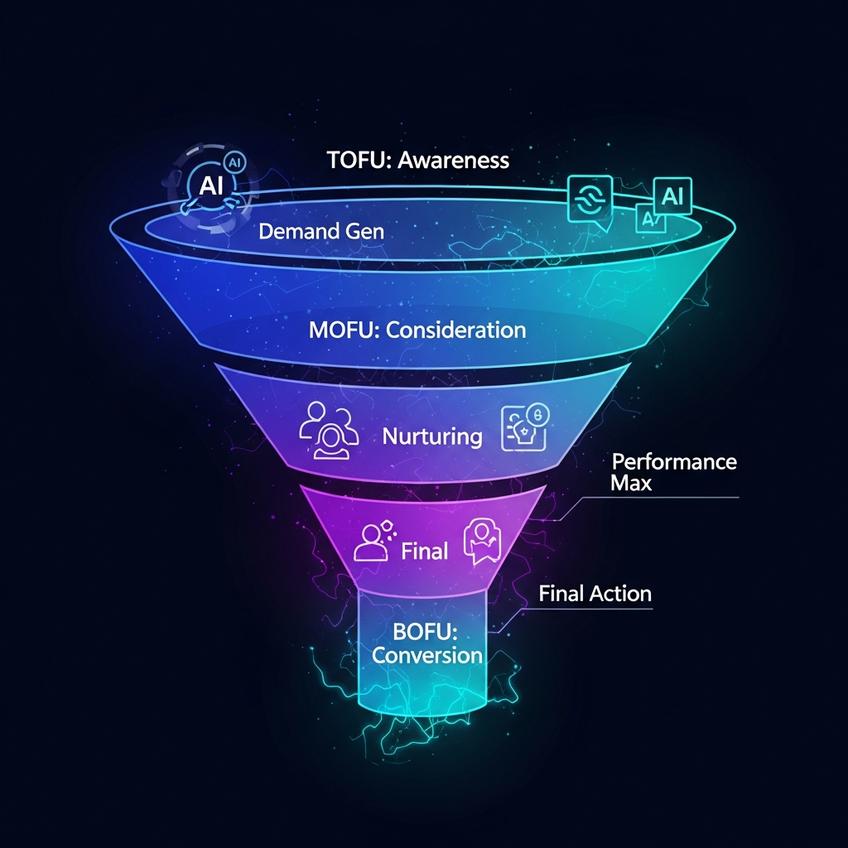
How Agentic AI Is Changing Every Stage of the B2B Marketing Funnel
Smarter Prospect Discovery
Finding the right prospects has always been one of the biggest challenges in B2B marketing. Traditional lead generation often relies on static databases, manual research, or broad targeting that produces inconsistent results.
Agentic AI continuously analyses data from multiple sources to identify companies and decision makers that match your ideal customer profile.
These sources may include:
- CRM platforms
- Website visitor behaviour
- Industry news
- Job changes
- Funding announcements
- Technology adoption signals
- Intent data platforms
- Social media activity
- Public company information
Instead of providing marketers with a long list of contacts, Agentic AI prioritises accounts that are most likely to convert.
For example, an AI agent may detect that a software company has recently hired a new Chief Marketing Officer, expanded into Europe, and increased spending on cloud infrastructure. These combined signals may indicate that the business is actively evaluating new marketing technology vendors.
Rather than waiting for marketers to discover this opportunity manually, the AI agent can alert the sales team immediately.
Intelligent Lead Qualification
Many marketing teams still spend valuable time reviewing leads that never become customers.
Traditional lead scoring assigns points based on simple rules such as:
- Downloaded an eBook
- Opened three emails
- Visited the pricing page
While useful, these models often miss important buying signals.
Agentic AI evaluates hundreds of behavioural and contextual indicators simultaneously.
It considers factors such as:
- Frequency of website visits
- Pages viewed
- Time spent on content
- Company size
- Industry
- Recent business activity
- Technology stack
- Previous conversations
- Engagement across multiple channels
- Historical conversion patterns
Instead of assigning a fixed score, Agentic AI predicts the likelihood that a prospect will become a qualified opportunity.
Sales representatives receive higher quality leads, allowing them to focus their efforts where they matter most.
Hyper Personalised Customer Experiences
Modern buyers expect relevant communication throughout every interaction.
Generic email campaigns often produce lower engagement because they fail to address specific business challenges.
Agentic AI creates personalised experiences based on each prospect’s behaviour and interests.
For example, two visitors may download the same cybersecurity report.
Although they accessed identical content, their follow up journey may be completely different.
The AI agent recognises that one visitor works in healthcare while the other works in financial services.
Instead of sending identical emails, it automatically delivers:
- Industry specific case studies
- Relevant compliance resources
- Tailored webinar invitations
- Product demonstrations
- Customer success stories
- Personalised follow up sequences
This level of personalisation increases engagement without requiring marketers to manually create hundreds of campaign variations.
Autonomous Content Distribution
Creating valuable content is only one part of a successful marketing strategy.
Distributing that content effectively is equally important.
Agentic AI can determine:
- Which audience should receive the content
- The best communication channel
- The ideal publishing time
- Recommended follow up actions
- Performance optimisation opportunities
For example, after publishing a whitepaper, the AI agent may decide to:
- Send personalised email campaigns
- Schedule LinkedIn posts
- Launch paid advertising
- Recommend related blog articles
- Trigger webinar invitations
- Notify the sales team about high engagement accounts
Rather than executing isolated marketing activities, the AI coordinates a complete campaign ecosystem.
Agentic AI and Account Based Marketing
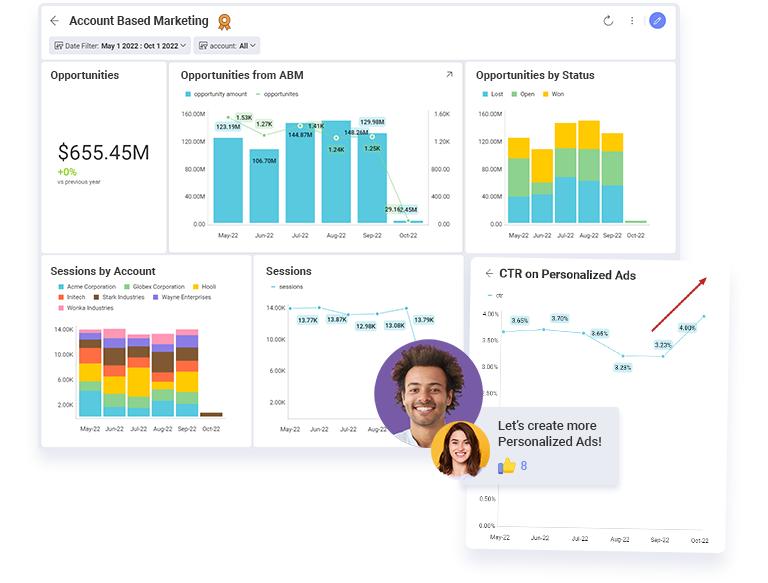
Account Based Marketing has become one of the most effective B2B marketing strategies, but it also requires significant coordination between marketing and sales.
Agentic AI simplifies this process by continuously monitoring target accounts and recommending actions based on account activity.
Examples include:
- Detecting increased buying intent
- Identifying new stakeholders
- Tracking executive job changes
- Monitoring competitor activity
- Recommending personalised outreach
- Suggesting relevant marketing assets
Instead of reviewing dashboards every morning, revenue teams receive actionable recommendations in real time.
Improving Sales and Marketing Alignment
One of the biggest barriers to revenue growth is poor communication between sales and marketing teams.
Marketing often focuses on generating leads, while sales concentrates on closing opportunities.
Agentic AI creates a shared intelligence layer that keeps both departments aligned.
Examples include:
- Marketing receives feedback about lead quality.
- Sales gains visibility into campaign engagement.
- Customer success identifies expansion opportunities.
- Revenue operations tracks pipeline performance.
- Leadership monitors overall business impact.
Everyone works from the same continuously updated data.
This reduces friction and improves collaboration across the organisation.
Real World Use Cases of Agentic AI in B2B Marketing
Automated Email Campaign Optimisation
Instead of manually reviewing campaign reports every week, Agentic AI continuously monitors performance.
If open rates decline, it may:
- Rewrite subject lines
- Adjust send times
- Segment audiences differently
- Pause underperforming campaigns
- Launch alternative messaging
These improvements happen much faster than traditional optimisation processes.
Dynamic Website Personalisation
Every visitor arrives with different needs.
Agentic AI can personalise website experiences in real time.
Examples include:
- Industry specific headlines
- Personalised product recommendations
- Relevant customer stories
- Custom calls to action
- Dynamic pricing content
- Region specific messaging
Visitors receive information that is most relevant to their business challenges.
Predictive Pipeline Management
Revenue forecasting often depends on historical trends and manual judgement.
Agentic AI continuously analyses pipeline health to predict:
- Which opportunities may stall
- Which accounts require additional engagement
- Expected revenue outcomes
- Sales bottlenecks
- Pipeline risks
Revenue leaders gain earlier visibility into potential issues and can act before targets are affected.
AI Powered Sales Assistance
Sales representatives spend significant time preparing for meetings.
Agentic AI reduces preparation time by automatically generating account summaries.
These summaries may include:
- Recent company news
- Decision makers
- Previous conversations
- Website activity
- Marketing engagement
- Competitive landscape
- Recommended discussion topics
- Suggested next steps
Instead of spending hours researching accounts, sales teams receive actionable intelligence within minutes.

Benefits of Agentic AI for Revenue Teams
Organisations adopting Agentic AI are beginning to experience measurable improvements across multiple business functions.
Key advantages include:
Increased Productivity
Routine administrative tasks become automated, allowing teams to focus on strategy and customer relationships.
Better Lead Quality
AI identifies prospects with stronger purchase intent, helping sales teams prioritise their efforts.
Faster Campaign Optimisation
Campaign performance is monitored continuously rather than through periodic reviews.
Improved Customer Experience
Personalised engagement increases relevance throughout the buyer journey.
Stronger Decision Making
Real time insights support faster and more informed business decisions.
Better Return on Marketing Investment
Marketing budgets are allocated more effectively because AI identifies high performing channels and audiences.
Example Workflow: Agentic AI in Action
Imagine a B2B software company launching a new cloud security platform.
Instead of assigning separate teams to manage each marketing activity, an Agentic AI system coordinates the campaign.
The workflow might look like this:
- Identifies target industries with the highest demand.
- Researches companies showing buying intent.
- Prioritises key decision makers.
- Generates personalised email campaigns.
- Publishes supporting blog content.
- Launches LinkedIn advertising.
- Monitors campaign engagement.
- Adjusts messaging based on performance.
- Alerts sales representatives when buying signals increase.
- Generates weekly performance insights for leadership.
What previously required multiple teams working across several software platforms can now be orchestrated by intelligent AI agents working together under human supervision.
Challenges, Best Practices, Future Trends, Conclusion, and SEO Resources
While Agentic AI offers enormous opportunities for B2B marketers, successful adoption requires thoughtful planning. Like any emerging technology, autonomous AI systems introduce new operational, ethical, and governance considerations that organisations must address. Companies that combine AI capabilities with human expertise will be best positioned to maximise value while maintaining customer trust.
Challenges of Implementing Agentic AI
Data Quality Remains Critical
Agentic AI is only as effective as the data it receives. Many B2B organisations still struggle with duplicate contacts, outdated CRM records, incomplete customer profiles, and inconsistent reporting across platforms.
Poor data quality can lead to:
- Incorrect prospect targeting
- Low quality lead recommendations
- Inaccurate forecasting
- Ineffective personalisation
- Reduced campaign performance
Before deploying autonomous AI agents, businesses should establish a strong data governance strategy.
Best practices include:
- Regular CRM data cleansing
- Standardised customer records
- Accurate lead source tracking
- Unified customer data platforms
- Ongoing database validation
High quality data enables Agentic AI to make more accurate and reliable decisions.
Maintaining Human Oversight
Although Agentic AI can automate complex workflows, it should not replace human judgement.
Revenue teams remain responsible for:
- Business strategy
- Brand positioning
- Customer relationships
- Ethical decision making
- Budget approval
- Compliance oversight
AI can recommend actions, but experienced professionals provide the context that technology cannot fully understand.
Successful organisations treat AI as a collaborative partner rather than a replacement for skilled marketers and sales professionals.
Privacy and Regulatory Compliance
B2B marketers manage large volumes of customer and prospect information. Agentic AI systems must operate within established privacy regulations.
Revenue teams should ensure compliance with frameworks such as:
- GDPR
- CCPA
- CAN-SPAM
- CASL
- Industry specific data protection requirements
Key considerations include:
- Customer consent management
- Secure data storage
- Transparent AI usage
- Responsible data collection
- Access controls
- Audit trails
Strong governance helps organisations protect customer trust while reducing regulatory risk.
Integration Across Existing Technology
Most B2B organisations already use multiple platforms, including:
- CRM systems
- Marketing automation platforms
- Sales engagement tools
- Analytics software
- Customer support platforms
- Advertising platforms
Agentic AI delivers the greatest value when these systems work together.
Businesses should prioritise platforms that support:
- API connectivity
- Real time data sharing
- Unified reporting
- Workflow automation
- Cross platform orchestration
Connected technology ecosystems enable AI agents to operate more effectively across the entire customer journey.
Best Practices for Adopting Agentic AI
Start with Clearly Defined Business Goals
Instead of implementing AI simply because it is popular, organisations should identify measurable objectives.
Examples include:
- Increase marketing qualified leads by 20 percent
- Reduce campaign launch time by 50 percent
- Improve email engagement
- Increase sales productivity
- Improve customer retention
- Reduce manual reporting
Clear objectives make it easier to measure success.
Begin with High Impact Use Cases
Rather than automating every marketing activity immediately, start with workflows that deliver fast business value.
Examples include:
- Lead scoring
- Campaign optimisation
- Email personalisation
- Account research
- Customer segmentation
- Reporting automation
Early success builds confidence and encourages wider adoption.
Invest in Team Education
Technology adoption succeeds when employees understand how to use it effectively.
Marketing and sales teams should learn:
- AI fundamentals
- Prompt engineering
- Workflow design
- Data interpretation
- AI governance
- Performance measurement
Continuous learning helps employees collaborate more effectively with intelligent systems.
Measure Business Outcomes
Traditional AI metrics such as processing speed or content generation volume are less meaningful than business results.
Revenue teams should monitor:
- Pipeline growth
- Conversion rates
- Customer acquisition cost
- Marketing return on investment
- Sales cycle duration
- Revenue influenced by AI
- Customer lifetime value
Business performance should remain the primary measure of success.
The Future of Agentic AI in B2B Marketing
The rapid evolution of artificial intelligence suggests that Agentic AI will become increasingly sophisticated over the next several years.
Several trends are already emerging.
Multi Agent Collaboration
Instead of relying on a single AI assistant, businesses will deploy specialised AI agents that work together.
For example:
- One agent manages content creation.
- Another optimises advertising campaigns.
- Another monitors customer intent.
- Another supports sales representatives.
- Another forecasts revenue.
These agents will collaborate across shared business goals, improving efficiency throughout the organisation.
Real Time Decision Making
Future AI systems will process customer behaviour continuously.
Rather than reviewing weekly reports, businesses will receive immediate recommendations based on:
- Website engagement
- Market changes
- Competitor activity
- Customer interactions
- Sales pipeline movement
Marketing strategies will become increasingly adaptive.
Predictive Customer Journeys
Instead of reacting to customer behaviour, Agentic AI will anticipate future actions.
Businesses may soon identify:
- Customers likely to purchase
- Accounts at risk of churn
- Expansion opportunities
- Cross sell potential
- Renewal likelihood
This predictive capability will help revenue teams engage customers before opportunities are lost.
Autonomous Revenue Operations
Revenue Operations, often referred to as RevOps, is expected to become one of the biggest beneficiaries of Agentic AI.
Future AI agents may coordinate activities across:
- Marketing
- Sales
- Customer Success
- Finance
- Business Intelligence
This unified approach will improve forecasting, planning, and operational efficiency.
Preparing Your Revenue Team for an AI First Future
Organisations do not need to replace existing marketing teams to benefit from Agentic AI.
Instead, successful businesses will combine:
- Experienced marketers
- Skilled sales professionals
- Reliable customer data
- Intelligent automation
- Strategic leadership
This balanced approach allows companies to scale operations while maintaining creativity, trust, and customer relationships.
The goal is not fully autonomous marketing. The goal is empowering people with intelligent systems that reduce repetitive work and improve business outcomes.
Conclusion
Agentic AI represents one of the most significant developments in the evolution of B2B marketing.
Unlike previous generations of artificial intelligence that focused primarily on content creation or task automation, Agentic AI introduces autonomous decision making, continuous optimisation, and coordinated execution across multiple business functions.
For revenue teams, the implications are substantial.
Marketing departments can identify stronger prospects, personalise customer experiences, optimise campaigns in real time, and deliver better qualified opportunities to sales.
Sales teams gain deeper account intelligence, faster research, and improved forecasting.
Leadership benefits from stronger alignment across marketing, sales, customer success, and revenue operations.
However, successful adoption depends on more than technology alone.
Organisations must invest in high quality data, responsible AI governance, employee education, and clearly defined business objectives.
Companies that embrace Agentic AI thoughtfully today will be better positioned to compete in an increasingly intelligent, automated, and customer focused marketplace.
The future of B2B marketing will not be driven by AI alone. It will be shaped by organisations that successfully combine human expertise with autonomous intelligence to create exceptional customer experiences and sustainable revenue growth.
Frequently Asked Questions
What is Agentic AI?
Agentic AI refers to artificial intelligence systems that can independently plan, make decisions, execute tasks, and continuously improve their performance while working toward defined business goals.
How is Agentic AI different from Generative AI?
Generative AI primarily creates content such as text, images, or code based on prompts. Agentic AI goes further by planning workflows, making decisions, executing actions, and adapting to changing conditions with minimal human intervention.
How can B2B marketers benefit from Agentic AI?
B2B marketers can use Agentic AI to improve lead generation, personalise customer experiences, optimise campaigns, automate reporting, strengthen Account Based Marketing strategies, and improve collaboration between marketing and sales teams.
Is Agentic AI replacing marketing professionals?
No. Agentic AI is designed to support marketing professionals by automating repetitive tasks and providing intelligent recommendations. Human expertise remains essential for strategy, creativity, relationship building, and governance.
What industries can benefit from Agentic AI?
Industries including technology, healthcare, manufacturing, finance, cybersecurity, professional services, education, logistics, telecommunications, and SaaS can all benefit from Agentic AI powered revenue operations.