


A B2B marketing campaign can have excellent creative, strong messaging, targeted audiences, and a healthy media budget. Yet, the campaign can still produce disappointing ROI if sales and marketing are not working toward the same objective.
This is one of the most important lessons B2B organizations continue to learn: generating leads is not the same as generating revenue.
Marketing may focus on impressions, clicks, form fills, MQLs, and engagement. Sales may focus on qualified opportunities, conversations, pipeline, win rates, and revenue. When these goals are disconnected, campaign performance can suffer even when individual teams are doing their jobs well.
Recent research highlights how widespread this challenge remains. A 2026 Unbounce survey of more than 500 SMB go-to-market professionals found that 87% expected better sales and marketing alignment to improve performance, while only 56% considered their teams highly aligned. The research also found that highly aligned teams were 2x more likely to report high-quality leads.
This creates an important opportunity for B2B organizations.
Instead of treating sales and marketing alignment as an internal communication exercise, companies can treat it as a campaign performance strategy.
When both teams agree on the target audience, messaging, qualification criteria, follow-up process, campaign goals, and revenue metrics, marketing campaigns can become more efficient and produce stronger returns.
8
What Is Sales and Marketing Alignment?
Sales and marketing alignment is the process of making sure both teams operate around shared business objectives, customer definitions, data, messaging, and processes.
It does not simply mean scheduling more meetings between marketing and sales.
True alignment means both departments understand:
- Who the ideal customer is
- Which accounts should be prioritized
- What problems those customers are trying to solve
- What messaging should be used
- What qualifies as a marketing lead
- When a lead should be passed to sales
- How quickly sales should follow up
- Which campaign metrics matter
- How campaign performance connects to pipeline and revenue
Salesforce describes sales and marketing alignment as the coordination of goals, processes, and communication between the two departments to drive revenue and improve customer experience.
This distinction is important because a campaign can look successful from a marketing dashboard while producing little value for sales.
For example, imagine a campaign generates:
10,000 visitors → 1,000 leads → 200 MQLs
At first glance, the campaign looks successful.
But suppose sales discovers that only 30 of those MQLs match the company’s ideal customer profile. If only 10 become genuine sales opportunities, the campaign’s apparent success becomes much less impressive.
The problem may not be the campaign itself.
The problem may be alignment.
The Campaign Problem: Marketing Generated Leads, But Sales Saw Little Pipeline
One common B2B campaign scenario looks like this:
Marketing launches a campaign targeting a broad industry audience. The campaign generates strong engagement and a high number of leads.
Marketing reports:
- Strong click-through rate
- High content downloads
- Growing MQL volume
- Good email engagement
- Low cost per lead
Sales, however, reports:
- Leads are not decision-makers
- Many companies are outside the target market
- Contacts lack buying intent
- Follow-up takes too long
- Leads are missing useful context
- Sales representatives cannot identify which leads deserve priority
Both teams may believe they are right.
Marketing delivered the leads it was measured on.
Sales is evaluating whether those leads can become revenue.
This disconnect can create a cycle of frustration.
Marketing says:
“Sales is not following up on our leads.”
Sales says:
“Marketing is sending us poor-quality leads.”
Leadership sees campaign spending without a proportional increase in pipeline.
The solution is not necessarily to increase the campaign budget.
The solution can be to improve the system connecting marketing and sales.
Lesson 1: Start With One Definition of a Qualified Lead
One of the biggest lessons from improving campaign ROI is simple:
Sales and marketing must agree on what a qualified lead actually means.
If marketing defines an MQL based primarily on engagement, while sales defines a qualified lead based on company fit and buying intent, the campaign will create friction.
A better approach is to establish shared qualification criteria.
For example:
Ideal Customer Profile
A qualified prospect may need to meet several conditions:
- Target industry
- Appropriate company size
- Relevant geographic market
- Suitable job function
- Appropriate seniority
- Relevant business challenge
- Demonstrated interest
- Potential purchasing authority
This can be combined into a lead scoring framework.
For example:
| Qualification Factor | Example Weight |
|---|---|
| Target industry | 20 points |
| Company size | 15 points |
| Job seniority | 15 points |
| Relevant job function | 15 points |
| Content engagement | 10 points |
| Website activity | 10 points |
| Buying intent | 15 points |
Once sales and marketing agree on these criteria, campaigns become much easier to optimize.
Marketing knows what audience to target.
Sales knows what leads to prioritize.
Leadership gets better visibility into campaign ROI.
Recent research from Unbounce found that highly aligned teams were more than twice as likely to report high-quality leads compared with less aligned teams.
Lesson 2: Stop Measuring Campaign Success Only by Lead Volume
Another important lesson is that lead volume can be a misleading campaign metric.
A campaign producing 5,000 leads is not necessarily better than a campaign producing 500 leads.
The more useful question is:
How many qualified opportunities did the campaign create?
This changes the campaign measurement framework.
Instead of:
Impressions → Clicks → Leads
Think:
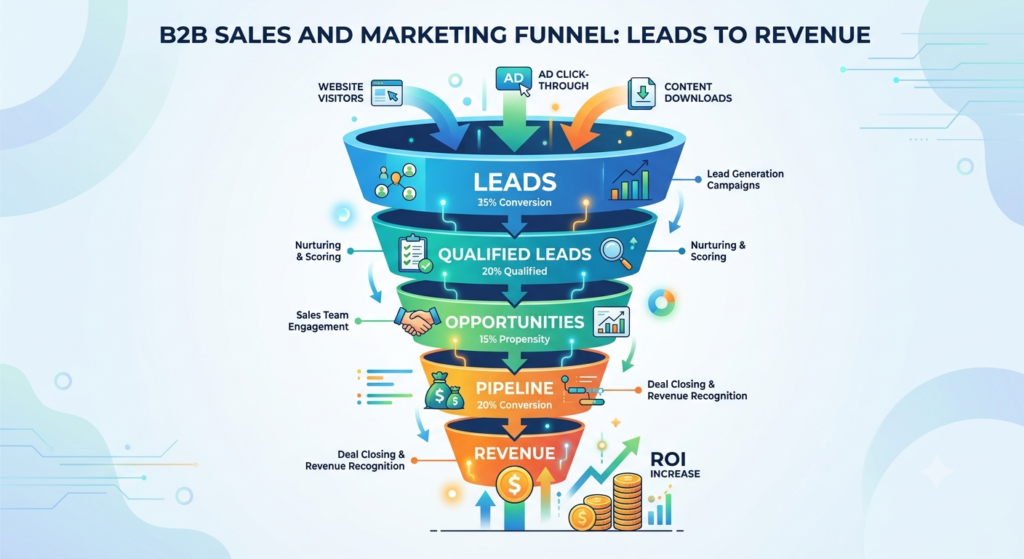
Impressions → Engagement → Qualified Leads → Sales Opportunities → Pipeline → Revenue
This allows marketers to understand what happens after a lead is generated.
Consider two campaigns.
Campaign A
- Leads: 1,000
- Qualified leads: 100
- Opportunities: 15
- Closed deals: 3
Campaign B
- Leads: 400
- Qualified leads: 150
- Opportunities: 35
- Closed deals: 8
Campaign A generated more leads.
Campaign B generated more business.
If leadership only evaluates cost per lead, Campaign A might appear to be the winner.
If leadership evaluates pipeline and revenue, Campaign B clearly performs better.
This is why sales feedback is essential to campaign optimization.
Lesson 3: Build a Strong Sales Follow-Up Process
Generating a qualified lead is only one part of campaign performance.
What happens next can significantly influence ROI.
A highly targeted campaign can underperform if sales follow-up is inconsistent or delayed.
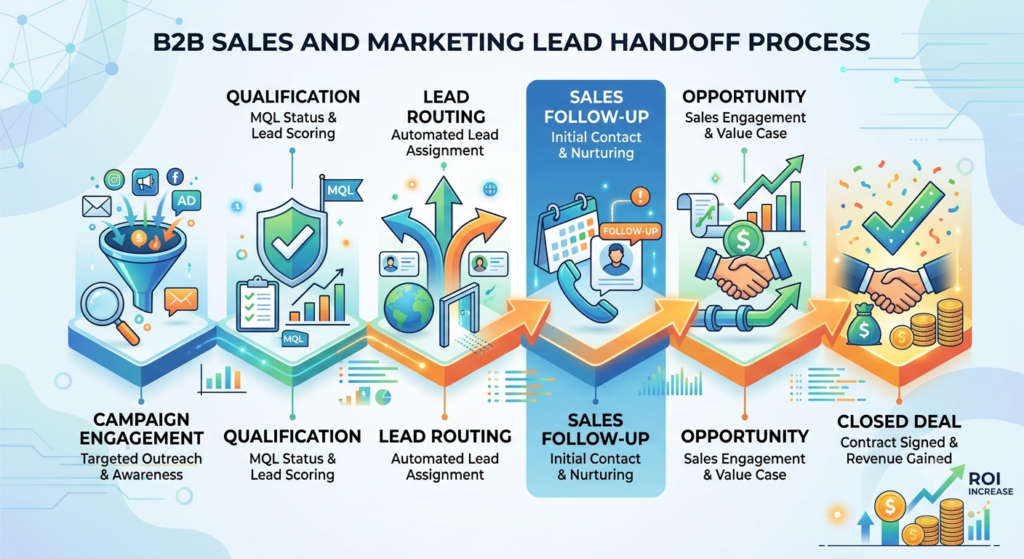
Sales and marketing should therefore establish a clear handoff process.
A basic workflow might look like:
Campaign Engagement → Lead Qualification → Lead Routing → Sales Notification → Sales Follow-Up → Opportunity Creation → Pipeline Tracking
The handoff should include useful information such as:
- Campaign source
- Content interacted with
- Industry
- Company size
- Job title
- Lead score
- Previous interactions
- Key areas of interest
- Relevant behavioral signals
This gives sales representatives context before contacting the prospect.
Instead of making a generic call, the salesperson can start with a relevant conversation.
For example:
“Thanks for downloading our report on B2B demand generation. I noticed your team is exploring account-based strategies. Are you currently building that program internally?”
That conversation is very different from:
“Hi, I’m calling to see if you’re interested in our services.”
Context creates relevance.
Relevance creates better conversations.
Better conversations can create better opportunities.
Lesson 4: Make Sales Feedback Part of Campaign Optimization
Marketing teams often analyze campaign data after a campaign ends.
However, sales teams can provide information that analytics platforms cannot.
Sales representatives speak directly with prospects.
They hear:
- Common objections
- Competitor concerns
- Pricing issues
- Product questions
- Buying barriers
- New customer priorities
- Reasons prospects reject offers
- Reasons prospects move forward
That information should flow back into marketing.
For example, sales might discover that prospects repeatedly ask:
“How quickly can this solution integrate with our existing systems?”
Marketing can turn that insight into:
- A blog article
- A comparison guide
- An FAQ
- A webinar
- A case study
- An email sequence
- A campaign landing page
Sales therefore becomes more than the final stage of the funnel.
Sales becomes a source of campaign intelligence.
Research from the Content Marketing Institute and LinkedIn found that highly aligned content marketing and sales teams collaborate more frequently around content activities and are more likely to have a documented content strategy.
Lesson 5: Create Shared Campaign Goals
Another major lesson is that sales and marketing should not have completely separate definitions of campaign success.
Marketing may have goals such as:
- Generate 1,000 leads
- Achieve a 5% CTR
- Generate 300 MQLs
Sales may have goals such as:
- Create 50 opportunities
- Generate $500,000 in pipeline
- Close 10 new accounts
These goals should connect.
A stronger campaign objective might be:
Generate 300 qualified accounts that can produce 50 sales opportunities and $500,000 in influenced pipeline.
Now marketing understands what happens beyond the lead stage.
Sales understands what marketing is trying to accomplish.
Leadership can evaluate the entire campaign as a revenue program.
Salesforce also emphasizes shared goals, common definitions, communication, and connected systems as important elements of sales and marketing alignment.
Lesson 6: Use One Source of Truth for Campaign Data
Data fragmentation can quickly destroy campaign ROI.
Marketing may work in one platform.
Sales may work in another.
Customer data may exist in a CRM.
Campaign engagement may exist in a marketing automation platform.
Sales representatives may maintain additional spreadsheets.
The result can be inconsistent information.
One system may say a lead is active.
Another may show that the prospect has already spoken with sales.
A third system may show incomplete company information.
This makes campaign attribution difficult.
A centralized CRM and connected marketing systems can help create a consistent view of the buyer journey.
Salesforce’s current State of Marketing research highlights the growing importance of unified data strategies and the challenges organizations face in activating real-time data effectively.
The objective should be simple:
Everyone should be working from the same customer information.
Lesson 7: Review Campaign Performance Together
Sales and marketing alignment should not happen only before a campaign launches.
It should continue throughout the campaign.
A practical approach is to create a recurring campaign review.
Weekly Campaign Review
Marketing shares:
- Leads generated
- Engagement
- Lead sources
- Audience performance
- Content performance
- Cost metrics
Sales shares:
- Lead quality
- Contact rates
- Conversations
- Opportunities
- Objections
- Disqualified leads
- Customer feedback
Together, both teams identify:
What should we continue?
What should we change?
What should we stop?
This creates a feedback loop.
Instead of waiting until the end of a campaign to discover a problem, teams can make adjustments while the campaign is still active.
Lesson 8: Align Messaging With Real Buyer Conversations
Campaign messaging often becomes stronger when sales contributes directly to its development.
Marketing may describe a product using positioning language developed internally.
Sales may hear prospects describe the problem differently.
For example, marketing might promote:
“Improve operational efficiency with an advanced data management platform.”
Sales may discover prospects are actually saying:
“We spend too much time cleaning outdated contact data.”
The second statement may be much more powerful because it reflects the buyer’s language.
Sales calls can therefore become a source of messaging research.
Marketing can use those insights to improve:
- Headlines
- Email subject lines
- Landing pages
- Ad copy
- CTAs
- Blog topics
- Whitepapers
- Case studies
- Sales enablement content
This creates consistency across the buyer journey.
The prospect sees one connected story rather than different messages from marketing and sales.
Lesson 9: Calculate ROI Beyond Cost Per Lead
Campaign ROI should ultimately connect spending with business outcomes.
A basic ROI calculation is:
ROI = (Revenue Generated – Campaign Cost) ÷ Campaign Cost × 100
However, B2B organizations often need a more complete measurement framework because campaigns may influence opportunities over a longer buying cycle.
Track metrics such as:
Lead-Level Metrics
- Cost per lead
- Lead volume
- Lead-to-MQL rate
- Lead quality
Sales Metrics
- MQL-to-SQL conversion
- Sales acceptance rate
- Contact rate
- Opportunity creation
- Opportunity conversion
Revenue Metrics
- Pipeline generated
- Pipeline influenced
- Customer acquisition cost
- Revenue generated
- Customer lifetime value
- Campaign ROI
This approach helps organizations identify where campaign performance improves.
For example:
Campaign spend decreases 10%
Qualified leads increase 20%
Opportunities increase 35%
Pipeline increases 45%
That is a much more meaningful campaign story than simply reporting a lower cost per lead.
A Simple Sales and Marketing Alignment Framework
B2B organizations can use the following framework to improve campaign performance.
Step 1: Define the ICP
Agree on the industries, companies, roles, and characteristics that represent the best prospects.
Step 2: Define Qualification
Create shared rules for MQL, SQL, opportunity, and disqualified lead.
Step 3: Define Campaign Objectives
Connect marketing objectives to pipeline and revenue goals.
Step 4: Build the Campaign Together
Have sales contribute customer insights, objections, messaging, and account priorities.
Step 5: Create a Clear Handoff
Define when, how, and where leads are transferred to sales.
Step 6: Track the Full Funnel
Measure performance from engagement through revenue.
Step 7: Share Feedback
Create a regular process for sales to report lead quality and customer feedback.
Step 8: Optimize Continuously
Adjust targeting, messaging, content, qualification, and follow-up based on performance.
Step 9: Review ROI
Evaluate the campaign based on qualified pipeline and revenue rather than lead volume alone.
The Culture Lesson: Alignment Is a Habit, Not a Meeting
One of the most important lessons is that sales and marketing alignment cannot be created through a single meeting.
It requires an organizational culture where both teams understand that they are part of the same revenue engine.
For years, sales and marketing have sometimes operated as separate departments with different priorities.
Marketing creates demand.
Sales converts demand.
But modern B2B buying journeys are much more interconnected.
Buyers research independently. They consume content. They compare vendors. They interact with websites. They speak with sales representatives. They involve multiple stakeholders.
HubSpot’s current marketing statistics report that 96% of prospects conduct their own research before speaking with a human sales representative, highlighting why marketing and sales need to work together throughout the buying journey.
This means marketing cannot simply hand a lead to sales and consider the job finished.
Sales cannot ignore marketing content and build the entire buyer conversation independently.
Both functions influence the customer experience.
The Results: What Better Alignment Can Improve
When sales and marketing become better aligned, organizations can improve several areas of campaign performance.
Better Lead Quality
Marketing understands which prospects sales considers valuable.
Higher Conversion Rates
Sales receives leads with stronger fit and intent.
Faster Follow-Up
Clear handoff rules reduce delays.
Better Sales Conversations
Sales receives campaign and engagement context.
More Relevant Content
Marketing uses real sales conversations to develop content.
Stronger Pipeline
Campaign optimization moves beyond lead generation toward opportunity creation.
More Efficient Spending
Budgets can shift toward audiences, channels, and campaigns that produce revenue.
Improved Customer Experience
Prospects receive more consistent communication throughout the buying journey.
Research from a 2024 Forrester analysis also highlighted an important challenge: organizations can have high perceptions of alignment while actual alignment remains weaker. This means leadership should measure operational behavior rather than simply asking teams whether they feel aligned.

Final Takeaway
The biggest lesson is straightforward:
Better sales and marketing alignment can turn campaigns from lead-generation programs into revenue-generation systems.
The objective is not for marketing to generate more leads simply for the sake of volume.
The objective is to generate the right demand, identify the right prospects, provide sales with the right context, and measure what happens all the way through the revenue cycle.
The strongest alignment happens when sales and marketing share:
- The same audience
- The same customer definition
- The same data
- The same messaging
- The same qualification criteria
- The same campaign objectives
- The same revenue metrics
Campaign ROI improves when every stage of the process becomes connected.
Marketing learns from sales.
Sales learns from marketing.
Both teams learn from customers.
And leadership gets a clearer picture of what marketing investment is actually producing.
For B2B companies, that is the real value of alignment.
It is not simply about making two departments communicate better.
It is about creating a more efficient, measurable, and revenue-focused growth engine.