


Introduction
The marketing technology industry is entering a new phase of transformation as businesses rethink how they attract prospects, understand customer behavior, manage data, and measure marketing performance. Investments in artificial intelligence, marketing automation, customer data platforms, analytics, and integrated marketing systems are changing the way organizations approach B2B growth.
For years, companies expanded their marketing technology stacks by adding individual tools for email campaigns, lead generation, customer relationship management, analytics, and advertising. Although these tools helped teams scale their activities, they also introduced new challenges. Disconnected systems, duplicate customer records, inconsistent reporting, and limited visibility into the buyer journey made it difficult to connect marketing activities with measurable business outcomes.
Major MarTech investments signal a shift away from simply adding more software toward building smarter, more connected marketing operations. Businesses increasingly need technology that can interpret customer data, support personalized communication, improve campaign efficiency, and help sales and marketing teams work toward shared revenue goals.
Artificial intelligence is accelerating this transition, but it is not the only factor influencing investment decisions. Data quality, privacy requirements, integration capabilities, customer experience, and return on investment are also becoming important considerations.
For B2B organizations, these developments matter because purchasing decisions typically involve multiple stakeholders, longer sales cycles, and extensive research before a prospect engages with a sales representative. The technology businesses invest in today will influence how effectively they identify potential buyers, nurture relationships, and generate qualified opportunities in the future.
This article explores the major MarTech investment themes shaping the B2B marketing industry, why they matter, and how marketing leaders can prepare for the next stage of digital transformation.
Why MarTech Investments Are Becoming More Strategic
Marketing technology has evolved from a collection of supporting tools into a core part of business strategy. Modern marketing teams are expected to demonstrate how their activities contribute to pipeline development, customer acquisition, retention, and revenue growth.
This expectation has changed how organizations evaluate technology investments. Instead of selecting platforms based only on features, companies are examining whether those platforms solve operational problems and support measurable business objectives.
For example, a B2B company might invest in an advanced marketing automation platform to improve lead nurturing. However, if its customer database contains outdated contacts, its segmentation rules are weak, or its sales team does not follow up consistently, the new platform may not deliver the expected results.
The most valuable investments therefore combine technology with reliable data, clearly defined processes, and appropriate human oversight.
Another important factor is the growing pressure on marketing budgets. Decision-makers want stronger evidence that technology spending improves campaign performance. Marketing leaders must explain not only what a platform does, but also how it reduces manual work, improves lead quality, supports sales conversations, or makes performance easier to measure.
This is pushing MarTech decisions closer to revenue operations and broader business planning.
1. Artificial Intelligence Is Attracting Greater Marketing Technology Investment
Artificial intelligence has become one of the most influential forces in marketing technology. Software providers are incorporating AI into campaign creation, audience segmentation, customer engagement, predictive analytics, content production, and workflow management.
The investment opportunity extends beyond generating marketing copy. Businesses are exploring how AI can help interpret large volumes of customer information, recognize patterns in campaign performance, prioritize accounts, and recommend appropriate next actions.
AI Is Moving Beyond Content Generation
Generative AI initially attracted attention for its ability to produce emails, blog drafts, advertisements, and social media content. However, B2B marketing teams increasingly need AI capabilities that connect content creation with the rest of the marketing process.
For example, an AI-enabled platform may help marketers identify common questions among a target audience, suggest content themes for different stages of the buyer journey, and adapt messaging to specific industry segments.
Other applications include lead scoring, predictive audience selection, campaign optimization, and automated reporting.
These capabilities can reduce repetitive work and help marketing teams respond more quickly to changing customer behavior. Nevertheless, AI-generated recommendations are only as reliable as the data and instructions behind them.
Companies still need human review to maintain factual accuracy, brand consistency, regulatory compliance, and appropriate communication with prospects.
What This Means for B2B Marketers
B2B marketers should evaluate AI based on practical business outcomes rather than the number of AI features a platform advertises.
Useful evaluation questions include whether the technology improves lead qualification, reduces campaign production time, identifies high-intent accounts, or helps sales teams prioritize their outreach.
Businesses should also examine how AI systems access data, whether their outputs can be audited, and what controls are available for protecting confidential customer information.

2. Marketing Platforms Are Moving Toward Unified Technology Ecosystems
Another important investment trend is the movement toward integrated marketing technology ecosystems. Businesses want their marketing, sales, customer service, and analytics platforms to exchange information without creating unnecessary operational complexity.
A typical B2B marketing environment may include a customer relationship management system, marketing automation software, website analytics, advertising platforms, data enrichment services, content management systems, and sales engagement tools.
When these platforms operate independently, teams may struggle to establish a consistent view of each account or prospect.
For example, a marketing team may record a whitepaper download in one system, while the sales team uses another platform to track outreach. If the systems are poorly integrated, sales representatives may not see the prospect’s recent activity or understand which topics generated interest.
Unified ecosystems help reduce these gaps by connecting customer interactions across different channels.
Integration Is Becoming More Valuable Than Tool Count
The goal is not necessarily to purchase one platform that replaces every existing application. Instead, businesses need a technology architecture that allows the tools they retain to work together effectively.
APIs, native integrations, shared data models, and automation workflows can help connect these systems. However, organizations must also establish clear rules for data ownership, record synchronization, duplicate management, and reporting.
An integrated environment can improve campaign visibility, make handoffs between marketing and sales more consistent, and reduce the manual effort required to compile performance reports.
Why This Matters for B2B Growth
B2B buying journeys frequently span email, websites, professional networks, events, webinars, and direct sales interactions. A fragmented technology stack makes it harder to understand how these touchpoints influence purchasing decisions.
A connected ecosystem provides a stronger foundation for account-based marketing, multi-channel demand generation, lead nurturing, and pipeline measurement.
Businesses evaluating new platforms should therefore consider integration capabilities alongside pricing, functionality, and ease of use.
3. Customer Data Platforms and Data Quality Are Gaining Importance
Customer data is central to effective marketing technology. Yet many organizations still manage information across disconnected databases, spreadsheets, CRM records, campaign tools, and external data providers.
This creates a fundamental problem: even sophisticated automation cannot reliably personalize communication or identify valuable prospects if the underlying information is inaccurate or incomplete.
Customer data platforms, data integration tools, and data quality solutions are attracting attention because businesses need more consistent ways to organize and activate customer information.
Building a More Reliable Customer View
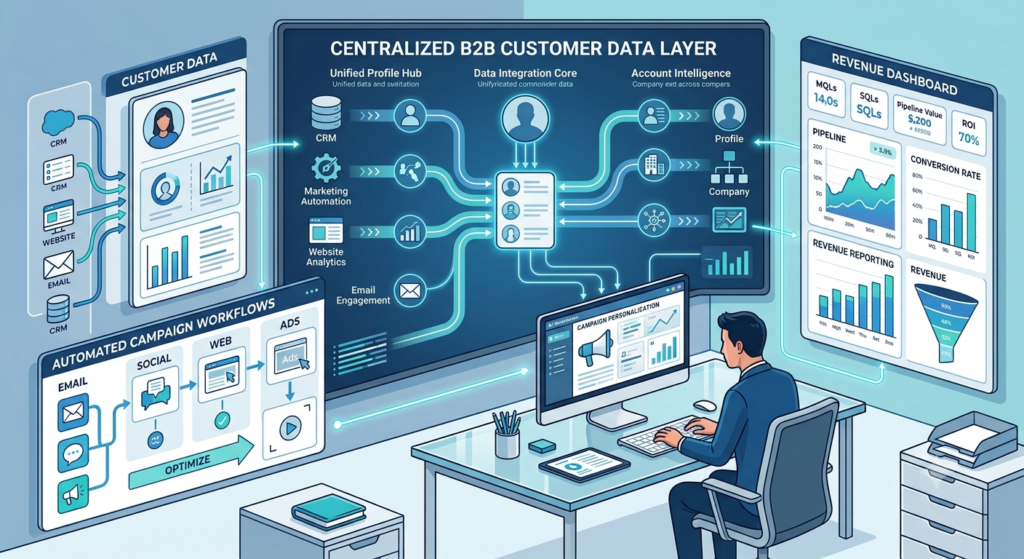
A customer data platform can help bring information from multiple sources into a more unified customer profile. Depending on the platform and its configuration, this may include website interactions, campaign engagement, account details, and other permitted customer signals.
The objective is to make relevant information available to the teams and systems that need it.
For B2B organizations, the challenge is often more complex than creating a single individual profile. Marketing teams must also connect contacts to their companies, identify relationships among buying committee members, and distinguish between account-level interest and individual engagement.
A prospect downloading a technical guide, for instance, may indicate interest in a particular solution. If several relevant contacts from the same organization engage with related content, the combined activity may justify further account research.
However, engagement signals should not automatically be treated as proof of purchase intent. They need to be evaluated in context.
Data Hygiene Is a Business Priority
Investments in data quality help businesses address outdated contact information, duplicate records, invalid email addresses, incomplete company details, and inconsistent industry classifications.
These problems affect more than database accuracy. Poor data can reduce email deliverability, distort campaign reporting, waste sales resources, and weaken segmentation.
A practical data quality program should include regular validation, deduplication, enrichment, suppression management, and clear procedures for updating records.
4. Account-Based Marketing Technology Is Becoming More Sophisticated
Account-based marketing, commonly known as ABM, focuses marketing and sales resources on selected organizations that match a company’s ideal customer profile.
MarTech investment is helping businesses make ABM more data-driven by improving account identification, contact discovery, intent analysis, audience targeting, campaign orchestration, and performance measurement.
Instead of running broad campaigns and evaluating every response in isolation, businesses can coordinate activity around the needs and interests of specific accounts.
From Static Account Lists to Dynamic Prioritization
Traditional ABM programs often begin with a predefined list of target companies. Although this provides focus, account priorities can change as businesses grow, launch new products, hire relevant decision-makers, or demonstrate interest in specific topics.
Modern account intelligence tools can help teams update account priorities using available firmographic, engagement, and intent-related information.
For example, a technology provider targeting manufacturing companies may prioritize organizations that fit its employee-size requirements, operate in relevant markets, and show credible engagement with related solution content.
The marketing team can then coordinate industry-specific content, targeted advertising, email nurturing, and sales outreach.
Technology supports the process, but successful ABM still requires a clear ideal customer profile, accurate contact information, relevant messaging, and alignment between sales and marketing.
Measuring ABM Beyond Clicks
ABM performance should not be judged solely by impressions, email opens, or website traffic.
More useful indicators include target-account engagement, meetings with relevant stakeholders, sales-qualified opportunities, pipeline contribution, progression through the sales cycle, and revenue generated.
Because B2B purchases can take months, marketers should also evaluate whether their measurement framework captures meaningful account progression over time.
These requirements are increasing the value of technology that connects account intelligence with campaign execution and CRM reporting.
5. Marketing Measurement Is Shifting Toward Pipeline and Revenue Impact
Marketing analytics is another area receiving greater attention as companies seek stronger evidence of business value.
For many years, teams relied heavily on activity metrics such as impressions, clicks, downloads, and form submissions. These indicators remain useful for understanding campaign engagement, but they do not independently establish whether marketing is generating commercially valuable opportunities.
Executives increasingly want to understand how marketing contributes to pipeline creation, sales velocity, customer acquisition, and revenue.
Connecting Campaign Activity to Business Outcomes
Modern analytics platforms can help combine campaign engagement data with CRM stages, opportunity records, and sales outcomes.
This makes it possible to examine questions such as:
- Which campaigns generate the highest proportion of qualified opportunities?
- Which channels consistently engage relevant decision-makers?
- How long does it take leads from different sources to progress through the pipeline?
- Which industries or account segments produce stronger conversion rates?
- Where are prospects dropping out of the buyer journey?
Reliable answers require consistent definitions and disciplined data collection. If one team defines a marketing-qualified lead differently from another, performance comparisons can become misleading.
Businesses should agree on shared lifecycle stages, qualification requirements, campaign naming conventions, and reporting responsibilities before relying on advanced analytics.
Attribution Requires Careful Interpretation
Multi-touch attribution attempts to understand how different marketing interactions relate to a conversion or opportunity. It can provide useful insights, but it does not always prove that a particular touchpoint caused the outcome.
B2B buyers may interact with multiple channels, conduct independent research, attend events, and engage with several colleagues before contacting sales.
Consequently, marketing leaders should combine attribution reporting with sales feedback, account-level analysis, controlled experiments where appropriate, and broader pipeline trends.
The most valuable investment is not simply a more complex dashboard. It is a measurement framework that supports better business decisions.
6. Marketing Automation Is Evolving Into Intelligent Workflow Orchestration
Marketing automation has long helped businesses schedule campaigns, nurture leads, and manage repetitive communications. Newer capabilities are expanding the role of automation by connecting multiple tasks and using contextual information to guide workflows.
This shift matters for B2B organizations that manage large prospect databases, multiple audience segments, complex qualification criteria, and long nurturing cycles.
Smarter Lead Nurturing and Qualification
An automation workflow can deliver relevant content based on a prospect’s industry, role, previous engagement, or stage in the buying journey.
For example, a prospect who downloads an introductory guide may receive educational content, while a prospect who requests detailed product information may be routed for more direct follow-up, depending on the company’s qualification rules.
AI-assisted systems may also help summarize interactions, recommend content, or flag records for review. These capabilities should complement defined qualification criteria rather than replace them without validation.
Automation Needs Human Oversight
More automation does not automatically mean better marketing.
Poorly designed workflows can send irrelevant emails, create excessive contact frequency, trigger duplicate sales outreach, or continue nurturing people who have already converted.
Businesses should establish safeguards for consent, suppression lists, workflow testing, escalation rules, and campaign monitoring.
Marketing teams should also review whether automated actions are producing the intended outcomes. A workflow that increases email engagement but fails to improve qualified meetings may need to be redesigned.
The investment opportunity lies in combining operational efficiency with relevance, timing, and measurable performance.
7. Privacy, Consent, and First-Party Data Are Influencing Investment Decisions
Data governance has become an important consideration in marketing technology strategy. Businesses need to understand how customer information is collected, stored, shared, enriched, and used across platforms.
For B2B marketers, this includes managing contact permissions, respecting opt-out requests, evaluating data providers, and understanding the legal requirements that apply to each target market.
First-party data, which organizations collect through their own websites, forms, customer relationships, and other direct interactions, can provide valuable insights when collected transparently and used appropriately.
However, first-party data is not automatically unrestricted. Businesses must still consider applicable privacy laws, consent requirements, retention policies, and the expectations communicated to individuals.
Privacy Should Be Part of Platform Selection
When evaluating a MarTech platform, organizations should examine access controls, audit logs, data retention settings, integration permissions, security practices, and the vendor’s approach to processing customer information.
Companies using AI features should also determine whether sensitive data is shared with external models, how outputs are generated, and what safeguards are available.
Privacy and security reviews should involve the appropriate legal, IT, and information security stakeholders.
Investing in governance early can help reduce compliance risks and prevent expensive changes later in the technology lifecycle.
8. Content Technology Is Supporting More Personalized Buyer Experiences
Content remains central to B2B marketing because buyers often research problems, compare solutions, and evaluate providers before speaking with a sales representative.
MarTech platforms are increasingly being used to organize content, understand engagement, personalize experiences, and identify gaps in the buyer journey.
These capabilities can help organizations deliver relevant information without requiring every campaign to be managed manually.
Personalization Must Be Useful, Not Intrusive
B2B personalization can involve tailoring content to an industry, job role, company size, business challenge, or buying stage.
A financial services prospect researching compliance technology may need different educational resources from a manufacturing company evaluating operational software.
Marketing platforms can help manage these variations through segmentation, dynamic content, and workflow rules.
However, personalization should not depend on unsupported assumptions about individual prospects. The objective is to make content more relevant, not to create an uncomfortable experience through excessive tracking or overly specific messaging.
Content Performance Should Inform Investment
Organizations should assess whether their content technology helps identify high-performing assets, improve content distribution, and support meaningful buyer engagement.
Useful metrics include qualified conversions, engagement from target accounts, assisted pipeline progression, and the contribution of content to sales conversations.
Technology can reveal patterns, but marketers still need subject expertise and a strong understanding of their audience to produce credible content.
9. Composable MarTech Is Encouraging More Flexible Technology Stacks
Another important development is the interest in composable marketing technology. Rather than relying entirely on a single large platform, some organizations prefer to combine specialized tools that perform specific functions and connect through integrations.
This approach can offer flexibility. A business might use one system for customer relationship management, another for data enrichment, a separate platform for email delivery, and a dedicated analytics solution.
The company can then select tools based on its requirements instead of accepting every capability within a single suite.
Flexibility Comes With Trade-Offs
Composable systems can become difficult to manage if integrations are unreliable or data standards are inconsistent.
Each additional platform may introduce separate costs, permissions, training requirements, vendor relationships, and maintenance responsibilities.
Businesses should evaluate the total cost of ownership rather than focusing only on individual subscription prices.
For smaller marketing teams, an integrated platform may be easier to operate. Larger organizations with specialized requirements may benefit from a modular architecture.
The right approach depends on business complexity, technical resources, security requirements, and the level of flexibility the organization actually needs.
10. What Major MarTech Investment Trends Mean for B2B Companies
The direction of MarTech investment has practical implications for companies of different sizes. Businesses do not need to purchase every emerging platform to remain competitive. They need to identify the operational gaps that prevent them from reaching their marketing and revenue goals.
For Small and Mid-Sized B2B Businesses
Smaller organizations should prioritize foundational capabilities before adopting advanced systems.
Reliable CRM records, clean contact data, consistent email workflows, clear lead qualification rules, and basic campaign reporting can deliver significant operational value.
Once these foundations are established, businesses can evaluate AI assistance, predictive analytics, and more advanced automation based on demonstrated needs.
For Enterprise Marketing Teams
Enterprise organizations often face more complex integration and governance challenges. They may need to coordinate regional teams, multiple business units, large account portfolios, and different customer data environments.
For these businesses, investment priorities may include shared data architecture, identity resolution, account intelligence, workflow governance, and consolidated revenue reporting.
Technology selection should involve marketing, sales, operations, IT, and security teams where appropriate.
For B2B Demand Generation Teams
Demand generation teams should examine how their technology supports the full process from audience selection to qualified opportunity creation.
This includes identifying relevant accounts, validating contact data, developing audience-specific campaigns, monitoring engagement, applying qualification criteria, and delivering actionable information to sales.
A connected process can help teams reduce waste, improve follow-up, and generate a clearer view of campaign effectiveness.
The objective should be to create a consistent, measurable process rather than maximizing the number of leads entering the database.
11. How to Evaluate a MarTech Investment Before Committing
With vendors introducing new AI features and integrated capabilities, marketing leaders need a disciplined process for evaluating investment opportunities.
A practical evaluation framework can help organizations avoid buying technology that looks impressive but fails to solve a genuine business problem.
Step 1: Identify the Business Problem
Start by defining the issue that requires attention. It might involve inaccurate contact data, slow campaign production, limited visibility into target accounts, inconsistent lead handoffs, or difficulty measuring pipeline contribution.
A clearly defined problem creates a stronger basis for comparing potential solutions.
Step 2: Establish Baseline Metrics
Measure the current process before introducing a new platform. Depending on the use case, baseline indicators may include cost per qualified lead, lead-to-opportunity conversion, campaign launch time, data error rates, or manual reporting hours.
Without a baseline, it becomes difficult to determine whether the investment has improved performance.
Step 3: Assess Integration and Data Requirements
Determine whether the proposed platform connects with existing CRM, analytics, marketing automation, and data management systems.
Clarify which system owns each important record, how updates are synchronized, and how errors will be handled.
Step 4: Run a Focused Pilot
Test the technology with a defined audience, workflow, or campaign before expanding deployment.
A pilot should have a clear objective, an agreed measurement period, and specific success criteria. Where possible, compare results with a suitable baseline or control group.
Step 5: Calculate Total Cost and Expected Value
Include licensing, implementation, integration, training, data preparation, maintenance, and governance costs.
Compare these costs with realistic expected benefits, such as reduced manual work, improved conversion rates, better data quality, or increased qualified pipeline.
Avoid treating projected vendor outcomes as guaranteed results.
Step 6: Review Performance and Scale Carefully
After the pilot, evaluate what worked, what failed, and what needs adjustment. Expand the deployment only when the results and operational requirements support a broader rollout.
This approach helps businesses make evidence-based decisions and reduces the risk of investing in technology that does not align with their objectives.
12. The Future of MarTech Investment: Outcomes Over Features
The next phase of marketing technology investment is likely to place greater emphasis on measurable outcomes, connected workflows, and the effective use of customer data.
AI will continue to influence product development, but its commercial value will depend on how well it integrates into existing marketing operations. Data platforms will remain important, but their effectiveness will depend on information quality and governance. Automation will help teams scale, but it will still require thoughtful workflows and human oversight.
For B2B marketers, the central question is no longer simply which platform offers the most features. It is which combination of technology, data, and processes helps the organization understand buyers and generate meaningful business opportunities.
Companies that build reliable foundations and evaluate investments against clear objectives will be better positioned to adapt as the market evolves.
Conclusion
Major MarTech investments signal a broader transformation in B2B marketing. AI, integrated platforms, customer data management, account-based marketing, analytics, and intelligent automation are influencing how businesses plan campaigns and measure performance.
These developments also highlight an important lesson: technology alone does not guarantee marketing success.
Organizations need accurate data, relevant content, well-defined qualification processes, reliable integrations, and alignment between marketing and sales. They must also evaluate privacy, security, implementation costs, and measurable business value before committing to new systems.
For B2B companies, the strongest investment strategy is one that connects technology decisions to real operational challenges and revenue objectives. Rather than chasing every new feature, marketing leaders should build a flexible, reliable foundation that helps them identify the right buyers, deliver relevant experiences, and turn engagement into qualified sales opportunities.
As MarTech continues to evolve, the companies that combine intelligent technology with disciplined execution will be better prepared to compete in an increasingly data-driven B2B marketplace.
Frequently Asked Questions
MarTech investments are expenditures on marketing technology platforms, software, data solutions, and related services used to plan, execute, automate, analyze, and improve marketing activities.
They can help B2B organizations improve audience targeting, manage customer data, automate campaigns, coordinate marketing and sales activities, and measure performance across longer buying cycles.
AI is expanding the capabilities of marketing platforms through content assistance, audience analysis, predictive insights, lead scoring, campaign optimization, and workflow support. Its effectiveness depends on data quality, implementation, and appropriate human oversight.
Data quality affects segmentation, personalization, deliverability, lead qualification, reporting, and sales follow-up. Inaccurate or outdated records can reduce the effectiveness of even advanced marketing platforms.
Not necessarily. An all-in-one platform may simplify operations for some organizations, while others may benefit from specialized tools connected through integrations. The best choice depends on business requirements, resources, and total cost of ownership.
Companies can compare implementation and operating costs with measurable outcomes such as reduced manual effort, improved data accuracy, stronger lead-to-opportunity conversion, increased qualified pipeline, and improved campaign efficiency.
Businesses should establish clear use cases, reliable data, integration requirements, security controls, privacy safeguards, human review processes, and baseline performance metrics before scaling AI adoption.
A major challenge is connecting fragmented systems and inaccurate data with a consistent process for engaging prospects and measuring revenue impact. Technology selection must be supported by data governance, operational alignment, and clear performance definitions.