

Introduction
Artificial intelligence has moved from an experimental technology to a practical part of modern B2B marketing. Marketing teams are using AI to analyze customer data, develop campaign ideas, personalize content, identify prospects, optimize messaging, predict engagement, and improve campaign performance.
But the conversation among B2B marketing leaders is changing.
The question is no longer simply whether marketers should use AI. The more important question is how AI should be integrated into campaigns without sacrificing strategy, creativity, customer understanding, brand trust, or measurable business outcomes.
Current B2B marketing discussions increasingly point toward a more mature approach. AI is becoming part of the marketing operating system rather than a standalone tool used for isolated tasks. Industry research published in 2026 shows widespread AI adoption among marketers, while also highlighting a gap between using AI and achieving meaningful performance improvements.
That gap is exactly where marketing leaders are focusing their attention.
AI can help a B2B organization move faster, but speed alone does not create pipeline. More content does not automatically create demand. More personalization does not necessarily create stronger relationships.
The emerging leadership view is that AI-powered campaigns need three things working together: better data, stronger strategy, and human judgment.
AI Is Moving From Experimentation to Execution
One of the biggest changes in B2B marketing is the shift from AI experimentation toward practical implementation.
Marketing teams have spent the last few years testing generative AI for blog writing, email drafts, social media posts, research, brainstorming, and content repurposing. Those applications remain useful, but marketing leaders are now looking at broader campaign workflows.
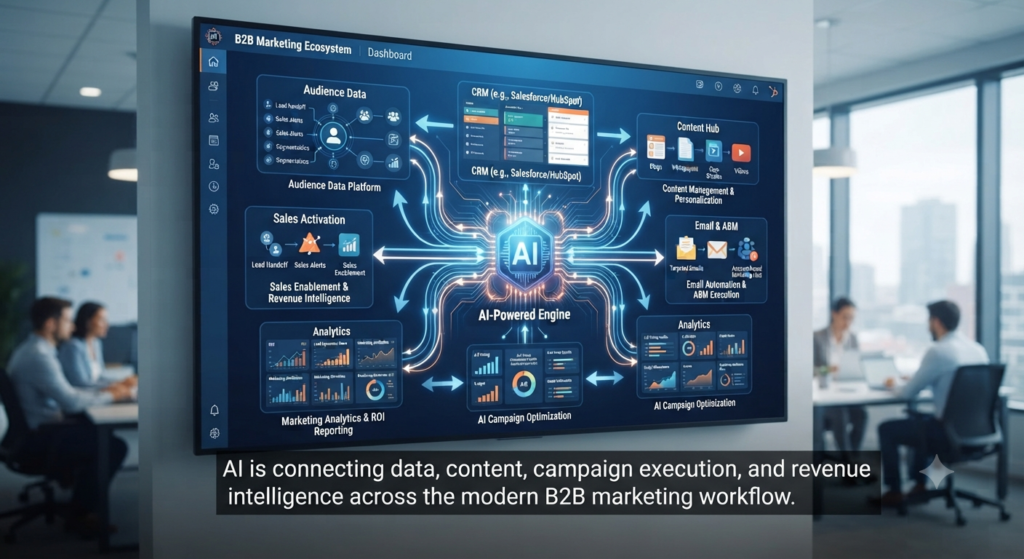
AI can potentially support multiple stages of the B2B campaign lifecycle, including audience research, account identification, content development, campaign personalization, lead scoring, engagement analysis, and performance optimization.
Recent industry commentary describes this transition as a move from experimentation toward commercial execution. The focus is increasingly on whether AI can help organizations shorten sales cycles, improve content quality, generate actionable insights, and create measurable business value.
This is an important distinction.
A campaign that uses AI is not automatically an AI-powered campaign.
A genuinely AI-powered campaign uses intelligence throughout the process, from understanding the audience to deciding what message should be delivered, through to analyzing what happened afterward.
B2B Marketing Leaders Are Asking a Different Question
Traditional marketing discussions often focused on questions such as:
- How much content can we produce?
- How quickly can we launch a campaign?
- How many leads can we generate?
- Which channel has the highest engagement?
AI is pushing marketing leaders toward deeper questions.
Which accounts are most likely to become customers?
What signals indicate that an organization is entering an active buying cycle?
Which members of a buying group need different messages?
What content should be delivered at each stage?
Why did one campaign outperform another?
Which accounts are showing meaningful engagement but have not yet converted?
How can marketing and sales respond to those signals faster?
These questions are much closer to revenue strategy than traditional content production.
That is why AI is becoming particularly important in B2B demand generation and account-based marketing.
AI Is Changing Personalization in B2B Campaigns
Personalization has been part of B2B marketing for years, but many campaigns still rely on basic personalization.
A company name may be inserted into an email. A job title may influence a message. Industry may determine which landing page a prospect sees.
AI creates the opportunity to move beyond these surface-level approaches.
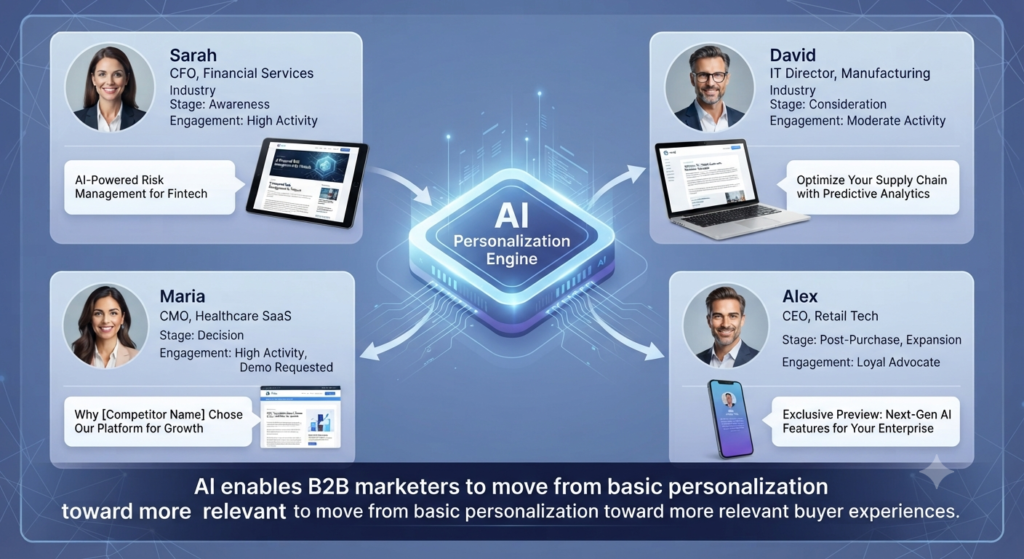
A sophisticated AI-powered campaign can analyze multiple signals and help marketers understand what a prospect may actually care about.
For example, a technology company targeting enterprise organizations could develop different campaign messaging based on company size, industry, technology environment, business priorities, recent engagement, content consumption, and buying stage.
The objective is not to make every message different simply because technology allows it.
The objective is to make each interaction more relevant.
Research into AI-generated advertising imagery also highlights an important limitation. Greater personalization can improve perceptions of relevance, but excessive personalization can also create discomfort. This means B2B marketers need to find the right balance between relevance and restraint.
The lesson for marketing leaders is simple: personalization should feel useful, not intrusive.
Data Quality Is Becoming Even More Important
AI-powered campaigns are only as reliable as the information feeding them.
This makes data quality one of the most important issues in AI-powered B2B marketing.
If a database contains outdated job titles, incorrect company information, duplicate contacts, inaccurate industry classifications, or inactive email addresses, AI may make decisions based on flawed information.
Better AI does not automatically fix bad data.
In fact, AI can make poor data decisions faster and at greater scale.
Marketing leaders are therefore placing greater emphasis on data enrichment, verification, segmentation, governance, and data hygiene.
For B2B organizations, this can include maintaining accurate information about:
Company information: Industry, employee count, location, revenue range, technology environment, and business model.
Contact information: Job title, seniority, department, responsibilities, email validity, and professional relevance.
Engagement information: Email interactions, content downloads, website activity, event participation, campaign responses, and sales interactions.
Intent signals: Research behavior, topic interest, technology changes, hiring activity, business expansion, and other relevant buying indicators.
When these signals are reliable, AI can become much more useful for campaign planning and optimization.
AI Is Helping Marketing Teams Understand Buying Groups
B2B buying decisions rarely involve one person.
Enterprise purchases can involve executives, technical teams, procurement, finance, operations, security, and end users. Each stakeholder may have different concerns.
A CFO may focus on business impact and financial efficiency.
A technology leader may care about integration and security.
A marketing leader may focus on performance and customer experience.
A procurement team may prioritize commercial terms and risk.
AI can help marketing teams organize these different signals and develop campaign strategies around buying groups rather than treating every contact as an isolated lead.
This is particularly relevant to ABM campaigns.
Instead of asking whether a campaign generated 500 contacts, marketing leaders can ask whether the campaign created meaningful engagement across the right accounts and buying groups.
That represents a significant shift in campaign measurement.
AI Can Make Campaign Optimization More Continuous
Traditional campaign optimization often happens in stages.
A campaign launches.
The team waits for results.
Performance is reviewed.
Changes are made.
The campaign runs again.
AI has the potential to make this process more continuous.
Campaign platforms can analyze performance patterns and help marketers identify which audiences, messages, channels, or content assets are producing stronger engagement.
This creates an opportunity for marketers to move toward continuous optimization.
For example, if a particular message receives strong engagement from senior IT decision-makers but performs poorly among finance stakeholders, marketers can adjust content and messaging instead of waiting until the campaign is finished.
The same principle can apply to email subject lines, landing page messaging, content recommendations, audience segmentation, and paid media.
The goal is not simply automation.
The goal is faster learning.
Marketing Leaders Still Believe Human Judgment Matters
Despite the growth of AI, the leadership conversation is not simply about replacing marketers.
In fact, many current discussions emphasize the importance of human judgment.
AI can identify patterns, summarize information, generate variations, and automate repetitive work. But marketers still need to determine whether a message is strategically appropriate, whether a claim is credible, whether the content reflects the brand, and whether the campaign aligns with the customer’s actual needs.
Recent discussions around the future of marketing roles emphasize that AI skills are becoming more valuable, but marketers also need business understanding, data literacy, adaptability, and strategic thinking.
This means the role of the B2B marketer is changing.
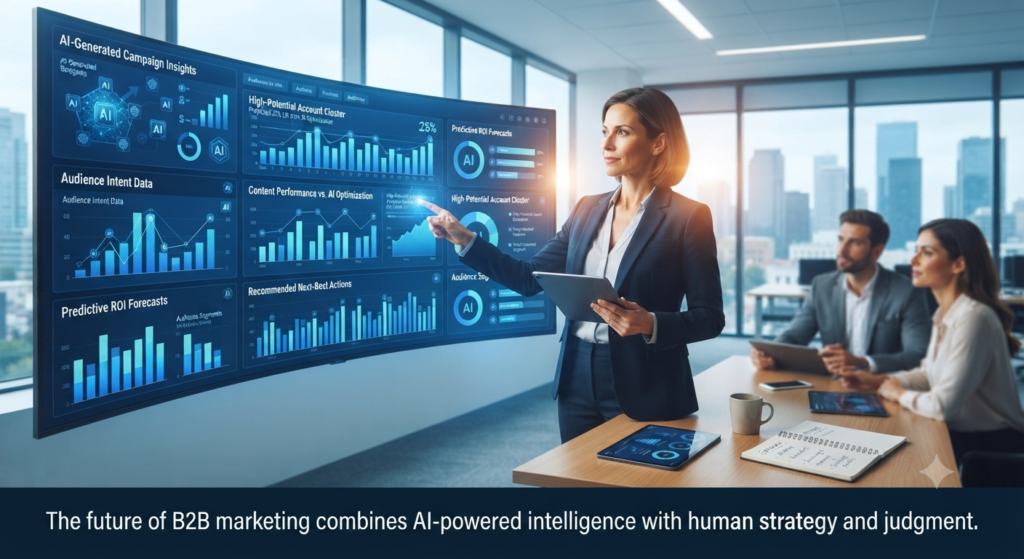
Instead of spending most of their time manually producing campaign assets, marketers can increasingly spend more time interpreting information, developing strategy, reviewing AI outputs, understanding customers, and improving the overall revenue process.
The New Marketing Skill: AI Direction
One emerging skill is the ability to direct AI effectively.
Good AI-powered marketing does not simply involve entering a prompt and publishing the result.
Marketing teams need to understand:
- What information should AI receive?
- Which sources should be trusted?
- What customer context should be included?
- Which outputs require human review?
- What brand rules must be followed?
- What data should not be exposed?
- How should AI recommendations be evaluated?
- Which campaign decisions should remain human-led?
This creates a new layer of marketing expertise.
The best marketers may not necessarily be the people who generate the most AI content. They may be the people who know where AI creates value and where human expertise is more important.
AI Is Also Changing B2B Content Strategy
The rise of AI-generated answers and AI-powered search is changing how marketers think about content visibility.
Traditional SEO remains important, but B2B brands are increasingly considering how their content appears in AI-generated answers and recommendation systems.
Recent marketing discussions around generative engine optimization, or GEO, show that brands are increasingly interested in how AI systems represent and reference companies.
For B2B marketers, this means publishing generic content at scale may not be enough.
Brands need authoritative content that clearly demonstrates expertise.
This includes:
- Original research
- Expert commentary
- Detailed guides
- Customer stories
- Case studies
- Industry analysis
- First-party insights
- Strong product documentation
- Expert-led thought leadership
AI systems need information to understand a company, its expertise, its products, and its relevance.
That makes brand authority increasingly important.
The Measurement Conversation Is Changing
One of the biggest challenges with AI-powered campaigns is measurement.
Marketing leaders do not want to report that AI created 500 pieces of content or saved 200 hours.
Those numbers may demonstrate efficiency, but they do not necessarily demonstrate business impact.
The more important metrics are becoming:
Pipeline contribution: Did the campaign influence qualified pipeline?
Conversion quality: Did campaign-generated opportunities become meaningful sales opportunities?
Account engagement: Are target accounts becoming more engaged?
Buying group coverage: Are multiple relevant stakeholders interacting with the campaign?
Sales velocity: Is the campaign helping move opportunities forward faster?
Cost efficiency: Is the organization producing stronger results with fewer resources?
Revenue impact: Is AI contributing to measurable business growth?
This shift is critical.
AI should not become another marketing vanity metric.
The purpose of AI-powered marketing is to improve the effectiveness of the marketing system.
The Risk of Creating More Content Than Buyers Need
There is also a growing concern about AI-generated content saturation.
If every company uses AI to publish more blog posts, more emails, more social posts, and more downloadable content, volume alone becomes less valuable.
B2B buyers do not need more generic content.
They need useful information that helps them understand problems, evaluate options, reduce risk, and make decisions.
This is why originality is becoming increasingly important.
AI can help marketers research and organize information, but human expertise is still needed to add experience, perspective, customer insight, and strong opinions.
The brands that stand out will not necessarily be those producing the most content.
They will be those producing the most useful and credible content.
Governance Is Becoming Part of Campaign Strategy
AI also introduces new questions around privacy, accuracy, brand safety, intellectual property, and responsible use.
Marketing teams need clear rules around how AI can access customer information, how generated content is reviewed, how sensitive information is handled, and who is responsible for final campaign decisions.
This is especially important as AI becomes integrated into more marketing systems.
A simple generative AI writing experiment may require limited governance.
An AI system connected to CRM data, customer records, campaign platforms, and sales systems requires significantly more oversight.
Marketing leaders therefore need to think about AI governance as part of marketing operations, not simply as an IT issue.
What AI-Powered Campaigns Could Look Like in Practice
Consider a B2B technology company targeting mid-market and enterprise organizations.
Instead of launching one generic campaign, the company could use AI to analyze its ideal customer profile and segment accounts based on industry, company size, technology environment, engagement signals, and buying stage.
The campaign could then develop different content paths for different stakeholder groups.
A senior executive might receive business-focused messaging.
A technical decision-maker could receive integration and security information.
A finance stakeholder could receive ROI and cost-related content.
AI could assist with identifying engagement patterns and recommending which accounts deserve additional attention.
Marketing and sales teams could then use these signals to prioritize conversations.
The campaign becomes more than an email sequence or advertising campaign.
It becomes an intelligence-driven revenue process.
What B2B Marketing Leaders Should Take From the Conversation
The current discussion around AI-powered campaigns points toward several important conclusions.
First, AI is becoming a core capability rather than an optional experiment.
Second, data quality is becoming more important because AI depends on accurate inputs.
Third, personalization is becoming more sophisticated, but marketers need to avoid making interactions feel intrusive.
Fourth, campaign measurement is moving toward pipeline, revenue, account engagement, and commercial outcomes.
Fifth, human judgment remains essential.
And finally, AI should be integrated into the broader marketing strategy instead of being treated as a separate technology project.
Final Thoughts
The conversation around AI-powered B2B campaigns is moving beyond hype.
Marketing leaders are increasingly asking how AI can improve the way teams understand customers, identify opportunities, personalize engagement, optimize campaigns, and contribute to revenue.
That is a much more meaningful conversation than simply asking how much content AI can create.
The strongest B2B marketing organizations will likely be those that combine AI efficiency with human expertise.
AI can analyze enormous amounts of information.
It can automate repetitive work.
It can identify patterns.
It can accelerate experimentation.
But strategy still requires understanding.
Creativity still requires perspective.
Trust still requires credibility.
And successful B2B campaigns still need to solve real customer problems.
The future of AI-powered B2B marketing is therefore unlikely to be about humans versus machines.
It is about marketers using intelligent systems to make better decisions, create more relevant experiences, and build stronger connections with the right buyers.
For marketing leaders, the opportunity is not simply to adopt AI.
The opportunity is to rethink what a modern B2B campaign can become when intelligence, data, technology, creativity, and human judgment work together.