
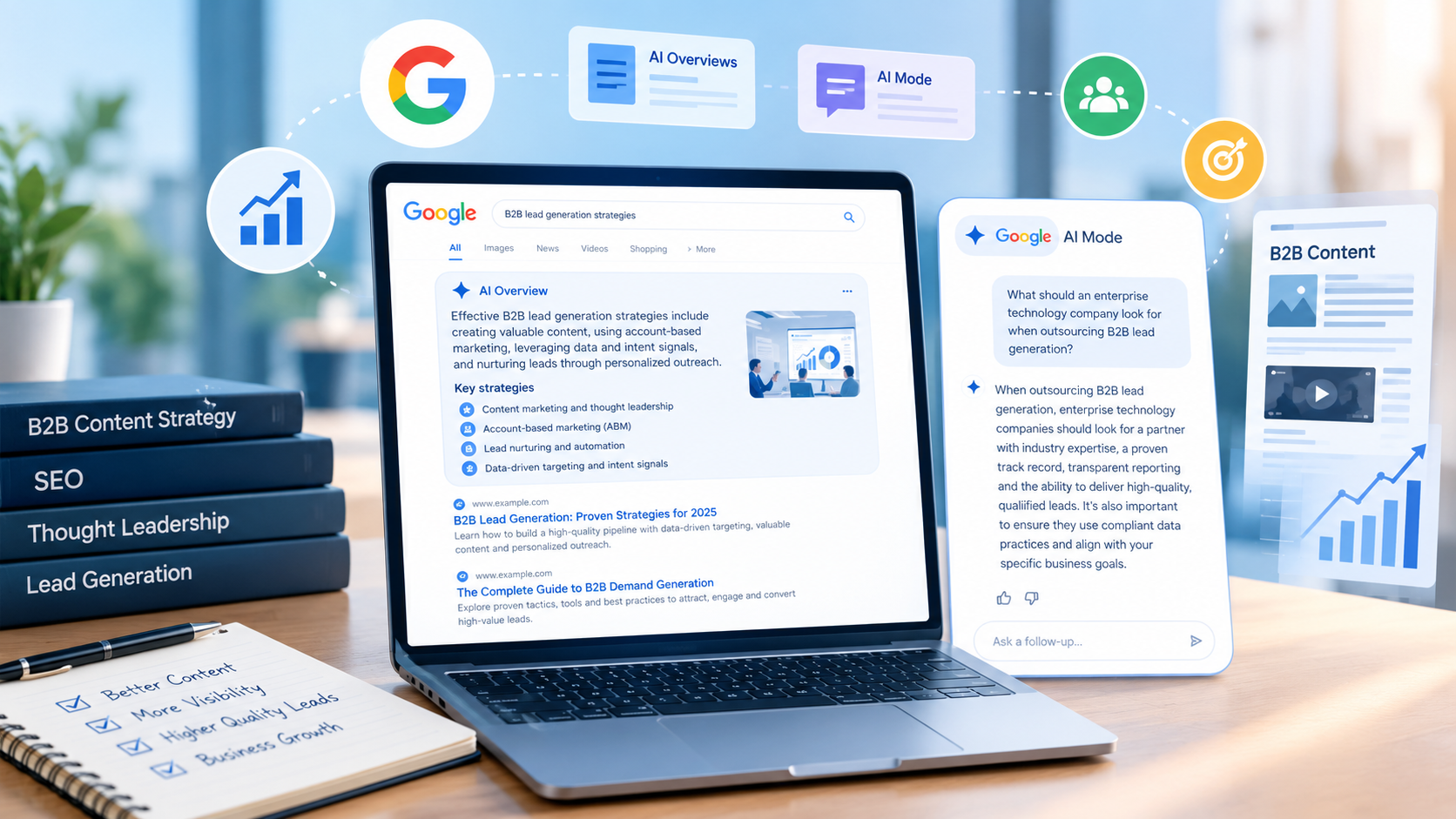

Google Search is undergoing one of its biggest transformations in years as artificial intelligence becomes a more visible part of how people discover, evaluate and consume information online. The introduction and expansion of AI Overviews, AI Mode and new generative AI reporting in Google Search Console are changing the relationship between search visibility, content and website traffic.
For B2B marketers, these changes are especially significant. Business buyers already conduct extensive online research before speaking with a salesperson. They compare vendors, investigate technologies, read industry reports, review case studies and search for solutions to specific business problems. As Google makes search more conversational and capable of synthesizing information from multiple sources, the traditional approach of creating content around individual keywords is becoming less sufficient.
Google’s latest guidance makes an important point clear: SEO is not becoming irrelevant because of AI Search. Google’s generative AI search experiences continue to rely on its core Search ranking and quality systems. At the same time, Google is encouraging website owners to focus on valuable, original and people-first content rather than trying to manipulate AI search systems with artificial optimization tricks.
This creates a major opportunity for B2B companies that are willing to rethink how they approach content marketing.
Google Search Is Becoming More Conversational
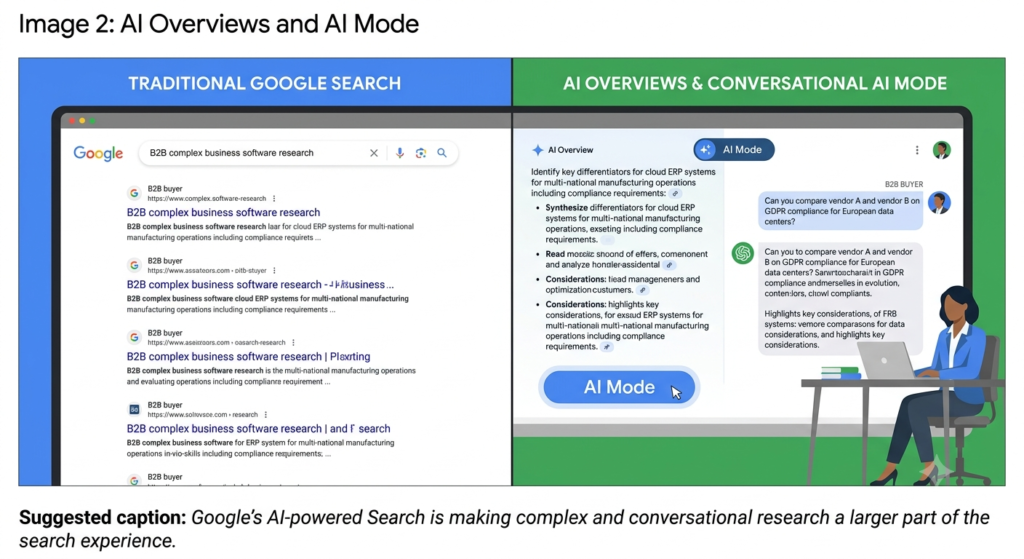
Traditional Google Search generally required users to enter a query, review a list of results and decide which links were worth visiting. AI-powered Search is changing that process by allowing users to explore more complex questions and receive synthesized information directly within the search experience.
AI Overviews can provide generated responses to relevant searches, while AI Mode is designed for more conversational and exploratory interactions. Instead of searching for a series of short keywords, users can increasingly ask detailed questions that contain context, constraints and multiple requirements.
For example, a B2B buyer researching lead generation may start with a broad search such as “B2B lead generation services.” The next search could become more specific: “What should an enterprise technology company look for when outsourcing B2B lead generation?” The buyer might then ask which qualification metrics matter, how lead quality should be measured and what information should be included in a campaign agreement.
This type of search behavior creates a more complicated content environment for marketers. A single webpage may no longer compete only for one keyword. It may need to provide enough context and expertise to remain useful across a wider range of related questions.
Google’s current documentation explains that its generative AI search experiences use information retrieved from the Search index and can generate responses using related searches to better understand complex queries.
For B2B marketers, this means content needs to become more comprehensive without becoming unnecessarily repetitive.
AI Search Does Not Mean Traditional SEO Is Dead
The rapid growth of generative AI has created a common misconception that traditional SEO is becoming obsolete. Google’s own guidance directly challenges that assumption.
Google states that its generative AI features are rooted in the same core Search ranking and quality systems that power traditional Search. Websites still need to meet Google’s technical requirements, remain crawlable and indexable, provide a strong user experience and publish content that genuinely helps their audience.
This is an important distinction for B2B marketing teams.
Companies should not abandon keyword research, technical SEO, internal linking, page optimization or content architecture simply because AI Search is becoming more prominent. Instead, these elements should become part of a larger strategy focused on authority, relevance and usefulness.
A B2B company that already has strong SEO foundations has an advantage because those foundations remain relevant to Google’s AI-powered search experiences.
The change is that marketers now need to think beyond the traditional question of whether a page can rank for a particular phrase. They also need to consider whether the page provides enough original and useful information to contribute to a buyer’s broader research journey.
Google Is Putting More Emphasis on Original and Non-Commodity Content
One of the most important messages in Google’s latest guidance is the importance of creating content that goes beyond information already available everywhere else.
Google describes this as valuable, non-commodity content. In practical terms, this means B2B companies should avoid producing articles that simply summarize information readers can find on hundreds of competing websites.
Consider two different approaches to a B2B marketing article.
The first might be titled “What Is Lead Generation?” and provide a basic definition followed by several generic benefits.
The second could be titled “Why B2B Lead Quality Drops When Campaigns Scale and How Marketing Teams Can Prevent It.” The second topic provides room for real experience, campaign observations, qualification processes, operational challenges and practical recommendations.
The difference is not simply the number of words.
The difference is expertise.
Google’s latest generative AI optimization guidance specifically encourages publishers to provide unique viewpoints, first-hand experience and information that goes beyond common knowledge. Google also states that there is no ideal page length and that content should be created for the audience rather than an arbitrary word count.
This should influence how B2B companies plan their editorial calendars.
Instead of asking, “What keyword can we write an article about this week?” marketers should increasingly ask, “What useful knowledge can our company contribute that another website cannot easily reproduce?”
B2B Companies Need to Invest in First-Hand Expertise
The shift toward AI Search makes proprietary knowledge more valuable.
Generic information can now be produced quickly. What remains difficult to reproduce is genuine experience.
A B2B company that has managed hundreds of campaigns, worked with enterprise buyers, analyzed customer behavior or developed proprietary processes has access to information that generic content producers do not.
That information can become the foundation of stronger SEO content.
For example, a B2B lead generation company could publish an article analyzing patterns it has observed across different industries. Instead of simply explaining what MQLs, HQLs and SQLs mean, the article could examine why qualification standards vary between industries and how sales teams can prevent poorly qualified leads from entering the pipeline.
Similarly, a demand generation company could publish research based on campaign performance, buyer engagement or content consumption trends.
This kind of content has greater potential to establish authority because it contains an original perspective.
It also gives the brand a reason to be referenced, shared and revisited.
AI Overviews Are Changing the Meaning of Search Visibility
AI Overviews introduce an important change in how marketers should think about visibility.
In traditional Search, marketers often focused heavily on rankings and clicks. If a page ranked near the top of Google and generated organic traffic, the SEO strategy appeared to be working.
AI-powered search makes the journey less straightforward.
A user may receive useful information directly within an AI-generated response before deciding whether to visit a website. At the same time, Google’s AI experiences can provide links to supporting webpages, giving users opportunities to explore the sources behind the information.
Google says its generative AI features can use retrieved webpages to ground responses and provide prominent links to relevant sources.
This means B2B content should be designed not only to attract clicks but also to demonstrate expertise when it is encountered during the research process.
A company may not receive a direct visit from every person who encounters information derived from its content. However, the content can still contribute to brand awareness and buyer confidence.
That makes brand authority increasingly important in B2B SEO.
Google Search Console Is Giving Marketers New AI Visibility Data
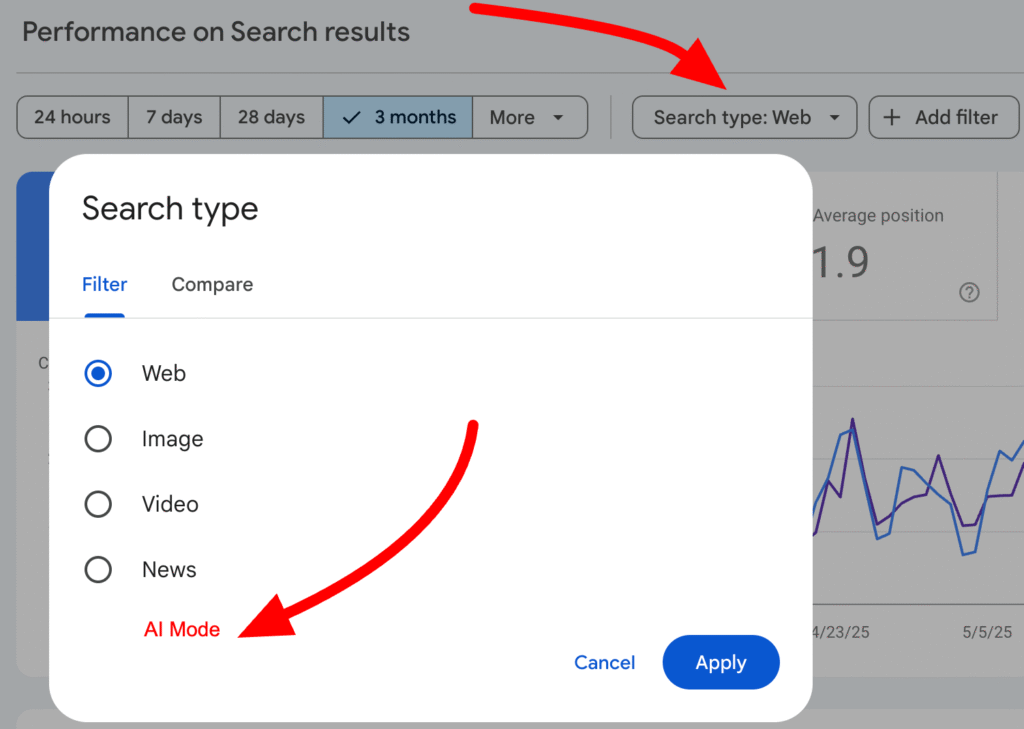
One of Google’s most important recent platform updates is the introduction of dedicated reporting for generative AI visibility in Search Console.
Google announced its Search Generative AI performance reports in June 2026. The reports provide dedicated views of website impressions from generative AI features in Search, including AI Overviews and AI Mode. Google subsequently stated that the insights were rolled out globally by August 31, 2026.
This is a major development for SEO and content teams because marketers can now analyze generative AI visibility more directly instead of relying entirely on third-party estimates.
The data can help businesses understand how their content is being discovered through Google’s evolving AI search experiences.
This also changes the conversation between SEO teams and business leaders.
Previously, an SEO report might focus heavily on rankings, impressions, clicks and conversions. Going forward, companies can increasingly investigate how their visibility extends into AI-powered search environments.
The important point is that AI visibility should not become another vanity metric. It should ultimately be connected to business outcomes.
A B2B marketing team should still ask whether search visibility contributes to qualified leads, sales conversations, opportunities and revenue.
B2B Content Strategy Needs to Move From Keywords to Topics
Keywords remain useful, but B2B content strategies should become more topic-focused.
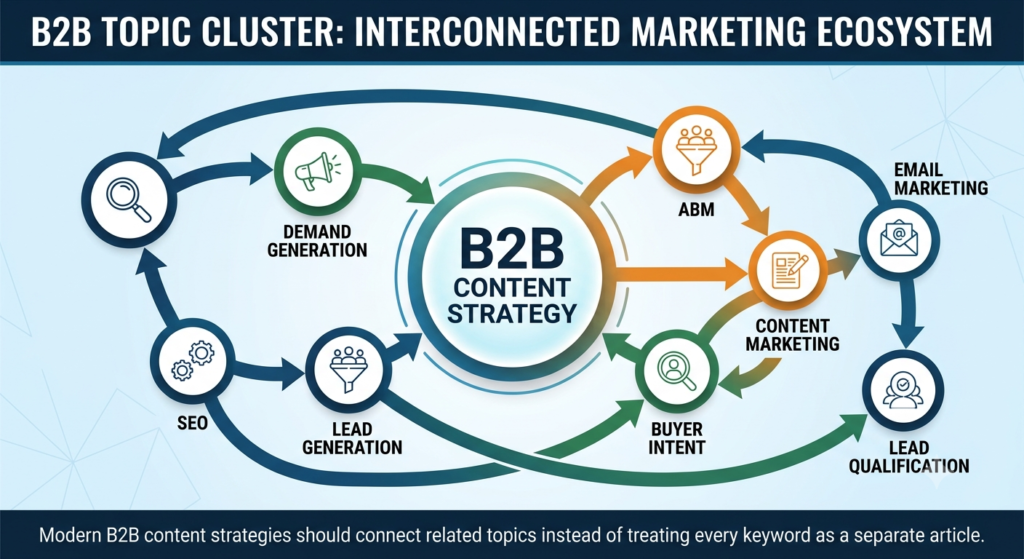
A company should not create dozens of disconnected articles simply because each article targets a slightly different keyword. Instead, it should build connected resources around important business topics.
For example, a B2B company focusing on lead generation could develop a central resource around B2B lead generation and then create supporting content covering qualification, database management, lead scoring, appointment setting, demand generation, email marketing and account-based marketing.
These articles should naturally reference one another when relevant.
This approach creates a stronger information architecture while helping users move through related questions.
It also reflects how modern search works. A complex question may lead to several related searches, and Google’s AI systems can explore multiple related queries to construct a broader answer. Google refers to this process as query fan-out.
The implication for B2B marketers is important: content should cover a subject deeply enough to address the surrounding questions that matter to the audience.
Long-Form Content Still Has a Role, But Length Is Not the Strategy
The rise of AI Search does not mean every B2B article should simply become longer.
Google explicitly states that there is no preferred word count for ranking. Content should be as comprehensive as necessary to satisfy the user.
This is particularly important because many SEO strategies have historically treated word count as a ranking objective.
A 2,000-word article filled with repetitive statements is not automatically better than a 1,200-word article that answers a business question clearly and thoroughly.
The better approach is to use long-form content when the subject requires depth.
A B2B article about enterprise lead generation may need several sections because the topic involves targeting, qualification, data quality, outreach, campaign management and measurement.
A simple definition of a marketing term may not need thousands of words.
The goal should always be completeness and usefulness rather than length for its own sake.
Content Structure Still Matters for Human Readers
Although marketers should not create content solely for AI systems, strong structure remains important.
Google’s guidance recommends organizing content in a way that helps readers navigate the page. Clear headings, meaningful paragraphs and logical sections can make complex information easier to understand.
This is especially important for B2B content because business readers are often looking for specific information rather than reading every sentence from beginning to end.
A decision-maker may want the answer to a particular question. A marketing manager may want implementation details. A sales leader may be interested in qualification and conversion. A C-level executive may care primarily about business impact.
A well-structured article allows each reader to find the information that matters to them.
The result is better usability without resorting to artificial content fragmentation.
B2B Websites Should Not Create Hundreds of AI-Generated Pages
The availability of generative AI makes it easier than ever to produce content at scale.
That does not mean companies should publish hundreds or thousands of lightly edited AI-generated articles.
Google’s guidance states that generative AI can be useful for research and helping structure original content, but producing large amounts of content without adding value can violate Google’s spam policies concerning scaled content abuse.
This creates an important distinction.
Using AI to help a subject-matter expert organize ideas is fundamentally different from generating hundreds of pages designed primarily to capture search traffic.
B2B companies should therefore use AI as a productivity tool rather than as a replacement for expertise.
AI can help with research, outlines, content organization and editorial workflows. Human experts should provide the experience, judgment, examples and original insights that make the final content valuable.
Images and Videos Are Becoming More Important
B2B marketers should also think beyond text.
Google’s latest guidance specifically highlights the importance of relevant, high-quality images and video in generative AI search experiences.
This creates an opportunity for B2B publishers to make their articles more useful through original visual content.
A technical article could include an original process diagram. A research article could include charts based on proprietary data. A campaign strategy article could include a visual framework explaining the buyer journey.
Video can also support complex subjects.
For example, an article about B2B demand generation could include a short video explaining how awareness, engagement, qualification and sales conversion work together.
The important point is that visuals should support the article rather than simply decorate it.
Suggested image placement: After the introduction.
Suggested image concept: A modern editorial illustration showing a traditional Google search interface evolving into AI Overviews and conversational AI Search, with B2B marketing content, analytics and buyer research represented visually.
Suggested image alt text: Google AI Search changes and their impact on B2B content strategy
Internal Linking Will Become More Strategic
Internal linking has always been an important part of SEO, but it becomes even more valuable when a website develops comprehensive topic coverage.
B2B websites should connect related articles based on the user’s research journey.
An article about demand generation could naturally link to resources about lead generation, account-based marketing, email marketing and buyer intent. An article about database management could link to content covering data hygiene, contact discovery and campaign targeting.
The objective should not be to insert links simply because they contain target keywords.
The purpose should be to help readers discover the next useful resource.
This creates a stronger content ecosystem and helps search engines understand how different pages relate to one another.
B2B Marketers Should Stop Chasing AI Search Hacks
The rapid development of AI Search has created a market for new optimization terminology and tactics. Concepts such as AEO and GEO are widely discussed, but Google’s latest official guidance makes it clear that website owners do not need special optimization tricks to appear in Google’s generative AI features.
Google specifically states that websites do not need special files such as llms.txt for Google Search’s AI features. It also says there is no requirement to break content into tiny chunks specifically for AI systems and no special schema markup required solely for generative AI Search.
This is useful guidance for B2B marketers because it brings the focus back to fundamentals.
Instead of spending resources trying to discover a secret AI ranking formula, companies should invest in content quality, technical accessibility, original expertise, useful visuals and a strong user experience.
Those investments can benefit both traditional Search and generative AI search experiences.
The New B2B SEO Measurement Model
The biggest change may ultimately be how B2B companies measure content performance.
Traditional SEO reporting is still important. Organic impressions, clicks, rankings, click-through rates and conversions remain useful indicators.
However, B2B marketing teams should increasingly combine these metrics with generative AI visibility data.
The new Search Console reporting gives marketers a dedicated way to examine impressions from generative AI features such as AI Overviews and AI Mode.
The next step is connecting visibility to business impact.
A strong reporting framework should help answer questions such as whether content is attracting relevant prospects, whether visitors are engaging with high-value resources, whether content assists lead generation and whether organic visibility contributes to qualified opportunities.
This is particularly important for B2B businesses because traffic volume alone rarely tells the full story.
A page attracting 10,000 visitors without generating meaningful business engagement may be less valuable than a specialized industry article attracting 1,000 highly relevant visitors who become leads or enter a sales conversation.
What B2B Marketers Should Change in Their Content Strategy
The most effective response to Google’s AI Search changes is not to completely rebuild an SEO program overnight. Instead, marketing teams should gradually improve the quality and strategic depth of the content they already produce.
Start by reviewing the existing content library. Identify articles that provide little original value, overlap with other pages or no longer answer the questions buyers are asking. These pages can often be improved substantially through stronger examples, updated information, original data and clearer explanations.
Next, identify the questions sales teams hear most frequently. Those questions can provide some of the best content opportunities because they represent real buyer concerns rather than theoretical keyword ideas.
B2B marketers should also involve subject-matter experts in content production. A marketing article becomes much more valuable when it contains insights from people who actually understand the industry, campaigns, technology or customer problems being discussed.
Finally, connect content to business objectives. A successful B2B content strategy should not simply produce articles. It should help educate buyers, build trust, generate demand and support the sales process.
The Future of B2B Search Is About Being Useful
Google’s latest AI Search changes are not simply another algorithm update that marketers can address by changing a few keywords.
They represent a broader change in how people interact with search.
Buyers can ask more complex questions. Search systems can synthesize information from multiple sources. AI Overviews and AI Mode can change how users discover websites. Search Console is also beginning to provide more direct insight into visibility within generative AI experiences.
For B2B companies, the response should be strategic rather than reactive.
The brands most likely to benefit from this environment will be those that consistently provide useful, original and trustworthy information.
That means publishing content based on genuine expertise rather than generic summaries. It means developing topic depth instead of creating isolated keyword pages. It means using original research, case studies, examples, visuals and expert perspectives to make content difficult to replace.
Most importantly, it means remembering that AI Search still serves people.
Google’s latest guidance repeatedly points marketers back toward the same principle: create content that users find helpful and satisfying.
Conclusion: Google AI Search Is Raising the Standard for B2B Content
Google’s AI Search evolution is changing the way B2B marketers should think about organic visibility.
AI Overviews and AI Mode are making search more conversational and capable of handling complex research journeys. Google’s new generative AI performance reports are giving website owners additional visibility into how their content performs within these experiences. At the same time, Google’s official guidance confirms that traditional SEO fundamentals remain important.
The biggest change is not that keywords have disappeared.
The bigger change is that useful expertise matters more than ever.
B2B companies should focus on creating content that answers real buyer questions, demonstrates first-hand knowledge, provides original information and connects naturally with other resources across the website.
The future of B2B SEO will not be won simply by publishing more pages.
It will be won by publishing information that buyers genuinely need and that competitors cannot easily reproduce.
As Google continues to evolve Search around artificial intelligence, B2B marketers have an opportunity to move beyond traditional keyword rankings and build stronger digital authority across the entire buyer journey.
The brands that adapt early will not simply compete for clicks.
They will compete to become trusted sources of information in the new AI-powered search ecosystem.