

Marketing technology is entering another major transition.
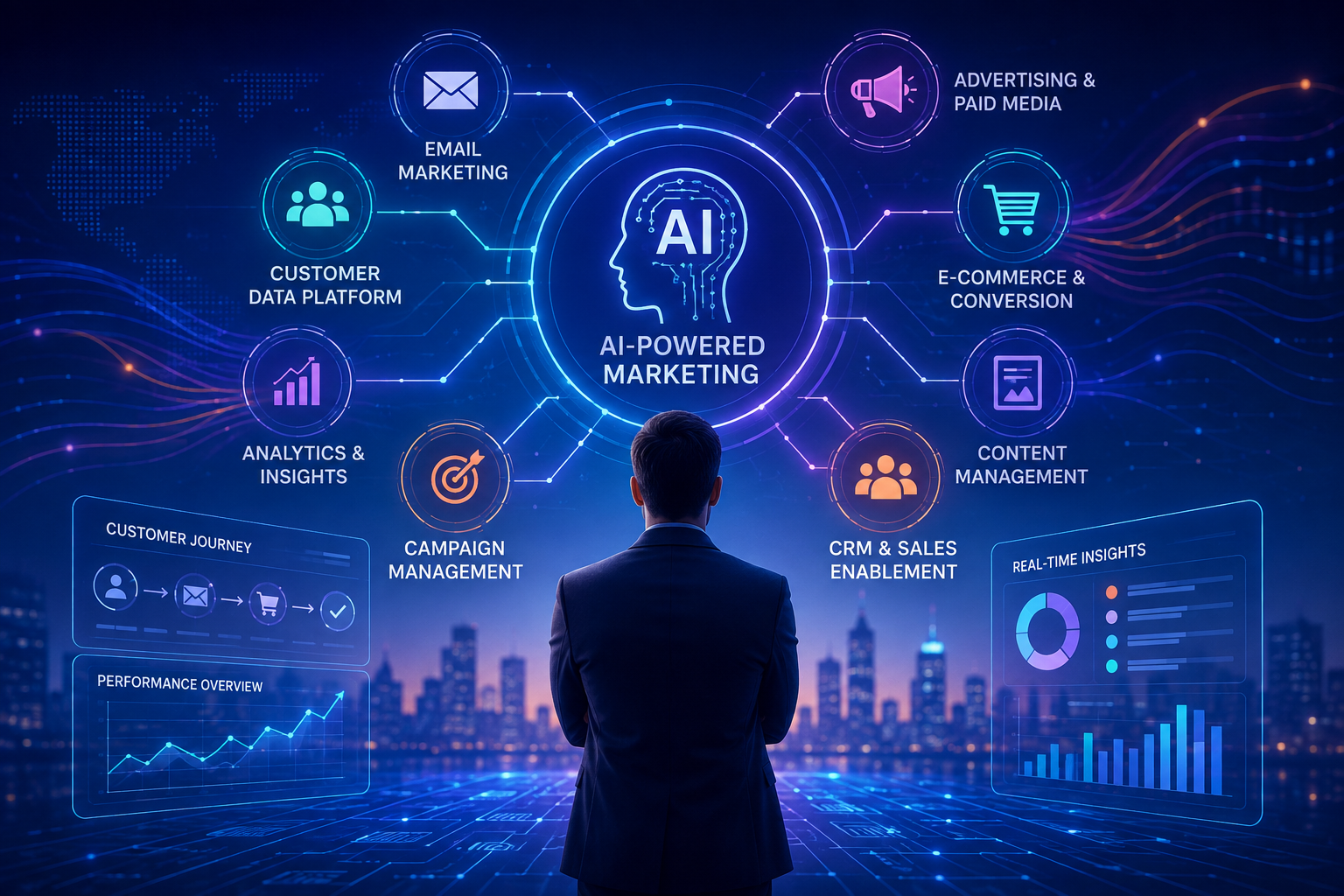
For years, marketers built technology stacks around CRM platforms, marketing automation, analytics tools, advertising platforms, customer data platforms, content management systems, and dozens of specialized applications. The objective was straightforward: connect the right tools, automate repetitive tasks, collect customer data, and help marketing teams generate better results.
That model is changing.
In 2026, the biggest MarTech industry shifts are being driven by artificial intelligence, autonomous AI agents, changing search behavior, connected customer data, privacy requirements, and the growing pressure to prove marketing ROI.
The shift is no longer simply about adding AI features to existing marketing software. Major technology companies are redesigning marketing platforms around AI-powered decision-making and automated execution.
Google is introducing agentic capabilities across advertising, analytics, creative, and commerce. Adobe is expanding AI agents across customer experience workflows. Salesforce is positioning AI agents and connected data as central parts of its enterprise platform.
For marketing leaders, this means the question is no longer, “Which MarTech tools should we buy?”
The more important question is:
“How should our marketing organization operate when AI can increasingly execute the work itself?”
Here are the biggest MarTech industry shifts marketing leaders should watch.
1. AI Is Moving From Assistant to Autonomous Marketing Agent
The most important change in MarTech is the transition from generative AI assistants to agentic AI.
Traditional marketing AI typically responds to a prompt. A marketer asks an AI tool to create an email, summarize campaign data, write an advertisement, or generate content.
Agentic AI goes further.
An AI agent can potentially analyze information, make decisions, execute tasks, monitor results, and adjust its actions based on predefined objectives.
This creates a fundamentally different marketing workflow.
Instead of:
Marketer → Tool → Output
The emerging model looks more like:
Marketing Goal → AI Agent → Data → Decision → Action → Measurement → Optimization
This is already becoming visible across major MarTech platforms.
Adobe describes its agentic approach as moving AI toward an “AI coworker” experience, while its Experience Platform includes agents designed to automate marketing and customer experience workflows.
Salesforce is also expanding its Agentforce ecosystem and connecting AI agents with customer data and enterprise workflows. Recent developments around Salesforce and Anthropic demonstrate how major enterprise software providers are positioning AI as an operational layer rather than simply another software feature.
Why marketing leaders should care
Marketing teams may eventually spend less time manually executing campaigns and more time:
- Defining objectives
- Designing customer strategies
- Reviewing AI decisions
- Managing brand governance
- Validating data
- Setting performance boundaries
- Measuring business impact
The competitive advantage will not necessarily belong to companies with the most AI tools.
It may belong to companies that build the best AI-powered marketing operating model.
2. The MarTech Stack Is Moving From Tool Collections to Connected Platforms
For years, marketing teams accumulated software.
One platform handled email.
Another handled CRM.
Another handled analytics.
Another handled content.
Another handled advertising.
Another handled customer data.
Another handled personalization.
This created what many marketing organizations now experience as MarTech sprawl.
The problem is not simply the number of tools. The bigger problem is fragmented data and disconnected workflows.
Modern MarTech platforms are increasingly trying to solve this by connecting customer data, marketing execution, analytics, content, and AI agents.
Google’s 2026 marketing announcements provide a clear example. Its new AI capabilities connect advertising, analytics, Merchant Center, creative workflows, measurement, and commerce. Its Ask Advisor is designed to work across multiple Google marketing products rather than functioning as an isolated AI feature.
Salesforce is making a similar move by connecting Data 360, Agentforce, Slack, marketing, sales, service, commerce, and other enterprise applications.
What this means for CMOs
The future MarTech stack may be smaller, more integrated, and more intelligent.
Instead of asking:
“How many tools do we have?”
Marketing leaders should ask:
“How effectively can our systems share data and execute a customer journey?”
That distinction will become increasingly important when evaluating new technology investments.
3. Search Is Becoming an AI Discovery Experience
Search marketing is also undergoing a significant transformation.
For years, SEO was largely built around ranking webpages in traditional search results.
AI-powered search changes the discovery process.
Users increasingly ask conversational questions and expect AI systems to synthesize information, recommend options, compare products, and provide direct answers.
This creates a new challenge for marketers:
How do you make your brand visible when the customer does not necessarily click through ten search results?
Google’s 2026 Marketing Live announcements show how quickly this environment is evolving. Google introduced new AI-powered search advertising formats, AI Max capabilities, agentic tools, and new ways for products and brands to appear across conversational AI experiences.
Adobe has also described the emergence of an “agentic web,” where brands are increasingly discovered and interpreted by AI agents as well as human users.
The new SEO question
Traditional SEO asks:
“Can we rank?”
AI-era SEO increasingly asks:
“Can AI systems understand, trust, retrieve, and recommend our brand?”
That means marketers should invest in:
- Authoritative content
- Structured information
- Original research
- Clear product information
- Expert insights
- Strong brand reputation
- Consistent messaging
- First-party data
- Technically accessible websites
SEO is not disappearing.
It is becoming broader.
4. Marketing Data Is Becoming More Valuable Than Marketing Tools
AI is only as useful as the information it can access.
This makes customer data one of the most important assets in the modern MarTech ecosystem.
A company can purchase the latest AI platform, but if its customer data is incomplete, duplicated, outdated, poorly governed, or trapped inside disconnected systems, the AI will struggle to produce reliable outcomes.
This is why customer data platforms, CRM systems, data warehouses, analytics platforms, and identity systems are becoming increasingly important.
Google’s latest marketing infrastructure emphasizes “data strength” and connected measurement as foundations for AI-powered marketing.
Adobe is similarly integrating AI agents with Experience Platform and customer profiles so that AI-driven experiences can operate using connected customer information.
What marketing leaders should evaluate
Before investing heavily in another AI application, assess:
- Is our customer data accurate?
- Is our CRM properly maintained?
- Can marketing and sales access the same customer information?
- Can AI tools access approved data securely?
- Are customer identities resolved across channels?
- Can we measure the journey from first interaction to revenue?
If the answer to these questions is no, another AI tool may not solve the underlying problem.
5. Personalization Is Moving Toward Real-Time Decisioning
Personalization has been a MarTech promise for years.
But traditional personalization often relies on predefined audience segments.
For example:
Visitors from India → Segment A
Existing customers → Segment B
High-value accounts → Segment C
AI is enabling a more dynamic approach.
Instead of simply placing customers into predefined groups, AI systems can evaluate behavior, context, customer history, content engagement, and other signals to determine what action should happen next.
This creates the possibility of real-time personalization.
For example, an AI-powered marketing system could determine that a prospect:
- Visited a pricing page
- Downloaded a technical report
- Opened multiple emails
- Returned to the website
- Matches a high-value account profile
The system could then adjust the next interaction automatically.
This could include changing content, triggering an email, notifying sales, adjusting an advertisement, or recommending a specific resource.
Adobe’s agentic marketing approach specifically focuses on AI systems orchestrating personalized customer experiences at scale.
The leadership implication
Personalization is moving from:
“Who is this customer?”
to:
“What should happen next for this customer?”
That is a much more powerful question.
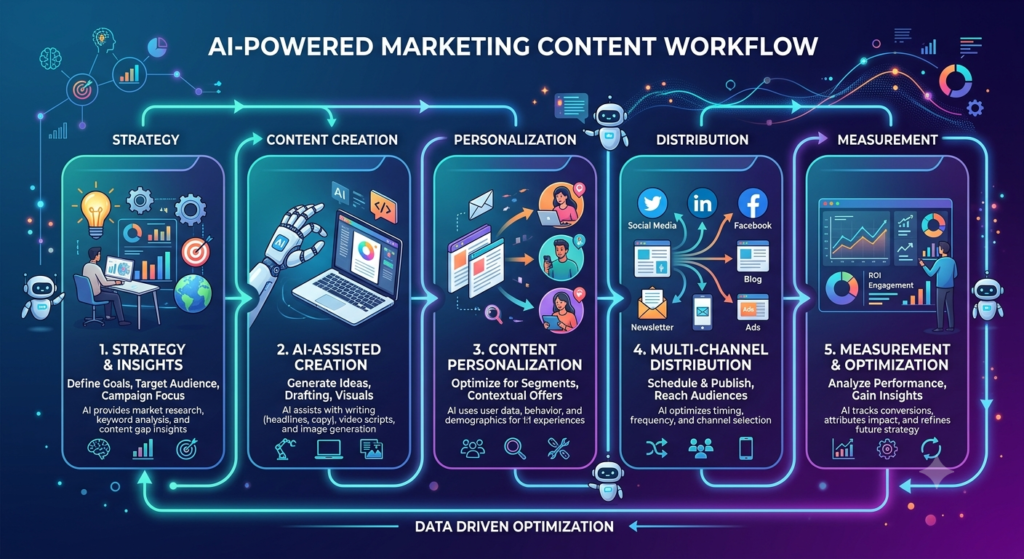
6. Creative Production Is Becoming an AI-Powered Content Supply Chain
Marketing teams are under constant pressure to produce more content.
More social posts.
More landing pages.
More advertisements.
More videos.
More emails.
More sales enablement content.
More personalized assets.
Traditional production processes can struggle to keep up.
AI is changing this by helping marketing teams generate, adapt, test, and distribute creative assets faster.
Google’s 2026 marketing announcements included new AI-powered creative capabilities through Asset Studio and multimodal asset generation.
Adobe is also expanding AI agents that can help marketers find content, create variations, update experiences, and move approved assets into activation workflows.
This means the marketing content supply chain is becoming increasingly automated.
7. Measurement Is Moving Beyond Clicks and Leads
Another major MarTech shift is happening in measurement.
For years, marketers relied heavily on:
- Click-through rate
- Cost per click
- Leads
- Cost per lead
- Website traffic
- Email opens
- Conversion rates
These metrics remain useful, but marketing leaders increasingly need to connect activity to business outcomes.
AI is making this even more important because automated systems can generate enormous amounts of activity.
More campaigns do not automatically mean more revenue.
Google’s 2026 marketing announcements emphasize unified measurement, incrementality, marketing mix modeling, and customer journey analysis as part of its evolving marketing infrastructure.
The shift is therefore from:
“How many leads did marketing generate?”
toward:
“How much qualified pipeline and revenue did marketing influence?”
This will push marketing operations teams to improve CRM integration, attribution models, data quality, and revenue reporting.
8. AI Governance Is Becoming a Core Marketing Responsibility
The rapid adoption of AI creates another challenge: governance.
Marketing teams are increasingly using AI to work with:
- Customer information
- Campaign data
- Proprietary content
- Sales information
- Product information
- Behavioral data
- Creative assets
Without appropriate controls, AI adoption can create security, privacy, compliance, and brand risks.
Marketing leaders therefore need clear policies covering:
- Approved AI tools
- Data access
- Customer information
- Human approval
- Content accuracy
- Brand standards
- Intellectual property
- AI-generated content
- Security
- Compliance
Adobe’s current CX Enterprise documentation includes AI monitoring, AI credit consumption, agentic AI capabilities, and content transparency mechanisms such as C2PA metadata for AI-generated and AI-edited content.
The lesson is simple:
AI governance cannot remain solely an IT issue.
Marketing leaders need to be involved because AI increasingly influences customer-facing experiences.
9. The Marketing Organization Itself Is Changing
Technology changes workflows.
Workflows change roles.
As AI handles more repetitive execution, marketing teams will increasingly need people who can manage strategy, data, creativity, experimentation, and AI systems.
The role of a marketing operations professional, for example, may evolve from configuring automation workflows manually to managing automated systems and AI agents.
Similarly, content marketers may spend less time producing first drafts and more time developing original ideas, expertise, positioning, editorial standards, and quality control.
Campaign managers may spend less time building every individual campaign and more time designing the rules under which AI systems operate.
The new marketing skill set
Marketing leaders should increasingly prioritize:
- AI literacy
- Data literacy
- Strategic thinking
- Experimentation
- Customer journey design
- Prompt and workflow design
- AI governance
- Analytics
- Revenue measurement
- Cross-functional collaboration
The best marketing teams may not be the teams with the most people.
They may be the teams that combine human judgment with machine execution most effectively.
10. Agentic Commerce Could Change the Customer Journey
One of the most interesting MarTech shifts is the emergence of agentic commerce.
In a traditional customer journey, a person searches for a product, visits websites, compares options, selects a product, adds it to a cart, and completes checkout.
In an agentic commerce environment, AI systems may increasingly perform parts of this process on behalf of the customer.
Google is already building toward this model with agentic commerce initiatives, AI-powered shopping experiences, product data improvements, and the Universal Commerce Protocol.
This has major implications for marketers.
Brands will need product information that is:
- Accurate
- Structured
- Current
- Machine-readable
- Easy for AI systems to interpret
- Consistent across channels
The future customer may not always interact directly with a brand’s website before making a purchase.
Sometimes, an AI agent may make the recommendation first.
What Marketing Leaders Should Do Now
The MarTech landscape is changing quickly, but marketing leaders do not need to replace their entire technology stack overnight.
Instead, start with a strategic assessment.
1. Audit your current MarTech stack
Identify:
- Tools that overlap
- Tools that are underused
- Data silos
- Manual workflows
- Integration problems
- Expensive legacy systems
2. Identify high-value AI opportunities
Do not implement AI simply because competitors are doing it.
Look for repetitive, high-volume processes where automation could create measurable value.
Examples include:
- Lead qualification
- Content production
- Audience segmentation
- Campaign optimization
- Reporting
- Customer support
- Personalization
- Data analysis
3. Strengthen your data foundation
AI requires reliable information.
Improve:
- CRM data quality
- Customer identity resolution
- Data governance
- Tracking
- Attribution
- First-party data collection
4. Build AI governance
Define what AI can and cannot do.
Create approval processes for sensitive customer-facing activities.
5. Train your marketing team
AI adoption is not simply a technology project.
Your people need to understand how to work with AI, evaluate its outputs, and manage its limitations.
6. Measure business impact
Move beyond vanity metrics.
Connect marketing activity to:
Campaign → Engagement → Qualified Lead → Opportunity → Revenue
That is where AI investment becomes a business decision rather than a technology experiment.
The Bigger Picture: MarTech Is Becoming an Operating System for Growth
The biggest MarTech industry shifts are not isolated product launches.
They are part of a larger transformation.
AI is becoming an execution layer.
Customer data is becoming the foundation.
Platforms are becoming more connected.
Search is becoming conversational.
Content production is becoming increasingly automated.
Measurement is becoming more sophisticated.
And marketing organizations are being redesigned around human plus AI collaboration.
The most important change may be that MarTech is moving from a collection of tools toward an intelligent operating system for customer growth.
Marketing leaders who treat AI as another software category may miss the bigger opportunity.
The leaders who rethink their workflows, data architecture, customer journeys, measurement systems, and team structures around AI will be better positioned to compete.
The future of MarTech will not simply be about having better technology.
It will be about building a marketing organization that can learn, decide, execute, and adapt faster than the competition.