

Introduction
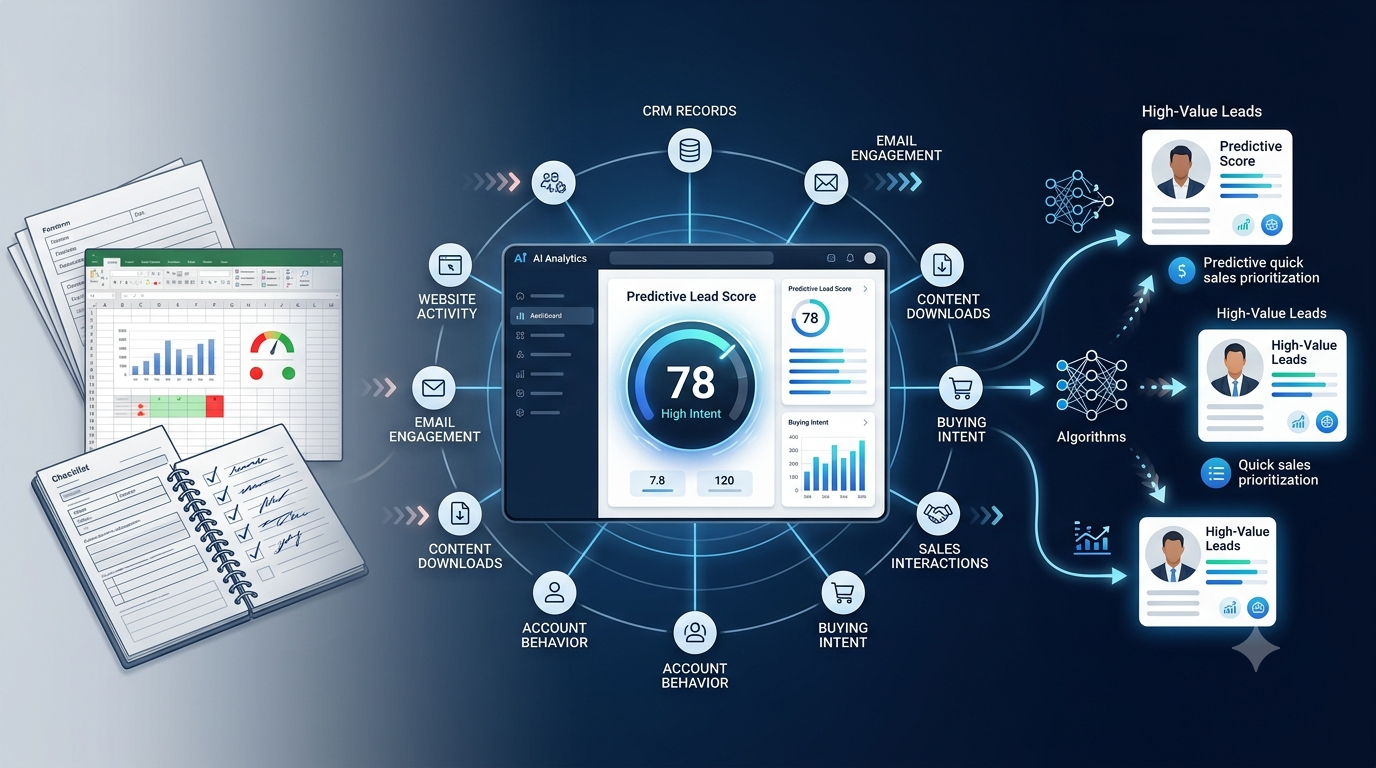
For years, B2B sales and marketing teams have relied on traditional lead qualification models to determine which prospects deserve sales attention. Models such as BANT, lead scoring matrices, demographic filters, firmographic criteria, and manually assigned engagement points have helped organizations organize large prospect databases.
But the B2B buying journey has changed dramatically.
Prospects now interact with brands across websites, webinars, email campaigns, social platforms, content libraries, review sites, product pages, and multiple digital channels before speaking with a salesperson. At the same time, buying groups have become larger, sales cycles have become more complex, and the amount of behavioral data available to marketing teams has increased significantly.
This is creating a major challenge for traditional qualification models.
A prospect who downloads one whitepaper may not necessarily be ready to buy. Another prospect who never fills out a form may be actively researching a solution through multiple anonymous website visits, product comparisons, and account-level activities.
AI-powered lead scoring is emerging as an answer to this problem.
Instead of relying only on predetermined rules, AI-powered systems can analyze historical conversion data, behavioral signals, account characteristics, engagement patterns, and other relevant information to identify which leads are more likely to progress toward a business outcome.
Microsoft’s predictive lead scoring, for example, uses machine learning to score leads based on historical data and provides insights into the factors influencing the score. Its system can also provide near-real-time scoring for newly created leads.
Adobe’s current B2B predictive scoring capabilities similarly extend scoring beyond individual people to accounts, with models designed around opportunity-stage conversion events and account-level signals.
The result is a fundamental shift:
Traditional qualification asks whether a lead meets predefined criteria. AI-powered qualification increasingly asks how likely that lead or account is to produce a desired business outcome.
What Is AI-Powered Lead Scoring?
AI-powered lead scoring uses machine learning, predictive analytics, behavioral data, and automation to estimate the likelihood that a lead will take a commercially valuable action.
Depending on the platform and implementation, that action could be:
- Becoming a marketing-qualified lead
- Becoming a sales-qualified lead
- Requesting a demo
- Starting a trial
- Creating an opportunity
- Purchasing a product
- Expanding an existing account
- Re-engaging with a sales campaign
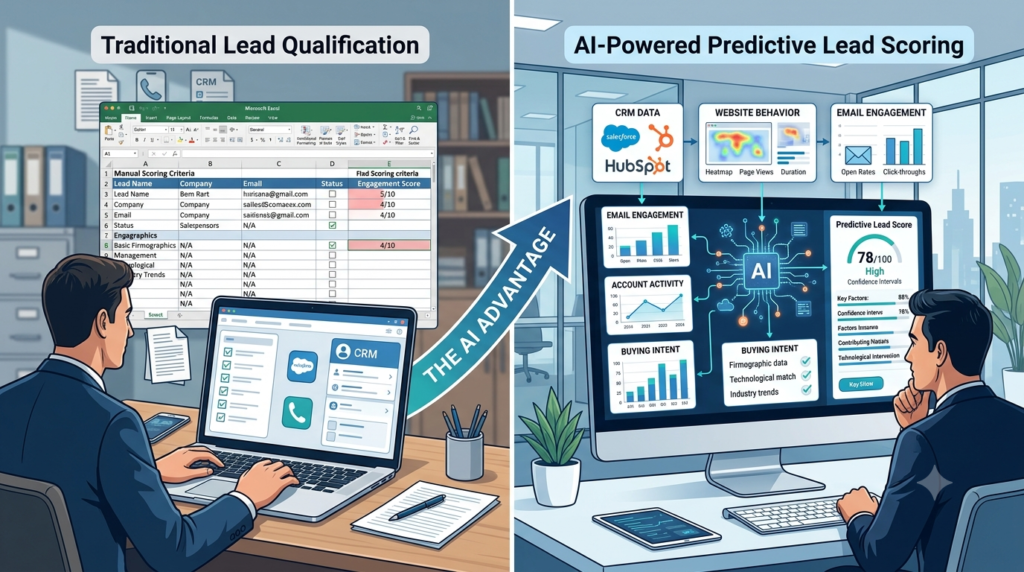
Traditional scoring generally assigns fixed values to specific actions.
For example:
| Prospect Activity | Traditional Score |
|---|---|
| Opens email | +5 |
| Clicks email | +10 |
| Downloads whitepaper | +15 |
| Visits pricing page | +20 |
| Attends webinar | +15 |
| Job title matches ICP | +20 |
Once the prospect reaches a predetermined threshold, the system may automatically classify the person as sales-ready.
The problem is that these values are usually based on assumptions.
AI-powered scoring takes a different approach. Instead of assuming that a particular action always indicates buying intent, the model can analyze historical outcomes and identify which combinations of signals are actually associated with conversion.
Microsoft describes predictive lead scoring as a machine-learning approach that uses historical lead data to prioritize leads and reduce qualification time.
This makes the scoring model more dynamic and potentially more closely connected to actual revenue outcomes.
Why Traditional Lead Qualification Models Are Under Pressure
Traditional qualification is not disappearing because it is useless.
It is being challenged because modern B2B buying behavior is too complex for simple rules to capture consistently.
1. Buyer Journeys Are No Longer Linear
A prospect might discover a company through LinkedIn, visit the website several times, download a report, attend a webinar two weeks later, compare competitors, return through an organic search, and finally request a sales conversation.
A traditional model may treat each action independently.
AI can evaluate the broader behavioral pattern.
The difference is important.
A single webinar attendance might not mean much. But webinar attendance combined with repeated visits to product pages, increased engagement from the same company, senior decision-maker involvement, and accelerated activity could represent a much stronger buying signal.
2. More Data Does Not Automatically Mean Better Qualification
Modern marketing platforms collect enormous quantities of data.
The challenge is determining which signals matter.
AI can analyze relationships between hundreds or thousands of variables that would be difficult for a human marketing operations team to evaluate manually.
This allows organizations to move from:
“What did the prospect do?”
to:
“What does the complete pattern of behavior suggest?”
3. Static Scores Can Become Outdated
A scoring system created two years ago may reflect buyer behavior that no longer exists.
Market conditions change.
Products change.
Customer preferences change.
Competitors change.
Buying committees change.
AI models can be retrained using newer historical outcomes, allowing scoring systems to evolve with the available data. Microsoft’s predictive scoring documentation, for example, includes automated retraining capabilities for its models.
AI Scoring vs. Traditional Lead Qualification
The difference can be summarized simply.
| Traditional Qualification | AI-Powered Qualification |
| Fixed rules | Dynamic predictions |
| Manual assumptions | Historical outcome patterns |
| Activity-based | Behavior and outcome-based |
| Individual lead focused | Lead and account focused |
| Static thresholds | Continuously optimized signals |
| Limited variables | Large numbers of variables |
| Manual analysis | Automated analysis |
| Periodic updates | Model-based updates |
| Qualification by score | Qualification by predicted likelihood |
Traditional scoring still has an important role, especially for basic eligibility checks.
For example, a company may still require a prospect to belong to a specific geography, company size, industry, or customer segment.
AI does not necessarily replace these rules.
Instead, it can sit above them and add a predictive layer.
How AI-Powered Lead Scoring Works
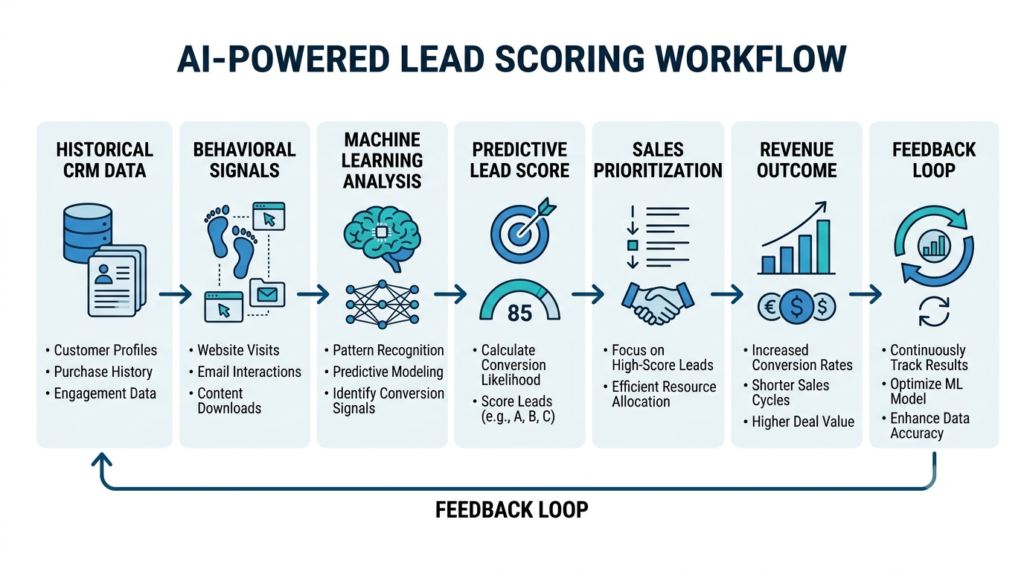
A typical AI-powered lead scoring workflow involves several stages.
Step 1: Collect Historical Data
The system analyzes previous leads and their outcomes.
This can include:
- Qualified leads
- Disqualified leads
- Opportunities
- Closed-won deals
- Closed-lost deals
- Campaign engagement
- Website behavior
- Email engagement
- Content consumption
- Account information
- CRM activity
- Sales interactions
The quality of this historical data is critical.
If the CRM contains inconsistent qualification definitions or large numbers of incorrectly classified leads, the model may learn misleading patterns.
Microsoft, for example, requires sufficient historical qualified and disqualified lead records before predictive lead scoring can create a model.
Step 2: Identify Relevant Signals
The AI system determines which characteristics and behaviors are associated with the desired outcome.
Potential signals can include:
- Industry
- Company size
- Job role
- Geography
- Website activity
- Content engagement
- Email interactions
- Product interest
- Previous sales activity
- Account engagement
- Conversion history
- Engagement velocity
The model can then determine which combinations of these variables are most useful for predicting outcomes.
Step 3: Generate a Predictive Score
The system assigns a score representing the relative likelihood of the lead achieving the defined objective.
For example:
Lead A: 87
Lead B: 64
Lead C: 31
The numbers do not necessarily mean that Lead A has an 87% chance of buying.
Some systems explicitly describe their scores as relative likelihood rather than probability percentages. Adobe’s predictive B2B scoring documentation makes this distinction clear.
Step 4: Explain the Score
Modern predictive systems increasingly provide insight into why a lead received a particular score.
For example:
Positive signals
- High engagement with product content
- Strong account fit
- Multiple contacts from the same organization
- Recent increase in activity
Negative signals
- Low historical conversion rate for the segment
- Limited engagement
- Poor account fit
- No recent activity
Microsoft’s predictive lead scoring interface includes influential factors that help users understand what is increasing or decreasing a lead’s score.
Step 5: Trigger Automated Actions
Once a lead crosses a defined threshold, automation can initiate the next step.
For example:
High score → Sales notification → CRM task → Personalized outreach
Medium score → Nurture campaign → Additional content → Re-evaluation
Low score → Automated nurture → Monitor future engagement
This turns lead scoring from a reporting function into an operational workflow.
AI Is Moving Qualification From Leads to Accounts
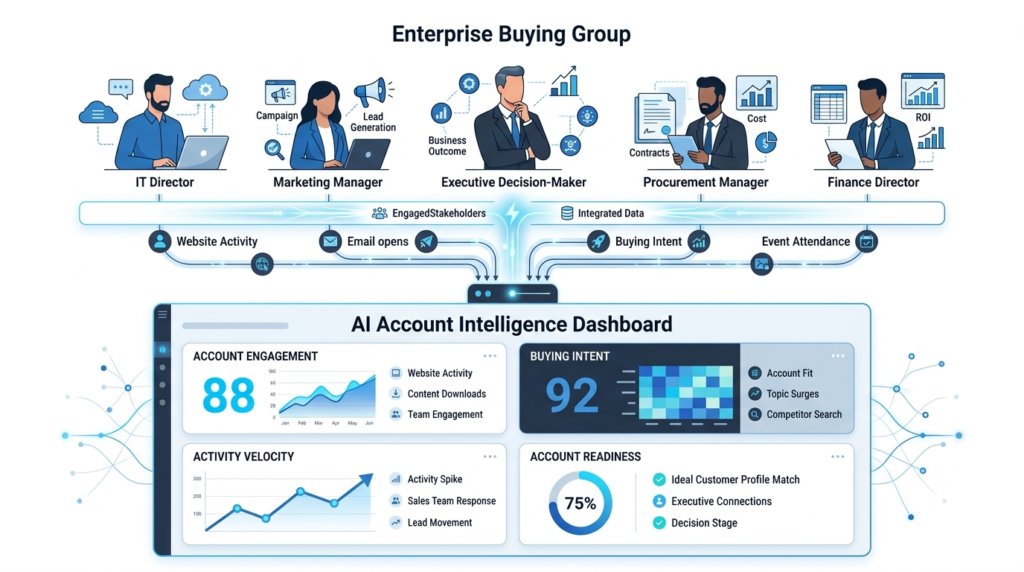
One of the most important changes in B2B qualification is the movement from individual lead scoring toward account and buying-group scoring.
A single contact rarely represents an entire B2B purchase.
A buying decision may involve:
- An end user
- A department manager
- A technical evaluator
- Procurement
- Finance
- An executive sponsor
This means that evaluating one contact in isolation can produce an incomplete picture.
Adobe’s B2B predictive scoring approach includes both person-level and account-level scoring and aggregates person activities to help generate account-level scores.
This is especially important for account-based marketing.
Consider this example:
A marketing manager from Company A visits your website twice.
Individually, the lead might appear moderately interested.
But the situation changes when the CRM shows that:
- The CTO visited the product page.
- A procurement manager downloaded pricing information.
- Three employees attended a webinar.
- The marketing manager returned to the website five times.
- Several contacts engaged with product content within the same week.
The individual leads may each appear average.
The account could actually be highly active.
AI-powered account scoring can help sales teams identify this type of buying activity earlier.
Behavioral Velocity Is Becoming a Critical Signal
Another important development is the increasing importance of engagement velocity.
Traditional lead scoring may count actions.
AI can examine how quickly those actions happen.
Imagine two prospects.
Prospect A
- Downloads one report
- Opens two emails
- Visits the website once
Activity occurs over three months.
Prospect B
- Visits five product pages
- Downloads a technical guide
- Watches a product video
- Returns to the pricing page
- Attends a webinar
All activity occurs within five days.
Both prospects may have similar total activity scores.
But Prospect B may demonstrate significantly stronger current buying momentum.
AI models can identify patterns like these when they are supported by sufficient historical data.
AI-Powered Qualification Can Improve Sales Prioritization
Sales teams often face a basic resource problem.
There are more leads than salespeople can effectively contact.
If sales representatives receive hundreds of leads, they need a way to determine where to spend their limited time.
AI-powered scoring can help rank the pipeline.
Instead of simply sorting leads by the latest form submission, sales teams can prioritize leads based on predicted business value or conversion likelihood.
This can create a more efficient workflow:
Thousands of records
↓
AI analyzes signals
↓
Leads and accounts ranked
↓
High-priority prospects identified
↓
Sales receives prioritized opportunities
↓
Sales outcomes feed back into the model
The final stage is particularly important.
The best AI scoring systems should not operate as isolated prediction engines. They should become part of a feedback loop.
The Feedback Loop Is the Real Competitive Advantage
AI scoring becomes more valuable when sales outcomes continuously improve the qualification process.
A simplified feedback loop looks like this:
Marketing Data → AI Model → Lead Ranking → Sales Action → Revenue Outcome → New Training Data
If the sales team consistently finds that certain high-scoring leads do not convert, the organization needs to investigate why.
Likewise, if some medium-scoring leads repeatedly become successful customers, the model may be missing important signals.
Recent research into lead ranking also highlights the importance of closing the loop between predictions and real-world sales outcomes. A 2026 study on production lead ranking reported that static approaches can struggle when deployed in changing environments and proposed feedback-driven optimization as a way to improve ranking performance.
This points toward a broader shift:
The future of lead scoring is not simply better prediction. It is continuous learning from actual business outcomes.
AI Does Not Mean Humans Disappear
The rise of AI-powered lead scoring does not mean sales representatives should blindly accept every AI recommendation.
There are several reasons for maintaining human oversight.
Context Matters
A company may receive a high score because several employees are researching a product.
But perhaps the company has already signed a contract with a competitor.
Or perhaps the activity is related to market research rather than a buying project.
AI may detect patterns.
Salespeople provide context.
Data Can Be Wrong
If CRM data is inaccurate, AI predictions can also become unreliable.
Bad data can produce bad recommendations.
Models Can Develop Bias
If historical sales teams systematically favored certain industries, regions, job titles, or company sizes, a model trained on that history may reproduce those patterns.
Organizations therefore need regular model evaluation and governance.
Human Judgment Still Matters
AI should help salespeople answer:
“Who should I prioritize?”
It should not automatically answer every question about:
“Who should I sell to?”
A human-led, AI-assisted qualification process is often more practical than complete automation.
What B2B Marketing Teams Need to Change
The shift toward AI-powered qualification requires more than purchasing an AI tool.
Marketing teams need to rethink how they define lead quality.
1. Define the Business Outcome
Do not start with:
“We need an AI lead score.”
Start with:
“What outcome are we trying to predict?”
Possible outcomes include:
- Sales acceptance
- Opportunity creation
- Pipeline generation
- Closed-won revenue
- Product adoption
- Expansion
A model trained around the wrong outcome can optimize the wrong behavior.
2. Clean the CRM
Before deploying predictive scoring, organizations should examine:
- Duplicate records
- Incorrect lead statuses
- Missing fields
- Inconsistent industry values
- Outdated company information
- Poor opportunity tracking
- Inconsistent qualification definitions
AI cannot compensate for fundamentally unreliable data.
3. Align Sales and Marketing
Marketing may define a qualified lead differently from sales.
AI can expose these inconsistencies.
Sales and marketing teams should agree on:
- Qualification criteria
- Target accounts
- Conversion events
- Sales acceptance rules
- Disqualification reasons
- Follow-up expectations
- Revenue outcomes
4. Start With a Controlled Use Case
Organizations do not need to automate everything immediately.
A practical starting point could be:
AI ranks existing MQLs → Sales reviews the ranking → Results are tracked → Model is evaluated
Once the organization understands the system’s strengths and weaknesses, automation can gradually expand.
Where AI-Powered Lead Scoring Is Headed
The next phase of AI-powered qualification will likely move beyond individual lead scores.
Instead of asking:
“How likely is this person to convert?”
B2B organizations will increasingly ask:
“How ready is this buying group to engage with sales?”
This involves combining:
- Person-level behavior
- Account-level engagement
- Buying-group composition
- Intent signals
- Engagement velocity
- Historical conversion patterns
- Sales activity
- Product interest
Adobe’s B2B architecture already describes AI-based readiness scoring that can incorporate multiple signals and, in some approaches, buying velocity and competitive signals.
This could eventually lead to more dynamic qualification systems where AI does not simply assign a number.
Instead, the system could recommend:
Priority: High
Reason: Multiple stakeholders active
Buying velocity: Increasing
Recommended action: Sales outreach
Recommended contact: Economic decision-maker
Suggested message: Focus on operational efficiency
That represents a significant evolution from a static “MQL = 50 points” model.
Key Benefits of AI-Powered Lead Scoring
When implemented correctly, AI-powered lead scoring can provide several advantages.
Faster Lead Prioritization
Sales teams can identify high-value prospects without manually reviewing every record.
Better Use of Sales Resources
Representatives can spend more time on leads with stronger predicted potential.
More Dynamic Qualification
Models can adapt as buying patterns change.
Better Account Visibility
B2B teams can evaluate multiple contacts and account-level engagement together.
Improved Marketing Alignment
Marketing teams can optimize campaigns based on outcomes rather than surface-level engagement.
More Relevant Automation
Different lead segments can receive different actions based on predicted readiness.
Continuous Optimization
Sales outcomes can feed back into the scoring system and improve future prioritization.
Challenges Organizations Should Consider
AI-powered scoring is powerful, but it is not a magic solution.
Companies should consider several risks.
Data Quality
Poor CRM data can reduce model reliability.
Explainability
Sales teams need to understand why a lead received a particular score.
Model Drift
Buyer behavior changes, so models need monitoring and retraining.
Over-Automation
Automatically routing every high-scoring lead to sales can create false positives.
Privacy and Compliance
Organizations must ensure that data collection, processing, profiling, and automated decision-making comply with applicable privacy requirements.
Organizational Adoption
A technically strong model can fail if sales representatives do not trust or use it.
The goal should therefore be AI-assisted qualification, not AI replacing every human decision.
The New Definition of a Qualified Lead
The biggest change may not be technological.
It may be conceptual.
Traditional qualification often defines a qualified lead through a collection of attributes:
Right company + right title + enough engagement + threshold score = qualified
AI-powered qualification introduces a more dynamic model:
Relevant account + meaningful behavior + buying momentum + historical patterns + predicted business outcome = sales priority
This distinction matters.
A lead does not become valuable simply because it clicked an email.
A lead becomes valuable when multiple signals suggest that the prospect or account has a meaningful likelihood of progressing toward the organization’s desired commercial outcome.
Conclusion
AI-powered lead scoring is changing the way B2B organizations think about qualification.
Traditional scoring systems remain useful for deterministic rules, eligibility checks, and straightforward segmentation. However, modern buying journeys generate too many complex signals for static scoring models to interpret effectively on their own.
Predictive systems can analyze historical outcomes, behavioral patterns, account activity, and other signals to prioritize leads and accounts based on their predicted likelihood of reaching a business objective. Microsoft and Adobe both provide current examples of predictive scoring systems that use machine learning and account-level or lead-level signals to support B2B qualification.
The most important shift is therefore not simply from manual scoring to automated scoring.
It is from rule-based qualification to outcome-driven prioritization.
For B2B marketing and sales teams, the future is likely to involve a hybrid model in which AI continuously evaluates buying signals, sales teams provide human context, and actual revenue outcomes improve the next generation of predictions.
Organizations that build this feedback loop effectively can move beyond asking which leads are active and start identifying which prospects are showing the strongest evidence of buying intent.
That is where AI-powered lead scoring can become more than another marketing automation feature.
It can become an intelligence layer connecting marketing engagement, sales activity, account behavior, and revenue outcomes.