
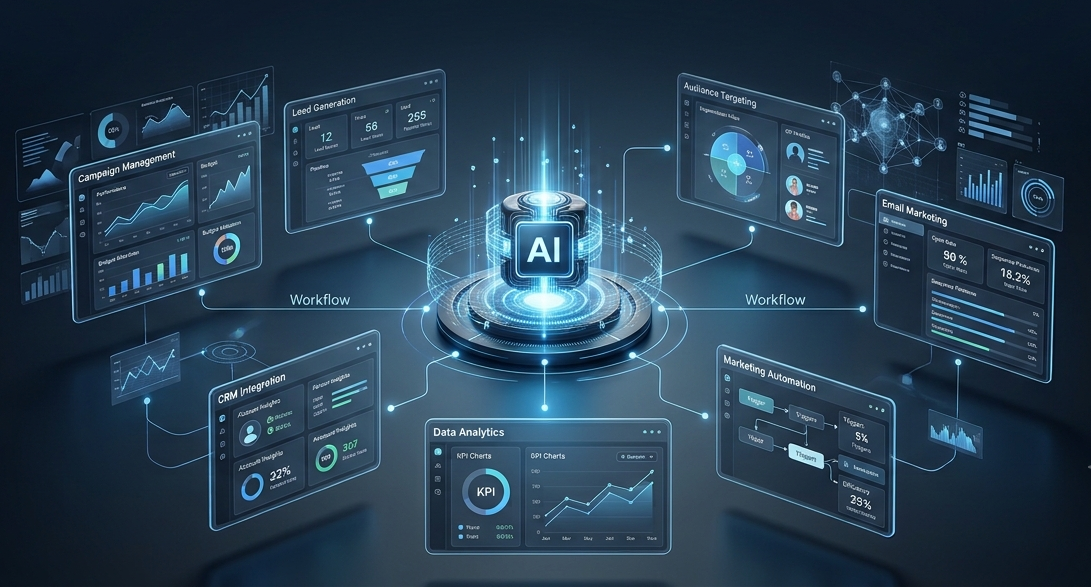

AI is moving beyond content generation and basic automation. Intelligent AI agents are helping B2B marketing teams plan campaigns, analyze buyer behavior, personalize engagement, qualify prospects, and optimize marketing performance with greater speed and precision.
B2B marketing is entering a new phase of transformation. Businesses are no longer relying entirely on traditional campaign management tools, manual reporting, or disconnected marketing workflows. Artificial intelligence is becoming an important part of how organizations plan, execute, monitor, and improve their marketing strategies.
One of the most significant developments in this transformation is the emergence of AI agents. Unlike conventional automation tools that follow predefined instructions, AI agents can analyze information, make context-based decisions, perform multiple tasks, and adapt their actions according to campaign objectives.
For B2B marketing teams managing multiple audiences, channels, campaigns, and sales requirements, this development creates new opportunities. AI agents can support everything from identifying potential customers and researching target accounts to managing personalized outreach and evaluating campaign performance.
According to HubSpot’s 2026 State of AI in Marketing report, 86% of surveyed marketers use AI agents, while 76% report increased usage over the previous six months. These developments highlight how agent-based technologies are becoming increasingly relevant to modern marketing operations.
The important question is no longer whether AI will influence B2B campaign management. It is how businesses can integrate AI agents into their existing strategies to improve campaign execution, strengthen customer engagement, and generate better business outcomes.
What Are AI Agents in B2B Marketing?
AI agents are intelligent software systems designed to perform tasks, analyze information, make decisions, and take actions toward specific objectives with varying levels of human supervision.
Traditional marketing automation typically depends on predefined rules. For example, when a prospect downloads a whitepaper, an automated system may send a follow-up email after a specified period.
An AI agent can take a more advanced approach. It can analyze the prospect’s company profile, understand the downloaded content, evaluate previous interactions, identify relevant interests, and recommend an appropriate follow-up action.
Depending on its permissions and integrations, it may also prepare personalized communication, update CRM information, or notify the sales team when a prospect demonstrates strong buying intent.
In B2B marketing, AI agents can support several interconnected activities:
- Identifying and researching target accounts.
- Analyzing buyer intent and engagement signals.
- Segmenting audiences based on business characteristics.
- Developing personalized campaign messaging.
- Coordinating email and other marketing channels.
- Monitoring campaign performance.
- Identifying opportunities for optimization.
- Supporting lead qualification and sales handoffs.
The key difference is that AI agents can work across multiple steps instead of simply completing one isolated instruction.
Why AI Agents Are Becoming Important for B2B Campaign Management
B2B campaigns are becoming increasingly complex. Marketing teams must reach decision-makers across different industries, company sizes, job functions, and geographic markets.
A single campaign may involve audience research, database preparation, content development, landing page creation, email marketing, lead qualification, reporting, and sales coordination.
Managing these activities manually can consume considerable time and create operational challenges.
AI agents offer an opportunity to connect these activities through intelligent workflows.
1. Managing Complex Campaign Workflows
Traditional campaign management often involves multiple tools and teams working independently. Marketing professionals may use one platform for email campaigns, another for CRM management, and separate systems for analytics and audience research.
AI agents can help coordinate these activities by connecting information across supported platforms.
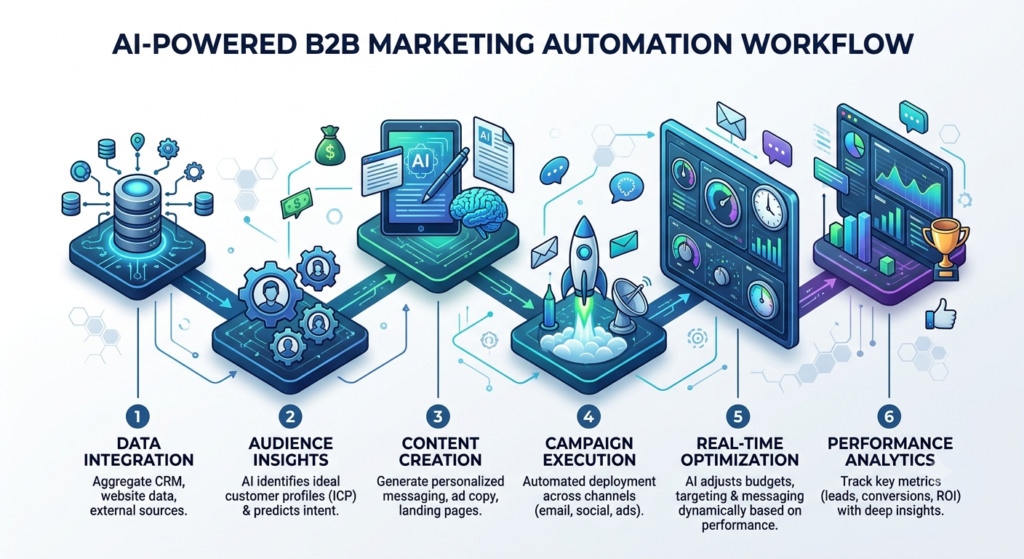
For example, an AI-powered campaign workflow could:
- Analyze campaign objectives and target audience requirements.
- Research relevant companies and decision-makers.
- Organize prospects into appropriate audience segments.
- Prepare campaign messaging for different buyer groups.
- Coordinate approved campaign activities.
- Monitor engagement and campaign responses.
- Identify prospects requiring additional attention.
- Generate performance summaries for marketing teams.
This approach reduces repetitive coordination and helps teams maintain better visibility throughout the campaign lifecycle.
2. Improving B2B Audience Targeting
Reaching the right audience is one of the most important factors in successful B2B marketing.
A campaign targeting technology companies with more than 500 employees, for example, requires different audience criteria than a campaign targeting small and medium-sized businesses.
AI agents can analyze multiple data points, including:
- Industry and sub-industry.
- Company size and employee count.
- Business location.
- Job title and seniority.
- Department and decision-making responsibilities.
- Technology adoption.
- Previous campaign engagement.
- Available buying-intent indicators.
By combining these signals, AI agents can help marketing teams identify audience segments that better match their ideal customer profiles.
This can improve targeting precision and reduce unnecessary outreach to organizations that do not meet campaign requirements.
However, the quality of these recommendations depends on the accuracy, freshness, and completeness of the underlying B2B database.
3. Delivering More Personalized Campaign Experiences
Generic marketing messages often struggle to capture the attention of B2B decision-makers.
Different professionals have different priorities. A Chief Marketing Officer may be interested in improving demand generation performance, while a Sales Director may focus on pipeline quality and conversion rates.
AI agents can use available business information and engagement history to help create more relevant campaign experiences.
For example:
- Technology companies can receive messaging focused on digital transformation.
- Manufacturing organizations can receive content about operational efficiency.
- Financial services companies can receive messaging around data management and compliance.
- Marketing leaders can receive resources related to campaign performance and demand generation.
AI agents can also help adapt email subject lines, landing page messaging, content recommendations, and follow-up communication according to audience characteristics.
The objective is not simply to send more messages. It is to make every interaction more relevant to the recipient.
5 Major Ways AI Agents Are Transforming B2B Campaign Management
1. AI-Powered Campaign Planning and Strategy
Campaign planning requires marketers to understand their target audience, business objectives, competitive environment, available resources, and expected outcomes.
AI agents can assist with this process by analyzing historical campaign data, identifying patterns, and highlighting potential opportunities.
For example, an AI agent may review previous campaign results and identify that a particular industry segment consistently generates stronger engagement.
It can then recommend prioritizing that segment in upcoming campaigns.
AI agents can also help marketing teams:
- Analyze previous campaign performance.
- Identify audience opportunities.
- Recommend campaign objectives.
- Develop campaign briefs.
- Suggest content themes.
- Identify potential channel combinations.
- Support budget allocation decisions.
Human marketers remain responsible for strategic direction, but AI agents can provide useful intelligence to support faster and more informed decisions.
2. Automated Lead Identification and Qualification
Lead identification and qualification are critical components of B2B demand generation.
Marketing teams need to identify prospects that match campaign requirements and demonstrate genuine business relevance.
AI agents can support this process by combining company information, contact details, engagement history, and available intent signals.
For example, an agent may identify a prospect who:
- Works for a company within the target industry.
- Holds a relevant decision-making position.
- Meets the required company-size criteria.
- Has engaged with relevant campaign content.
- Demonstrates interest in a specific product or service.
Based on predefined qualification criteria, the agent can recommend whether the prospect requires further nurturing, additional verification, or a sales follow-up.
AI agents can also support BANT-based qualification by helping organize information around Budget, Authority, Need, and Timeline.
However, qualification decisions should be validated against actual campaign requirements. An engagement signal alone does not automatically indicate purchase readiness.
3. Smarter Email Marketing and Outreach
Email marketing continues to play an important role in B2B communication. However, managing large-scale campaigns requires careful audience segmentation, message development, scheduling, and performance monitoring.
AI agents can help automate and improve several parts of the email marketing process.
They can assist with:
- Developing audience-specific email content.
- Recommending subject lines.
- Personalizing messaging based on company profiles.
- Identifying appropriate follow-up opportunities.
- Monitoring delivery and engagement metrics.
- Analyzing responses and identifying interested prospects.
- Recommending adjustments to campaign sequences.
For example, if a particular audience segment demonstrates stronger engagement with educational content than promotional messaging, an AI agent can highlight this pattern and recommend adjusting the next campaign communication.
With proper integrations and approval permissions, agents can also coordinate follow-up activities across connected marketing platforms.
This helps marketing teams move toward more responsive and data-driven email campaigns.
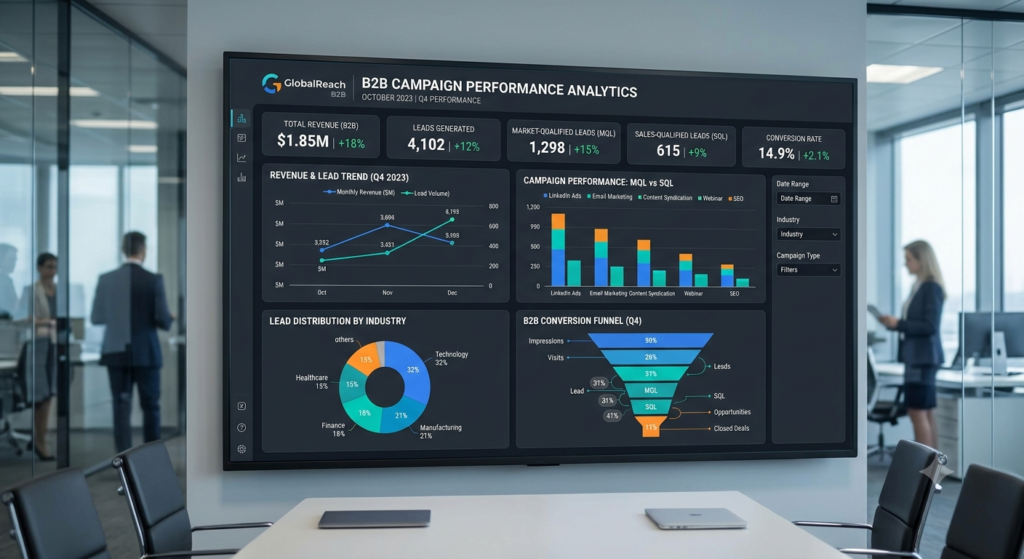
4. Real-Time Campaign Monitoring and Optimization
One of the biggest challenges in traditional campaign management is identifying performance issues quickly enough to take corrective action.
Marketing teams often depend on scheduled reports and manual analysis to understand what is happening across different campaign channels.
AI agents can continuously monitor available campaign data and identify important performance changes.
For example, an agent may detect:
- Declining email engagement.
- Lower-than-expected landing page conversions.
- Poor performance from a particular audience segment.
- Changes in lead qualification rates.
- Differences in campaign performance across industries.
- Unusual increases in campaign costs.
Based on these observations, it can recommend adjustments to targeting, messaging, content, or campaign timing.
More advanced implementations can execute approved changes automatically within predefined limits.
This allows businesses to move from reactive campaign reporting toward more proactive campaign optimization.
5. Better Marketing and Sales Alignment
B2B marketing success does not end when a prospect responds to a campaign. The information must reach the appropriate sales team with enough context to support the next interaction.
AI agents can improve this handoff by organizing prospect information, summarizing engagement history, and highlighting relevant qualification details.
For example, when a prospect downloads a product-focused whitepaper and subsequently engages with a pricing-related resource, an AI agent can flag the activity for review.
It may also prepare a summary containing:
- Company profile.
- Contact information.
- Relevant campaign interactions.
- Content engagement history.
- Available buying-intent signals.
- Qualification status.
- Recommended next steps.
This gives sales professionals better context before contacting a prospect.
When marketing and sales teams operate with shared information, businesses can improve follow-up consistency and reduce unnecessary delays between lead generation and sales engagement.
How AI Agents Are Changing the B2B Campaign Management Process
The transformation becomes clearer when comparing traditional campaign management with an AI-supported approach.
| Campaign Activity | Traditional Approach | AI Agent-Supported Approach |
|---|---|---|
| Audience Research | Manual research | Assisted account and audience analysis |
| Data Segmentation | Rule-based filtering | Context-based segment recommendations |
| Content Development | Manual drafting | AI-assisted content creation and adaptation |
| Email Marketing | Scheduled workflows | Adaptive, context-aware workflows |
| Lead Qualification | Manual evaluation | Automated analysis with human validation |
| Performance Reporting | Periodic reporting | Continuous monitoring and insights |
| Campaign Optimization | Manual adjustments | AI-generated recommendations and approved actions |
| Sales Handoff | Manual information sharing | Automated summaries and CRM updates |
AI agents do not eliminate the need for campaign managers. Instead, they change how campaign managers spend their time.
Rather than focusing primarily on repetitive administrative tasks, marketing professionals can dedicate more attention to strategy, audience understanding, creative direction, quality control, and business outcomes.
The Role of Data Quality in AI-Powered B2B Campaigns
AI agents are only as effective as the information they can access.
Even advanced AI systems can produce inaccurate recommendations when they operate with outdated company records, incomplete contact information, incorrect job titles, or inconsistent database structures.
For B2B organizations, this makes data quality a foundational requirement for successful AI-powered campaign management.
Consider a campaign targeting senior marketing decision-makers in the technology industry. If the database contains outdated job titles or incorrect company classifications, an AI agent may identify the wrong audience and recommend irrelevant campaign activities.
To avoid these issues, businesses should prioritize:
Accurate Business Information: Company names, industries, locations, and employee counts should be validated.
Contact Verification: Professional email addresses, job titles, and contact information should be checked for accuracy.
Consistent Data Structures: CRM records and marketing databases should follow standardized formats.
Regular Database Maintenance: Outdated, duplicate, and incomplete records should be identified and addressed.
Relevant Audience Segmentation: Data should be organized according to campaign-specific targeting requirements.
A reliable B2B database helps AI agents make better decisions, develop more relevant audience segments, and support more effective campaign execution.
For businesses investing in demand generation and account-based marketing, data quality should be treated as a strategic priority rather than a routine administrative task.
Challenges Businesses Must Consider Before Adopting AI Agents
Although AI agents offer significant opportunities, implementing them without proper planning can create operational and strategic risks.
Businesses should understand the following challenges before integrating AI agents into their marketing operations.
1. Data Privacy and Compliance
AI-powered marketing workflows often process company information, contact details, and campaign engagement data.
Organizations must ensure that data collection, processing, storage, and communication activities follow applicable privacy regulations and marketing requirements.
Access controls and clear data-handling policies are essential.
2. Inaccurate AI Recommendations
AI agents can occasionally misinterpret information, produce inaccurate content, or make recommendations based on incomplete data.
Human review is especially important for campaign messaging, audience selection, lead qualification, and external communication.
3. Integration With Existing Marketing Platforms
Businesses may already use CRM systems, email marketing platforms, analytics tools, and database management solutions.
AI agents must be integrated properly to access relevant information and execute approved workflows.
Disconnected systems can create duplicate records, inconsistent reporting, and incomplete campaign visibility.
4. Maintaining Brand Voice and Messaging
AI-generated communication should reflect the organization’s positioning, tone, and messaging standards.
Businesses should establish clear guidelines for content creation and ensure that campaign materials receive appropriate review before publication or distribution.
5. Measuring Actual Business Impact
Increased automation does not automatically translate into better campaign performance.
Organizations should measure whether AI agents are improving meaningful business outcomes, including lead quality, conversion rates, campaign efficiency, sales engagement, and cost per qualified lead.
The goal should be measurable improvement, not simply greater AI adoption.
How B2B Businesses Can Start Implementing AI Agents
Organizations do not need to transform their entire marketing department overnight.
A practical implementation strategy should begin with specific business challenges and gradually expand as teams gain experience.
Step 1: Identify Repetitive Campaign Activities
Review existing marketing workflows and identify tasks that consume time without requiring extensive human judgment. Examples include data organization, report preparation, campaign summaries, and content variations.
Step 2: Establish Clear Campaign Objectives
Define what the AI agent should achieve. Objectives may include improving audience segmentation, reducing manual reporting, accelerating campaign preparation, or supporting lead qualification.
Step 3: Prepare Reliable Data Sources
Review the quality of available company and contact information. Ensure that the AI agent has access only to relevant, authorized, and properly structured data.
Step 4: Connect Relevant Marketing Platforms
Integrate the AI agent with the appropriate CRM, email marketing, analytics, and campaign management systems. Establish permissions for reading information, recommending actions, and executing approved tasks.
Step 5: Introduce Human Approval Processes
Define which activities can be automated and which require human approval. External communication, important targeting decisions, and sensitive customer information should receive appropriate oversight.
Step 6: Monitor Performance and Improve Workflows
Evaluate campaign outcomes regularly. Compare performance before and after implementation, identify operational gaps, and improve the agent’s instructions and workflow design.
Starting with a focused use case allows organizations to understand the technology’s capabilities before expanding AI adoption across multiple campaign activities.
What Does the Future of B2B Campaign Management Look Like?
The future of B2B campaign management will likely involve greater coordination between human marketers, AI agents, marketing platforms, and business intelligence systems.
Instead of managing isolated activities through separate tools, organizations will increasingly explore connected workflows that support the entire buyer journey.
Several developments are expected to influence this transformation.
Multi-Agent Marketing Workflows
Businesses may use multiple specialized AI agents working together.
One agent could focus on audience research, another on content development, another on campaign performance, and another on lead qualification.
A coordinating agent could manage the workflow and ensure that each activity follows the campaign’s objectives and approval requirements.
More Contextual Personalization
AI agents will increasingly use available business and engagement information to help create relevant experiences for different industries, company sizes, and decision-making roles.
This could make B2B communication more specific and useful without requiring marketing teams to manually develop every variation.
Predictive Campaign Intelligence
AI-powered systems will continue to improve their ability to identify patterns in historical campaign data and highlight potential opportunities.
Marketing teams may use these insights to anticipate audience engagement, identify promising segments, and make more informed resource-allocation decisions.
Stronger Marketing and Sales Collaboration
Connected AI workflows can help marketing and sales teams access consistent prospect information, engagement summaries, and qualification insights.
This may reduce unnecessary handoffs and create a more connected approach to pipeline development.
Greater Focus on Human Strategy
As AI agents take on more repetitive operational activities, human professionals will remain essential for strategic planning, creative judgment, relationship building, brand positioning, and complex decision-making.
The most successful organizations will likely be those that understand how to combine AI capabilities with human expertise rather than treating them as competing approaches.

Conclusion: AI Agents Are Redefining How B2B Campaigns Are Managed
AI agents are changing B2B campaign management by introducing more intelligent ways to research audiences, organize data, personalize communication, qualify prospects, and optimize marketing activities.
Their biggest contribution is not simply automating individual tasks. It is the ability to connect multiple campaign activities into more coordinated and responsive workflows.
However, successful implementation requires more than adopting new AI technology. Businesses need reliable B2B data, clearly defined campaign objectives, appropriate platform integrations, consistent quality checks, and human oversight.
For B2B marketing teams, the opportunity lies in building a smarter campaign management approach where technology supports better decisions and marketing professionals focus on delivering meaningful business outcomes.
At The LeadCrafters, we recognize that effective B2B growth starts with understanding the right audience, maintaining reliable data, and connecting marketing activities with measurable business objectives. As AI continues to reshape campaign management, these fundamentals will remain essential for building stronger demand generation strategies and meaningful business relationships.
The future of B2B campaigns will not be defined by how much marketing teams automate. It will be defined by how intelligently they combine data, technology, and human expertise to reach the right audience.
Frequently Asked Questions (FAQs)
AI agents are intelligent systems that can analyze data, make decisions, and perform multiple marketing tasks toward defined campaign objectives. They can support audience research, campaign planning, content development, lead qualification, and performance monitoring.
AI agents can improve campaign operations by reducing repetitive work, supporting audience segmentation, personalizing communication, analyzing engagement signals, and recommending campaign optimizations.
Yes. AI agents can support several lead generation activities, including target account research, prospect identification, audience segmentation, engagement analysis, and lead qualification. Human validation remains important to maintain data accuracy and lead quality.
Traditional marketing automation generally follows predefined rules and workflows. AI agents can interpret context, analyze information, make decisions, and coordinate multiple tasks with varying levels of autonomy.
Accurate and updated data helps AI agents identify relevant audiences, understand company profiles, personalize communication, and support better qualification decisions. Poor-quality data can result in inaccurate targeting and ineffective campaign execution.
AI agents are more likely to transform marketing responsibilities than eliminate the need for human expertise. Marketing professionals will continue to play important roles in strategy, creativity, quality control, relationship building, and business decision-making.
Businesses can begin by identifying repetitive campaign activities, establishing clear objectives, preparing reliable data sources, integrating relevant platforms, introducing human approval processes, and measuring performance.