

B2B marketing is entering a new phase.
For years, marketing teams focused on automating individual tasks. Email automation, lead scoring, audience segmentation, ad targeting, content recommendations, and campaign reporting each became increasingly sophisticated. But these systems often operated independently.
Today, the conversation is shifting from automation to orchestration.
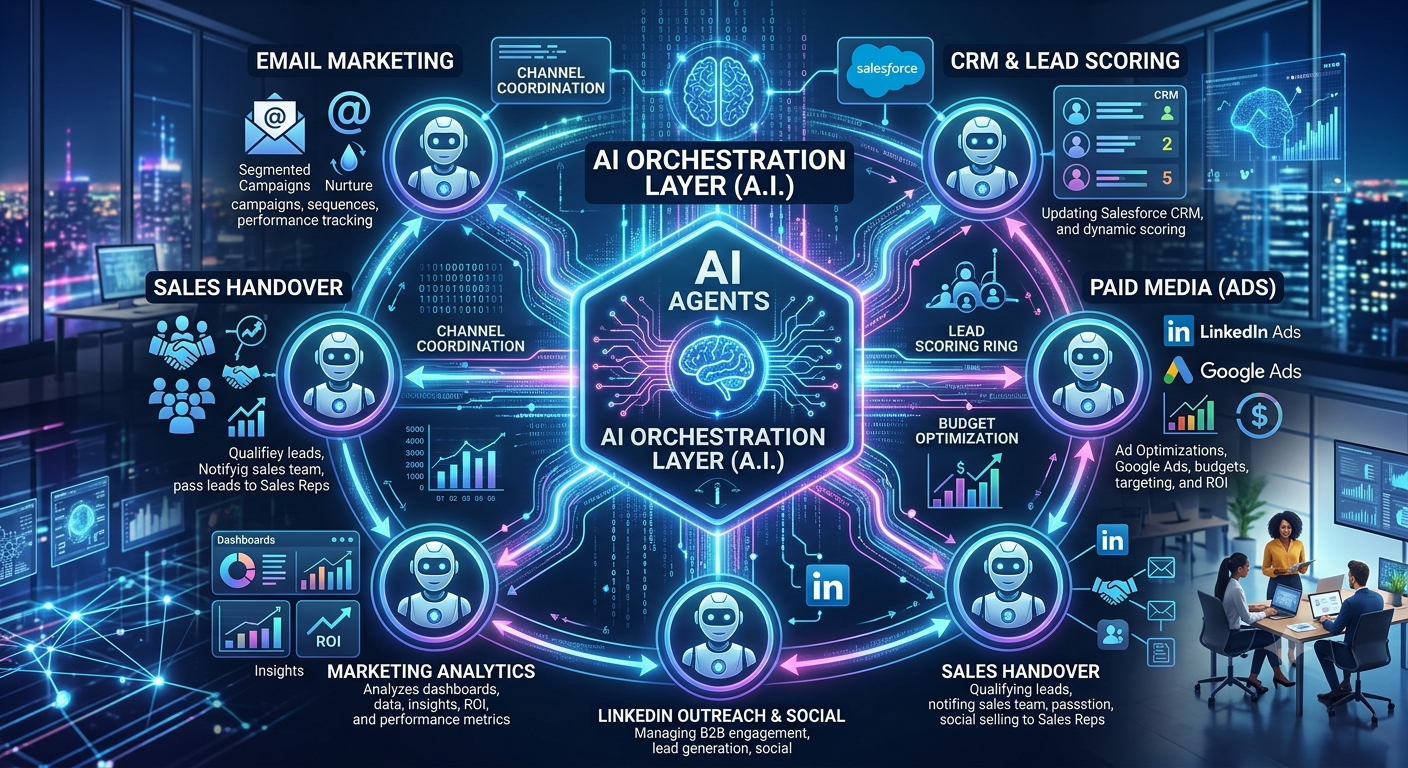
AI-powered campaign orchestration is emerging as one of the most important developments in B2B marketing because it connects data, content, audiences, channels, timing, and optimization into a more coordinated marketing system.
Instead of simply asking AI to write an email or summarize a report, B2B marketers are increasingly using AI to help determine who should be targeted, what message they should receive, which channel should be used, when an interaction should happen, and what action should follow.
The shift is significant because B2B campaigns are becoming more complex. A single campaign can involve email, paid media, LinkedIn, landing pages, webinars, content syndication, sales outreach, retargeting, CRM workflows, and multiple buyer personas.
Managing all of these touchpoints manually creates delays, inconsistencies, and missed opportunities.
AI-powered orchestration aims to connect them.
According to McKinsey, orchestration is emerging as one of the core capabilities shaping the future of marketing, alongside insights, creativity, personalization, and agentic commerce.
At the same time, Adobe’s 2026 research shows that more than half of B2B organizations expect agentic AI to coordinate sales, marketing, and service journeys in real time. However, only 41% report having a unified customer data foundation capable of supporting AI at scale.
This creates a major opportunity for B2B marketing leaders.
The companies that learn how to connect AI with reliable data, strong strategy, human oversight, and measurable campaign objectives could gain a significant advantage.
AI-powered orchestration is part of a much broader transformation taking place across B2B marketing trends for 2026, including AI personalization, buying-group ABM, and AI search.
What Is AI-Powered Campaign Orchestration?
AI-powered campaign orchestration is the use of artificial intelligence to coordinate different components of a marketing campaign across audiences, channels, content, timing, workflows, and measurement.
Traditional campaign management often looks like this:
Strategy → Content Creation → Campaign Setup → Distribution → Reporting
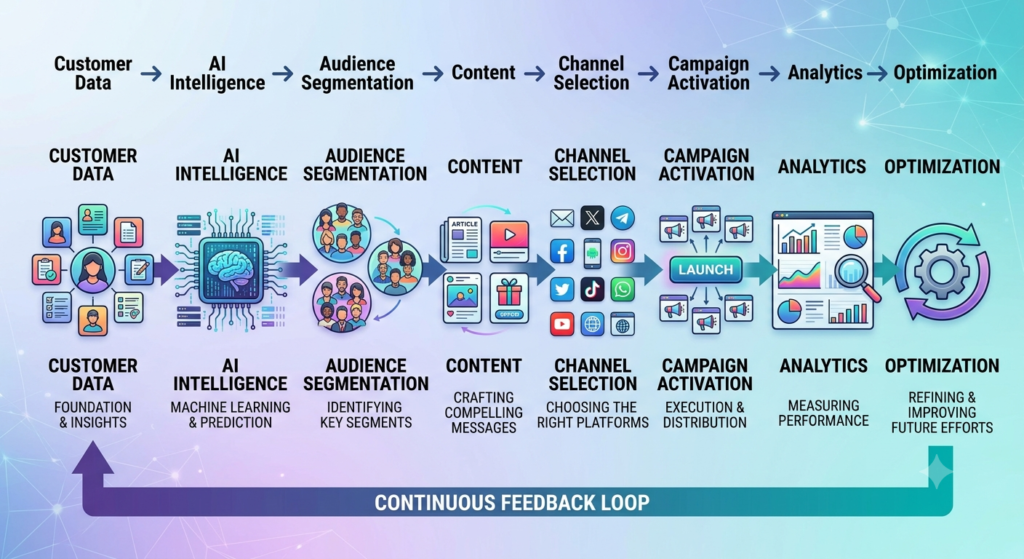
AI-powered orchestration moves toward a continuous feedback loop:
Data → Intelligence → Decision → Personalization → Activation → Measurement → Optimization
The difference is important.
Traditional marketing automation generally follows predefined rules. For example:
If a prospect downloads an asset, send Email A.
If the prospect opens the email, send Email B.
If the prospect reaches a certain lead score, notify sales.
AI-powered orchestration can introduce more adaptive decision-making. Instead of relying only on fixed rules, AI can analyze multiple signals and help determine which action makes the most sense.
For example, an account might:
- Visit a pricing page
- Engage with a LinkedIn advertisement
- Download a cybersecurity report
- Have several employees interact with content
- Show increased intent activity
- Receive an email from sales
An orchestration system can bring these signals together and help marketers determine that the account is becoming more active.
The next campaign interaction can then be adjusted accordingly.
The goal is not simply to send more messages.
The goal is to create better coordinated buyer experiences.
Why AI-Powered Campaign Orchestration Is Becoming a Hot Topic
The rise of AI-powered campaign orchestration is being driven by several changes happening simultaneously across B2B marketing.
1. Content Production Has Become Easier
Generative AI has dramatically reduced the time required to produce marketing content.
Marketers can now create:
- Email variations
- Blog content
- Social posts
- Ad copy
- Landing page messaging
- Sales enablement content
- Webinar summaries
- Content briefs
- Persona-specific messaging
- Campaign concepts
The challenge is no longer simply producing enough content.
The challenge is coordinating all that content.
As AI makes content production faster, marketing teams need better systems for deciding where, when, why, and for whom that content should be activated.
This is one reason orchestration is becoming more important.
A campaign may contain dozens of assets, but those assets only create value when they work together.
2. B2B Buyers Expect More Personalization
B2B buyers increasingly expect digital experiences to reflect their interests and business needs.
Generic campaigns can struggle to capture attention when buyers are exposed to highly personalized experiences across other parts of their digital lives.
Salesforce’s 2026 State of Marketing research found that 75% of marketers have adopted AI, while 84% still report running generic campaigns. The research also found that 78% of marketers need more personalized content than they can currently produce.
This creates an interesting contradiction.
Marketers have more AI capabilities than ever, yet many campaigns still feel generic.
AI-powered orchestration could help close that gap by connecting personalization with campaign execution.
Instead of creating one campaign for an entire market, marketers can potentially create different experiences based on:
- Industry
- Company size
- Buyer role
- Account intent
- Website behavior
- Previous engagement
- Content interests
- Buying stage
- Geographic market
- Product interest
The result can be a more relevant journey without requiring marketers to manually build every variation.
3. B2B Campaigns Are Becoming More Complex
Modern B2B campaigns rarely operate through a single channel.
A typical campaign might include:
LinkedIn → Landing Page → Content Download → Email Nurture → Webinar → Retargeting → Sales Outreach → CRM Follow-Up
The problem is that these channels are frequently managed through different platforms.
When systems are disconnected, the buyer can receive conflicting or repetitive messages.
For example, a prospect could download a whitepaper and immediately receive another advertisement promoting the same asset.
Another prospect could already be in conversation with sales but continue receiving generic awareness emails.
Campaign orchestration addresses this coordination problem by connecting campaign activity across channels.
This is particularly important for account-based marketing, where multiple people from the same company can interact with multiple campaigns at the same time.
AI-powered orchestration becomes especially powerful when ABM and demand generation work together to coordinate account targeting, personalization, and multi-channel engagement.
4. AI Is Moving From Assistance Toward Decision Support
The first generation of marketing AI primarily helped marketers complete tasks.
Examples included:
- Writing an email
- Creating headlines
- Summarizing data
- Generating social content
- Producing campaign ideas
The next phase is more strategic.
AI systems are increasingly being used to help marketers answer questions such as:
- Which accounts should we prioritize?
- Which audiences are showing buying signals?
- Which content should an account see next?
- Which channel should receive more budget?
- Which message is performing best?
- Which leads need sales attention?
- Which campaign elements are contributing to pipeline?
- When should a prospect receive the next interaction?
McKinsey describes this broader shift as marketing becoming a continuous growth engine that integrates insights, content, commerce, and performance rather than operating only through isolated campaigns.
How AI-Powered Campaign Orchestration Works
AI-powered orchestration generally connects several layers of the B2B marketing stack.
1. Data Collection
The system first needs access to useful customer and prospect signals.
These can include:
- CRM data
- Website activity
- Email engagement
- Advertising interactions
- Content downloads
- Event participation
- Intent signals
- Firmographic information
- Technographic information
- Sales activity
- Previous campaign engagement
The quality of orchestration depends heavily on the quality of this data.
AI cannot make reliable decisions if the underlying information is incomplete, outdated, duplicated, or disconnected.
Adobe’s 2026 research highlights this challenge. Only 41% of surveyed B2B organizations said they have a unified customer data foundation that can support AI at scale.
2. Audience Intelligence
Once data is available, AI can help identify patterns across audiences and accounts.
For example, instead of treating every lead equally, AI can help identify accounts that show stronger engagement or higher buying intent.
This can help marketers prioritize:
- High-intent accounts
- Engaged prospects
- Existing customers
- Expansion opportunities
- Dormant accounts
- Specific buyer personas
For B2B marketers, this is particularly valuable because purchasing decisions often involve multiple stakeholders.
An AI system can help marketers understand not only whether an account is active, but also how different members of the buying committee are engaging.
3. Content Personalization
The next layer is content.
AI can generate or recommend different messaging based on the audience.
For example:
CFO: Focus on ROI, efficiency, cost control, and business impact.
CMO: Focus on pipeline, personalization, campaign performance, and growth.
CTO: Focus on architecture, security, integration, scalability, and technical requirements.
The underlying campaign remains the same, but the message changes according to the buyer.
This allows B2B teams to move beyond basic personalization such as inserting a person’s first name.
The more valuable form of personalization is contextual personalization.
4. Channel Coordination
AI-powered orchestration can connect different campaign channels.
Consider an account that has interacted with a product page.
Instead of simply triggering another email, the system could evaluate the account’s recent activity and determine whether it should:
- Receive a personalized email
- See a different advertisement
- Be added to an ABM sequence
- Receive a case study
- Be routed to sales
- Enter a nurture workflow
- Be excluded from another campaign
The important point is that the next action is influenced by the complete customer context.
5. Continuous Optimization
Traditional campaigns often follow a launch-and-report model.
Marketers launch a campaign, wait for results, analyze the data, and make changes during the next campaign.
AI-powered orchestration moves toward continuous optimization.
Performance signals can influence future decisions throughout the campaign.
For example:
If an audience responds strongly to a particular message, the campaign can prioritize that messaging.
If an audience stops engaging, the system can reduce frequency or change the content.
If an account demonstrates high intent, it can be moved into a more sales-focused journey.
This creates a more dynamic marketing system.
AI Orchestration vs. Traditional Marketing Automation
It is important not to confuse AI-powered campaign orchestration with traditional marketing automation.
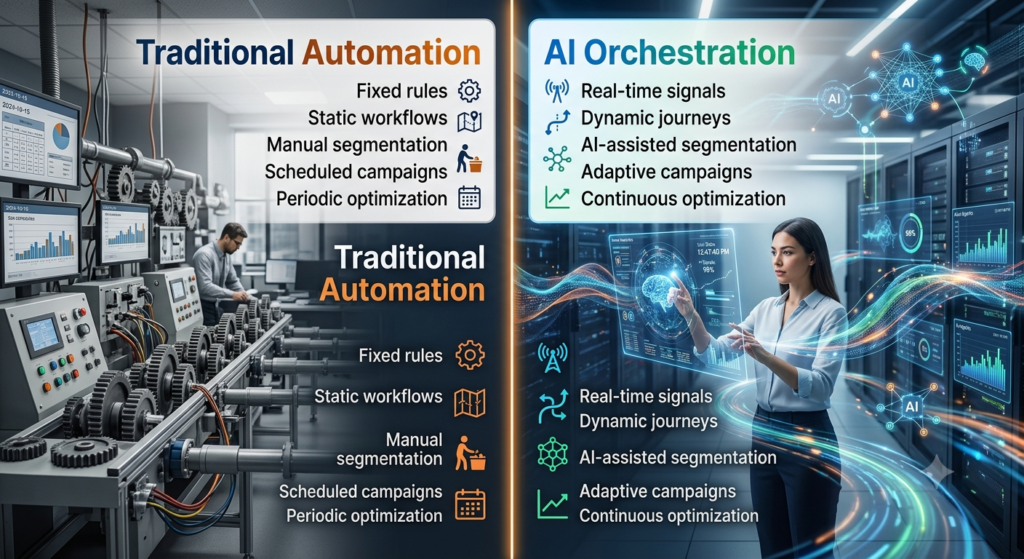
| Traditional Marketing Automation | AI-Powered Campaign Orchestration |
|---|---|
| Rule-based workflows | Adaptive decision-making |
| Predefined journeys | Dynamic journeys |
| Manual segmentation | AI-assisted audience intelligence |
| Static campaign variants | Dynamic personalization |
| Channel-specific execution | Cross-channel coordination |
| Periodic optimization | Continuous optimization |
| Human-defined conditions | AI-assisted decisions |
| Campaign-centric | Buyer and account-centric |
Traditional marketing automation is still extremely valuable.
In fact, AI orchestration does not necessarily replace marketing automation.
Instead, it can sit above existing systems and make them more intelligent.
HubSpot, for example, describes its campaign capabilities around multi-channel orchestration, AI-assisted workflows, automated approvals, and real-time reporting.
The future is therefore less about replacing the marketing technology stack and more about connecting and coordinating it.
The Biggest Benefits for B2B Marketing Teams
Faster Campaign Execution
AI can reduce the time required to develop campaign assets, analyze audiences, and activate workflows.
Instead of spending weeks coordinating every campaign element, marketers can focus more of their time on strategy.
Greater Personalization
AI makes it more practical to create variations for different industries, personas, accounts, and buying stages.
This is especially valuable for ABM campaigns.
Better Resource Allocation
Marketing teams can use AI to identify where their time and budget are most likely to create value.
Instead of treating every account equally, marketers can prioritize accounts showing stronger signals.
Improved Cross-Channel Consistency
When campaign assets are created and managed from a shared strategic framework, messaging can remain more consistent across email, social, advertising, websites, and sales enablement.
Faster Response to Buyer Signals
B2B buying signals can change quickly.
AI-powered orchestration can help marketing teams respond to those changes faster than manually managed workflows.
Stronger Marketing and Sales Alignment
Orchestration can connect marketing engagement with sales activity.
When both teams work from the same account and engagement signals, it becomes easier to determine when an account should remain in marketing nurture and when it should receive sales attention.
The Risks of AI-Powered Campaign Orchestration
AI orchestration is powerful, but it is not automatically successful.
Poor Data Can Create Poor Decisions
If CRM data is inaccurate, AI may make inaccurate recommendations.
Data hygiene must therefore remain a priority.
Too Much Automation Can Damage the Customer Experience
Not every marketing decision should be automated.
A prospect who receives five AI-generated messages in one week is not necessarily experiencing personalization.
They may simply be experiencing spam at scale.
Brand Consistency Still Requires Human Oversight
AI-generated content can sometimes miss brand nuance, positioning, or context.
Human review remains important, especially for strategic campaigns.
Privacy and Governance Matter
B2B marketing teams must consider consent, data security, access controls, and regulatory requirements when using AI with customer data.
AI Does Not Replace Strategy
AI can optimize execution, but it cannot compensate for a weak value proposition.
If the campaign targets the wrong audience or promotes an irrelevant offer, better automation will not solve the fundamental problem.
How B2B Companies Can Start With AI Campaign Orchestration
Companies do not need to transform their entire marketing operation overnight.
A practical approach is to begin with one high-value campaign.
Step 1: Choose One Campaign
Select a campaign with measurable objectives.
Examples include:
- Demand generation
- ABM
- Lead nurturing
- Product launch
- Webinar promotion
- Content syndication
- Customer expansion
Step 2: Define the Business Objective
Do not begin with the question:
“How can we use AI?”
Begin with:
“What marketing decision or bottleneck are we trying to improve?”
The objective might be increasing qualified leads, improving account engagement, reducing campaign production time, or improving pipeline contribution.
Step 3: Connect Your Data
Bring together the data needed to understand the audience.
At minimum, consider CRM, campaign engagement, website behavior, and firmographic information.
Step 4: Build a Campaign Brief
Create a structured brief containing:
- Target audience
- ICP
- Buyer personas
- Pain points
- Value proposition
- Campaign objective
- Key messages
- Offers
- Channels
- Conversion goals
- Brand guidelines
The better the strategic input, the better AI can support execution.
Step 5: Add Human Approval
Create clear checkpoints.
AI can generate recommendations and assets, but humans should approve important campaign decisions.
Step 6: Measure Business Outcomes
Do not measure AI success only by content volume.
Track:
- Engagement
- Qualified leads
- MQLs
- SQLs
- Opportunities
- Pipeline
- Conversion rates
- Cost per qualified lead
- Revenue influence
- Campaign velocity
The objective is not to produce more marketing.
The objective is to produce better business outcomes.
What the Future of B2B Campaign Orchestration Looks Like
The next generation of B2B marketing will likely be less campaign-centric and more journey-centric.
Instead of marketers manually planning every interaction, AI systems will increasingly help coordinate journeys based on real-time signals.
A campaign could begin with an account entering a target segment.
The system identifies relevant personas.
AI generates appropriate messaging.
The campaign activates across email, advertising, social, web, and sales channels.
Engagement signals are collected.
The system evaluates those signals.
The next interaction changes according to buyer behavior.
Sales receives an alert when the account reaches a defined engagement threshold.
Marketing continues nurturing other members of the buying committee.
The campaign then learns from the outcome.
This creates a continuous loop between data, decisions, content, activation, and measurement.
BCG’s 2026 CMO research illustrates both the opportunity and the maturity gap. While 96% of surveyed CMOs said AI is driving end-to-end transformation, only about one-third said they had actually completed the work. BCG also reported that only 8% of surveyed organizations were running campaigns in which multiple AI agents operate autonomously.
That gap is important.
The competitive advantage may not come from simply having access to AI.
It may come from building the infrastructure, processes, data quality, governance, and organizational capabilities required to use AI effectively.
Why This Matters for B2B Marketers
The rise of AI-powered campaign orchestration represents a broader change in how marketing teams operate.
AI is moving from being a tool that helps marketers create things to a system that can help marketers coordinate decisions.
That is a much bigger shift.
The winning B2B teams will not necessarily be the companies generating the most AI content.
They will be the companies that know how to connect:
Data + AI + Content + Channels + Sales + Customer Signals + Human Strategy
When these elements operate independently, marketing becomes fragmented.
When they work together, marketing becomes an adaptive growth system.
For B2B organizations dealing with long sales cycles, multiple stakeholders, complex products, and increasingly demanding buyers, that difference could become significant.
The future of B2B marketing is not about replacing marketers with AI.
It is about giving marketers the intelligence and infrastructure to orchestrate increasingly complex customer journeys at a scale that was previously impossible.
Final Takeaway
AI-powered campaign orchestration is becoming one of the defining developments in modern B2B marketing.
The first AI wave focused heavily on content creation.
The next wave is focused on coordination.
AI can help marketers understand audiences, personalize content, coordinate channels, identify buying signals, optimize campaigns, and connect marketing activity with revenue outcomes.
But technology alone will not create successful orchestration.
B2B companies need clean data, clear strategy, strong governance, human oversight, integrated systems, and meaningful measurement.
The real opportunity is not simply to automate more marketing.
It is to make every campaign more connected, more relevant, more responsive, and more measurable.
As AI continues moving toward agentic and autonomous workflows, campaign orchestration could become a core operating capability for B2B marketing teams.
The companies that build that capability early may be better positioned to compete in a market where buyers expect relevance, speed, and personalized experiences at every stage of the journey.
Frequently Asked Questions
AI-powered campaign orchestration uses artificial intelligence to coordinate audience targeting, content, personalization, channels, timing, workflows, and campaign optimization across the B2B customer journey.
Marketing automation typically executes predefined rules and workflows. AI-powered orchestration adds intelligence and adaptive decision-making to help determine what action should happen next based on multiple customer and campaign signals.
No. AI can automate repetitive work and support decision-making, but strategy, positioning, creativity, governance, and human judgment remain important.
Useful data can include CRM information, website behavior, email engagement, advertising activity, content interactions, firmographic data, intent signals, sales activity, and customer history.
Yes. ABM is one of the strongest use cases because AI can help marketers prioritize accounts, identify buying signals, personalize messaging, coordinate multiple channels, and manage complex buying committees.
Data quality and integration are among the biggest challenges. Adobe’s 2026 research found that only 41% of B2B organizations reported having a unified customer data foundation capable of supporting AI at scale.
Start with one measurable campaign. Identify the biggest bottleneck, establish a clear objective, connect the relevant data, introduce AI into selected workflows, maintain human approval, and measure business outcomes.