

Introduction
Every marketer appreciates the value of great creative. Eye catching visuals, compelling headlines, engaging videos, and memorable branding all play an important role in attracting attention. Creative assets often become the most visible part of a marketing campaign, leading many businesses to believe that investing in exceptional design alone is enough to guarantee outstanding results.
Unfortunately, that assumption has proven incorrect time and time again.
Across industries, organisations spend significant budgets producing beautifully designed advertisements, professionally edited videos, interactive landing pages, and high quality social media content. Yet many of these campaigns struggle to generate qualified leads, meaningful engagement, or measurable revenue. While the creative work receives praise from internal teams and even wins industry awards, the campaign itself often falls short of its business objectives.
The reason is simple. Creative captures attention, but attention alone does not create customers.
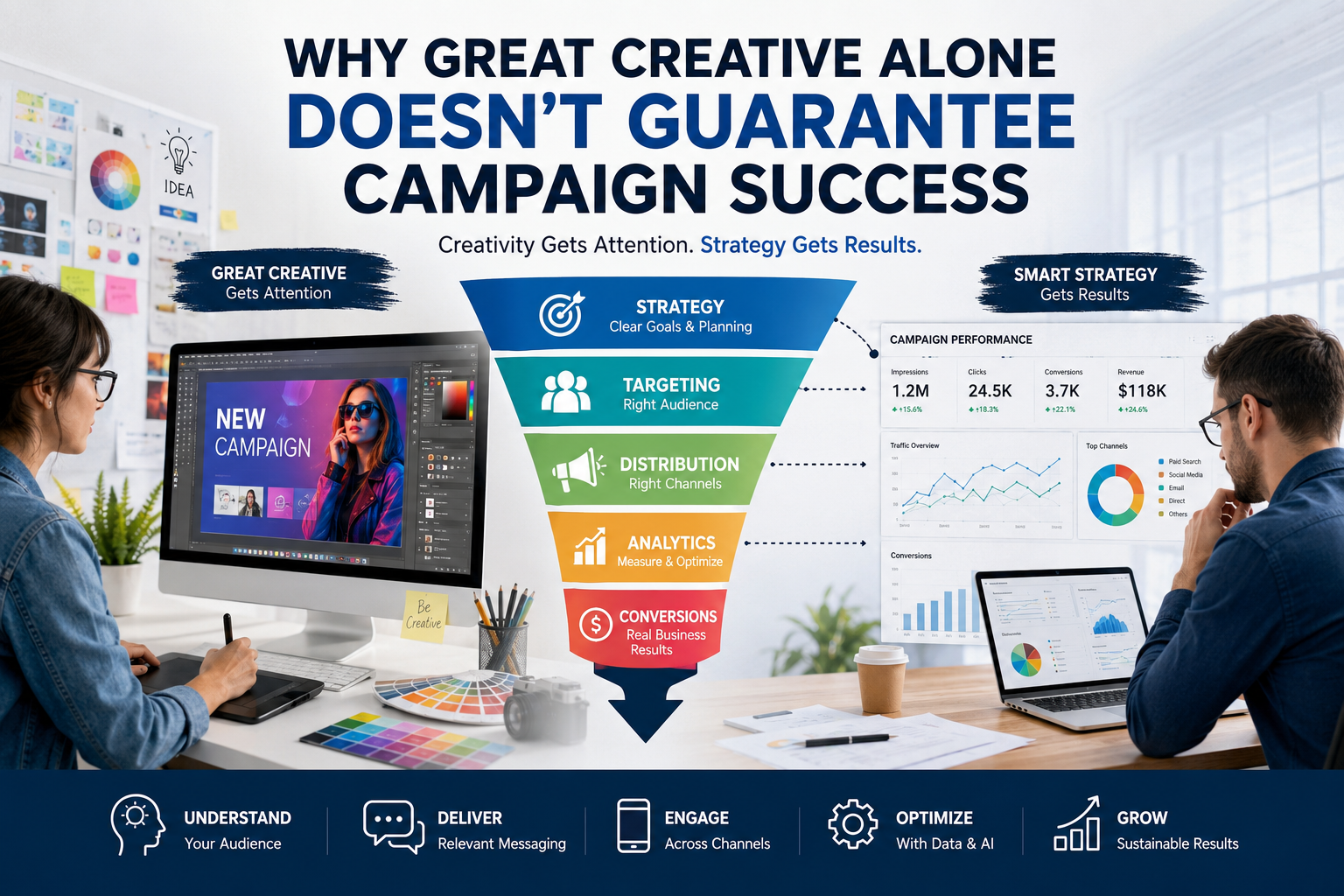
Modern marketing has evolved into a discipline driven by strategy, customer insights, data, technology, and continuous optimisation. Every successful campaign relies on multiple components working together. Audience research identifies the right prospects. Strategic messaging communicates genuine value. Distribution ensures the content reaches decision makers. Marketing automation nurtures leads through the buying journey. Analytics reveal what is working and where improvements are needed. Creative supports every one of these activities, but it cannot replace them.
This lesson has become especially important in B2B marketing, where purchasing decisions involve multiple stakeholders, longer sales cycles, and extensive research before buyers engage with sales teams. A visually impressive advertisement may generate initial curiosity, but decision makers ultimately respond to relevance, credibility, trust, and demonstrated business value.
Throughout this article, we will explore why creative excellence is only one piece of the campaign success puzzle. We will examine how strategy, audience targeting, messaging, data analysis, channel selection, and optimisation transform good creative into high performing marketing campaigns that generate measurable business growth.
The Myth That Great Creative Guarantees Results
One of the biggest misconceptions in modern marketing is the belief that exceptional creative automatically leads to exceptional results. This mindset has existed for decades, largely because some of the world’s most memorable advertising campaigns became famous for their originality and visual appeal. Businesses often remember award winning television commercials, iconic print advertisements, or viral social media campaigns and assume that creativity alone was responsible for their success.
The reality is far more complex.
Successful campaigns rarely achieve strong performance because of creative alone. Behind every high performing campaign is months of research, audience analysis, strategic planning, channel selection, budget allocation, campaign testing, and ongoing optimisation. The creative is simply the most visible outcome of a much larger marketing process.
Consider a company launching a new software solution for enterprise organisations. The marketing team produces an outstanding promotional video featuring impressive animation, engaging storytelling, and polished production quality. The campaign receives thousands of views on social media, and employees proudly share the content across their networks.
However, after several weeks, sales teams report very few qualified leads. Website traffic remains flat, product demonstrations do not increase, and pipeline growth falls below expectations.
Was the creative poor?
Not necessarily.
Instead, the campaign may have targeted the wrong audience, communicated unclear business value, lacked an effective call to action, or appeared on platforms where decision makers rarely engage with enterprise software content.
This example highlights an important lesson that many marketing leaders eventually learn. Creative can encourage people to notice your campaign, but strategy determines whether they take meaningful action.
Today’s buyers are exposed to an overwhelming amount of digital content every day. Professionals receive countless emails, browse social media during short breaks, attend webinars, consume industry news, and interact with advertising across search engines and websites. In such a competitive environment, attractive design alone is no longer enough to influence purchasing decisions.
Instead, successful campaigns combine creativity with relevance, timing, personalisation, and measurable business objectives.
Businesses that understand this distinction consistently outperform competitors that rely solely on impressive creative execution.

Marketing Success Begins with Strategy, Not Design
Every successful marketing campaign begins with a clear strategic foundation. Before designers create graphics, copywriters develop messaging, or video producers begin filming, organisations should first define what they want the campaign to achieve.
Unfortunately, many businesses reverse this process.
Excited about launching a new product or promoting an upcoming event, they immediately focus on logos, colours, advertisements, landing page layouts, and promotional videos. While these assets are important, they become significantly less effective when created without a well defined strategy guiding every decision.
A strong marketing strategy answers several essential questions before any creative work begins.
Who is the target audience?
What specific business challenge are they trying to solve?
Why should they trust your organisation instead of a competitor?
What action should prospects take after engaging with your campaign?
How will campaign success be measured?
Without clear answers to these questions, creative becomes little more than attractive decoration.
For example, imagine two organisations promoting similar cybersecurity solutions.
The first company invests heavily in cinematic promotional videos, sophisticated animations, and expensive photography. Their advertisements look impressive but focus primarily on product features.
The second company produces simpler creative assets but bases every message on extensive customer research. Their campaign addresses common security concerns faced by Chief Information Security Officers, highlights measurable business outcomes, includes customer success stories, and offers a practical cybersecurity assessment.
Although the second campaign may appear less visually impressive, it is far more likely to generate qualified leads because it addresses genuine customer needs rather than showcasing creative talent.
This principle applies across every marketing discipline, including content marketing, email marketing, demand generation, search advertising, social media, and account based marketing.
Creative should communicate strategy rather than replace it.
Marketing teams that begin with research, objectives, customer insights, and measurable outcomes consistently achieve stronger performance because every creative decision supports a clearly defined business goal.
Strategy provides direction.
Creative brings that strategy to life.
The most successful campaigns never separate the two.
Understanding Your Audience Is More Valuable Than Stunning Visuals
One of the most common reasons marketing campaigns fail is not poor creative quality but poor audience understanding. Businesses often spend weeks perfecting advertisements while investing very little time researching the people they hope to reach.
This imbalance can significantly reduce campaign performance.
Modern buyers expect personalised experiences. They want content that reflects their industry, addresses their specific challenges, and demonstrates a genuine understanding of their business objectives. Generic messaging supported by beautiful design rarely creates meaningful engagement because it lacks relevance.
Imagine a campaign promoting marketing automation software. If the advertisement focuses only on attractive visuals and broad claims such as “Transform Your Marketing Today,” it may capture attention but fail to persuade experienced marketing leaders. These decision makers are more interested in measurable outcomes such as improving lead quality, reducing customer acquisition costs, increasing campaign efficiency, or integrating automation with existing CRM systems.
By understanding the audience before developing creative assets, marketers can produce messaging that speaks directly to these priorities.
Audience research should examine several factors, including industry trends, organisational size, decision making responsibilities, buying behaviour, pain points, preferred communication channels, and common objections. These insights enable marketing teams to create campaigns that feel relevant rather than generic.
In B2B marketing, audience segmentation is particularly important because different stakeholders evaluate purchasing decisions from different perspectives. A Chief Marketing Officer may focus on pipeline growth and return on investment, while an IT Director may prioritise security, compliance, and system integration. Finance leaders often concentrate on operational costs and long term value.
A single advertisement cannot effectively address every stakeholder with identical messaging.
Instead, successful campaigns adapt their creative, content, and calls to action based on audience needs. This personalised approach increases engagement because prospects immediately recognise that the campaign understands their business challenges.
When organisations place audience understanding at the centre of campaign planning, creative becomes significantly more powerful. Visual excellence captures attention, but relevance creates trust, encourages engagement, and ultimately drives conversions.
Why Distribution Can Outperform Great Creative
One of the most overlooked factors in marketing is distribution. Even the most creative campaign will struggle to achieve meaningful results if the right people never see it. Businesses often spend weeks or even months producing high quality creative assets while allocating minimal time and budget to promotion. This imbalance is one of the primary reasons many campaigns fail to generate a strong return on investment.
Think of creative as the engine of a car and distribution as the road. A powerful engine has little value if there is nowhere to drive. Similarly, an outstanding advertisement cannot produce leads or sales if it never reaches the intended audience.
Today’s marketers have access to a wide range of distribution channels, each serving a different purpose within the customer journey. Organic social media helps build brand awareness, while paid advertising enables precise audience targeting. Email marketing nurtures existing prospects, content syndication expands reach across industry publications, and search engine optimisation attracts users actively searching for solutions.
Successful campaigns rarely rely on a single channel. Instead, they use an integrated approach that allows the same core message to reach potential customers through multiple touchpoints. A prospect may first encounter your brand through a LinkedIn post, later receive a personalised email, download a whitepaper from an industry publication, and eventually return to your website through a Google search. Each interaction reinforces the previous one and moves the buyer closer to making a decision.
This multichannel approach increases familiarity and trust, both of which play an important role in modern purchasing decisions.
Another common mistake is assuming that publishing content automatically leads to visibility. In reality, social media algorithms, search engine competition, and declining organic reach make it increasingly difficult for content to gain traction without a thoughtful promotion strategy.
Businesses that consistently achieve strong campaign performance typically invest as much effort in distribution as they do in creative production. They identify where their audience spends time, adapt content for each platform, schedule posts strategically, and monitor engagement across every channel.
Creative attracts attention, but effective distribution ensures that attention comes from the people who are most likely to become customers.

The Importance of Messaging and Value Proposition
Creative design can encourage someone to stop scrolling for a moment, but messaging determines whether they continue reading, click the advertisement, or take the next step.
Many campaigns fail because they focus too heavily on appearance while neglecting the actual message being communicated. Attractive graphics without a compelling value proposition often leave potential customers wondering why they should care.
A strong value proposition clearly answers one fundamental question.
Why should someone choose your solution instead of every other option available?
The answer should be specific, relevant, and focused on customer outcomes rather than product features.
For example, imagine two advertisements promoting the same marketing automation platform.
The first advertisement says:
“The Future of Marketing Automation Is Here.”
While visually appealing, the statement is broad and does not explain how the product benefits the customer.
Now consider a second advertisement that says:
“Reduce Manual Marketing Tasks by 60% While Increasing Qualified Leads Through Intelligent Automation.”
This message immediately communicates a measurable business benefit. It tells potential customers what problem the solution solves and what outcome they can reasonably expect.
Modern buyers are busy professionals. They rarely spend time trying to interpret vague marketing language. They respond far more positively to messaging that demonstrates a clear understanding of their business challenges.
Effective messaging also requires consistency throughout the campaign. The promise made in an advertisement should continue on the landing page, within follow up emails, during sales conversations, and throughout the customer journey. When messaging changes between channels, trust begins to decline and conversion rates often suffer.
Another important lesson is that different audiences respond to different messages. A Chief Executive Officer may focus on revenue growth, while a Marketing Director prioritises campaign efficiency. An IT leader may care most about security, compliance, and system integration.
Successful campaigns recognise these differences and adapt their messaging accordingly.
Instead of creating one generic advertisement for every audience, leading organisations develop multiple versions that address the priorities of specific buyer personas. This personalised approach increases engagement because prospects immediately recognise that the campaign understands their needs.
Ultimately, creative captures attention, but messaging provides the reason to act.

Creative Must Support the Entire Customer Journey
Many organisations evaluate creative only at the advertisement stage, but successful campaigns recognise that creative influences every interaction throughout the customer journey.
A campaign begins long before someone becomes a customer and continues long after the first conversion.
Consider the experience of a potential buyer interested in purchasing enterprise software.
They may first discover the company through a LinkedIn advertisement featuring an informative infographic. Curious to learn more, they click through to a landing page where they download an industry report. Over the following weeks, they receive educational email content, attend a webinar, speak with a sales representative, request a product demonstration, and eventually make a purchasing decision.
Every one of these interactions contributes to the overall customer experience.
If the advertisement promises valuable insights but the landing page is confusing, the user may leave without downloading the content. If the email sequence feels irrelevant, engagement will decline. If the sales presentation fails to reinforce the campaign messaging, trust may be lost.
Creative should therefore be viewed as an ongoing experience rather than a single advertisement.
Consistency is particularly important. Colours, typography, messaging, tone of voice, and visual identity should remain recognisable throughout the campaign. This consistency strengthens brand recognition and reassures buyers that they are interacting with the same trusted organisation at every stage.
Equally important is the user experience. Fast loading landing pages, mobile responsive design, simple forms, intuitive navigation, and relevant content all influence campaign performance. Even the most impressive advertisement cannot compensate for a poor website experience.
Marketing and sales alignment also plays a critical role. When sales teams understand the campaign messaging and continue the conversation naturally, prospects experience a seamless transition from marketing to direct engagement.
The highest performing campaigns do not end when someone clicks an advertisement. They create a connected journey that guides buyers from awareness to consideration, from evaluation to purchase, and from customer to long term advocate.
Data Driven Marketing Beats Assumptions
Marketing has evolved significantly over the past decade. Decisions that were once based primarily on intuition or personal preference are now supported by detailed analytics and measurable performance data.
This shift has transformed the way successful campaigns are planned and optimised.
Creative discussions often include subjective opinions. One stakeholder prefers a blue background while another suggests a different headline. Although these conversations are common, they rarely identify the most effective solution.
Data provides objective answers.
Rather than asking which design looks better, marketers should ask which version generates higher engagement, attracts more qualified leads, or delivers a stronger conversion rate.
This is where campaign analytics become invaluable.
Modern marketing platforms allow businesses to monitor virtually every stage of customer engagement. They can track impressions, click through rates, landing page behaviour, form submissions, email open rates, webinar attendance, sales opportunities, and revenue attribution. These insights enable continuous improvement throughout the life of a campaign.
A/B testing is one of the simplest yet most effective optimisation techniques. Instead of assuming one advertisement will perform best, marketers create multiple versions with different headlines, images, calls to action, or landing page layouts. Performance data quickly reveals which variation resonates most strongly with the target audience.
For example, a company promoting a free industry report might test two headlines.
The first headline focuses on innovation.
The second highlights cost savings.
Although both advertisements use identical visuals, one may generate significantly more downloads because it better aligns with audience priorities.
Data driven marketing also helps organisations allocate budgets more effectively. If LinkedIn advertising consistently produces higher quality leads than display advertising, future investment can be adjusted accordingly. Likewise, if one audience segment demonstrates stronger engagement, campaigns can be refined to prioritise similar prospects.
Perhaps the greatest advantage of data is that it encourages continuous improvement. High performing marketing teams do not consider campaigns finished once they are launched. Instead, they monitor performance regularly, identify areas for improvement, test new ideas, and optimise every element based on measurable outcomes.
This commitment to ongoing optimisation is one of the defining characteristics of successful digital marketing.
Lessons from High Performing B2B Campaigns
One of the most valuable ways to understand why great creative alone does not guarantee campaign success is by examining the common characteristics shared by high performing B2B marketing campaigns. Although industries, products, and target audiences differ, successful campaigns consistently follow similar strategic principles.
Rather than relying solely on visually impressive advertisements, leading organisations build campaigns around customer needs, measurable objectives, and continuous optimisation. Creative serves as the vehicle for communicating value, but strategy determines the destination.
For example, many successful B2B software companies begin campaigns by identifying specific business challenges faced by their target audience. Instead of promoting product features, they publish educational content that helps potential customers solve real problems. Whitepapers, webinars, industry reports, and case studies provide valuable information while positioning the company as a trusted advisor.
This educational approach builds credibility long before a sales conversation begins.
Another common characteristic of successful campaigns is close collaboration between marketing and sales teams. Marketing departments generate awareness, educate prospects, and qualify leads, while sales teams continue the conversation using insights gathered throughout the campaign. This alignment creates a seamless buyer experience that improves conversion rates and shortens the sales cycle.
Successful campaigns also make extensive use of customer data. Rather than sending identical messages to every prospect, marketers segment audiences based on industry, company size, job role, previous engagement, and buying intent. Each audience receives messaging tailored to its specific challenges and priorities.
For example, a Chief Marketing Officer may receive content focused on improving pipeline growth and marketing attribution, while an Information Technology Director receives information about data security, compliance, and system integration. Although both prospects are evaluating the same solution, their decision making criteria differ significantly.
The highest performing campaigns recognise these differences and personalise communication accordingly.
Another lesson from successful campaigns is the importance of patience. Many organisations expect immediate results after launching a campaign, but B2B purchasing decisions often involve multiple stakeholders, lengthy approval processes, and extensive research. High performing marketers understand that nurturing relationships over time frequently produces better outcomes than aggressively pursuing immediate conversions.
This long term perspective allows campaigns to build trust gradually through consistent communication, valuable educational resources, and meaningful customer engagement.
Ultimately, successful B2B campaigns demonstrate that creative excellence is most effective when supported by audience research, strategic planning, data analysis, and a commitment to continuous improvement.

How Artificial Intelligence Is Transforming Campaign Optimisation
Artificial Intelligence has become one of the most significant developments in modern marketing. While creativity remains an essential human skill, AI enables organisations to make smarter, faster, and more informed decisions throughout the campaign lifecycle.
One of the greatest advantages of AI is its ability to analyse enormous volumes of customer data in real time. Traditional campaign analysis often required marketers to manually review reports and identify trends after a campaign had already ended. AI powered platforms can monitor customer behaviour continuously, allowing marketers to optimise campaigns while they are still running.
For example, AI can identify which advertisements receive the highest engagement, which audience segments are most likely to convert, and which communication channels generate the strongest return on investment. Instead of relying on assumptions, marketers receive actionable insights supported by measurable data.
Artificial Intelligence also improves audience segmentation. Rather than grouping customers using only demographic information, AI considers behavioural patterns, browsing activity, previous interactions, purchase intent, and content preferences. This deeper understanding enables businesses to deliver highly personalised experiences that feel relevant to individual buyers.
Dynamic creative optimisation is another area where AI is transforming marketing. Instead of displaying identical advertisements to every user, AI can automatically adjust headlines, images, calls to action, or promotional offers based on customer characteristics and previous engagement. This level of personalisation increases relevance while improving campaign performance.
Predictive analytics has also become increasingly valuable. By analysing historical campaign data, AI can estimate which prospects are most likely to become customers, allowing marketing teams to prioritise resources more effectively. Sales representatives can focus on high intent leads while marketing automation continues nurturing prospects who require additional education before making a purchasing decision.
Despite these technological advances, AI does not replace human creativity.
Instead, it enhances creative decision making by providing insights that help marketers understand what resonates with their audience. Human expertise remains essential for storytelling, emotional connection, brand positioning, and strategic thinking.
The organisations achieving the greatest success are those that combine creative talent with AI powered intelligence, creating campaigns that are both emotionally engaging and data driven.
Common Reasons Creative Campaigns Fail
Although every campaign is unique, many unsuccessful marketing initiatives fail for remarkably similar reasons. Understanding these common mistakes allows businesses to avoid costly errors while improving future campaign performance.
Targeting the Wrong Audience
Perhaps the most significant reason campaigns fail is poor audience targeting.
An advertisement may feature exceptional creative quality, persuasive messaging, and professional production, but if it reaches people with little interest in the product or service, meaningful results become unlikely.
Effective targeting begins with detailed buyer persona research. Organisations should understand who their customers are, what challenges they face, how they make purchasing decisions, and which communication channels they prefer. Campaigns that ignore these insights frequently generate low quality traffic and poor conversion rates.
Weak Value Proposition
Many campaigns spend considerable effort explaining product features while failing to explain why those features matter.
Customers rarely purchase products because of technical specifications alone. They invest in solutions that solve problems, improve efficiency, reduce costs, increase revenue, or minimise business risk.
A compelling value proposition focuses on customer outcomes rather than company achievements.
Poor Landing Page Experience
The customer experience should remain consistent after someone clicks an advertisement.
Unfortunately, many campaigns direct users to slow loading websites, confusing navigation, lengthy forms, or pages containing little relevant information. These obstacles often discourage visitors before they complete the desired action.
Landing pages should reinforce campaign messaging, load quickly on all devices, include a clear call to action, and minimise unnecessary distractions.
Lack of Campaign Testing
Launching a campaign without testing different creative variations limits opportunities for improvement.
Successful marketers regularly test headlines, images, email subject lines, landing page layouts, and calls to action. Even small adjustments can produce significant improvements in engagement and conversion rates.
Testing should continue throughout the campaign rather than ending after launch.
Measuring Vanity Metrics Instead of Business Results
Many organisations celebrate impressive social media engagement while overlooking more meaningful business outcomes.
High numbers of impressions, likes, or shares may create positive visibility, but they do not necessarily contribute to revenue growth.
Successful campaigns evaluate performance using metrics such as qualified leads, conversion rates, customer acquisition cost, pipeline contribution, sales opportunities, and return on investment.
When business objectives remain the primary focus, marketing decisions become significantly more effective.

Best Practices for Building Successful Marketing Campaigns
Businesses seeking stronger campaign performance should adopt a structured approach that balances creativity with strategic planning and measurable outcomes.
Begin every campaign by establishing clear objectives. Define exactly what success looks like before creative development begins. Whether the goal is increasing website traffic, generating qualified leads, improving event registrations, or accelerating sales pipeline growth, every creative decision should support that objective.
Invest time in understanding your audience. Conduct research, interview existing customers, analyse CRM data, and identify the questions prospects ask before making purchasing decisions. These insights allow marketers to create content that genuinely addresses customer needs.
Develop a compelling value proposition that communicates measurable benefits rather than generic marketing language. Prospects should immediately understand how your solution improves their business.
Use multiple marketing channels to maximise campaign reach. Combining search engine optimisation, email marketing, LinkedIn advertising, webinars, content syndication, and remarketing creates multiple opportunities for customer engagement throughout the buying journey.
Continuously monitor campaign performance using reliable analytics tools. Measure key performance indicators regularly and make adjustments based on evidence rather than assumptions.
Finally, encourage collaboration between marketing, sales, customer success, and leadership teams. Successful campaigns rarely result from isolated departments working independently. Cross functional alignment ensures consistent messaging, better customer experiences, and stronger commercial outcomes.
Businesses that consistently apply these best practices are far more likely to achieve sustainable marketing success than those relying solely on creative excellence.
Frequently Asked Questions
Why doesn’t great creative guarantee campaign success?
Great creative attracts attention, but campaign success also depends on strategy, audience targeting, messaging, distribution, customer experience, and ongoing optimisation. Without these supporting elements, even outstanding creative may fail to generate meaningful business results.
What is the most important factor in a successful marketing campaign?
There is no single factor that guarantees success. Strong campaigns combine clear objectives, audience research, compelling messaging, effective distribution, continuous testing, and performance analysis to achieve measurable outcomes.
Why is audience targeting important in digital marketing?
Audience targeting ensures that marketing messages reach people who are most likely to benefit from a product or service. Better targeting improves engagement, increases conversion rates, and reduces wasted advertising spend.
How does data improve marketing campaigns?
Data enables marketers to measure campaign performance, understand customer behaviour, optimise creative assets, improve audience segmentation, and make informed decisions based on measurable results rather than personal opinions.
Can Artificial Intelligence replace creative marketing teams?
No. Artificial Intelligence supports marketers by analysing data, identifying patterns, and automating optimisation. Human creativity remains essential for storytelling, emotional connection, strategic thinking, and brand development.
Conclusion
Exceptional creative will always play an important role in marketing. It captures attention, strengthens brand identity, and encourages audiences to engage with content. However, as digital marketing continues to evolve, organisations are learning that creativity alone is no longer enough to guarantee campaign success.
The highest performing campaigns are built on a foundation of strategic planning, audience understanding, compelling messaging, effective distribution, continuous optimisation, and measurable business objectives. Creative amplifies these elements, but it cannot compensate for weaknesses in targeting, customer experience, or campaign execution.
Businesses that consistently achieve strong results recognise that marketing is both an art and a science. Creativity inspires interest, while strategy converts that interest into meaningful business outcomes. By combining innovative design with data driven decision making, personalised communication, and cross functional collaboration, organisations can create campaigns that not only capture attention but also generate qualified leads, strengthen customer relationships, and deliver sustainable growth.
The lesson is clear. Great creative may start the conversation, but strategy, relevance, and execution determine whether that conversation becomes long term business success.